Brand Trust: Definition, Elements and How to Increase Brand Trustworthy Reputation
 15 min read
On this page
Brand trust is customers’ confidence that a brand keeps its promises, acts with integrity, and delivers reliably. Customers trust a brand for product and service reliability, brand integrity, transparency, consistency across touchpoints, and data privacy and security. Trust in a brand supports customer loyalty, repeat purchases, and recommendations.
Businesses measure brand trust through customer surveys, review sentiment, retention rates, complaint patterns, referrals, and service feedback. Businesses increase brand trust by auditing what customers say, fixing the gaps reviews expose, publishing transparent pricing and policies, collecting and answering reviews consistently, and supporting claims with third-party proof. A brand demonstrates trustworthiness by delivering an advertised product on time, honoring its refund policy, acknowledging service failures, and protecting customer information. Hidden fees, exaggerated claims, inconsistent service, ignored complaints, fake reviews, and data misuse damage that trust. Brands restore trust by acknowledging problems, correcting their causes, compensating affected customers where appropriate, and reporting progress.
Brand protection services guard a trustworthy reputation by monitoring impersonation, counterfeit activity, misleading content, and misinformation. Business reputation management builds credibility through accurate public information, review responses, issue resolution, and consistent communication. Reliable performance, honest policies, responsive customer care, positive reviews, secure data practices, and independent verification signal trustworthiness. Reputation reflects public judgment and credibility reflects perceived competence and believability, while brand trust reflects customers’ willingness to rely on a business. Each of those reputation signals leads back to the definition of brand trust: confidence that a brand keeps its promises through reliable, transparent, and principled behavior.
What Is Brand Trust?
Brand trust is the confidence customers have that a brand will keep its promises, deliver reliable products or services, and treat customers responsibly. Customers build that confidence through repeated experiences, including product performance, fair policies, and helpful responses when problems arise. Brand trust differs from brand awareness because recognition of a name does not prove reliability or integrity. Customers assess trust in a brand through direct experience, reviews, word of mouth, and the brand’s public behavior. The qualities that earn brand trust include reliability, integrity, transparency, consistency, and responsible data protection, and each quality forms one component of a trusted brand.
What Are the Elements of Brand Trust?
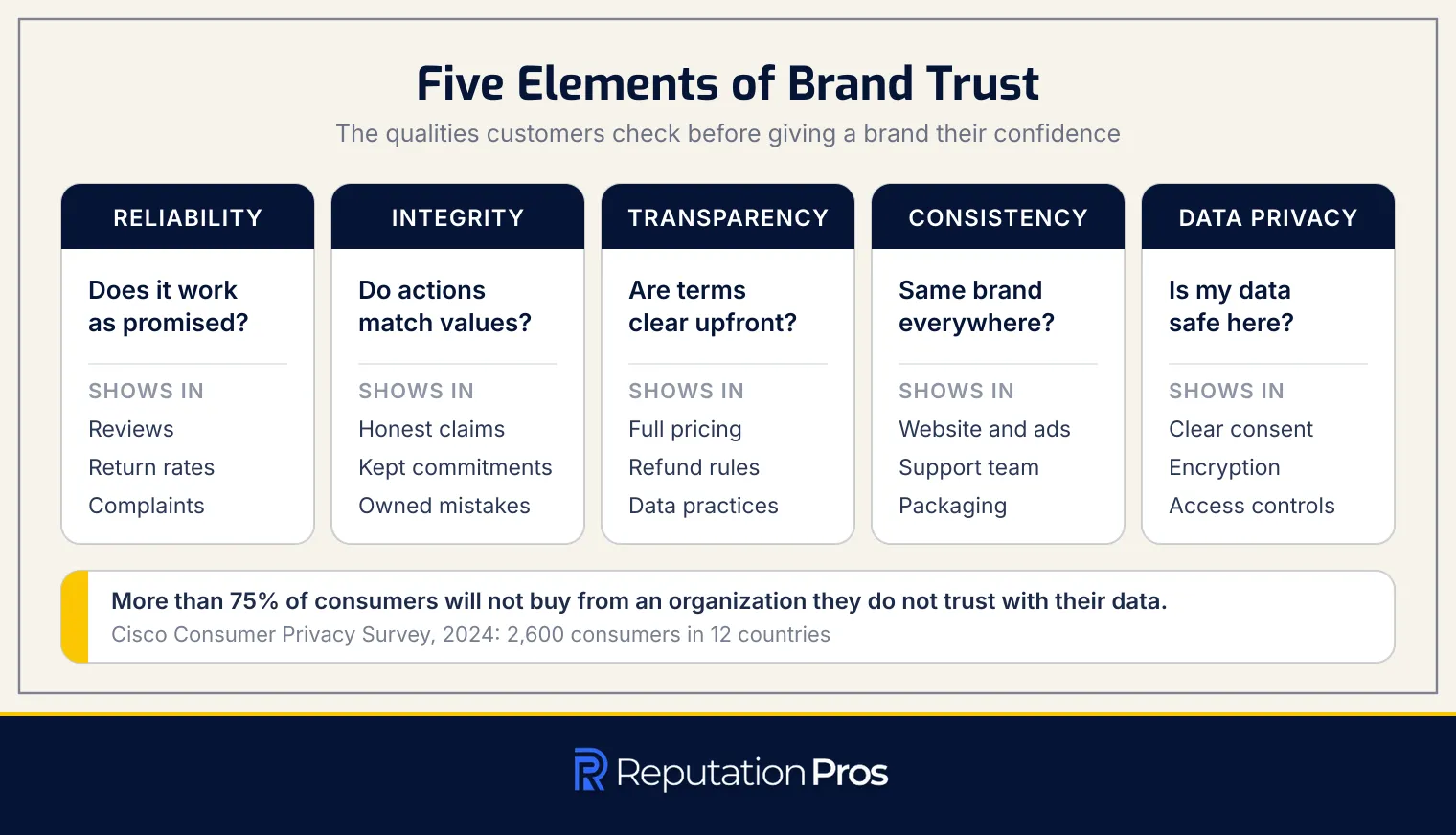
The five components of brand trust, the qualities customers use to judge whether a brand deserves their confidence, are listed below:
Product and Service Reliability
Product and service reliability is a brand’s ability to deliver its promised value consistently. Reliable products perform as described, while reliable services meet agreed standards for quality, timing, and customer support. Consistent delivery reduces customer uncertainty and builds confidence in future purchases. Reviews, return rates, and complaint patterns show whether a brand meets its promises and resolves problems effectively.
Brand Integrity
Brand integrity is the alignment between a company’s stated values, promises, and actions. A brand demonstrates integrity when it communicates honestly, treats customers with fairness, keeps commitments, and applies its principles across products, marketing, partnerships, and business practices. Customers judge brand integrity by comparing public claims with real experiences. A company strengthens trust when it acknowledges mistakes, corrects problems, and avoids unsupported promises, while inconsistent or misleading behavior weakens its credibility.
Transparency
Transparency is a brand’s practice of making relevant information visible, understandable, and accessible. Clear pricing, fees, terms, refund rules, product limitations, sourcing details, and data practices help customers evaluate a brand before they buy. Transparent brands explain business practices in plain language, disclose important conditions, and acknowledge problems with defined corrective actions. Accurate, observable communication reduces customer uncertainty and strengthens brand trust.
Consistency Across Touchpoints
Consistency across touchpoints means customers experience the same brand identity, message, values, and service quality wherever they interact with a business. A website, advertisement, social media account, package, store, and customer support team should communicate the same promises and deliver matching experiences. Aligned communication and service help customers know what to expect, which strengthens brand trust over repeated interactions. Brand guidelines, shared service standards, and scheduled channel audits help prevent conflicting prices, messages, and customer experiences.
Data Privacy and Security
Data privacy and security describe how a brand collects, uses, stores, and protects customer information. Trusted brands explain why they need personal or payment data, provide clear consent choices, and use safeguards such as encryption, access controls, and secure authentication. Customer data protection affects purchasing decisions. A 2024 Cisco study of 2,600 consumers across 12 countries, the “2024 Cisco Consumer Privacy Survey” published by Cisco in October 2024, found that more than 75% of consumers will not purchase from an organization they do not trust with their data.
Why Is Brand Trust Important?
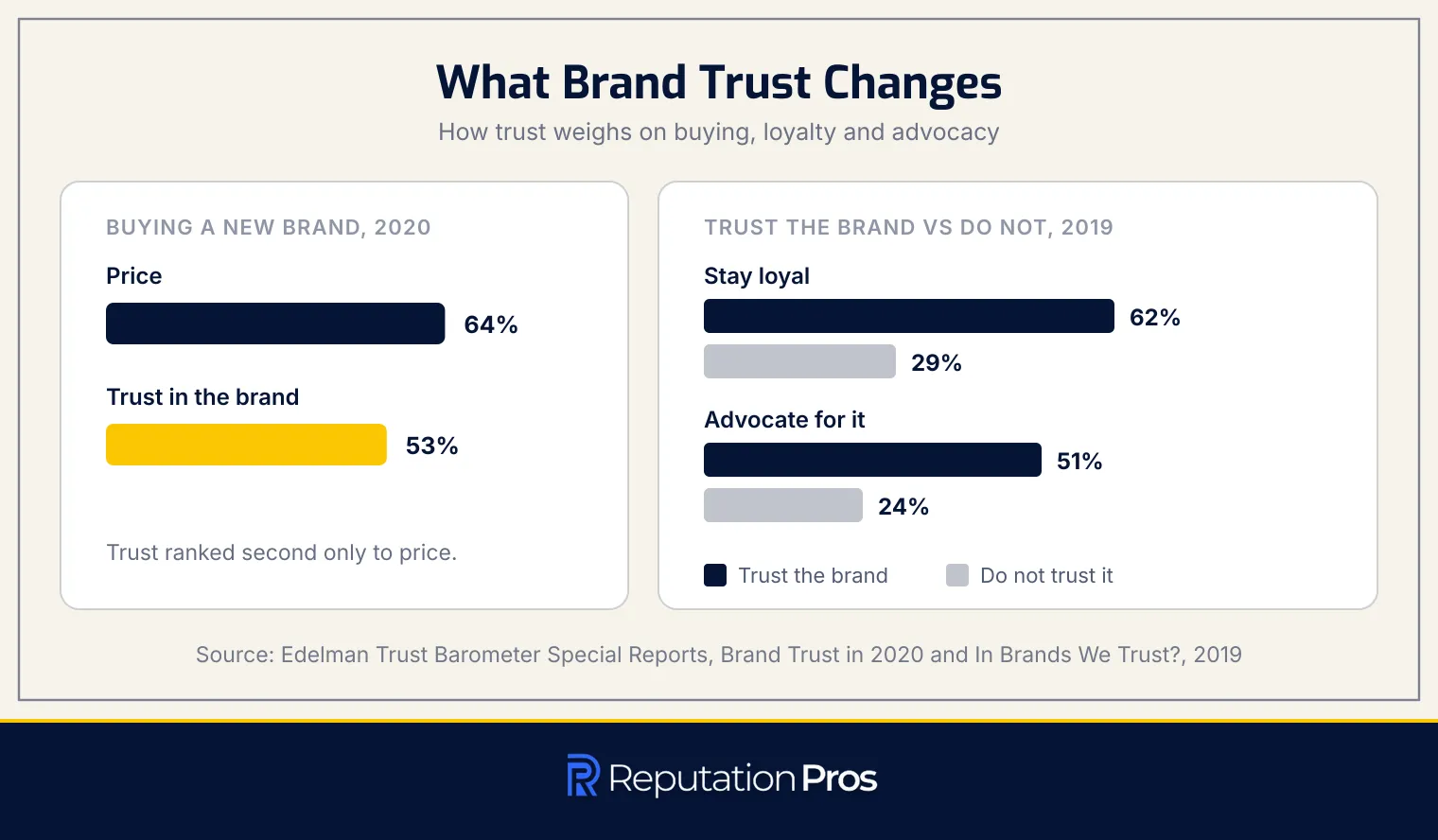
Brand trust is important because it reduces perceived purchase risk and helps customers choose, buy from, and stay loyal to a brand. Trust ranked second only to price when consumers considered buying a new brand, with 53% naming trust in the brand as a purchase factor against 64% for price, according to the “Edelman Trust Barometer Special Report: Brand Trust in 2020” by Edelman, June 2020. Brand trust strengthens customer relationships beyond a single purchase. Edelman reports that consumers who trust a brand are more than twice as likely to stay loyal to it (62% versus 29%) and to advocate for it (51% versus 24%), in the special report “In Brands We Trust?”, June 2019.
How Does Brand Trust Drive Customer Loyalty?
Brand trust drives customer loyalty by reducing the perceived risk of choosing a brand and increasing confidence in its promises. Customers who trust a brand are more likely to repurchase, recommend its products or services, and stay with the brand when competitors offer similar options. A 2001 study by Arjun Chaudhuri and Morris B. Holbrook, “The Chain of Effects from Brand Trust and Brand Affect to Brand Performance: The Role of Brand Loyalty” in the Journal of Marketing (April 2001), found that brand trust and brand affect combine to determine both purchase loyalty and attitudinal loyalty. Reliable products, honest communication, fair problem resolution, and secure handling of customer information strengthen that trust-loyalty relationship.
How Do You Measure Brand Trust?
To measure brand trust, businesses combine customer survey scores with behavioral and reputation data. Trust surveys ask whether customers consider a brand reliable, honest, transparent, and likely to keep its promises, using the same rating scale over time. Repeat purchases, customer retention, referrals, review ratings, complaint volume, and sentiment analysis show how trust relates to customer behavior and public reputation. Track the trust indicators on a fixed schedule, compare results across customer groups and channels, and review customer comments to identify the reasons behind score changes.
How to Increase Brand Trust Step by Step?
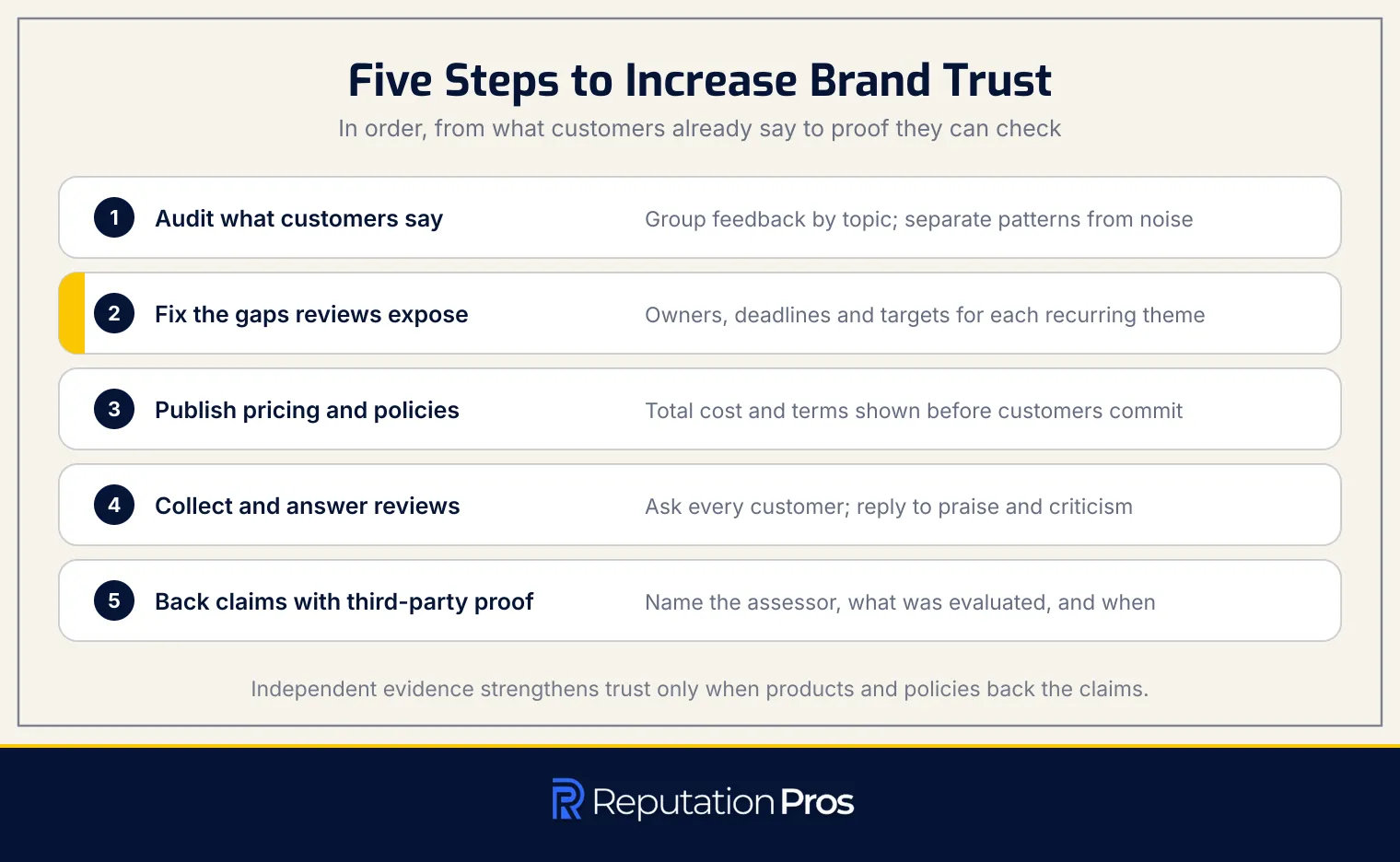
To increase brand trust step by step, businesses follow the five ordered steps listed below:
Step 1 - Audit What Customers Already Say About Your Brand
To audit what customers already say about your brand, gather customer feedback from review platforms, social media, surveys, support tickets, and community discussions. Group the comments by recurring topics such as product quality, delivery, pricing, service responsiveness, communication, and privacy. Track ratings, review volume, sentiment, unresolved complaints, and differences across customer groups or locations. Compare customer feedback with internal measures, including returns, refunds, repeat purchases, complaint-resolution times, and satisfaction scores. Separate recurring problems from isolated complaints, spam, impersonation, and reviews that violate platform rules, and never suppress honest criticism or manipulate ratings. The audit findings point to the product and service gaps the brand needs to fix next.
Step 2 - Fix the Product and Service Gaps Reviews Expose
To fix the product and service gaps reviews expose, turn recurring review complaints into verified operational changes. Group reviews by themes such as product quality, unclear instructions, delivery delays, billing problems, and customer support, then compare each theme with service records, return data, and complaint volumes. Prioritize the problems affecting the most customers or causing the greatest loss of trust. Assign owners, deadlines, and measurable targets, then track new reviews and service data to confirm improvement. Communicate completed fixes in plain terms and acknowledge the customer feedback that prompted them.
Step 3 - Publish Transparent Pricing and Policies
To publish transparent pricing and policies, write them in plain language and show them before customers commit. Display the total expected cost, including mandatory fees, taxes, renewal terms, and delivery charges. Required disclosures must be clear and conspicuous and written in language the intended audience understands, as the Federal Trade Commission notes in “.com Disclosures: How to Make Effective Disclosures in Digital Advertising”, March 2013. List cancellation rules, eligibility requirements, warranties, and refund procedures alongside the offer. Keep pricing and policy details consistent across advertisements, product pages, checkout screens, contracts, and support channels, and update terms with effective dates when they change. Clear pricing information helps customers compare options and reduces surprise charges, supporting a trustworthy brand reputation.
Step 4 - Collect and Answer Reviews Consistently
To collect and answer reviews consistently, request customer reviews through a clear, repeatable process after genuine purchases or service experiences. Invite all customers to share honest feedback by email, text message, or direct review-platform links, and never offer rewards for positive reviews or suppress criticism. Respond promptly and personally to positive and negative reviews. Thank reviewers, address the exact concerns raised, apologize when appropriate, and explain how the business will resolve the issue. Protect customer privacy by moving sensitive cases to a private channel while keeping the public reply helpful.
Step 5 - Back Your Claims With Third-Party Proof
To back your claims with third-party proof, support each brand claim with evidence from independent sources. Accredited certifications, product-testing results, industry awards, expert reviews, customer case studies, and verified performance data help customers assess a brand’s reliability. Name the assessor, explain what the assessor evaluated, and give the date of the assessment. Data from Nielsen’s 2021 Trust in Advertising Study of more than 40,000 consumers shows that 88% of global respondents trust recommendations from people they know more than any other channel, as reported in “Beyond martech: building trust with consumers and engaging where sentiment is high” by Nielsen, November 2021. Independent evidence strengthens brand trust only when reliable products and honest policies support the claims behind that evidence.
What Are Examples of Brand Trust?
Examples of brand trust are situations in which customers can rely on a company’s products, policies, service, and public statements. The clearest examples of brand trust are listed below:
- Consistent product performance: Customers return to household brands such as Dawn Dish Soap and Band-Aid when the products meet their expectations over time, and the two brands ranked first and second for net trust, according to “Most Trusted Brands 2026” by Morning Consult, June 2026.
- Reliable service: A delivery company demonstrates trust when parcels arrive as promised and customer issues receive fair resolution.
- Transparent pricing: A retailer builds trust by displaying the full cost, delivery fees, subscription terms, and refund rules before checkout.
- Responsible data practices: A company earns confidence by explaining data collection, protecting sensitive information, and communicating openly about privacy concerns.
- Visible corrective action: Toyota’s quality reforms after its major recalls show how a company can work to rebuild confidence after product failures.
What Mistakes Damage Brand Trust?
The mistakes that damage brand trust are actions that mislead customers, break commitments, or leave problems unresolved. The most common mistakes that damage brand trust are listed below:
- Overpromising and underdelivering: A brand weakens trust when its marketing or sales team promises more than the product or service can deliver. Exaggerated claims about performance, quality, savings, sustainability, or results create a gap between customer expectations and experience.
- Providing inconsistent quality: Customers question a brand’s reliability when product quality or service standards vary across purchases, locations, channels, or customer groups. Missed delivery dates, appointments, or response times weaken confidence further.
- Hiding fees and unclear terms: Surprise charges, buried exclusions, and undisclosed eligibility requirements make customers feel misled. Confusing refund, return, warranty, cancellation, or contract policies create further distrust.
- Changing terms without clear notice: A business damages trust when it changes prices, contracts, cancellation rules, or service conditions without timely explanation. Customers need clear notice of changes that affect their costs or rights.
- Making unsupported claims: A brand loses credibility when it presents unverified health, environmental, social, ethical, or performance claims as facts. Misleading superlatives, fake awards, unsupported rankings, and unrepresentative results can deceive customers and create regulatory risks.
- Misrepresenting or suppressing reviews: Fake testimonials, purchased reviews, undisclosed paid partnerships, and the removal of legitimate negative reviews give potential customers a misleading picture of real experiences. The Federal Trade Commission’s Consumer Reviews and Testimonials Rule, in effect since October 21, 2024, prohibits fake reviews, incentives tied to positive or negative sentiment, and review suppression, according to “The Consumer Reviews and Testimonials Rule: Questions and Answers” by the Federal Trade Commission, November 2024.
- Ignoring complaints and service failures: Unanswered complaints, long response delays, and unresolved requests signal that the company does not value customer feedback. Defensive replies and blame can turn an individual service issue into lasting reputational damage.
- Contradicting stated values: Customers question brand integrity when public actions conflict with declared principles. Greenwashing, empty social-responsibility claims, and unexplained differences in how customers are treated can make a brand appear insincere.
- Misusing customer data: A company weakens trust when it collects personal information without clear consent or uses data for unexpected purposes. Weak account security, mishandled sensitive information, and poor communication after a data incident increase customer concern.
- Concealing errors or defects: Hiding a product defect, service failure, regulatory issue, or material business relationship prevents customers from making informed decisions. Blaming customers for company-caused problems adds to the loss of trust.
- Mishandling a crisis: Delayed statements, speculation, changing explanations, and public blame can intensify reputational harm. An apology without a remedy, timeline, or measurable corrective action rarely demonstrates accountability.
- Neglecting reputation threats: A company risks customer confidence when it ignores unresolved complaints across review platforms and social networks. Unmonitored impersonation, counterfeit goods, misleading listings, and unauthorized brand use can further confuse customers.
When those mistakes become public, a brand can begin restoring trust through honest acknowledgment, practical remedies, consistent follow-through, and verifiable corrective action.
How Do You Restore Brand Trust After It Breaks?
To restore brand trust after it breaks, acknowledge the failure, correct its cause, and prove that the improvements last. The steps to restore brand trust are listed below:
- Acknowledge the problem promptly. Explain what happened and who was affected without minimizing harm or shifting blame.
- Apologize and accept responsibility. Use plain language and avoid excuses or conditional apologies.
- Fix the root cause. Correct the product, service, policy, process, or data practice behind the failure.
- Provide appropriate remedies. Offer refunds, replacements, or other support that addresses customer harm.
- Explain corrective actions. Share realistic timelines, responsible teams, and evidence of progress.
- Communicate consistently and measure recovery. Answer customer questions, track feedback and complaints, and keep promises over time.
How Do Brand Protection Services Guard a Trustworthy Reputation?
Brand protection services guard a trustworthy reputation by monitoring websites, social media, marketplaces, apps, and domains for impersonation, phishing, counterfeit products, fake accounts, unauthorized sellers, and trademark misuse. Early detection helps businesses address threats before fraudulent activity misleads customers or becomes associated with the genuine brand. Brand protection teams investigate suspicious activity, collect evidence, and coordinate takedown requests with platforms, registrars, hosting providers, marketplaces, and legal teams. Limiting the visibility and duration of fraudulent content reduces customer harm and preserves confidence in the legitimate business.
How Does Business Reputation Management Build a Trustworthy Brand Reputation?
Business reputation management builds a trustworthy brand reputation by tracking how customers, employees, investors, and the public perceive a company. Businesses monitor reviews, social media, search results, news coverage, and complaints, then respond professionally and correct inaccurate information. Review patterns help companies identify problems in products, services, and customer support. Companies that address legitimate concerns, communicate accurately, and support public claims with real customer evidence show accountability and strengthen trust over time.
Which Reputation Signals Make a Brand Look Trustworthy?
The reputation signals that make a brand look trustworthy are the visible proofs customers check before they rely on a business, and the three strongest signals are listed below:
How Does Brand Consistency Strengthen a Trustworthy Reputation?
Brand consistency strengthens a trustworthy reputation by making a company’s promises, messaging, and customer experience predictable across touchpoints. Consistent advertising, website content, social media, customer service, and product delivery show customers that the brand follows the same values and quality standards. Repeatedly meeting those expectations builds confidence in the brand’s reliability.
How Does Corporate Social Responsibility Build Brand Trust?
Corporate social responsibility builds brand trust when a company matches its social and environmental commitments with consistent, measurable action. Research by Cone Communications found that 87% of Americans would purchase a product because the company advocated for an issue they cared about, in the “2017 Cone Communications CSR Study” released in May 2017, showing that relevant CSR commitments can influence consumer choices.
What Does Consumer Research Show About Trust in Online Reviews?
Consumer research shows that online reviews shape brand evaluations, although consumer trust in reviews has fluctuated over time. Findings from the “Local Consumer Review Survey 2026” by Rosie Murphy, BrightLocal, February 2026, indicate that 97% of consumers read reviews for local businesses and that 49% trust online reviews about as much as recommendations from people they know. Review authenticity, detail, volume, and recency therefore remain important reputation signals.
How Does Brand Trust Relate to Reputation and Credibility?
Brand trust relates to reputation and credibility as a connected but distinct judgment: trust reflects a customer’s willingness to rely on a brand, reputation reflects public judgments of the brand’s past conduct, and credibility reflects whether the brand’s claims seem believable.
Is Brand Trust the Same as Brand Reputation?
No, brand trust is not the same as brand reputation, because brand trust is an individual customer’s confidence that a brand will keep its promises and act responsibly. Brand reputation is the collective perception formed from customers’ experiences, reviews, and opinions over time. A positive reputation can encourage trust, but a good reputation does not mean that every customer trusts the brand.
Is Brand Trust the Same as Brand Credibility?
No, brand trust and brand credibility are related but distinct concepts. Brand credibility describes whether customers believe a brand’s claims and competence, while brand trust reflects broader confidence that the brand will deliver reliably and act with integrity. Credible communication can build trust, and consistent performance can strengthen both.
Why Does Brand Trust Become a Lasting Reputation Asset?
Brand trust becomes a lasting reputation asset because customers build it through repeated experiences with reliable products, consistent service, and honest communication. Earned trust reduces perceived risk, supports customer loyalty, and helps a business withstand competition and reputational challenges. Credibility makes brand claims believable, trust encourages customers to rely on those claims, and reputation reflects broader judgments formed over time. Businesses strengthen a trustworthy brand reputation by investing in the five components of brand trust: product and service reliability, brand integrity, transparency, consistency across touchpoints, and data privacy and security.