What is the Impact of Reviews on Brand Reputation?
 14 min read
On this page
Online reviews shape brand reputation by converting individual customer experiences into a public record that prospective buyers consult before they buy. Reviews carry weight in purchase decisions: 93% of consumers who use online reviews say reviews affect their purchase decision, according to Podium’s “2017 State of Online Reviews,” a survey of 2,005 US consumers. Review content feeds the brand’s search results as well, so the review profile becomes part of what a brand looks like online.
The commercial effect is measurable. A 2011 Harvard Business School working paper by Michael Luca, “Reviews, Reputation, and Revenue: The Case of Yelp.com,” found that a one-star increase in a Yelp rating produced a 5 to 9 percent increase in revenue for independent Seattle restaurants, with no measurable effect on chain-affiliated locations.
Reviews cut both ways. A strong review profile supports credibility and search visibility, while an unmanaged one transfers complaints, service failures and suspected manipulation into the first thing a buyer reads about the brand.
What Is the Impact of Reviews on Brand Reputation?
The impact of reviews on brand reputation is the degree to which published customer ratings and written feedback determine how buyers, search engines and competitors judge a brand. Review ratings set the first impression on branded searches, written review text supplies the reasons behind that impression, and the aggregate profile persists long after any single transaction.
Review data functions as a public accountability record too. A brand cannot retract a published rating, so the review profile pressures operational standards in a way private feedback does not. Search engines surface that record on branded queries, which gives the review profile a second route into reputation beyond the review platforms themselves.
How Do Reviews Become a Public Reputation Signal?
Reviews become a public reputation signal when a private customer experience is published in a searchable, permanent location outside the brand’s control. A review posted to Google, Yelp or Trustpilot stays visible to every later researcher, carries a timestamp and an author, and sits beside competing brands’ ratings. Independence from brand messaging is what gives the signal its weight: the review exists whether or not the brand would choose to publish it.
How Do Online Reviews Shape Brand Reputation?
Online reviews shape brand reputation through three mechanisms that operate together: the star rating average that sets immediate perception, the review volume that establishes whether that average is credible, and the search visibility that carries both into branded search results.
Reading reviews is now routine rather than exceptional. 82% of US adults at least sometimes read online customer ratings or reviews before buying something for the first time, as documented in the Pew Research Center report “Online Shopping and E-Commerce,” December 2016.
How Does Star Rating Average Affect Brand Perception?
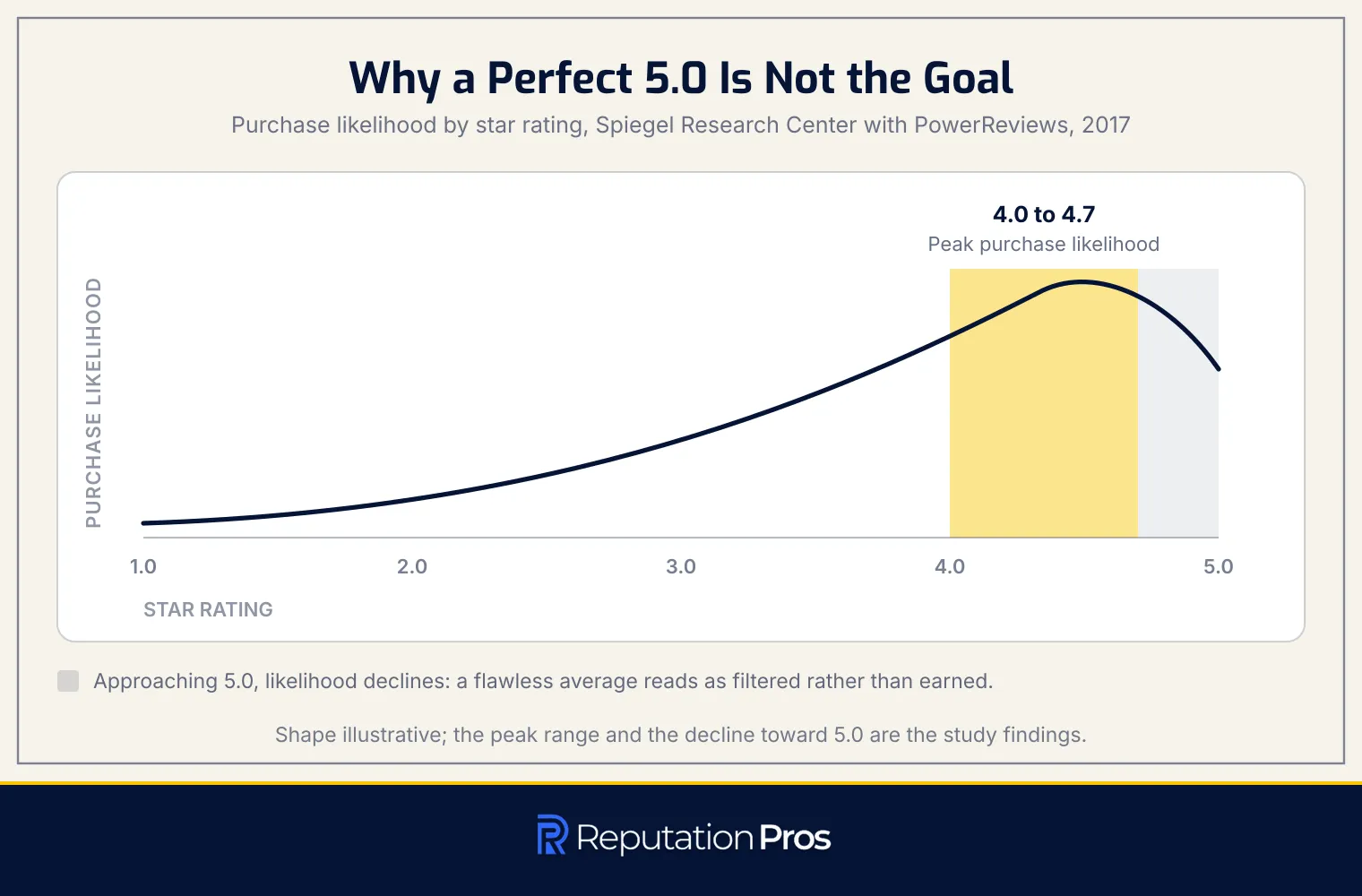
The star rating average affects brand perception by acting as the single number a buyer reads before any review text. Higher averages raise perceived quality and purchase intention, and lower averages push buyers into reading individual complaints.
Perfect scores work against the brand. Purchase likelihood peaks when ratings fall in the 4.0 to 4.7 range and declines as ratings approach 5.0, according to the Medill Spiegel Research Center’s “How Online Reviews Influence Sales,” its 2017 study with PowerReviews covering more than 100,000 SKUs. A flawless average reads as filtered rather than earned.
How Does Review Volume Change Credibility?
Review volume changes credibility by telling a buyer how much evidence sits behind the star rating. A rating built on several hundred reviews survives scrutiny that an identical rating built on four reviews does not, because volume signals an established customer base rather than a handful of favourable cases.
The marginal value of volume falls away quickly. Purchase likelihood for a product with five reviews is 270% greater than for a product with none, and the benefit of each further review falls away after the first five, per the Spiegel Research Center study. Volume only helps while the reviews read as varied and genuine; a large block of vague, same-week reviews in near-identical wording reduces credibility instead of building it.
How Do Search Engines Surface Reviews on Brand Queries?
Search engines surface reviews on branded queries by pulling star ratings, review counts and review snippets into the results page itself, through the local pack, the knowledge panel and rich results. A buyer searching the brand name reads the rating before reaching any page the brand controls.
Platform prominence follows review volume and freshness, so the review site a brand has least managed is the one a searcher sees first.
What Are the Positive Impacts of Reviews on Brand Reputation?
The positive impacts of reviews on brand reputation are listed below:
- Independent validation: Reviews supply third-party confirmation of quality that brand-owned copy cannot provide, because the reviewer has no stake in the sale.
- Conversion lift: Products with review content convert substantially better than products with none, with the largest gains on higher-priced items.
- Branded search visibility: Review volume and ratings feed the local pack and rich results, which widens the brand’s footprint on its own name.
- Operational feedback: Review text identifies recurring service and product failures that internal reporting misses.
- Customer retention: Public replies to criticism show prospective buyers how the brand behaves when something goes wrong.
- Competitive separation: Where every brand in a category holds a comparable rating, review recency and reply quality become the differentiator.
Trust Earned Through Independent Validation
Trust earned through independent validation comes from the reviewer’s lack of commercial interest in the outcome. A customer who has already paid has nothing to gain from praising the brand, which is why review text carries evidential weight that advertising copy does not.
That trust is no longer automatic. The share of consumers who trust online reviews as much as a personal recommendation fell from 79% in 2020 to 42% in 2025, according to the “Local Consumer Review Survey 2025” by Sammy Paget, BrightLocal, January 2025. Buyers increasingly read for specificity and authorship rather than accepting the aggregate at face value, which raises the value of detailed, verifiable reviews over volume alone.
Conversion Lift From Social Proof
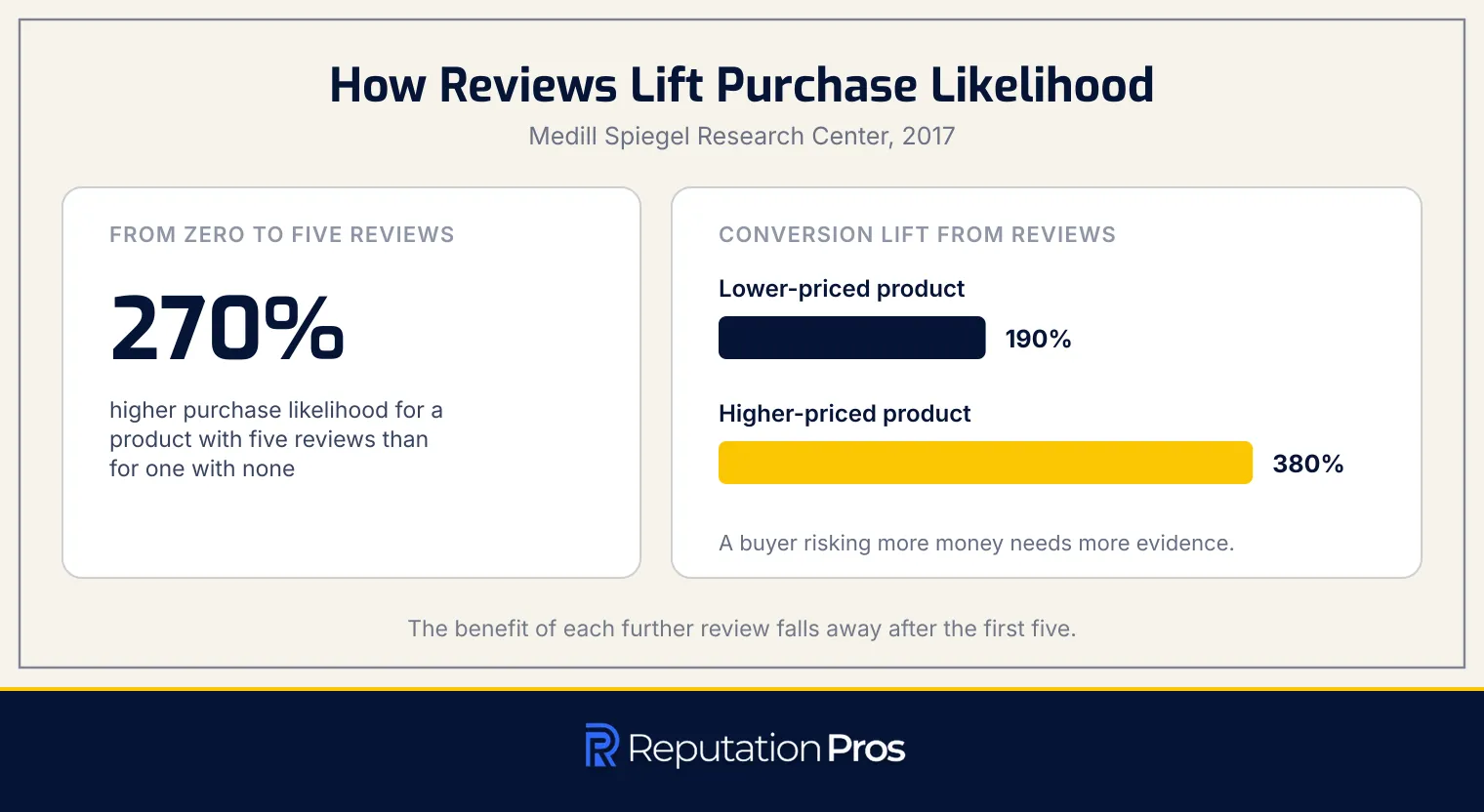
Conversion lift from social proof is the measurable increase in purchase rate that appears once a product carries review content. Research by the Medill Spiegel Research Center found purchase likelihood rises 270% between a product with no reviews and a product with five, with the effect larger on expensive items: conversion rose 190% for a lower-priced product against 380% for a higher-priced one.
Price sensitivity explains the pattern. A buyer risking more money needs more evidence, so review content does more work in high-consideration categories than in low-cost repeat purchases.
What Are the Negative Impacts of Reviews on Brand Reputation?
The negative impacts of reviews on brand reputation are listed below:
- Lost purchase consideration: A poor average removes the brand from the shortlist before any sales conversation starts.
- Revenue exposure: Rating movement tracks revenue movement, and Luca noted that a rating drop would likely reduce revenue although the magnitude of the downward effect was not established.
- Reduced branded search visibility: A weak review profile degrades the local pack and rich-result presence that branded searches depend on.
- Compounding from silence: Unanswered complaints read as confirmation, so the cost of a single review grows with the time it sits unaddressed.
- Competitive disadvantage: Buyers compare ratings side by side, and a half-star gap decides between otherwise equivalent options.
- Credibility collapse from manipulation: Detected fake reviews move doubt from the reviews to every other claim the brand makes.
Reputation Damage From Unanswered Complaints
Reputation damage from unanswered complaints comes from what silence communicates to the next reader rather than from the complaint itself. A visible criticism with no reply reads as an accurate account the brand could not dispute.
Replies change purchase behaviour directly. 88% of consumers would use a business that replies to all of its reviews, against 47% for a business that does not respond at all, according to BrightLocal’s “Local Consumer Review Survey 2024.” Leaving a complaint unanswered removes the brand from consideration for a measurable share of buyers who would otherwise have continued.
Credibility Damage From Fake or Incentivised Reviews
Credibility damage from fake or incentivised reviews follows from what manipulation implies about the brand’s actual standing. A buyer who identifies planted reviews concludes the brand could not earn genuine endorsement, and that judgement spreads to the brand’s product claims and pricing.
Platforms have built detection into the interface. Amazon’s Verified Purchase badge lets a shopper separate confirmed buyers from unverified accounts, which converts manipulation from a hidden tactic into a visible one. Recovery is slower than for an ordinary service failure, because the breach is of the mechanism that made reviews persuasive.
Which Review Platforms Carry the Most Reputation Weight?
The review platforms that carry the most reputation weight are listed below:
- Google Business Profile: Ratings appear directly in Search and Maps, which makes Google reviews the first a local searcher reads and a factor in local ranking.
- Amazon: For retail products, the Verified Purchase badge and review depth decide purchase on the platform where the transaction happens.
- Yelp: Strongest in restaurants, hospitality and local services, and the platform on which the Harvard Business School revenue finding was measured.
- Facebook: Recommendations surface inside users’ own social graph, which gives them persuasive force among people who know the reviewer.
- Category platforms: TripAdvisor, Trustpilot, Glassdoor and Healthgrades carry disproportionate weight with buyers already researching those categories.
- Social platforms: Instagram, TikTok and X host unstructured complaints that escalate faster than review sites, because sharing is the default behaviour.
How Did Online Reviews Replace Word of Mouth?
Online reviews replaced word of mouth by removing its two limits: reach and persistence. A spoken recommendation reached the people in the room and then disappeared, while a published review reaches every later searcher and stays available indefinitely.
The substitution changed who buyers trust. Buyers now weigh the aggregated experience of strangers against the opinion of people they know, and the BrightLocal 2025 decline to 42% shows that aggregated trust is conditional rather than absolute. Reviews carry what conversation could not: star ratings, dates, photographs and enough detail for a reader to judge whether the reviewer’s situation matches their own.
How Do You Measure the Reputation Impact of Reviews?
The reputation impact of reviews is measured through five metrics read together: the average star rating, total review volume, review velocity, the sentiment distribution inside review text, and the brand’s reply rate.
Platform metrics alone understate the effect. Branded search ranking, click-through on branded queries and conversion rate movement that tracks review activity connect the review profile to commercial outcomes, which is what makes the measurement actionable rather than descriptive.
What Common Mistakes Worsen Review Damage?
The mistakes that worsen review damage are listed below:
- No reply at all: Silence reads as agreement with the complaint.
- Slow reply: A response after the complaint has been read by every prospective buyer repairs nothing.
- Defensive or argumentative reply: Disputing a customer in public converts one complaint into a visible conflict.
- Template reply: Repeated wording across every review signals that no one read the individual case.
- Promotional reply: Turning a complaint into a sales message confirms the reviewer’s point.
- Disclosing private details: Publishing order numbers or account details to win an argument breaches the customer’s privacy.
- Pressuring for deletion: Asking a reviewer to remove criticism reads as suppression if the request becomes public.
- Uneven moderation: Flagging negative reviews while leaving positive ones unchecked produces a profile buyers discount.
- Planting positive reviews: Fabricated reviews carry platform sanctions and regulatory exposure alongside the credibility loss.
- Fixing the review, not the cause: Replying without changing the underlying process guarantees the same complaint returns.
How Do You Respond to Reviews That Are Damaging Your Brand Reputation?
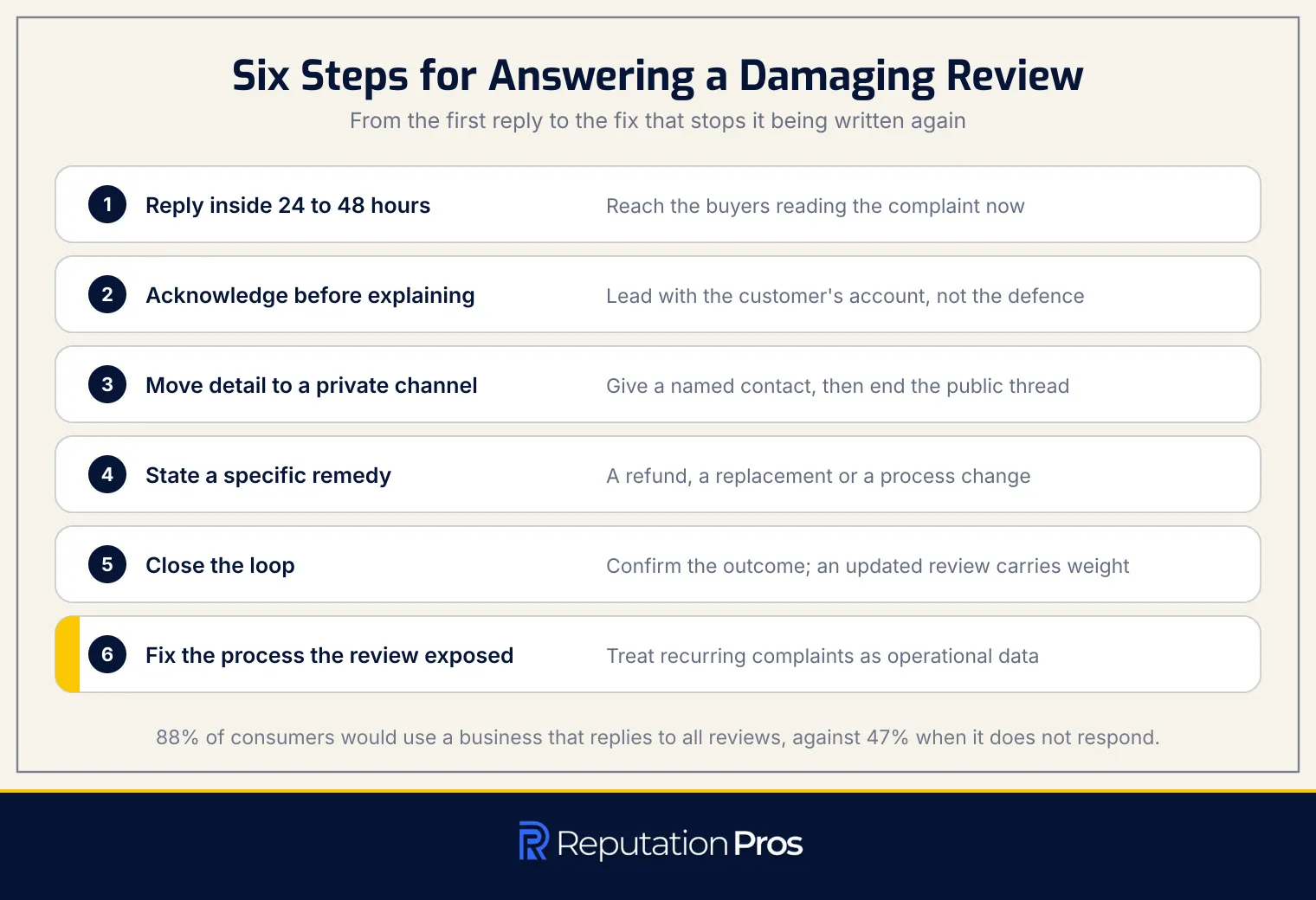
- Reply inside 24 to 48 hours A fast reply reaches the prospective buyers who are reading the complaint now, which is the window in which the response changes a decision.
- Acknowledge the experience before explaining it Opening with the customer’s account, not the brand’s defence, keeps the exchange from escalating in public view.
- Move the detail to a private channel Supplying a named contact and an email address or phone number ends the public thread without abandoning the customer.
- State a specific remedy A specific action, whether a refund, a replacement or a process change, gives the next reader something concrete to judge.
- Close the loop after resolution Confirming the outcome with the customer completes the record, and an updated review carries more weight than a reply.
- Fix the process the review exposed Treating recurring complaints as operational data is what stops the same review being written again.
How Does Review Monitoring Catch Reputation Damage Early?
Review monitoring catches reputation damage early by alerting on new reviews across every platform the brand appears on, instead of relying on someone checking each site. Automated monitoring detects rating movement, clustering of the same complaint and unusual review velocity, which are the three signals that precede a visible reputation problem.
Early detection changes what a response can achieve. A complaint answered the day it appears is a service recovery, while the same complaint answered a month later is damage control on a review that has already shaped a hundred purchase decisions.
How Does Brand Reputation Management Repair the Damage Reviews Cause?
Brand reputation management repairs review damage by working on the rating, the review text and the underlying cause at the same time. Reputation Pros handles the public replies, the policy-based removal requests for reviews that breach platform guidelines, and the review-generation programme that rebuilds the average with current customers.
Repair is sequenced rather than simultaneous. The brand first stops the inflow by fixing what generated the complaints, then addresses the published record, then rebuilds volume, because adding new reviews to an unfixed operation reproduces the original profile.
What Happens to a Brand After Sustained Negative Reviews?
A brand with sustained negative reviews loses purchase consideration before it loses customers. Buyers who read a consistent pattern of complaints conclude the problem runs through the business rather than being isolated, and they remove the brand from the shortlist without contacting it, which makes the loss invisible in the brand’s own data.
The second-order costs compound. Search visibility on branded queries declines, acquisition cost rises to compensate for the lost organic consideration, and the budget that would fund improvement is spent on damage control instead.
How Do Negative Reviews Cut Business Revenue?
Negative reviews cut business revenue by removing the brand from consideration at the point of decision. The Harvard Business School analysis of Seattle restaurants established the upward relationship, a one-star rating increase producing a 5 to 9 percent revenue increase among independents, and Luca noted that a decline would likely reduce revenue without establishing that the downward magnitude matches.
How Do Fake Reviews Damage Trust and Conversions?
Fake reviews damage trust and conversions by raising the perceived risk of the whole transaction. A buyer who suspects manipulation stops treating the review profile as evidence and has no replacement source, so the rational response is to leave rather than to investigate. The loss extends past the suspect reviews to the brand’s product claims, because the buyer now has a reason to doubt anything the brand asserts about itself.
Can a Business Owner Remove Negative Reviews?
No, a business owner cannot delete a negative review directly. Google, Yelp and Trustpilot reserve removal to themselves to keep their review data credible. A review that breaches platform policy, through spam, abuse, a conflict of interest or content about a different business, can be reported for removal with documentation, and the decision rests with the platform. Reviews that are accurate but unflattering stay published.
How Is Review Reputation Actively Managed?
Review reputation is managed through five practices run on a schedule: monitoring every platform the brand appears on, replying within a defined window, filing policy-based removal requests where a review breaches guidelines, asking satisfied customers for reviews without conditioning the request on sentiment, and tracking recurring complaints into operational fixes.
How Should a Brand Respond to Reviews at Scale?
A brand responds to reviews at scale by triaging on severity rather than handling every review the same way. Legally sensitive and highly negative reviews route to a named person, routine positive reviews follow a standard workflow, and the reply library supplies structure that each author adapts to the case in front of them.
Scale fails when personalisation disappears. Templated replies put off half of consumers, so the operating constraint is maintaining specificity as volume grows, not reducing reply time further.
How Does Reputation Repair Work After a Review Crisis?
Reputation repair after a review crisis works by replacing the review profile rather than arguing with it. The brand answers the cluster of complaints, corrects what produced them, then generates current reviews at sufficient volume that the crisis period becomes a visible but historical section of the record.
Time is the active ingredient. Review recency weighting means a sustained period of current, positive reviews displaces an older negative cluster in a way no single intervention achieves.
What Does Consumer Research Show About Trust and Reviews?
Consumer research shows that review reading is near-universal while review trust is declining. 82% of US adults at least sometimes read ratings or reviews before a first-time purchase, per the Pew Research Center’s “Online Shopping and E-Commerce,” while the share trusting reviews as much as a personal recommendation fell from 79% in 2020 to 42% in 2025 in BrightLocal’s “Local Consumer Review Survey 2025.”
Both findings point the same direction for brands. Buyers still consult the review profile, so it remains the decisive public signal, but they now interrogate it, which rewards detail, authorship and visible replies over a high average alone.
Why Do Reviews Remain the Strongest Public Signal of Brand Reputation?
Reviews remain the strongest public signal of brand reputation because no other source combines independence, volume and permanence. Brand-owned content states what a brand claims about itself; press coverage reports what an editor judged newsworthy; reviews record what customers found when they paid.
That record is the one search engines reproduce on branded queries, which makes it the first thing a buyer encounters and the last thing a brand can edit. The impact of reviews on brand reputation is therefore structural rather than reputational sentiment: the review profile is the brand’s public standing, continuously updated by people the brand does not control.