Customer Trust: Definition, Importance and How to Gain it for Your Brand
 13 min read
On this page
Customer trust is the confidence a buyer places in a brand to deliver what it promised, handle their money and data safely, and behave decently when something goes wrong. Customer trust sits apart from brand trust, which is the wider confidence in a company’s promises and values, and from reputation, which is the public judgement formed from everyone’s experience rather than one buyer’s.
Customers decide whether to trust a brand at identifiable moments: during research, at checkout and immediately after the first order. At each point they read for the same thing, evidence that the brand will behave predictably, and they find it in pricing clarity, review content, payment security and the plainness of the returns policy.
Gaining customer trust runs through six steps, from unambiguous pricing and independent proof to visible recovery when the brand gets something wrong. Measurement then uses a defined framework alongside behavioural indicators such as repeat purchase rate and retention.
Trust is the thing a brand can lose fastest. Mishandled data, hidden fees and unmet promises each remove it in a single transaction, and rebuilding takes acknowledgement, correction and a period of consistent delivery long enough for buyers to re-test the brand.
What Is Customer Trust?
Customer trust is a buyer’s confident expectation that a business will act in their interest across the transaction: delivering the product described, protecting their payment details and data, and resolving problems without being forced to.
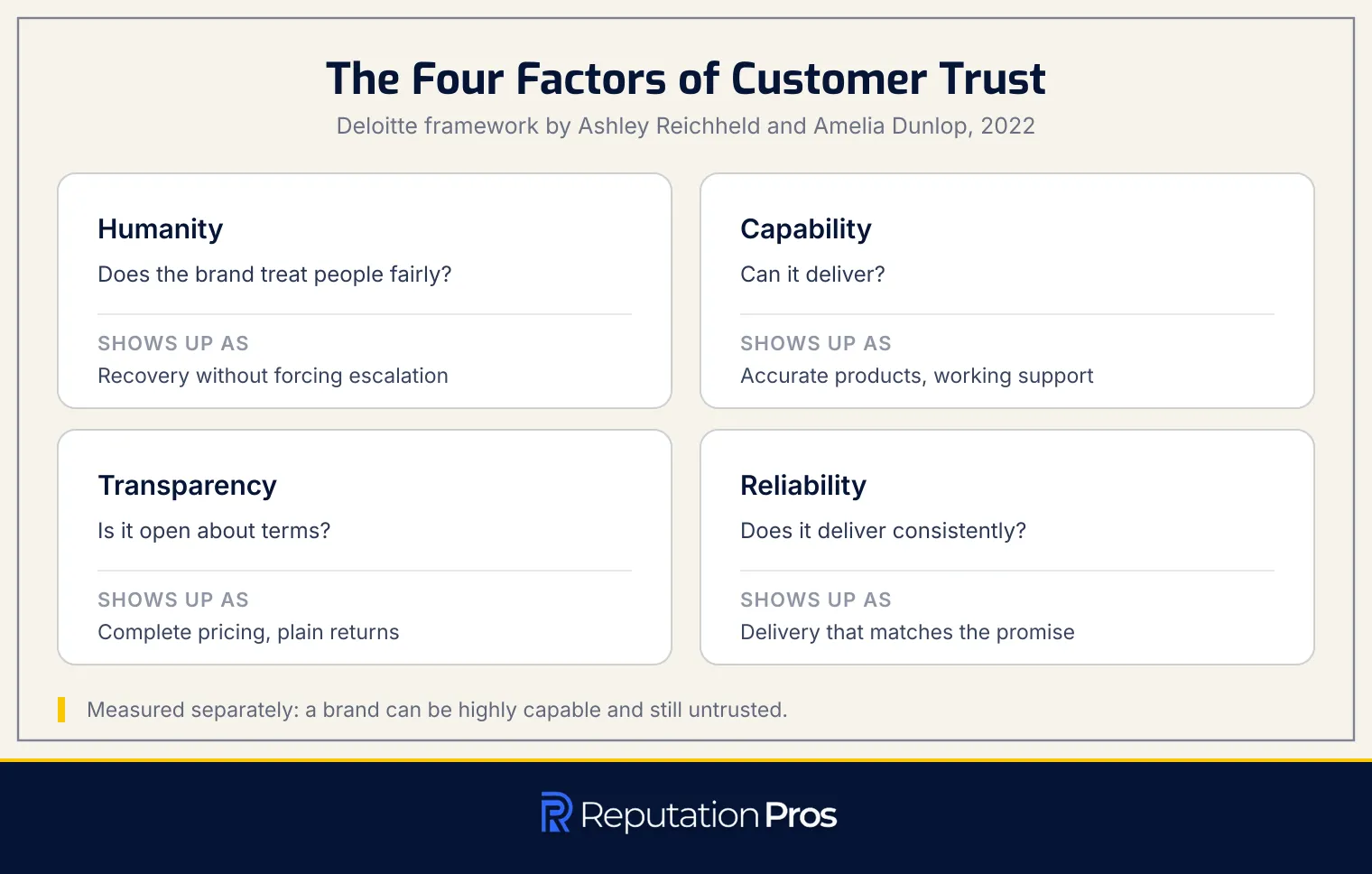
Deloitte’s framework breaks that expectation into four measurable factors. In “The Four Factors of Trust,” published in 2022, Ashley Reichheld and Amelia Dunlop identify humanity, capability, transparency and reliability as the components of trust, operationalised in Deloitte’s HX TrustID tool from over 200,000 survey responses across close to 500 brands. Humanity covers whether the brand treats people with fairness, capability whether it can deliver, transparency whether it is open about terms, and reliability whether it delivers consistently.
How Does Customer Trust Differ From Brand Trust and Reputation?
Customer trust, brand trust and reputation differ in whose experience produces them. Customer trust is personal, built from one buyer’s own transactions. Brand trust is general, held about the brand’s promises and values by people who may never have bought. Reputation is collective, assembled from public accounts, coverage and other customers’ experiences.
The practical distinction is what repairs each one. Reputation responds to the public record, brand trust responds to consistent positioning, and customer trust responds only to how that individual’s next transaction goes.
Why Does Customer Trust Decide Revenue and Retention?
Customer trust decides revenue and retention because it removes the cost of re-deciding. A buyer who trusts a brand stops comparing alternatives, which shortens the purchase, raises repeat rate and reduces how much discount is needed to close the next sale.
Trust determines what a single failure costs as well. The trusting customer treats a late delivery as an exception and contacts support; the untrusting customer treats it as confirmation and buys elsewhere without complaining. Because the second group leaves silently, trust damage appears in retention and win rate before it appears in any complaint channel.
How Does Customer Trust Affect Repeat Purchase and Loyalty?
Customer trust affects repeat purchase by lowering the perceived risk of buying again. The second purchase is a smaller decision than the first, since the buyer has already tested the brand’s delivery, billing and support, and trust is the record of how those tests went.
Loyalty follows from accumulated reliability rather than from satisfaction with any single order. A customer stays because the brand has been predictable across several transactions, which is why consistency outperforms occasional excellence in retaining buyers.
When Do Customers Decide Whether to Trust a Brand?
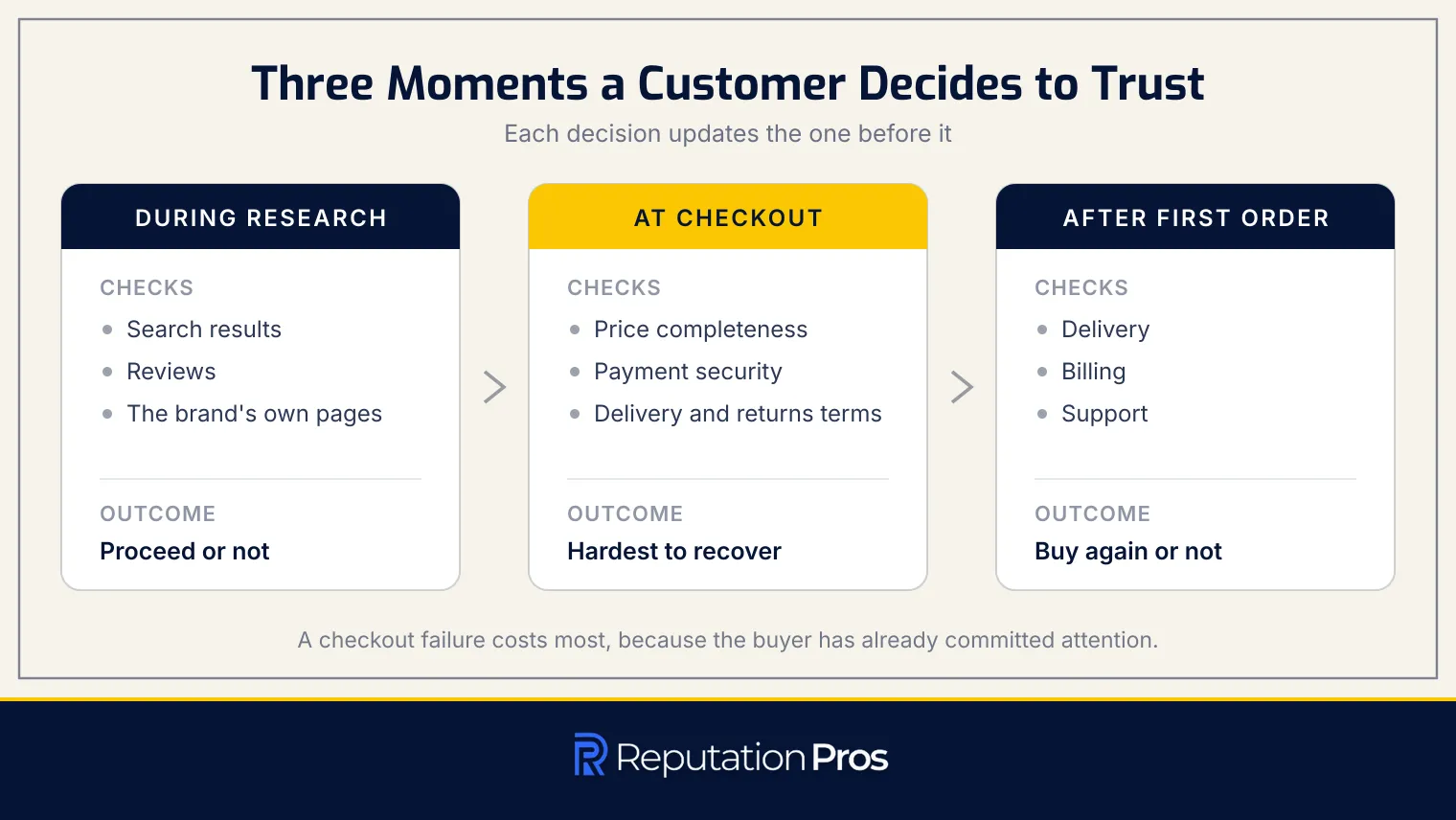
Customers decide whether to trust a brand in stages, and the first decision happens before any contact with the company. During research the buyer reads search results, reviews and the brand’s own pages, and forms a provisional judgement that determines whether they proceed at all.
The second decision happens at checkout, where price completeness, payment security and the clarity of delivery and returns terms are read as evidence of intent. The third happens after the first order, when the brand either behaved as described or did not. Each decision updates the previous one, and a failure at checkout is harder to recover than a failure in research because the buyer has already committed attention.
Which Signals Do Customers Check Before Buying?
The signals customers check before buying are listed below:
- Complete pricing: Total cost including fees and delivery, visible before checkout rather than at it.
- Independent reviews: Published accounts from buyers, read for specifics rather than for the average.
- Payment and data security: Recognisable payment methods and a stated position on how data is handled.
- Contactability: A named business, a working address and a route to a person.
How Do Reviews and Ratings Settle the Trust Decision?
Reviews and ratings settle the trust decision because they are the only evidence in the purchase that the brand did not author. A buyer weighing a brand’s claims against a stranger’s account treats the account as the more reliable of the two.
Review reading is standard: 82% of US adults at least sometimes read online customer ratings or reviews before buying something for the first time, as documented in the Pew Research Center report “Online Shopping and E-Commerce,” December 2016. How that content is read has changed, though. The share of consumers trusting online reviews as much as a personal recommendation fell from 79% in 2020 to 42% in 2025, according to the “Local Consumer Review Survey 2025” by Sammy Paget, BrightLocal, January 2025, so buyers now examine specificity and authorship rather than accepting the star average.
What Do You Need Before Building Customer Trust?
Before building customer trust a brand needs the operation to be capable of honouring it. Accurate product information, delivery that matches what is promised, working support and correct billing come first, because trust-building activity applied to an operation that fails produces faster discovery of the failure.
The brand needs a single accurate version of its own details too, consistent across its site, listings and profiles. Conflicting contact information or service descriptions read as carelessness at exactly the point a buyer is checking whether the business is real.
How to Gain Customer Trust Step by Step?
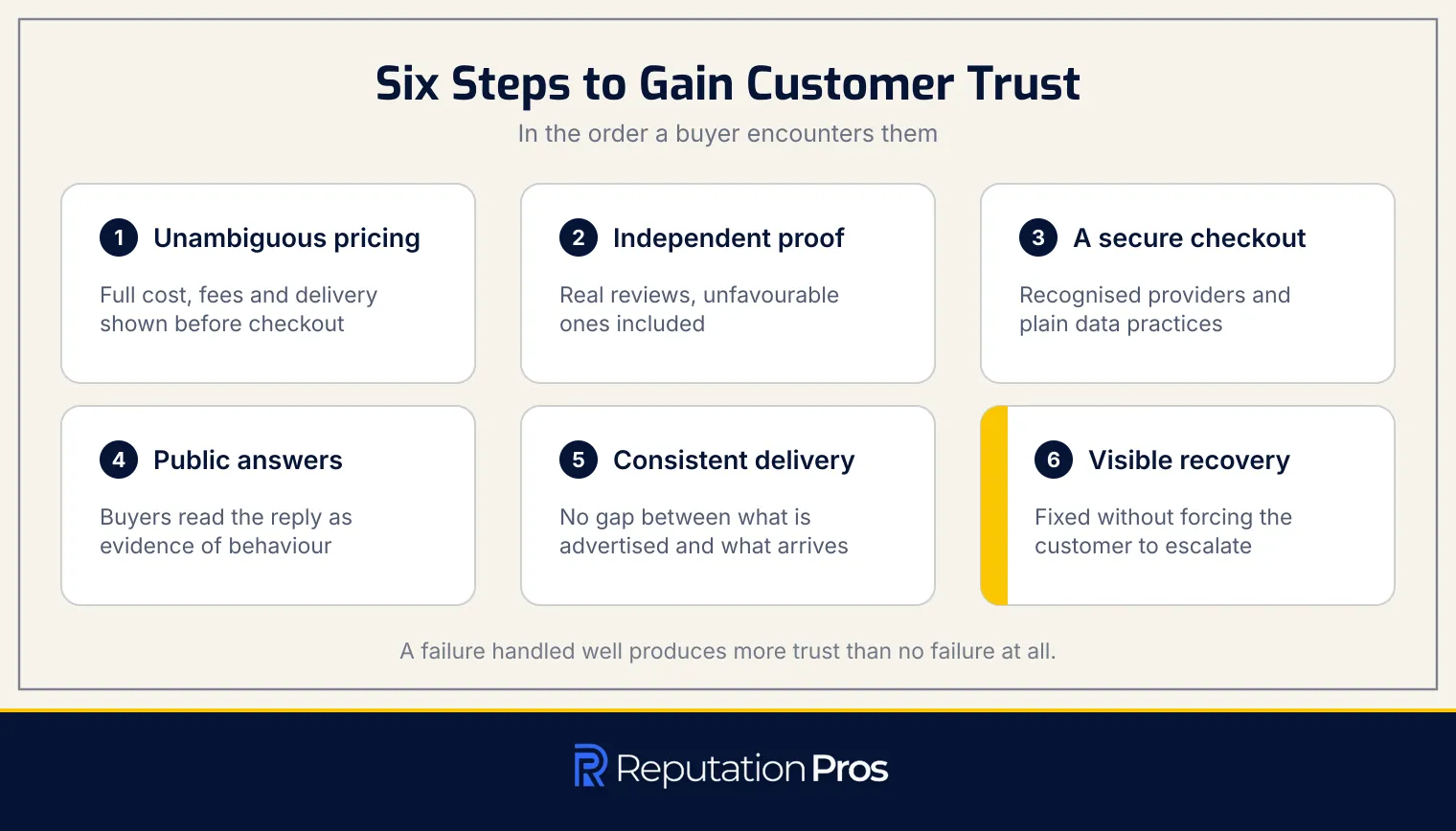
Gaining customer trust follows six steps, in the order a buyer encounters them.
Step 1 - Make Pricing, Terms, and Policies Unambiguous
To make pricing and terms unambiguous, state the full cost including fees and delivery before checkout, and write returns, refunds and data handling in language a buyer can act on. Ambiguity is read as concealment, so a cost that appears at the final step damages trust more than the same cost disclosed at the start.
Step 2 - Publish Independent Proof From Real Customers
To publish independent proof, collect reviews from customers who actually bought, on platforms the buyer already trusts, and display them including the unfavourable ones. A page of uniformly positive reviews reads as curated, which converts the proof into a reason for doubt.
Step 3 - Secure the Checkout and State Your Data Practices
To secure the checkout and state data practices, use recognised payment providers, make the security position visible at the point of payment, and say plainly what data is collected and what happens to it. The buyer is handing over money and personal details at the same moment, so this is where the trust decision is most expensive to lose.
Step 4 - Answer Questions and Complaints in Public
To answer questions and complaints in public, reply where the complaint was made rather than moving every exchange to private channels. The reply is read by prospective buyers as evidence of how the brand behaves under criticism, which makes a public answer worth more than a resolved private one.
Step 5 - Deliver Consistently on What You Promised
To deliver consistently, hold the gap between what is advertised and what arrives at zero across orders. Consistency builds trust faster than generosity, because a buyer can plan around a brand that is predictable and cannot plan around one that is occasionally excellent.
Step 6 - Recover Visibly When You Get It Wrong
To recover visibly, acknowledge the failure, fix it without requiring the customer to escalate, and let the resolution be seen. A failure handled well produces more trust than no failure at all, since the buyer has now tested the brand’s behaviour under pressure and has an answer.
How Do You Measure Customer Trust?
Customer trust is measured on a defined framework alongside behavioural evidence. Deloitte’s HX TrustID scores the four factors, humanity, capability, transparency and reliability, on a seven-point scale through an open-source survey, which produces a diagnostic rather than a single sentiment figure.
Behaviour confirms the survey. Repeat purchase rate, retention, refund and dispute frequency, and the proportion of customers who return after a service failure all record whether trust exists in practice, and a favourable survey alongside falling repeat purchase means the survey is reaching the wrong customers.
What Common Mistakes Destroy Customer Trust?
The mistakes that destroy customer trust are listed below:
- Hidden costs: Fees or delivery charges revealed at checkout after the buyer has decided.
- Mishandled data: Collecting more than is needed, or failing to say what happens to it.
- Promises the operation cannot meet: Delivery or service commitments made in marketing and missed in practice.
- Unanswered complaints: Criticism left visible and unaddressed, read by every later buyer.
- Fabricated or incentivised proof: Reviews and testimonials that fail inspection and discredit the genuine ones alongside them.
- Inconsistent information: Different prices, terms or contact details across the brand’s own channels.
- Forcing escalation: Requiring a customer to complain repeatedly before a problem is fixed.
- Silence after a failure: Not telling affected customers what happened, which they then learn elsewhere.
How Do You Rebuild Customer Trust After a Public Failure?
- Say what happened A plain account from the brand, before customers assemble one themselves, is what makes everything afterwards credible.
- Take responsibility without qualification A hedged acknowledgement reads as an attempt to limit liability and extends the problem.
- Fix the cause, not the complaint The failure recurs if the process that produced it is unchanged, and a second occurrence costs far more than the first.
- Tell affected customers directly People who experienced the failure should hear from the brand before they read coverage of it.
- Show the change Specific, checkable differences in how the brand now operates replace the assurance that it will do better.
- Earn current proof Reviews from customers served after the fix establish present performance, which is what a prospective buyer is assessing.
How Does Review Monitoring Reveal Where Trust Is Breaking?
Review monitoring reveals where trust is breaking by showing which part of the experience customers name. Complaints cluster around one stage, billing, delivery, support response or product condition, and the cluster identifies the process that needs changing.
Monitoring catches the problem while it is still cheap. A complaint pattern detected in its first week can be fixed before it becomes the dominant theme in a brand’s review profile, which is the point at which it starts costing new customers rather than existing ones.
How Does Brand Reputation Management Restore Customer Trust at Scale?
Brand reputation management restores customer trust at scale by handling the public record that prospective customers read while the operation addresses what produced it. Reputation Pros works the review profile, the branded search results and the response process together, so the evidence a new buyer finds reflects the brand’s current performance rather than its worst period.
Scale is the reason this becomes a managed function. One complaint can be answered by the business owner; several thousand reviews across a dozen platforms, each read by buyers at the moment of decision, require a system with defined response windows, escalation rules and measurement.
What Does Research Show About How Customers Decide to Trust?
Research shows that customers decide on trust from several independent factors rather than one combined impression. Deloitte’s work with Reichheld and Dunlop found the four factors, humanity, capability, transparency and reliability, operate separately, which means a brand can be highly capable and still untrusted because it is not transparent.
The diagnostic value is in the separation. A brand measuring a single trust score learns that trust is low; a brand measuring four factors learns which one to fix.
What Does Consumer Research Show About Trust and Online Reviews?
Consumer research shows review reading is near-universal while review trust is conditional. Pew Research Center recorded that 82% of US adults at least sometimes read ratings or reviews before a first-time purchase, and BrightLocal’s 2025 survey recorded the share trusting reviews as much as a personal recommendation falling from 79% in 2020 to 42% in 2025.
Both findings point the same way for a brand: the review profile is still consulted by almost every buyer, but it is now interrogated rather than accepted, which rewards detailed, attributable reviews over a high average.
How Do Fake Reviews Destroy Customer Trust and Conversions?
Fake reviews destroy customer trust by removing the buyer’s only independent evidence. A customer who identifies planted reviews has no replacement source for the judgement they were making, so the rational response is to leave rather than investigate further.
The damage extends past the reviews. Having found one claim manipulated, the buyer has grounds to doubt the product description, the pricing and the policies, which is why detected manipulation costs more than the negative reviews it was meant to hide.
Which Trust Signals Work Hardest Across Channels?
The trust signals that work hardest across channels are listed below:
- Independent review content: Carries most weight because the brand did not write it.
- Complete, visible pricing: Resolves the single most common suspicion at the point of decision.
- Public replies to criticism: Demonstrate behaviour rather than asserting values.
- Verifiable business identity: A named, contactable, locatable company.
- Consistency across channels: Matching information everywhere, which is what makes any individual signal believable.
How Do Seller Ratings and Returns Build E-commerce Trust?
Seller ratings and returns build e-commerce trust by limiting the buyer’s downside. The rating estimates the probability of a problem, and the returns policy caps the cost if one occurs, so the two together let a buyer commit without having handled the product.
A clear returns policy does more work than a generous one. A buyer needs to know what will happen, and a plainly stated fourteen-day window is more reassuring than an unexplained promise of satisfaction.
How Does Trustpilot Work for Businesses Building Customer Trust?
Trustpilot works for businesses building customer trust by hosting reviews on a platform the brand does not control, which is the source of its value. Businesses can invite customers to review and can reply publicly, while the platform retains the review and the moderation decision.
That independence is the point. A testimonial on a brand’s own site and a review on a third-party platform make the same claim, and buyers weight the second one higher because the brand could not have removed it.
How Do Search Engines Evaluate Trust and Authority?
Search engines evaluate trust and authority through signals they can verify independently of the site’s own claims: content attributed to identifiable authors with relevant credentials, links from established domains, consistency of business information across sources, and the review record attached to the entity. Google’s quality guidance frames this as expertise, authoritativeness and trustworthiness, which is why the evidence that convinces a search system and the evidence that convinces a customer largely coincide.
Why Does Earning Customer Trust Compound Into Brand Value?
Earning customer trust compounds into brand value because each trusted transaction lowers the cost of the next one. A trusting customer needs less discount, less reassurance and less support, returns at a higher rate, and supplies the review content that reduces acquisition cost for customers the brand has never met.
That accumulation is what converts trust from a sentiment into an asset. Definition, importance and method all point the same way: customer trust is earned transaction by transaction, and its value is the compounding effect of buyers who no longer have to be persuaded.