8 Best Ways to Increase Your Brand's Online Credibility
 13 min read
On this page
Increasing a brand’s online credibility means producing evidence a customer can check without taking the brand’s word for it. The eight methods that do this are publishing specialist knowledge under named authors, earning independent customer reviews, securing third-party press and analyst coverage, building a Google Knowledge Panel, maintaining an accurate Wikipedia presence, publishing original research, making trust signals visible on every page, and keeping claims, pricing and policies transparent.
Credibility is not the same as presentation. A brand can hold a polished identity and still fail the credibility test, because credibility rests on verifiable proof of competence while presentation rests on design and language.
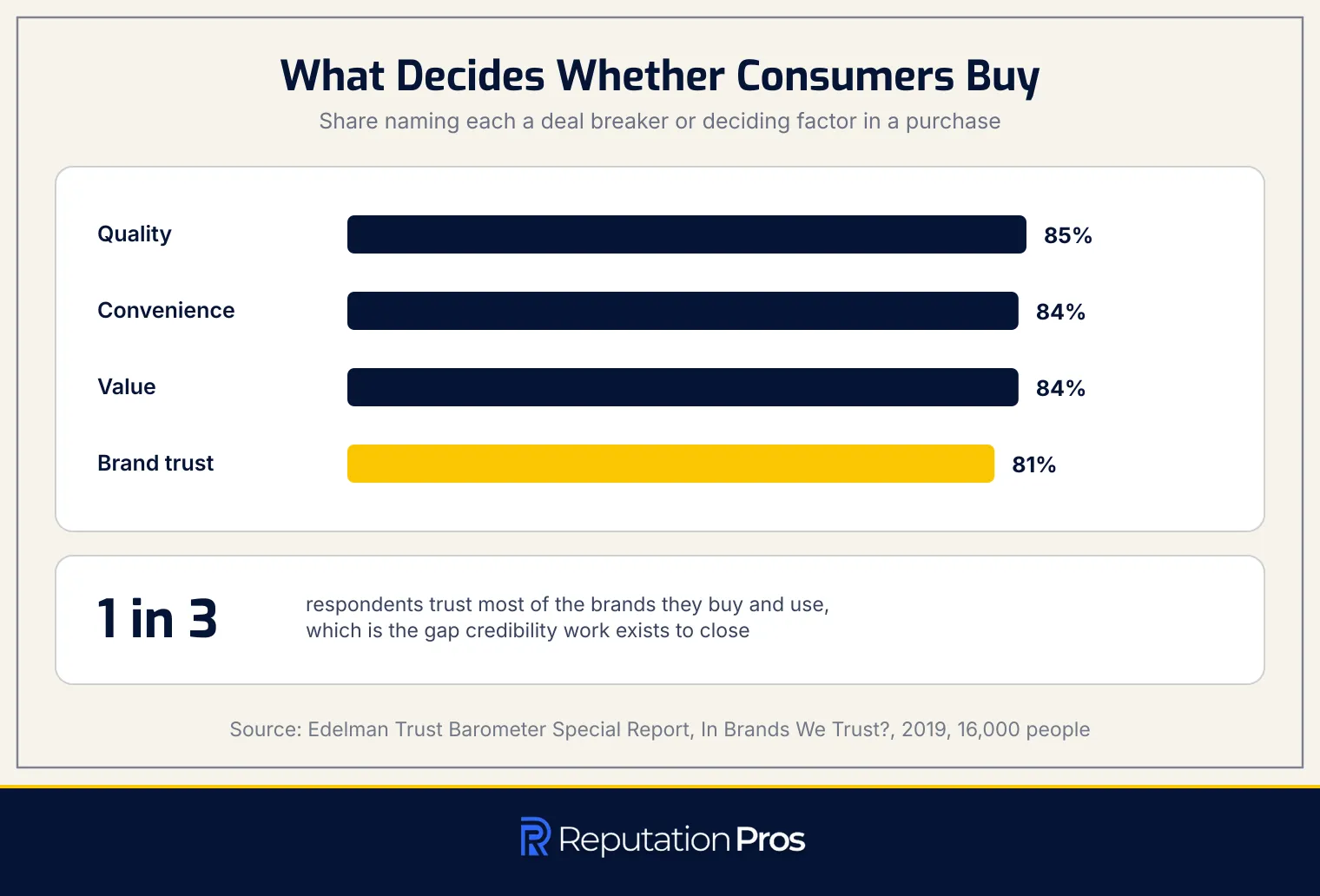
Brand trust decides purchases. Brand trust is a deal breaker or a deciding factor for 81% of consumers considering a purchase, according to Edelman’s 2019 Trust Barometer Special Report “In Brands We Trust?”, which surveyed 16,000 people across eight countries. The same report found only one in three respondents trust most of the brands they buy and use, which is the gap these eight tactics exist to close.
Before the work starts, a brand needs a consistent identity, accurate business information, documented products and an audit of what already exists: reviews, search results, press coverage, profiles and public claims. Measurement then runs on branded search growth, review quality and volume, sentiment, referral traffic, media mentions and conversion movement.
What Is Brand Credibility?
Brand credibility is the judgement that a brand can do what it says and will do it consistently. Two assessments produce it: competence, meaning the brand is capable of delivering, and trustworthiness, meaning it delivers reliably rather than occasionally.
Credibility separates from brand presentation at the point of proof. Visual polish and consistent messaging shape expectation, while credibility requires evidence a customer can verify independently: a named author with checkable credentials, a review written by someone who bought the product, a publication with no commercial stake in the coverage.
Accumulation matters more than any single campaign. Credibility is built from a record of consistent actions, which is why it cannot be bought quickly and why losing it is expensive.
Why Does Online Credibility Decide Whether Customers Buy?
Online credibility decides purchases because a customer buying remotely cannot inspect the product, so they substitute proof signals for physical inspection. Reviews, third-party coverage and transparent policies become the evidence standing in for handling the goods.
Edelman’s research places brand trust alongside the conventional purchase drivers rather than behind them: at 81% it ranks just below quality (85%), convenience (84%) and value (84%) as a deal breaker or deciding factor. Trust is therefore not a soft attribute competing with price, but a filter applied before price is considered.
Scepticism is the default position. With only one in three consumers trusting most of the brands they use, a brand that supplies checkable evidence separates itself from a majority that asks to be believed.
What Do You Need Before Building Online Credibility?
Before building online credibility a brand needs four things in place: a working website with clear ownership and contact details, business information that matches across every platform, documented products or services with substantiated claims, and an audit of the existing record.
The audit sets the baseline. Reading current reviews, branded search results, press coverage, third-party profiles and published claims establishes where credibility is already weak, which is what makes later improvement measurable rather than assumed.
How Were These 8 Credibility Tactics Selected?
The eight tactics were selected on four criteria: each produces evidence a third party can verify, each demonstrates competence rather than asserting it, each is visible where customers research, and each survives scrutiny.
Google’s quality framework uses the same dimensions. Its search quality guidance evaluates content on expertise, authoritativeness and trustworthiness, so tactics that satisfy a sceptical customer and tactics that satisfy a search evaluator overlap substantially. Tactics requiring manipulation were excluded, because anything that fails inspection converts a credibility programme into a liability.
The 8 Best Ways to Increase Your Brand’s Online Credibility
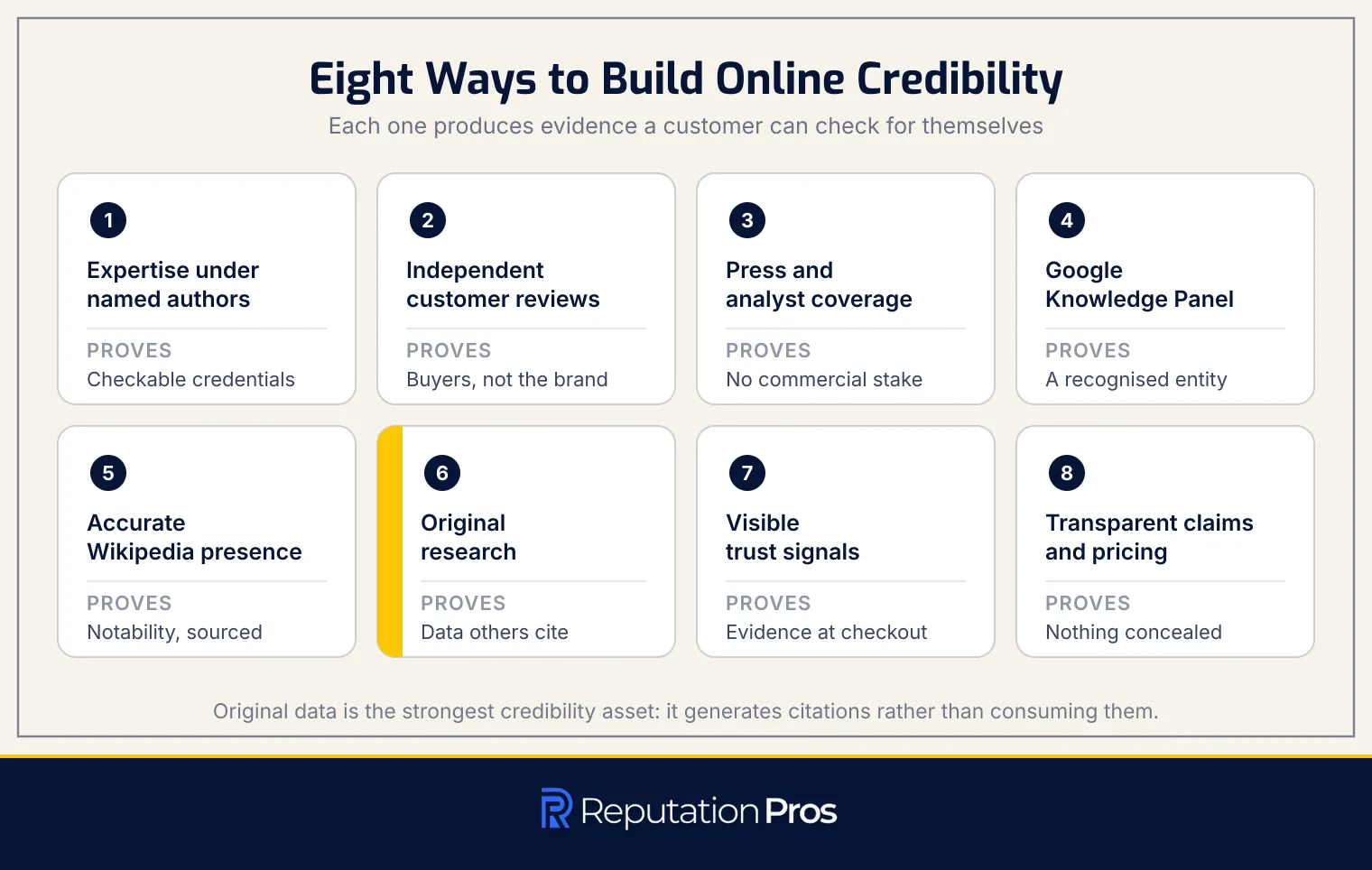
The eight ways to increase a brand’s online credibility are listed below.
1. Publish Verifiable Expertise Under Named Authors
To publish verifiable specialist knowledge under named authors, attach every substantive article to a real person with checkable credentials and a bio that states their qualifications and links to a professional profile. Match the author to the subject, so the person writing about tax policy holds a tax qualification. Anonymous authorship cannot be verified, which means it carries no credibility weight regardless of how accurate the content is.
2. Earn and Display Independent Customer Reviews
To earn independent reviews, ask real customers shortly after purchase through email, SMS or in-app prompts, and link directly to Google Business Profile, Trustpilot or the platform that matters in the category. Display the result including unfavourable reviews, with dates and reviewer identity where permitted, because a page showing only five-star reviews reads as filtered. Reply to criticism in public, since the reply is read by prospective customers as evidence of how the brand behaves.
3. Secure Third-Party Press and Analyst Coverage
To secure third-party coverage, build working relationships with the journalists and analysts who already cover the category, and offer them material with news value: original data, informed commentary on a live issue, or a documented company development. Pitching the brand itself rarely works; pitching something the publication’s readers need does. Coverage earns its credibility from the publisher’s independence, so it belongs on the brand’s site as a citation rather than as a reproduced article.
4. Build a Google Knowledge Panel for Your Brand Entity
To build a Knowledge Panel, establish the brand as a recognised entity in Google’s Knowledge Graph. Claim and complete the Google Business Profile, ensure consistent brand facts exist across authoritative sources, add the organisation to Wikidata with structured properties, and declare the brand’s details on the website with schema markup. Google generates panels from that aggregated data rather than on request, so the work is in supplying consistent evidence and the panel follows over weeks or months.
5. Maintain an Accurate Wikipedia Presence
To maintain an accurate Wikipedia presence, first establish that the brand meets Wikipedia’s notability threshold, which requires substantial coverage in independent reliable sources rather than press releases or self-published material. Written entries must hold a neutral tone and cite verifiable third-party sources. A brand should not edit its own article: the conflict-of-interest guideline makes direct editing a reputational risk, and corrections belong on the article’s talk page where they are handled transparently.
6. Publish Original Research and Thought Leadership
To publish original research, produce data the industry does not already have: a survey of your customer base, an analysis of your own operational dataset, or a study of a question practitioners argue about. Original data is the strongest credibility asset available to a brand, because it generates citations rather than consuming them. Commentary under named experts compounds the effect by attaching the brand to a recognisable point of view over time.
7. Make Trust Signals Visible on Every Page
To make trust signals visible, place the evidence where the decision happens rather than on a dedicated trust page. Security indicators, genuine certifications, a physical address, a working phone number and an accessible privacy policy belong in the header, footer and checkout. Every badge must be current and genuine, because an expired or invented certification converts a trust signal into proof of carelessness.
8. Keep Claims, Pricing, and Policies Transparent
To keep claims, pricing and policies transparent, state the complete price including fees and shipping before checkout, write returns, refunds and data handling in plain language, and limit product claims to what can be substantiated. Costs that appear only at the final step and terms buried in dense legal text both produce the same outcome: a customer who concludes the brand was concealing something, and who carries that judgement over to everything else it says.
How Do You Measure Whether Online Credibility Is Improving?
Online credibility improvement is measured on both direct and indirect indicators. Direct indicators include review volume and sentiment, branded search growth, organic traffic to credibility content, and movement in trust-sensitive conversion points such as form completion and checkout.
Indirect indicators show whether third parties are treating the brand as credible: citations by journalists and analysts, backlinks from authoritative domains, accuracy of the Knowledge Panel, and speaking invitations extended to named experts. Baseline measurement before the work begins is what separates demonstrated improvement from the impression of it.
What Common Mistakes Destroy Brand Credibility?
The mistakes that destroy brand credibility are listed below.
- Publishing fake reviews: Fabricated or AI-generated reviews from people who never bought the product.
- Buying reviews conditioned on sentiment: Paying for a particular opinion rather than for honest feedback.
- Suppressing criticism with threats: Using groundless legal or physical threats to remove a negative review.
- Undisclosed insider reviews: Employee or affiliate reviews presented as independent customer opinion.
- Fake independent review sites: A company-controlled review site holding itself out as impartial.
- Fake social proof: Purchased followers, likes or engagement indicators.
- Unsubstantiated claims: Health, performance or outcome claims without evidence behind them.
- Citing research that cannot be checked: Statistics with no traceable source, which fail the first verification attempt.
- Hidden terms and costs: Fees and conditions disclosed only in fine print or at checkout.
- Inconsistent brand information: Conflicting addresses, contact details or service descriptions across platforms.
- Anonymous expert content: Authoritative claims with no author or credentials attached.
- Copied content: Competitor material reproduced as the brand’s own.
- Undisclosed paid placement: Sponsored articles or endorsements presented as editorial.
- Defensive responses to valid complaints: Attacking the critic rather than addressing the complaint.
- Security and privacy failures: Mishandled data, which removes credibility across every other dimension at once.
Several of these now carry direct legal exposure. The Federal Trade Commission issued its final Rule on the Use of Consumer Reviews and Testimonials on 14 August 2024, effective 21 October 2024, prohibiting fake and AI-generated reviews, compensation conditioned on a particular sentiment, undisclosed insider reviews, company-controlled sites posing as independent, review suppression through groundless threats, and purchased social media indicators.
How Do You Rebuild Online Credibility After It Is Damaged?
- Acknowledge the problem through official channels A direct statement without defensiveness removes the argument about whether the issue happened and makes what follows credible.
- Correct the inaccurate material you control Audit owned properties and remove or update claims that are now wrong, since leaving them in place contradicts the acknowledgement.
- Publish what you are doing about it Named actions with dates give customers something checkable in place of an apology.
- Rebuild third-party validation Current reviews from current customers establish present performance, which is the only thing a prospective buyer is assessing.
- Earn coverage of the correction Independent reporting of the remedy carries weight the brand’s own account cannot.
- Update the authoritative references Wikipedia and the Knowledge Panel are read as the neutral record, so stale information there outlives everything else.
- Increase disclosure Making pricing, policies and practices more explicit removes the ambiguity that let the problem grow.
- Monitor continuously Tracking mentions, review scores and sentiment establishes whether recovery is actually happening.
How Does a Wikipedia and Knowledge Panel Presence Anchor Brand Credibility?
A Wikipedia article and a Google Knowledge Panel anchor brand credibility because neither is written by the brand. Wikipedia requires independent, verifiable sourcing and refuses entries for organisations without substantial external coverage, so the article’s existence is itself third-party confirmation of notability.
Reputation Pros manages both as a pair, because they are connected: the Knowledge Panel draws on the structured, independently sourced facts that Wikipedia and Wikidata establish, which means an inaccurate or absent Wikipedia presence limits what the panel can show.
How Does Brand Reputation Management Rebuild a Brand’s Online Credibility?
Brand reputation management rebuilds online credibility by auditing every source of the damage, then addressing the record and the cause together. Reputation Pros identifies the negative search results, reviews and media coverage driving the current judgement, handles the material that is inaccurate or policy-violating, and builds the named authorship, current reviews and press coverage that replace it.
Order matters more than effort. Publishing new credibility assets while the original problem remains visible produces a split record that reads as contradiction, so the sequence runs from correcting the cause, to the published record, to rebuilding the evidence.
How Does Credibility Sit Within Reputation and Authority?
Credibility sits between reputation and authority as the evidence layer both depend on. Reputation is the accumulated judgement of a brand over time, authority is recognised standing within a field, and credibility is the present question of whether the brand’s claims hold up.
How Do Reputation, Credibility, and Authority Differ?
Reputation, credibility and authority answer three questions in sequence. Reputation asks what the brand’s record has been. Credibility asks whether what it says now can be relied on. Authority asks whether the field treats the brand as a reference point. A brand can hold credibility without authority, as a reliable newcomer does, but authority without credibility collapses as soon as a claim is tested.
Which Credibility Signals Do Search Engines Actually Read?
Search engines read structured, verifiable signals rather than tone. Organization, Review and Article schema define what the entity and content are; author markup and bylines with credentials attach content to an identifiable person; links from authoritative domains record third-party endorsement; and consistency of brand facts across sources confirms the entity is what it claims to be. Google’s expertise, authoritativeness and trustworthiness criteria describe what its evaluators look for, which is why the signals that satisfy a search system and those that satisfy a customer converge.
Which Platforms Carry the Most Credibility Weight?
The platforms that carry the most credibility weight are listed below.
- Independent editorial publications: Coverage from outlets with editorial standards and no commercial stake in the brand.
- Wikipedia: Third-party validation gated by notability and sourcing requirements.
- Google Knowledge Panels: The brand summary Google itself presents, read as verified.
- LinkedIn: Where professional credentials and named specialists are checked.
- Recognised review platforms: Where customers compare experiences before buying.
- Industry directories and professional associations: Membership that confirms legitimacy within a field.
- Thought-leadership channels: Where original evidence accumulates into standing over time.
Why Does a Wikipedia Presence Signal Credibility?
A Wikipedia presence signals credibility because the brand does not control it. An independent editor community enforces notability, neutral point of view and secondary sourcing, so an article that survives means external coverage exists and has been checked by people with no interest in the outcome.
How Does LinkedIn Build Professional Authority?
LinkedIn builds professional authority by attaching claims to identifiable people with verifiable histories. A complete profile documents work history, qualifications and endorsements from named colleagues and clients, and published commentary under that profile accumulates into a visible track record. For brands whose credibility rests on individual specialists, the profiles of named experts carry more weight than the company page.
How Does a Knowledge Panel Change How Credible a Brand Looks?
A Knowledge Panel changes how credible a brand looks by presenting it as an entity Google recognises rather than a website making claims. The panel displays the brand’s description, logo and key facts in the results themselves, which separates it from competitors who appear only as links and resolves the identity question before the customer reaches any page.
How Does Thought Leadership Content Build Credibility Over Time?
Thought leadership content builds credibility over time by producing a record rather than a campaign. Each piece of original analysis adds to a body of work that can be checked for consistency, and consistency across years is what distinguishes a genuine specialist from a well-written article. Content weighted toward the reader’s questions rather than the brand’s products is what makes the record worth citing.
Why Do These 8 Tactics Compound Into Lasting Online Credibility?
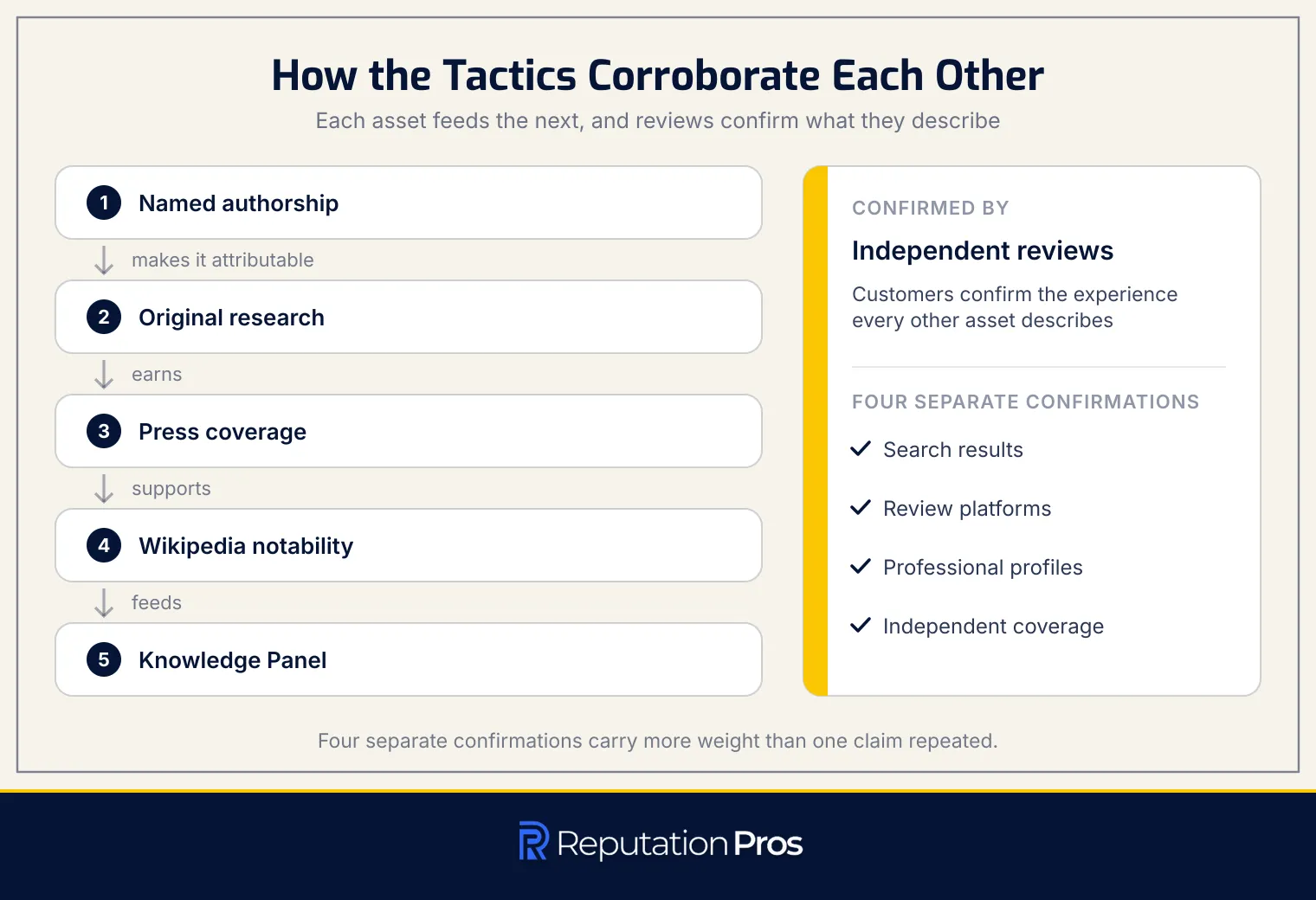
The eight tactics compound because each one corroborates the others. Named authorship makes original research attributable, original research earns press coverage, press coverage supports Wikipedia notability, Wikipedia and Wikidata feed the Knowledge Panel, and independent reviews confirm the customer experience those assets describe.
Corroboration is what makes the result durable. A customer who finds consistent evidence in search results, on review platforms, in professional profiles and in independent coverage has four separate confirmations rather than one claim repeated, and increasing a brand’s online credibility is the work of making those confirmations agree.