Importance of Brand Reputation to Stakeholders
 11 min read
On this page
Brand reputation is important to stakeholders because it is the basis on which each group decides whether to rely on a business. Customers decide whether to buy, investors whether to hold, candidates whether to apply, partners whether to commit and regulators how closely to look.
Reputation is not one judgement held by everyone. It is a set of judgements, one per stakeholder group, built from different evidence, which is why a company can hold strong standing with investors while carrying a workforce problem that has not yet reached the market.
The commercial stake is large. Executives attribute 63% of their company’s market value to its reputation, according to “The State of Corporate Reputation in 2020: Everything Matters Now,” published by Weber Shandwick with KRC Research in January 2020 from a survey of 2,227 executives across 22 markets.
Seven dimensions carry those judgements: products and services, innovation, workplace, governance, citizenship, leadership and performance. Each stakeholder group weights them differently, and managing reputation means knowing which dimension each group is actually reading.
What Does Brand Reputation Mean to a Business’s Stakeholders?
Brand reputation means, to a stakeholder, the expectation that a business will do what it says. For a customer that expectation covers product quality and service recovery; for an investor it covers governance and the durability of earnings; for a candidate it covers how the company treats the people already inside it.
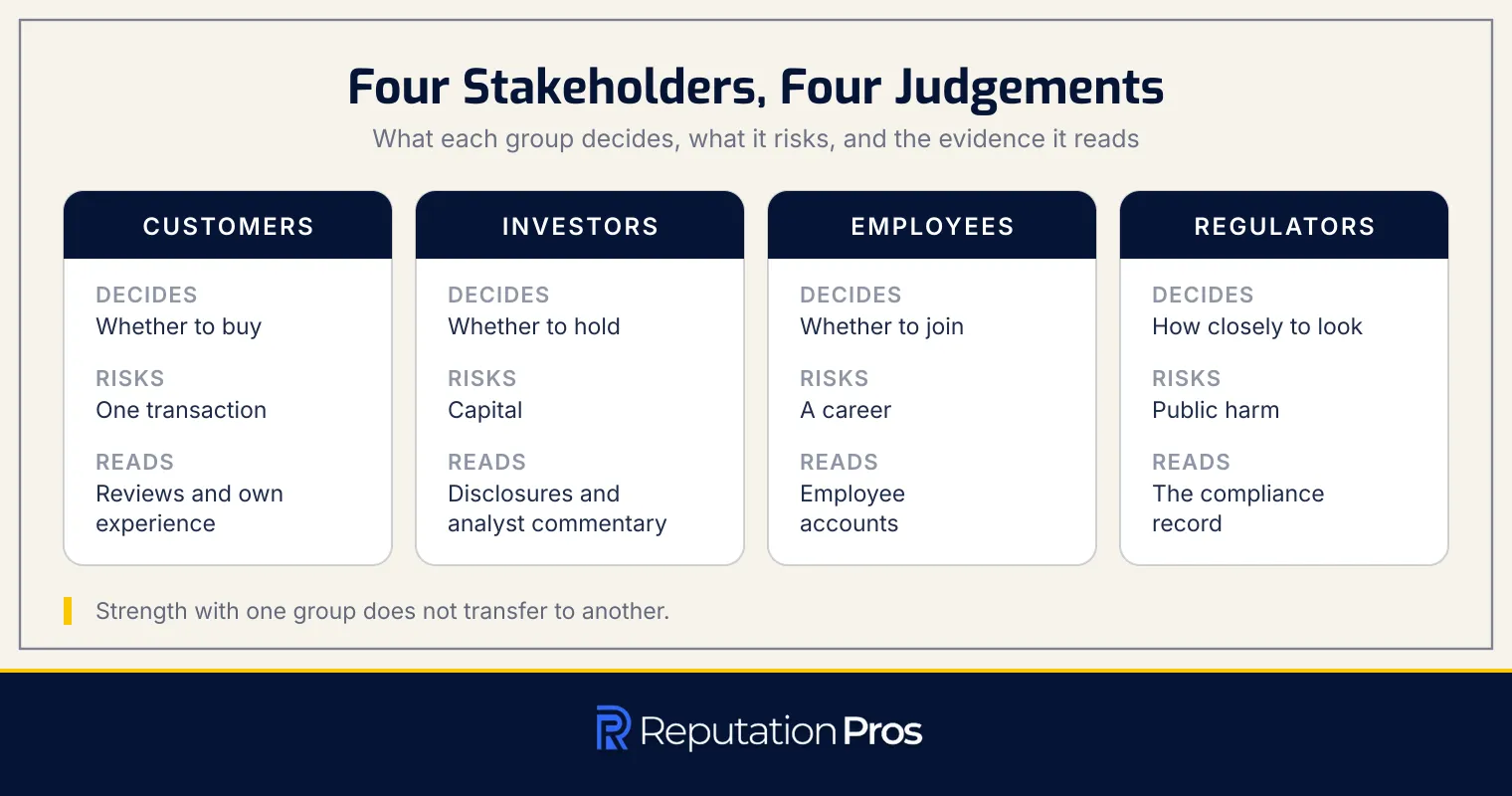
Each group forms that expectation from evidence it can reach. Customers read reviews and their own experience, investors read disclosures and analyst commentary, candidates read employee accounts, and regulators read the compliance record. The same company therefore holds several reputations at once, each accurate within the evidence that produced it.
Which Groups Count as Brand Reputation Stakeholders?
The groups that count as brand reputation stakeholders are listed below:
- Customers and prospective buyers: Decide purchase on perceived reliability and risk.
- Investors and shareholders: Read reputation as a proxy for management quality and downside exposure.
- Employees and job candidates: Decide whether to join, stay or advocate.
- Partners, suppliers and distributors: Judge whether association carries risk to their own standing.
- Lenders, insurers and regulators: Price or scrutinise the business according to its governance record.
- Media and industry analysts: Set the frame other stakeholders read the company through.
Why Does Brand Reputation Carry Different Weight for Each Stakeholder?
Brand reputation carries different weight for each stakeholder because each group bears a different risk. A customer risks one transaction, an employee risks a career, an investor risks capital and a regulator risks public harm, so each weighs the dimension closest to its own exposure.
The RepTrak framework developed by Reputation Institute measures this directly. Its seven rational dimensions were validated across five stakeholder groups in six countries, which establishes that reputation is composed of separate judgements held by separate groups rather than one general sentiment.
The practical consequence is that strength does not transfer. Strong financial performance reassures investors without addressing a workplace grievance, and an excellent product record does not answer a governance question, so a company reading only its strongest dimension will miss the one a different group is acting on.
Which Stakeholders Does Brand Reputation Affect Most?
The stakeholder groups brand reputation affects most are set out below, in the order a reputation problem usually reaches them.
Customers and Prospective Buyers
Customers and prospective buyers use brand reputation to price risk before they buy. A strong reputation reduces the perceived chance of a bad outcome, which is what allows a trusted brand to charge more than an unknown one for a comparable product.
Reputation decides whether a failure is forgiven too. A customer with a favourable prior view treats a service failure as an exception and complains; a customer without one treats it as confirmation and leaves. The loss shows up as churn rather than as a complaint, which is why customer reputation damage is frequently detected late.
Investors and Shareholders
Investors and shareholders read brand reputation as information about management and risk that the financial statements do not carry. The Weber Shandwick and KRC Research survey found executives themselves attribute 63% of market value to reputation, which locates the asset outside the balance sheet.
Reputation events move valuation faster than operating results do. A governance failure or a public scandal reprices a company within days, before any change in earnings, because investors are repricing the probability of future failures rather than reacting to a realised loss.
Employees and Job Candidates
Brand reputation affects employees and job candidates on both sides of the hiring decision. Candidates assess the company before applying, and existing employees decide whether to stay and whether to recommend.
Screening runs in both directions. 70% of employers research candidates on social media, 57% have found content that caused them not to hire someone, and 47% are less likely to interview a candidate they cannot find online, according to the CareerBuilder survey conducted by The Harris Poll, published 9 August 2018. The same visibility that lets an employer screen a candidate lets a candidate screen the employer.
Partners, Suppliers, and Distributors
Partners, suppliers and distributors treat brand reputation as transferable risk. A distributor stocking a brand under public criticism absorbs part of that criticism, and a supplier extending terms to a company with a governance problem carries the exposure.
Commercial terms reflect the assessment. Reputation shows up in contract conditions, payment terms and whether a partner will co-brand, which makes it a cost of capital in a different form.
Lenders, Insurers, and Regulators
Lenders, insurers and regulators read brand reputation through the governance dimension. Lenders and insurers price the probability of disruption, so a reputation marked by compliance failures raises the cost of borrowing and of cover.
Regulators allocate attention. A company with a record of consumer complaints or disclosure problems attracts closer scrutiny, which converts reputation into a direct operating cost through audit, reporting and remediation.
Media and Industry Analysts
Media and industry analysts shape the frame every other stakeholder reads the company through. They do not buy, invest or regulate, but they determine which dimension of the company becomes the subject of discussion.
That framing persists. Once a company has been characterised in coverage as a particular kind of operator, later stakeholders encounter the characterisation before they encounter the company, and reputation work has to address the frame rather than the individual article.
What Are the Seven Dimensions That Shape Brand Reputation?
The seven dimensions that shape brand reputation, as set out in the RepTrak framework, are listed below:
- Products and services: Quality, value and reliability of what the company sells.
- Innovation: Whether the company adapts and leads change in its category.
- Workplace: Employee treatment, satisfaction and fairness.
- Governance: Transparency, ethics and the conduct of the business.
- Citizenship: Environmental and social impact.
- Leadership: Quality of management and clarity of direction.
- Performance: Financial results and growth outlook.
Each dimension is measured from several underlying attributes rather than as a single score, which is what allows a company to identify the individual attribute producing a weak dimension.
Which Dimensions Do Stakeholders Weight Differently?
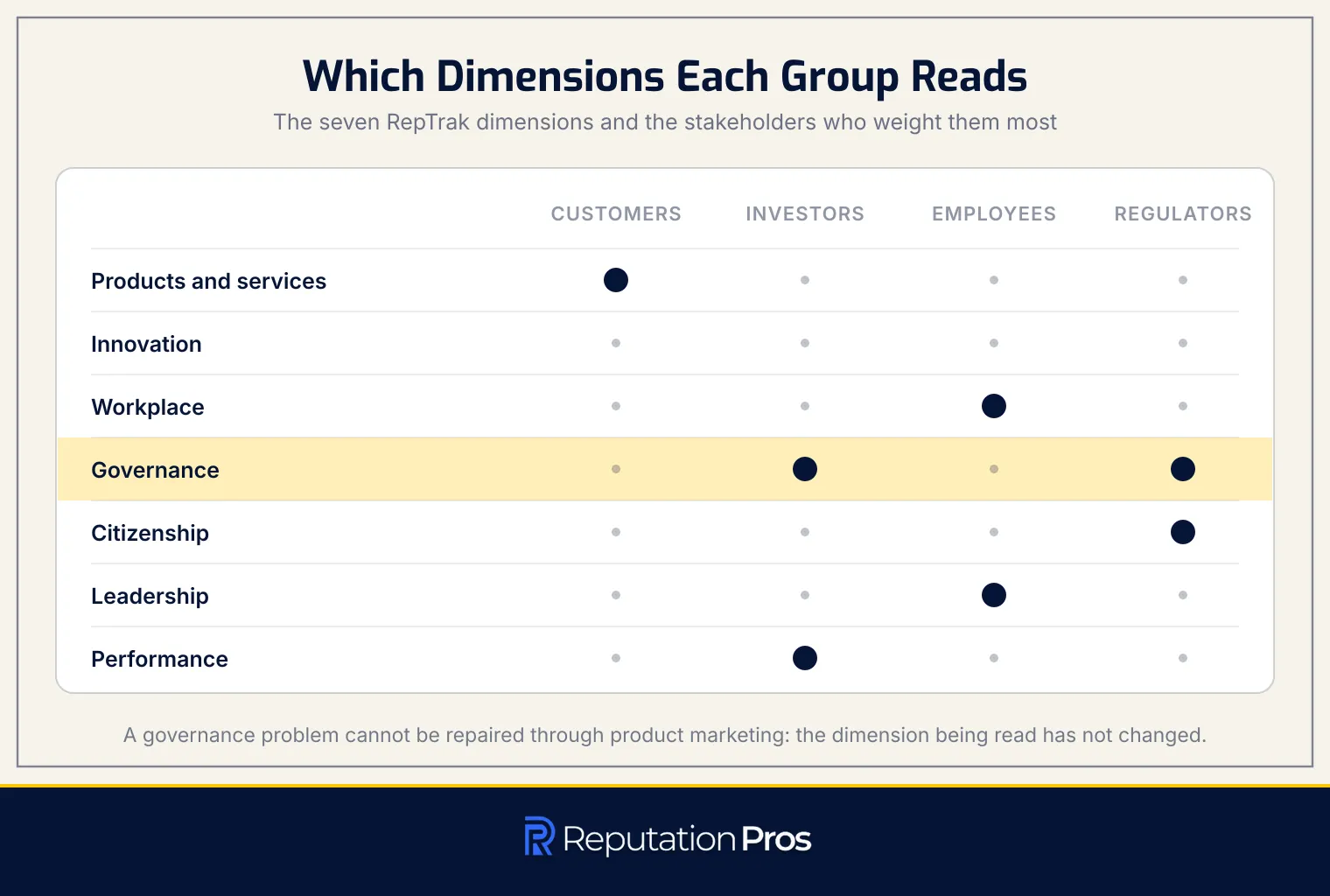
Stakeholders weight the dimensions according to their exposure. Customers weight products and services most heavily, investors weight performance and governance, employees and candidates weight workplace and leadership, and regulators weight governance and citizenship.
Reading the weighting changes where effort goes. A company with a governance problem cannot repair investor standing through product marketing, because the dimension the investor is reading has not changed.
How Does Brand Reputation Translate Into Financial Value?
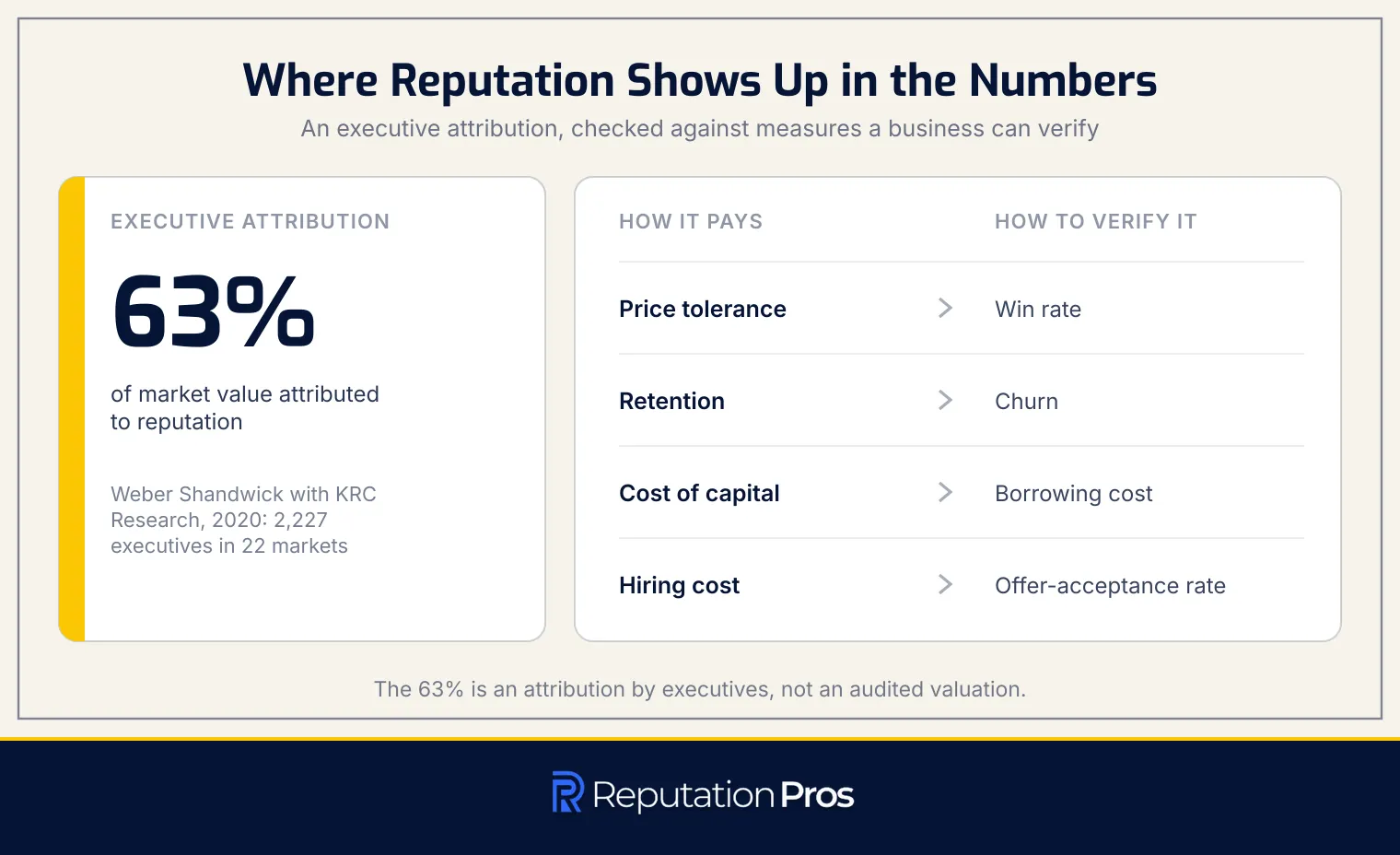
Brand reputation translates into financial value through price tolerance, retention, cost of capital and hiring cost. Each is a measurable commercial effect of a judgement held outside the company.
The executive view puts the figure at 63% of market value, per Weber Shandwick and KRC Research. That figure is an attribution by executives rather than an audited valuation, so it indicates how central reputation is held to be rather than supplying a line item, and it is best read alongside the operational measures a business can verify itself: churn, win rate, offer-acceptance rate and borrowing cost.
What Common Mistakes Weaken Stakeholder Trust?
The mistakes that weaken stakeholder trust are listed below:
- Managing one group and neglecting the rest: Customer-facing reputation work that ignores the workforce leaves a problem to surface through employee review platforms.
- Communicating after the fact: Stakeholders who learn of a problem from a third party discount every later statement.
- Treating a reputation event as a messaging task: A disclosure or product failure answered with communication alone recurs.
- Inconsistency between audiences: Telling investors and employees different versions of the same situation comes to light, because the audiences overlap.
- Measuring sentiment but not behaviour: Favourable sentiment alongside rising churn or falling offer acceptance means the measurement is reading the wrong group.
- Leaving the public record stale: Outdated or inaccurate information in the sources stakeholders check becomes the default answer.
How Do You Protect Brand Reputation Across Every Stakeholder Group?
- Map which dimension each group is reading Protection starts with knowing whether a group is judging governance, workplace or products, since the evidence that reassures one does not reach another.
- Monitor each group’s own channels Customers appear on review platforms, employees on employer review sites, investors in analyst commentary, so a single listening setup covering only social media misses most of the picture.
- Fix the dimension, not the mention A recurring complaint is an operational signal, and addressing the published version without the cause produces the same complaint again.
- Keep the authoritative record accurate The sources stakeholders check first, including search results and reference pages, carry disproportionate weight because they are read before anything the company publishes.
- Report movement in behaviour Retention, offer acceptance, partner renewals and borrowing cost confirm whether reputation work is reaching the groups it was meant to reach.
How Does Brand Protection Monitoring Defend Stakeholder Confidence?
Brand protection monitoring defends stakeholder confidence by detecting the signals that precede a visible problem. Trademark misuse, impersonation accounts, leaked material and coordinated criticism each appear before the stakeholder consequence does.
Early detection changes the available response. A problem found while it is confined to one channel can be addressed before investors, candidates and partners encounter it, which is the difference between a contained incident and a reputation event all groups have already read.
How Does Brand Reputation Management Preserve Stakeholder Value?
Brand reputation management preserves stakeholder value by keeping the public record accurate for every group that consults it. Reputation Pros audits what each stakeholder group currently finds, addresses the material driving an inaccurate judgement, and builds the verifiable content that answers the dimension each group is reading.
The work is continuous rather than episodic. Reputation is re-formed each time a stakeholder searches, so the value preserved is the accuracy of what they find at the moment of a decision, not the outcome of a past campaign.
How Does Stakeholder Importance Fit Into Brand Reputation as a Whole?
Stakeholder importance is the structure underneath brand reputation rather than a subdivision of it. Reputation exists only as the judgements particular groups hold, so a general reputation score is an average across audiences that each need something different.
How Does Corporate Reputation Move Stock Price and Investor Relations?
Corporate reputation moves stock price by changing the perceived probability of future problems. Investors reprice on governance and leadership signals because those dimensions predict the likelihood of a loss that has not happened yet, which is why a reputation event can move a valuation while current earnings are unchanged.
How Does Reputation Affect Employee Recruitment and Retention?
Reputation affects recruitment and retention by determining who applies and who stays. A company with a weak employer reputation receives fewer qualified applications and pays more to close the ones it does receive, and the same public record that deters candidates reaches employees deciding whether to remain.
How Do Negative Reviews Cut Revenue From Customers?
Negative reviews cut revenue by removing the company from consideration before a sales conversation starts. The customer who reads a pattern of complaints does not complain or negotiate; they select a competitor, which makes the loss invisible in the company’s own data and visible only in win rate.
How Do Stakeholders Judge Reputation Beyond Quarterly Performance?
Stakeholders judge reputation beyond quarterly performance because the questions they are asking are about durability. Results report what happened; governance, workplace and citizenship indicate whether it will continue.
How Does Reputation Affect Company Valuation?
Reputation affects company valuation by carrying expectations that current results do not. Executives attribute 63% of market value to it, and the mechanism is the discount or premium investors apply to future earnings based on how likely they judge a disruption to be.
What Is Employer Reputation and Why Does It Count for Stakeholders?
Employer reputation is the standing a company holds as a place to work, formed from employee accounts, review platforms and the visible treatment of staff. It counts beyond hiring because it is read as evidence about management: a stakeholder who sees a company treat its employees badly draws conclusions about how it treats customers and partners.
How Does ESG Performance Shape Corporate Reputation?
ESG performance shapes corporate reputation through the citizenship and governance dimensions, which investors, regulators and candidates all read. Environmental and social conduct functions as a forward indicator, since a company that manages those exposures badly is judged more likely to produce a future failure.
How Does Corporate Social Responsibility Affect Brand Reputation?
Corporate social responsibility affects brand reputation when the activity is connected to the business rather than adjacent to it. Programmes that address a company’s actual impact are read as accountability, while programmes unconnected to the operation are read as presentation, and the second kind damages the governance dimension it was meant to support.
Why Does Brand Reputation Ultimately Belong to Its Stakeholders?
Brand reputation belongs to its stakeholders because they hold it. A company controls its conduct, its disclosures and its products, but the judgement formed from those is assembled by customers, investors, employees, partners, regulators and analysts out of evidence they gather themselves.
That is what makes the importance of brand reputation to stakeholders a management question rather than a communications one. The only durable way to change the judgement is to change what each group finds when it looks, which means reputation work runs through the operation and the public record together.