8 Different Ways and Tools for Monitoring Online Reputation
 17 min read
 On this page
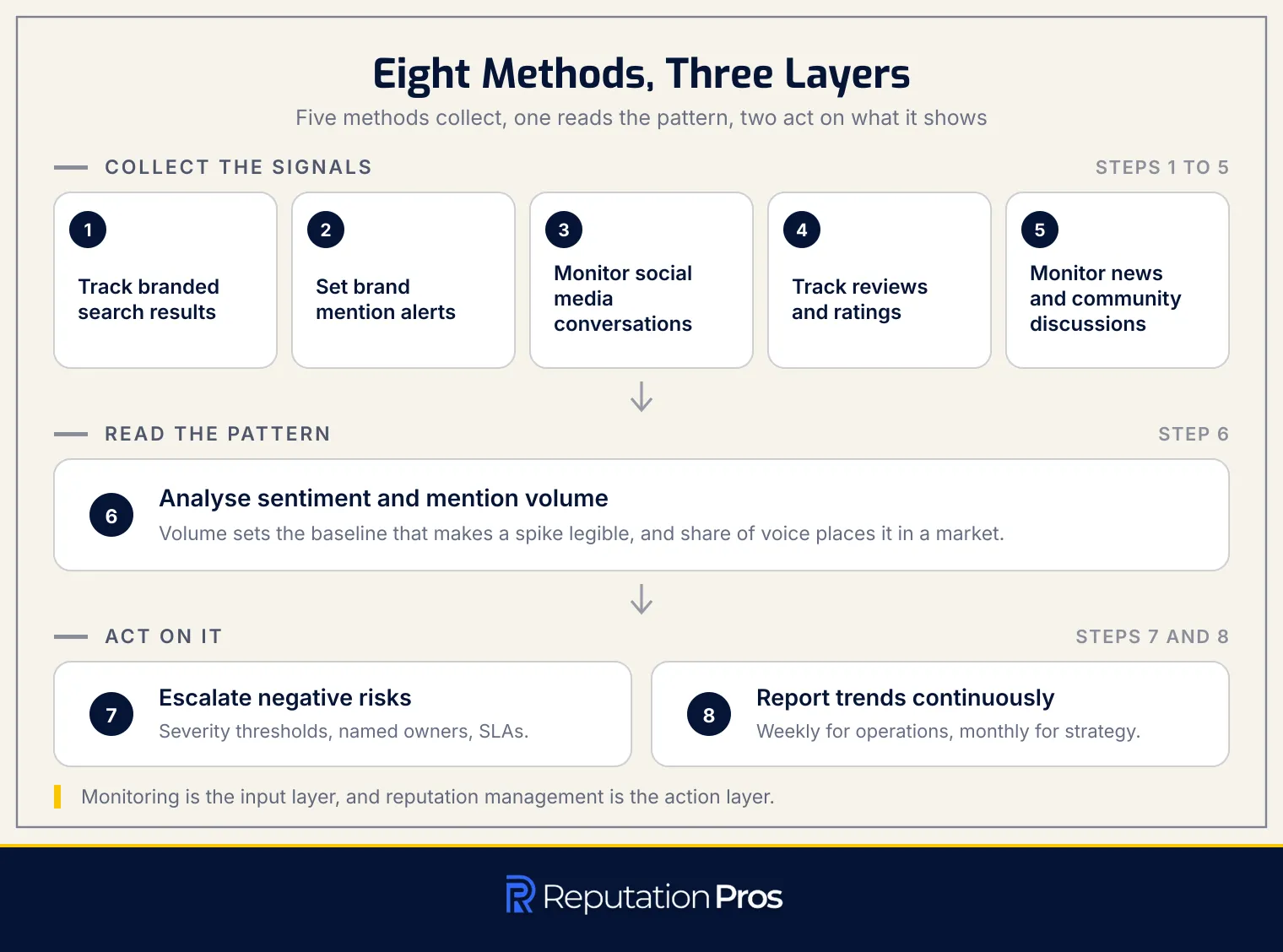
Eight methods monitor online reputation: tracking branded search results, setting brand mention alerts, monitoring social media conversations, tracking reviews and ratings, monitoring news and community discussions, analysing sentiment and mention volume, escalating negative reputation risks, and reporting reputation trends continuously. Online reputation monitoring is the continuous collection of brand-related signals across owned and third-party channels, covering brand and product names, executive names, customer feedback, social conversations, and press coverage.
The first five methods each cover a distinct source. Branded search results show what appears when someone searches the company. Mention alerts catch references across the web. Social conversations surface what people say on platform. Reviews and ratings aggregate customer feedback across sites. News and community discussions expose emerging issues in press outlets and forums. What those five collect then feeds sentiment and mention-volume analysis, which flags abnormal spikes, and escalation routes the negative ones to the team that can resolve them.
Monitoring methods split into manual and automated. Manual work covers incognito branded searches and direct platform checks; automated work runs through social listening platforms and review aggregators. Monitoring is the input layer and reputation management is the action layer, which is the distinction that decides what a monitoring programme is responsible for. Continuous monitoring builds trust because consumers consult reviews and public signals before they buy. The eight-way framework starts with what sits on page one of a branded search.
1. Track branded search results
Tracking branded search results means checking what appears on page one for the brand name and for brand-modifier queries such as “brand + reviews,” “brand + complaints,” and “brand + scam.” Running those searches in incognito mode or logged out strips personalisation, which is what makes the result resemble what the public sees.
Page one carries the weight. Record the position and nature of owned properties, including the official website, social profiles, and the Google Business Profile, alongside third-party results such as review sites, news articles, forum threads, and competitor mentions. Advanced search operators refine a query to surface recent mentions or results from one domain.
Cadence decides whether the tracking catches anything. Weekly suits most brands, and daily suits a brand in crisis or in a contested market. Logging position changes over time shows which results gain and lose visibility, and two shifts matter most: negative third-party content climbing, and owned assets losing ground, which is what a branded search strategy is built to hold.
Manual search checking has limits. Checking by hand consumes time, captures a snapshot rather than continuous coverage, and cannot alert anyone the moment new content appears, which is what alerting systems exist to solve.
2. Set brand mention alerts
Setting brand mention alerts starts with the term list: brand name, common misspellings, product names, executive names, relevant hashtags, and competitor terms. A term list built that way captures the full span of relevant conversation instead of the obvious half.
Alert frequency scales to brand size and expected mention volume. High-traffic brands need real-time or hourly alerts; smaller businesses take daily or weekly digests, which prevents the alert fatigue that makes people stop reading them. Google Alerts, Talkwalker Alerts, Mention, and Brand24 all serve this function, with free options covering indexed web pages and news articles and paid options extending across social platforms, blogs, forums, and review sites.
Free alerting services carry real coverage gaps, above all across social platforms and closed communities. Alerts work as an early-warning layer rather than a complete one, since they miss untagged social conversation and anything posted inside a closed platform, which is why alerting pairs with manual search rather than replacing it.
3. Monitor social media conversations
Monitoring social media conversations means tracking tagged and untagged mentions, hashtags, and comments across platforms. The aspects that make up social monitoring are listed below:
- Tagged versus untagged mentions: untagged mentions, where someone names a brand without linking it, account for most genuine discussion and are the ones native tools miss.
- Hashtags: branded and campaign hashtags capture conversation that never names the account.
- Post and ad comments: comments on organic posts and on paid advertisements both carry public perception.
- Platform breadth: X, Instagram, Facebook, LinkedIn, TikTok, YouTube, and Reddit each host a different part of the conversation.
- Real-time versus scheduled review: real-time review suits brands carrying high reputational risk, and a scheduled pass suits lower-volume brands.
- Native platform notifications: native notifications under-report, surfacing tagged interactions and little else, which is the gap dedicated social listening tools fill.
4. Track reviews and ratings
Tracking reviews and ratings means centralising feedback from every platform into one dashboard. Reviews from Google Business Profile, Yelp, Trustpilot, G2, and app stores aggregate into a platform such as Birdeye or ReviewTrackers, which makes rating average and review velocity readable in one place. Review velocity, the rate at which new reviews arrive, moves before the average does: a sudden spike in volume signals an emerging issue or a successful campaign while the star rating still looks unchanged.
New-review alerts close the gap between a review appearing and a team seeing it. Responding demonstrates the brand reads its feedback, which changes how later readers interpret both the review and the reply.
Review tracking includes detecting fake and suspicious reviews, recognisable through generic language, unusual posting patterns, and profiles with no review history. Fake reviews distort the rating and breach platform policy, which makes them reportable rather than just irritating. ReviewTrackers and Birdeye supply review request workflows, response templates, and location-level reporting for multi-site brands, and Reputology analyses review patterns to surface recurring issues that need an operational fix rather than a reply.
5. Monitor news and community discussions
Monitoring news and community discussions means tracking press and broadcast coverage, scanning forums and community threads, and following industry blogs. The three source types are listed below:
- Press and broadcast coverage: news articles and broadcast segments naming the brand, which carry the earliest signal of an issue reaching a wide audience.
- Forums and community threads: Reddit and Quora hold unfiltered customer sentiment and show a narrative forming before it reaches the press.
- Industry blogs: trade blogs discuss trends and issues ahead of mainstream coverage.
Media monitoring and social listening cover different ground. Media monitoring captures editorial content and journalist-led stories across news and broadcast. Social listening captures user-generated content across social platforms. Google News, Reddit, Quora, and trade press outlets are the core sources, and platforms including Meltwater, Cision, and Brandwatch deliver alerting and coverage across them. Scattered mentions read as measurable patterns once they are tracked together, which is what turns individual posts into a reputation direction.
6. Analyze sentiment and mention volume
Analysing sentiment and mention volume means classifying mentions as positive, neutral, or negative to read public perception across channels. Sentiment tools now reach past binary polarity into emotion categories such as anger, joy, and trust, which separates an annoyed customer from an angry one.
Mention volume measures how often a brand is discussed over time and establishes the baseline that makes a spike legible. A sudden spike signals a viral campaign, a crisis, or a product launch. Share of voice measures a brand’s conversation volume against competitors, which places the number in a market rather than in isolation.
Trend lines show whether sentiment is improving or declining and whether a reputation initiative moved anything. Net Promoter Score and Customer Satisfaction scores add direct customer feedback alongside the passive signals, which is how reputation gets measured rather than just observed. An abnormal shift in sentiment or volume triggers the evaluation of which signals warrant action.
7. Escalate negative reputation risks
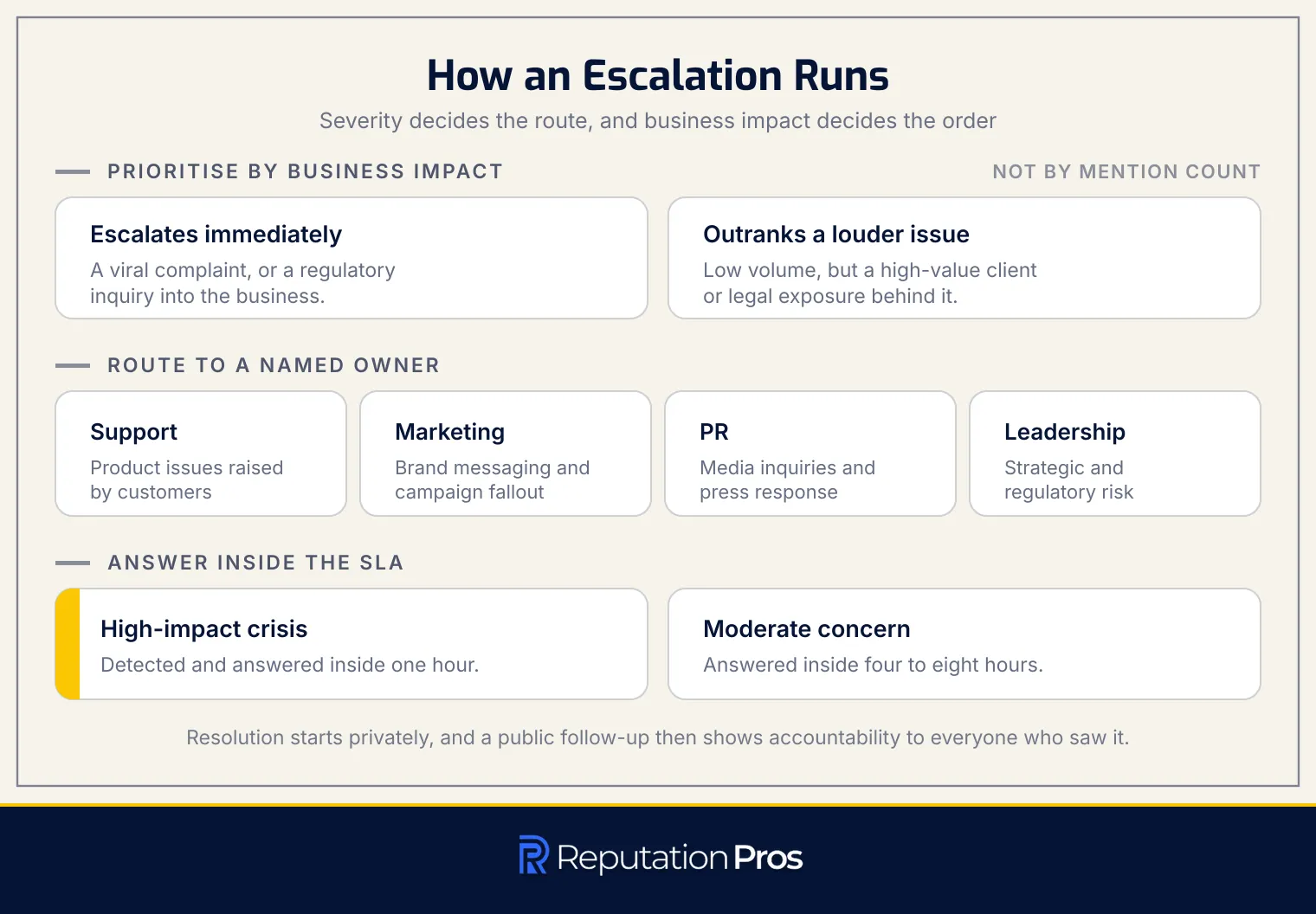
Escalating negative reputation risks means setting severity thresholds that trigger a response and prioritising by business impact rather than mention volume.
Severity thresholds and prioritisation. Severity thresholds decide when an issue escalates. A viral complaint or a regulatory inquiry demands immediate attention, while a low-volume issue touching a high-value client or carrying legal exposure outranks a high-volume one that touches neither. Prioritising by potential business impact rather than mention count is what keeps the loudest issue from displacing the most damaging one.
Cross-functional ownership and response SLAs. Escalation needs named owners: support for product issues, marketing for brand messaging, PR for media inquiries, and leadership for strategic risk. Each issue carries a response SLA setting the maximum time between detection and action, with a high-impact crisis inside an hour and a moderate concern inside four to eight hours. Pre-approved response templates hold consistency and compliance when the clock is short.
Resolution and reporting. Resolution starts privately, through a direct message or an email, and a public follow-up then demonstrates accountability to everyone who saw the original complaint. Every escalation and outcome gets logged with its response time and closure, and that log feeds the reporting cycle.
8. Report reputation trends continuously
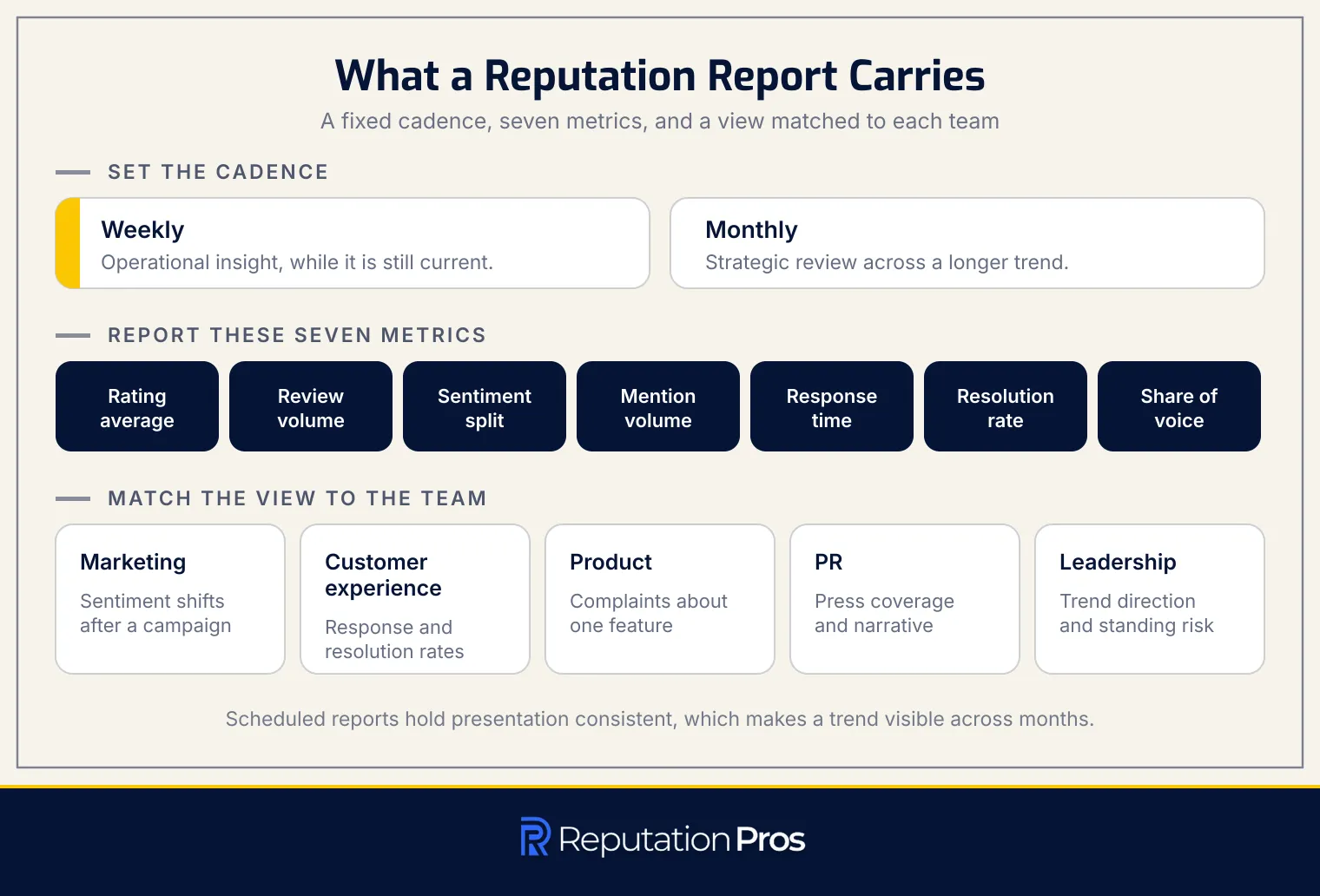
Reporting reputation trends continuously means running a fixed reporting cadence, weekly for operational insight and monthly for strategic review. A report carries rating average, review volume, sentiment split, mention volume, response time, resolution rate, and share of voice against competitors.
Dashboards and scheduled reports distribute those numbers to marketing, customer experience, product, PR, and leadership. Matching each view to the department makes the data actionable: a recurring complaint about one product feature belongs with the product team, and a sentiment spike after a campaign belongs with marketing.
Continuous reporting creates accountability and makes decisions traceable to evidence. Scheduled automated reports cut manual effort and hold presentation consistent, which is what makes a trend or an anomaly visible across months rather than within a single week.
What is online reputation monitoring?
Online reputation monitoring is the continuous collection of brand-related signals across owned and third-party channels. Online reputation monitoring functions as the input layer for reputation management, gathering data rather than acting on it. The signals collected span mentions, reviews, ratings, search results, social conversations, news coverage, and sentiment indicators. Those signals supply the intelligence a team needs to read brand perception, spot risk, and decide on a response.
What does online reputation monitoring track?
Online reputation monitoring tracks seven signal types, listed below:
- Mentions: brand names, product names, executive names, and related keywords across web content, tagged or untagged.
- Reviews and ratings: star ratings, written reviews, and customer feedback on Google Business Profile, Yelp, Trustpilot, G2, app stores, and sector-specific review sites.
- Search results: branded search positions and page-one content for brand queries, including modifier queries such as “brand + reviews” and “brand + complaints.”
- Social conversations: posts, comments, hashtags, and tagged and untagged mentions across X, Instagram, Facebook, LinkedIn, TikTok, YouTube, and Reddit.
- News coverage: press mentions, broadcast coverage, industry blog posts, and editorial content from news outlets and publishers.
- Sentiment: positive, neutral, and negative classification, emotion categories, polarity scoring, and sentiment trends over time.
- Competitor comparison: share of voice, comparative mention volume, sentiment benchmarking, and competitive positioning across the same channels and keywords tracked for the brand.
How does monitoring differ from reputation management?
Monitoring differs from reputation management in purpose: monitoring observes and measures, and management intervenes and changes. The differences are set out below.
| Dimension | Online Reputation Monitoring | Online Reputation Management |
|---|---|---|
| Purpose | Observes and measures brand perception across digital channels | Shapes and improves brand perception and search visibility |
| Activity Type | Observation, listening, tracking, and analysis | Intervention, response, content publishing, and SEO actions |
| Typical Actions | Logging brand mentions, tracking sentiment, and generating reports | Responding to reviews, suppressing negative content, and crisis management |
| Output | Alerts, dashboards, and trend reports | Improved ratings and stronger brand trust |
Monitoring supplies the data reputation management acts on, which is what lets a management team prioritise actions and allocate resources against evidence rather than instinct.
Which online sources should brands monitor?
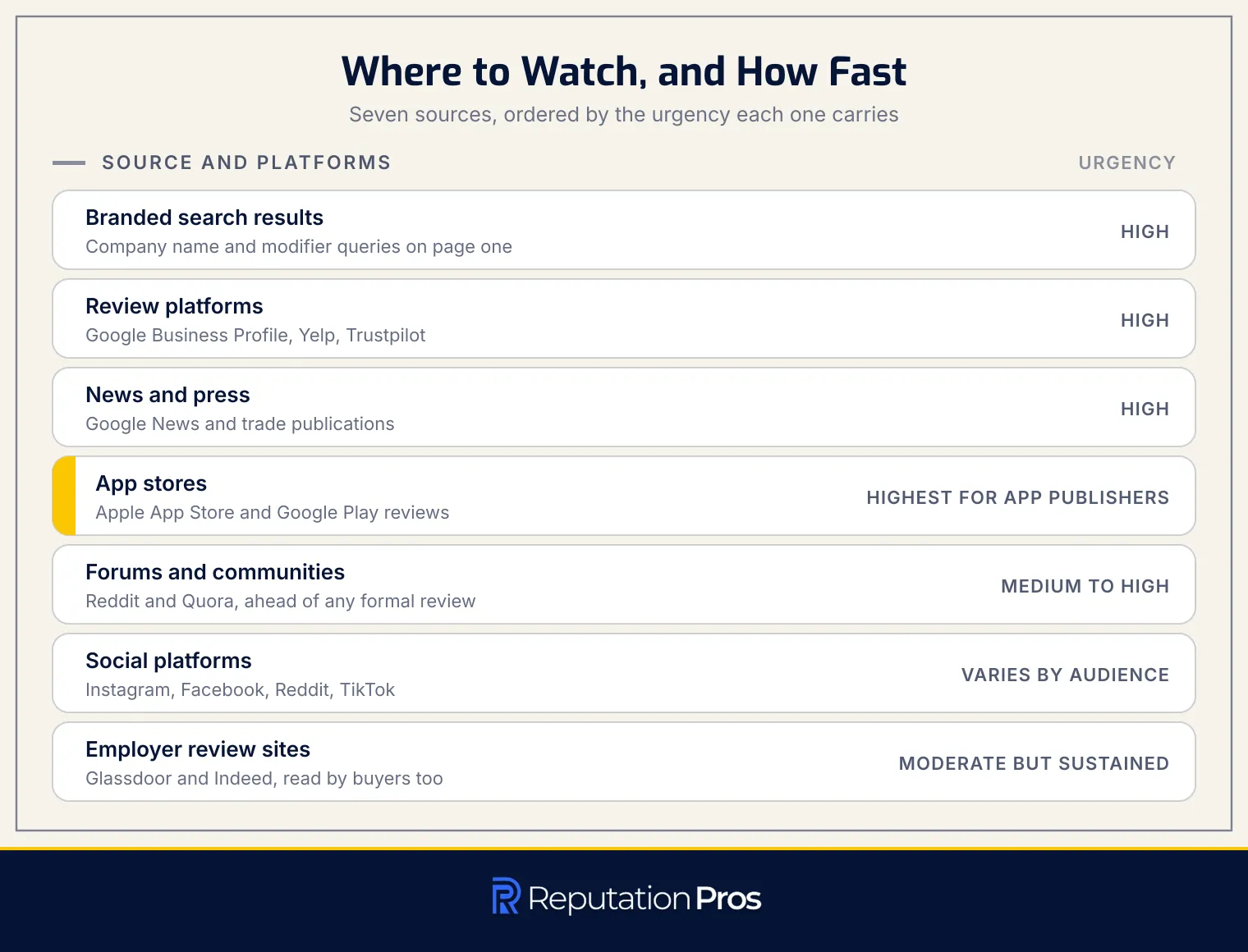
The online sources brands should monitor are listed below, each carrying a different signal and a different urgency:
- Branded search results: page-one listings for the company name and modifier queries, carrying high urgency because they form the first impression that shapes a purchase decision.
- Review platforms: Google Business Profile, Yelp, and Trustpilot carry customer satisfaction signals, at high urgency because a new negative review affects conversion immediately.
- Social platforms: Instagram, Facebook, and Reddit host real-time conversation and customer service issues, at an urgency that varies by audience, with TikTok and Instagram shaping perception among younger buyers.
- News and press: Google News and trade publications carry editorial coverage at high urgency, because press coverage moves public perception and then triggers social discussion.
- Forums and communities: Reddit and Quora hold early-stage complaints and troubleshooting threads at medium to high urgency, since they surface issues before formal reviews do.
- Employer review sites: Glassdoor and Indeed carry workplace culture signals at moderate but sustained urgency, affecting recruiting and perceived stability.
- App stores: app store reviews expose user experience and technical problems, at the highest urgency for app publishers because ratings drive downloads and retention.
Source priority shifts with business model. Local businesses lead with Google Business Profile and reviews, e-commerce brands with social and review platforms, B2B SaaS companies with review sites and industry press, and app publishers with app store ratings.
What are manual reputation monitoring methods?
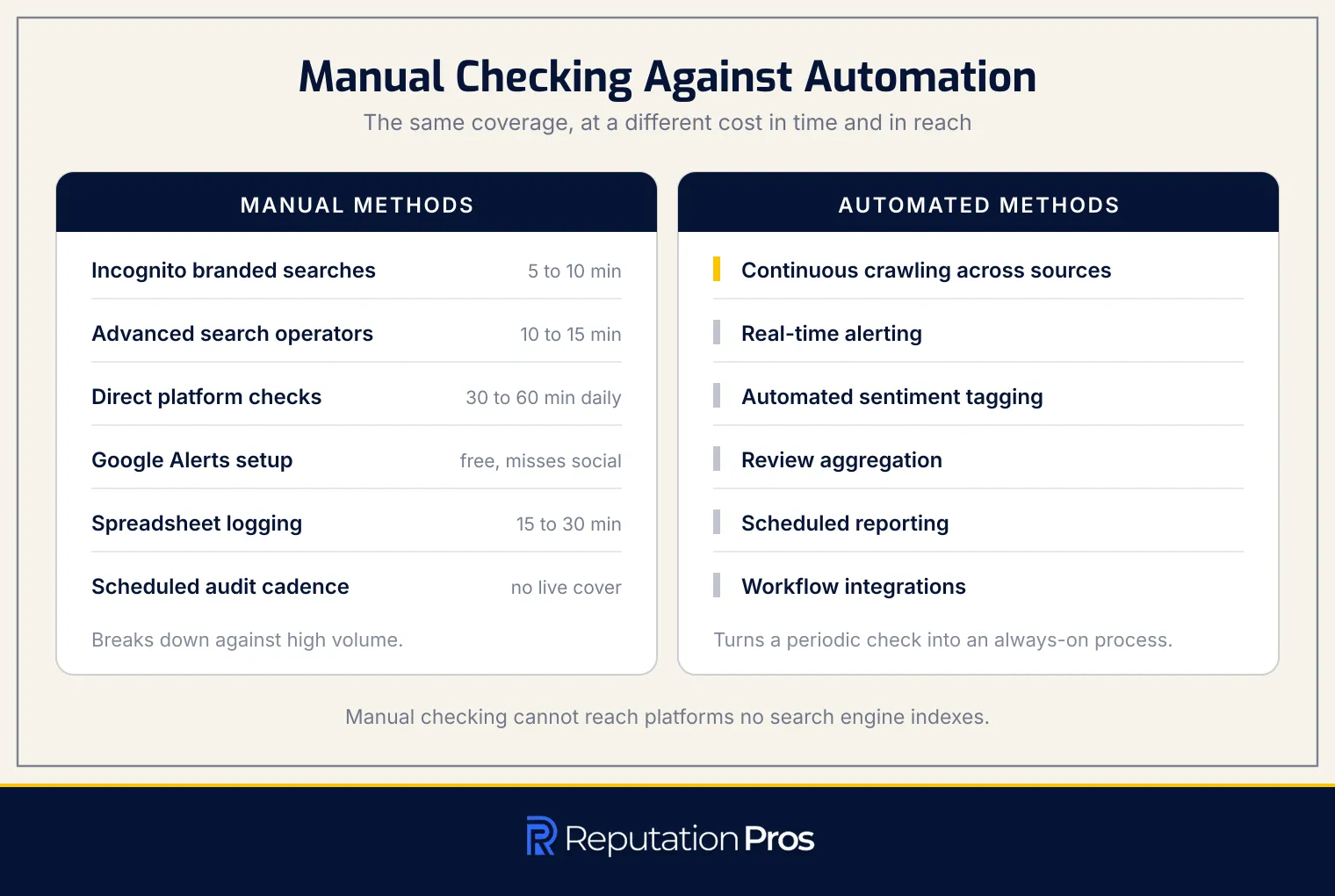
The manual reputation monitoring methods are listed below, each trading time for one kind of insight:
- Incognito branded searches: a private browser window searching the brand name with modifiers such as “reviews,” “complaints,” or “scam” returns the non-personalised result a prospective customer sees, at 5-10 minutes per search.
- Advanced search operators: Google commands including site:, inurl:, and -site: find mentions on named domains or exclude owned properties, at 10-15 minutes per session for someone who knows the syntax.
- Direct platform checks: logging into Google Business Profile, Yelp, and the social platforms captures the platform-only content no crawler indexes, at 30-60 minutes daily.
- Google Alerts setup: relevant terms entered into Google Alerts return email notification of new indexed mentions at no cost, missing social posts and requiring someone to read the inbox.
- Spreadsheet logging: review text and sentiment entered by hand tracks trends over time, at 15-30 minutes per session, and becomes unmanageable as the data grows.
- Scheduled audit cadence: fixed intervals for search and platform checks hold monitoring consistent, without the real-time coverage that catches an urgent issue on the day it appears.
Manual monitoring breaks down against high volume, against the need for real-time alerting, and against mentions on platforms no search engine indexes.
What are automated reputation monitoring methods?
The automated reputation monitoring methods are listed below:
- Continuous crawling across sources: systematic scanning of platforms and channels captures brand signals as they appear.
- Real-time alerting: notifications reach the team the moment a mention, review, or conversation lands.
- Automated sentiment tagging: classification of mentions as positive, neutral, or negative without human review, which makes tone readable at volume.
- Review aggregation: reviews from Google Business Profile, Yelp, Trustpilot, and elsewhere collect into a single dashboard rather than requiring a check on each platform.
- Scheduled reporting: daily, weekly, or monthly summaries of reputation metrics, sentiment trends, and mention volumes reach stakeholders without anyone compiling them.
- Workflow integrations: mentions push into existing support and CRM systems, so anything needing a response arrives with the team responsible for making it.
Automation turns reputation monitoring from a periodic check into an always-on process.
What types of tools are used to monitor online reputation?
The tool categories used to monitor online reputation are set out below.
| Tool Category | What It Monitors | Core Features | Typical Pricing Model |
|---|---|---|---|
| Social Listening | Brand mentions in social networks, forums, blogs, and broader online conversation | Keyword and hashtag tracking, untagged mention capture, sentiment analysis, share of voice, competitor benchmarking, trend detection | Subscription-based, with higher tiers for broader coverage and deeper analytics |
| Media Monitoring | News coverage, press mentions, editorial content, and broadcast coverage | Source scanning, journalist and outlet tracking, alerting on breaking coverage, earned-media reporting | Subscription-based, often priced by volume, geography, or source breadth |
| Review Management | Reviews and ratings across Google, Yelp, Trustpilot, app stores, and sector review sites | Review aggregation, response workflows, response templates, review request generation, location-level reporting | SaaS subscription, often priced per location, per seat, or by review volume |
| Search and SERP Visibility Tracking | Branded search results and page-one content for brand queries | SERP tracking, rank changes, owned-versus-third-party result monitoring, keyword visibility reporting | Subscription-based, sometimes bundled with SEO platforms or ORM suites |
| All-in-One ORM Suites | A combined view across social, news, reviews, and search | Unified dashboards, automated alerts, sentiment tagging, reporting, workflow integrations, multi-user access | Higher-priced SaaS or enterprise contracts, often custom-quoted |
Free options cover basic alerting across a narrow set of source types. Paid tools add real-time alerts, sentiment analysis, broader coverage, reporting, integrations, and multi-user collaboration. The right choice follows from coverage breadth, alert speed, analytics depth, reporting needs, integrations, and whether several teams need shared access. The best tools for online reputation monitoring divide along exactly those lines.
What are social listening tools for reputation monitoring?
Social listening tools capture untagged brand mentions across social platforms and the wider web. Boolean keyword and hashtag queries let them track conversation that never tags the brand account, which is where most honest opinion sits.
Social listening tools score sentiment, classifying mentions as positive, negative, or neutral, and measure share of voice as a percentage of industry conversation. Competitor benchmarking places a brand against rivals on the same measures, and trend detection surfaces emerging topics early enough to respond. Brandwatch, Sprout Social, Talkwalker, Brand24, Mention, and Hootsuite each occupy this category with a different balance of coverage and analysis.
What are review monitoring and management tools?
Review monitoring and management tools centralise customer reviews from multiple platforms into one dashboard, removing the manual check on each site. Their features are listed below:
- Multi-platform review aggregation: reviews collect automatically from every connected source.
- Review request and generation: automated prompts ask satisfied customers for feedback, which raises review volume and lifts the average.
- Response workflows and templates: pre-approved templates and custom replies go out from the dashboard rather than platform by platform.
- Location-level reporting: multi-site brands see review performance by location, which isolates the branch causing a drop.
- Leading platforms: Google Business Profile, Birdeye, and ReviewTrackers carry the fullest feature sets in this category.
How does monitoring support online reputation management?
Monitoring supports online reputation management by converting raw signals into the evidence a response runs on. Continuous monitoring lets a team answer reviews and mentions while they are current, resolve complaints before they escalate, and carry positive coverage further while it still has reach. Monitoring identifies the root cause behind recurring negative signals, which turns a pattern of complaints into a product, service, or communication fix rather than a series of individual replies.
Acting on monitoring output consistently is what builds reputation into an asset. A 2017 Marketing Science study by Davide Proserpio and Georgios Zervas, “Online Reputation Management: Estimating the Impact of Management Responses on Consumer Reviews,” measured that effect directly: comparing hotels on TripAdvisor, where management responds, against Expedia, where it almost never does, the researchers found that hotels which start responding see their ratings rise, because customers with a poor experience become less likely to leave a negative review once they can see the business replying. A brand that resolves what its monitoring surfaces accumulates the public record that shapes purchasing decisions and customer loyalty. That accumulation is what online reputation management sets out to build.
How can continuous online reputation monitoring strengthen trust?
Continuous online reputation monitoring strengthens trust by letting a brand respond promptly and consistently to what customers say in public. Reviews carry that weight directly: 97% of consumers read online reviews when deciding about a local business, 85% become more likely to use a business after reading positive reviews, and 77% are put off by negative ones, according to BrightLocal’s Local Consumer Review Survey 2026. The same survey found that 74% of consumers check at least two review sites before deciding, which is why monitoring one platform leaves most of the decision unobserved.
Response speed is the part monitoring controls. A complaint answered while it is still the top result reads differently from the same complaint answered a month later, and the reply is visible to every later reader rather than only to the reviewer. Sustained, visible responsiveness is what converts monitoring from a measurement exercise into the record that earns trust.