What is Customer Perception? Importance for Brand Reputation
 12 min read
On this page
Customer perception is how customers interpret, evaluate, and feel about a brand, product, or service. An individual customer’s perception reflects personal beliefs and reactions, while brand perception describes the broader impression people form from a brand’s identity, communications, and reputation, and customer expectation describes what customers anticipate before or during an interaction. Direct use, service encounters, advertising, pricing, word of mouth, and online reviews shape perception across three main types: perceived product quality, perceived value, and perceived service quality.
Customer perception matters for brand reputation because perception influences buying decisions, loyalty, recommendations, and willingness to forgive mistakes. Online reviews make individual experiences visible to potential customers. Businesses measure perception through satisfaction surveys, Net Promoter Score, customer-effort scores, interviews, review analysis, social listening, repeat purchases, churn, and sentiment analysis. Repeated perceptions of dependable products, transparent pricing, or responsive support shape a brand’s market position, while businesses improve negative perceptions by identifying problems, fixing customer experiences, communicating changes, and collecting follow-up feedback.
Negative customer perception becomes a reputation problem when unfavorable experiences repeat, gain visibility, or suggest a broader pattern. Social listening detects emerging complaint themes, sentiment changes, and spreading mentions, while business reputation management addresses underlying service issues and responds with accurate, consistent communication. Online ratings, review themes, review volume and recency, social mentions, search suggestions, complaint topics, referral behavior, and changes in conversion or retention reveal how customers perceive a brand. Brand image represents the mental picture people hold, while reputation scores summarize selected public signals; together, those signals lead back to the starting point of brand reputation: how customers interpret, evaluate, and feel about a brand.
What Is Customer Perception?
Customer perception is the collection of beliefs, feelings, judgments, and associations a customer forms about a company, product, service, or experience. A customer’s perception reflects how the customer interprets what they encounter, rather than what a business claims to offer. Customers form perceptions through product use, service interactions, advertising, word of mouth, and online content. Personal needs and past experiences shape those judgments, so two customers can interpret the same offer differently. Customer perception is frequently confused with brand perception and customer expectation, two related terms with distinct meanings.
How Does Customer Perception Differ From Brand Perception?
Customer perception differs from brand perception in scope: customer perception reflects one customer’s impressions, beliefs, and feelings about a company, product, or service, while brand perception describes how the wider public views the brand. Direct experiences with product performance, pricing, customer service, and post-purchase support shape the individual customer’s view. Brand perception reflects the views of customers, prospects, and other stakeholders, the wider public around a brand. Individual customer perceptions contribute to brand perception, while advertising, social media, news coverage, and word of mouth shape public views of a brand even among people who have never bought from the company.
How Does Customer Perception Differ From Customer Expectation?
Customer perception differs from customer expectation in timing: customer perception evaluates what a customer actually experienced, while customer expectation describes the performance the customer anticipated. The SERVQUAL scale measures perceived service quality by comparing customers’ perceptions of the service received with their expectations, according to “SERVQUAL: A Multiple-Item Scale for Measuring Consumer Perceptions of Service Quality” by A. Parasuraman, Valarie Zeithaml, and Leonard Berry, published in the Journal of Retailing, Spring 1988.
How Does Customer Perception Form?
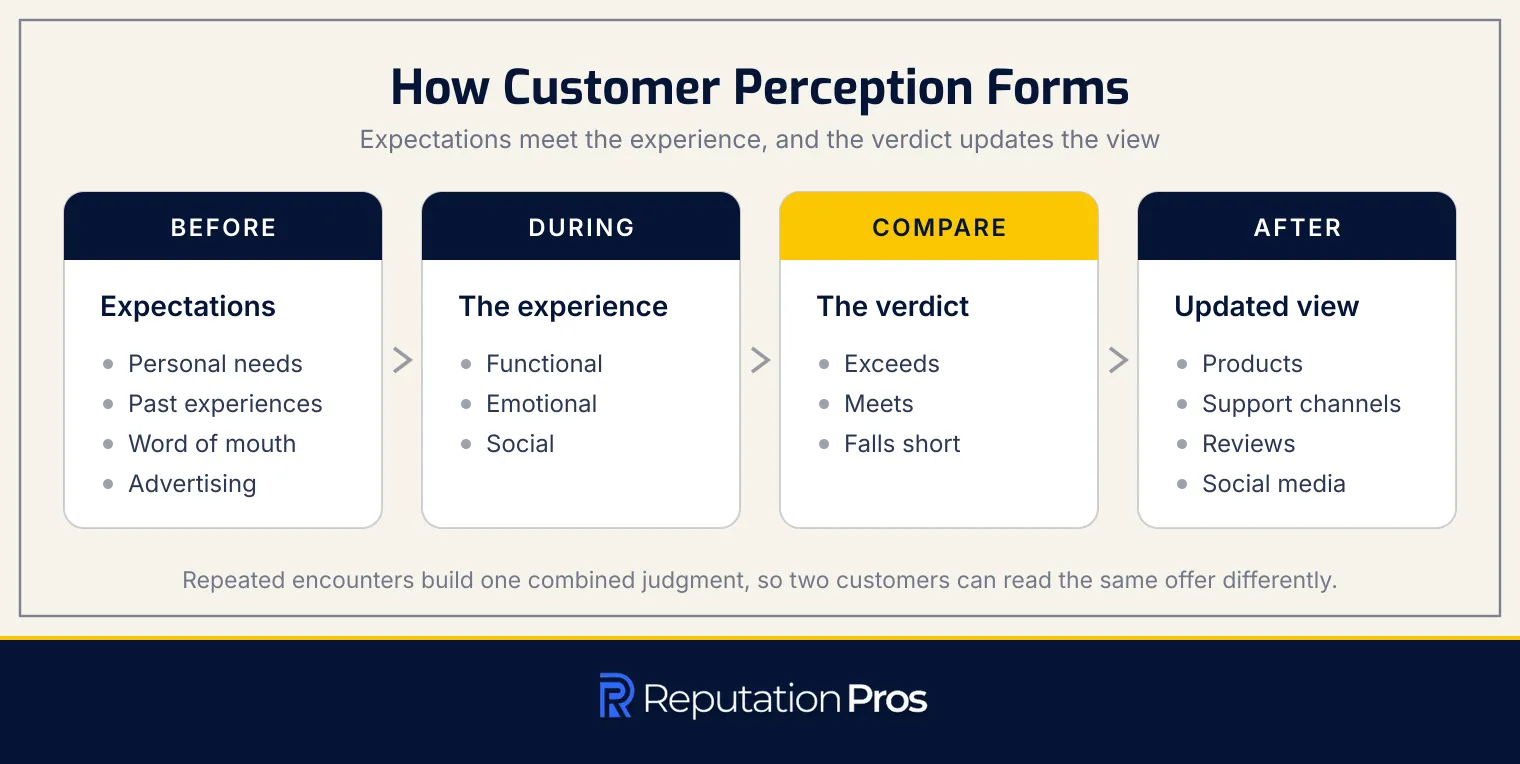
Customer perception forms as customers interpret interactions with a business, product, or service. Before each interaction, customers bring expectations shaped by personal needs, past experiences, word of mouth, advertising, and other brand communications. During and after an interaction, customers compare those expectations with the functional, emotional, and social aspects of the experience. A customer updates the view of the brand when an experience meets, exceeds, or falls short of expectations, and repeated encounters across products, websites, employees, support channels, stores, reviews, and social media build a combined judgment. Four factors carry the most weight in those repeated encounters.
Which Factors Shape Customer Perception?
The four core factors that shape customer perception are listed below:
- Product or service quality shapes judgments through reliability, performance, usability, and consistency.
- Price and perceived value reflect how customers compare costs with benefits, usefulness, and affordability.
- Customer experience and service shape perception through convenience, responsiveness, support, and problem resolution.
- Brand communication and public feedback influence judgments through advertising, brand values, recommendations, online reviews, and social media.
What Are the Types of Customer Perception?
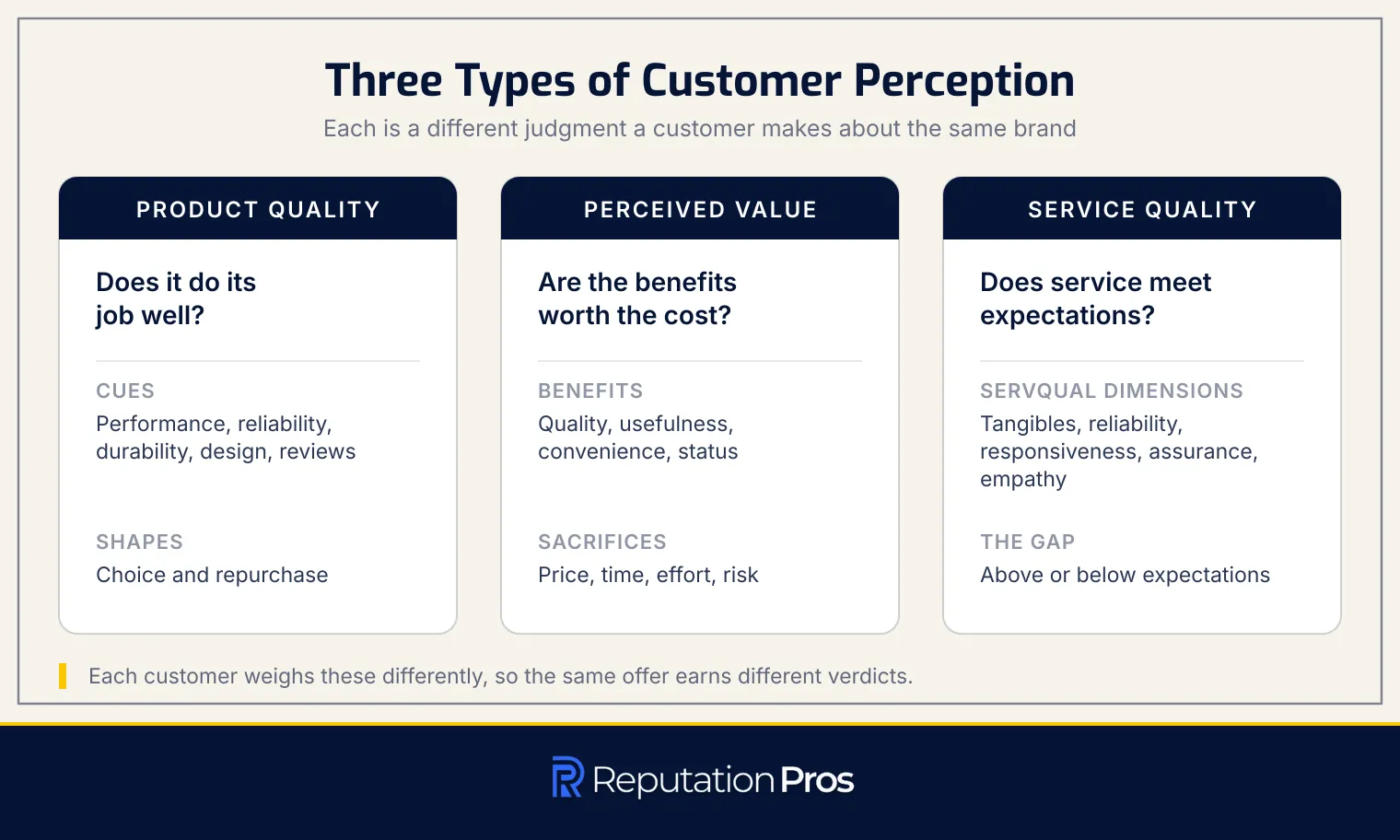
The main types of customer perception are listed below:
Perceived Product Quality
Perceived product quality is a customer’s judgment of a product’s general excellence and ability to meet its intended purpose. Customers assess quality through personal needs, prior experiences, expectations, and comparisons with alternatives, so quality judgments can differ from technical performance measures. Performance, reliability, durability, features, design, materials, packaging, price, brand reputation, and reviews act as quality cues for shoppers. Perceived product quality shapes product choice, purchase likelihood, shopping behavior, and repurchase decisions.
Perceived Value
Perceived value is a customer’s judgment of whether a product or service provides enough benefits for the costs required. Customers weigh benefits such as quality, usefulness, convenience, emotional satisfaction, or status against sacrifices such as price, time, effort, risk, and stress. Perceived value varies between customers because each customer assigns different importance to each benefit and sacrifice. One customer may prioritize a low price, while a second customer values superior quality or convenience; brands strengthen perceived value when customers believe the total benefits outweigh the financial and nonfinancial costs.
Perceived Service Quality
Perceived service quality is a customer’s judgment of how well a company delivers service compared with the customer’s expectations. Customers assess both the service outcome and the service experience, including staff behavior, facilities, and communication. The SERVQUAL model evaluates service quality through five dimensions: tangibles, reliability, responsiveness, assurance, and empathy. A positive gap means customers perceive service performance as exceeding expectations, while a negative gap means the experience falls short and may reduce trust, repeat business, and recommendations.
Why Is Customer Perception Important for Brand Reputation?
Customer perception is important for brand reputation because customers build their judgment of a brand from product quality, service, and brand interactions. Favorable experiences strengthen trust, loyalty, and recommendations, while unfavorable experiences can lead customers to switch brands or share criticism. A 2018 Ipsos study conducted with Medallia, “The Customer Experience Tipping Point,” found that 64% of more than 8,000 consumers in the United States, the United Kingdom, France, and Germany had avoided a brand because of a bad experience within the previous year. The survey result shows how individual customer perceptions turn into brand avoidance and affect a brand’s reputation.
How Does Customer Perception Influence Buying Behavior?
Customer perception influences buying behavior by shaping how consumers judge a product’s quality, value, convenience, risk, and trustworthiness. A favorable perception can strengthen purchase intention, while doubts about price, service, or reliability can lead shoppers to delay a decision, choose a competitor, or abandon a purchase. Research by Chengang Wang and colleagues, published in Heliyon in October 2023 as “The influence of consumer perception on purchase intention: Evidence from cross-border E-commerce platforms,” shows that higher perceived value raises purchase intention, rising shopping risk lowers purchase intention, and consumer trust and attitude mediate both relationships. Customer perceptions therefore shape whether consumers view a purchase as worthwhile and safe enough to complete.
How Do Online Reviews Turn Individual Perceptions Into Public Reputation?
Online reviews turn individual customer perceptions into public reputation by making customer experiences visible, comparable, and cumulative. Review ratings, recurring comments, review volume, and business responses combine to shape how prospective customers judge a brand. Review-driven choices show how customer opinions influence public impressions beyond individual transactions.
How Do You Measure Customer Perception?
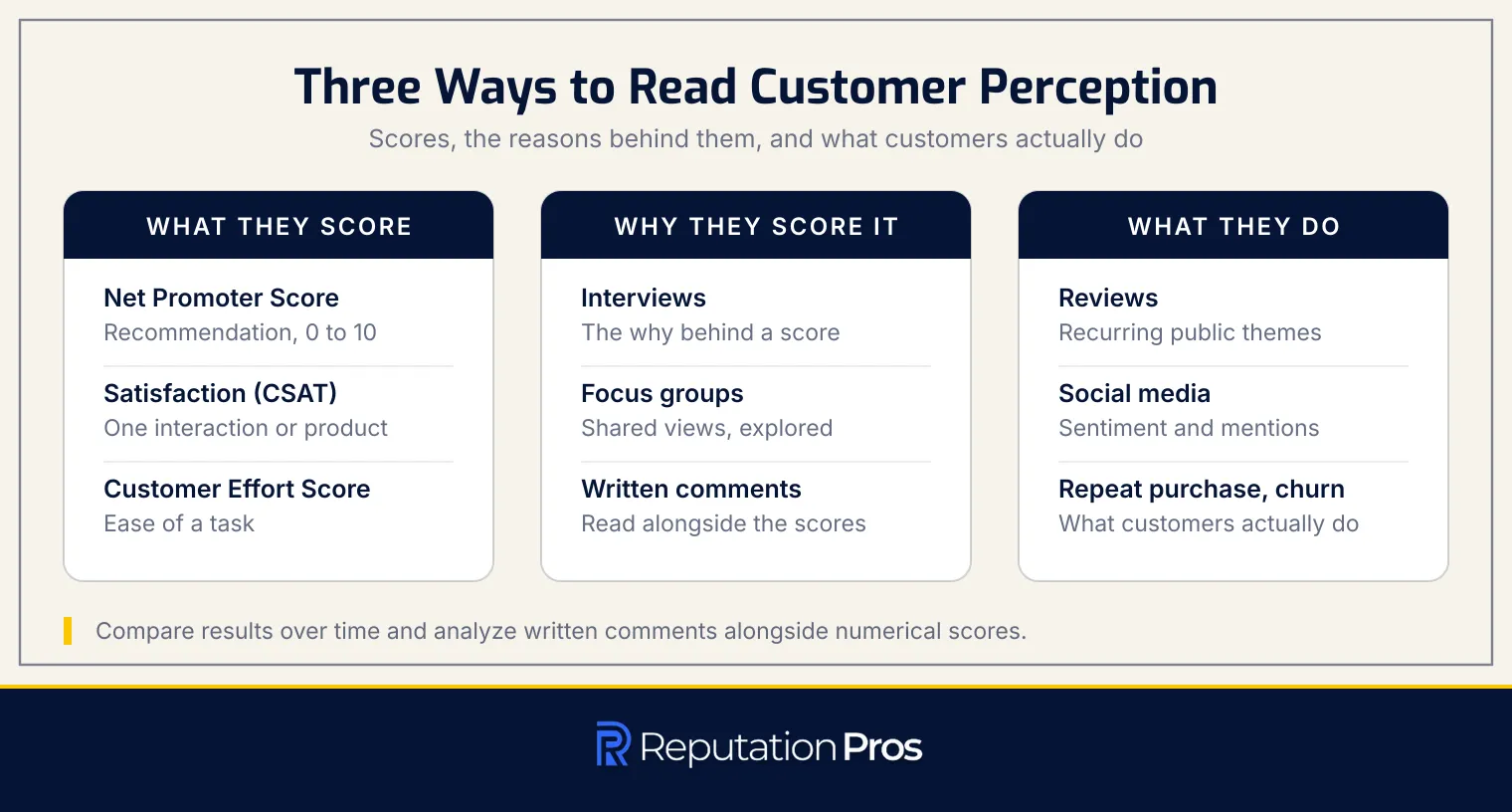
To measure customer perception, businesses combine customer feedback with behavioral and public signals. Net Promoter Score (NPS) measures recommendation likelihood on a 0 to 10 scale, while Customer Satisfaction Score (CSAT) measures satisfaction with a single interaction, product, or service. Customer Effort Score (CES) measures how easy customers find tasks such as resolving an issue or completing a purchase. Interviews and focus groups explain the reasons behind customer opinions, while reviews and social media reveal recurring public themes. Businesses compare results over time, segment responses by customer group or touchpoint, and analyze written comments alongside numerical scores. Those measurement methods guide the survey questions that ask what customers think, feel, value, and experience.
What Should a Customer Perception Survey Ask?
A customer perception survey should ask the questions listed below, scored on one consistent rating scale such as 1 to 5 or 1 to 10:
- How satisfied were you with your full experience with our product or service?
- How would you rate the product’s quality, reliability, ease of use, and fit for your needs?
- How satisfied were you with the value you received compared with the price you paid?
- How effectively did our customer service resolve your issue, and how likely are you to recommend us?
What Are Examples of Customer Perception Shaping a Brand?
Customer perception shapes a brand when customer feedback changes the brand’s products, packaging, positioning, or marketing. Good Girl Snacks switched from larger pickles to smaller gherkins after early customer feedback, a change that put more, crunchier pickles in each jar. Elavi replaced its black-and-gold packaging with more colorful designs after retail testing showed the original design got lost on store shelves.
McDonald’s removed artificial preservatives from Chicken McNuggets, pork sausage patties, and egg products in the United States in 2016, as customer expectations for simpler ingredients changed. Apple narrowed the Apple Watch pitch from style, communication, and fitness to fitness alone with the second-generation model, as Jefferson Pooley of Muhlenberg College notes in “Apple Watch pivots to fitness, and focuses on a different style of self-help,” published by The Conversation in September 2016. The Good Girl Snacks, Elavi, McDonald’s, and Apple Watch cases show how repeated customer feedback can lead brands to change what they sell and what they represent.
How Do You Improve a Negative Customer Perception?
To improve a negative customer perception, a brand addresses the customer’s concern, corrects its cause, and demonstrates consistent change through the steps below:
- Acknowledge the complaint promptly and respond without defensiveness.
- Investigate the customer’s experience and identify the underlying failure.
- Offer a fair remedy, such as a refund, replacement, correction, or service recovery.
- Respond professionally to public reviews, protect private information, and move detailed discussions to a suitable private channel.
- Train employees, correct recurring problems, and monitor later feedback to assess improvement.
When negative feedback spreads beyond one customer, the brand must address the original experience and rebuild confidence through visible, consistent corrective action.
When Does Negative Customer Perception Become a Reputation Problem?
Negative customer perception becomes a reputation problem when repeated dissatisfaction spreads beyond individual experiences and begins affecting public trust or buying decisions. Warning signs include recurring complaints, rising negative mentions, and visible criticism from credible sources. Unresolved problems and slow or defensive responses can strengthen a negative public narrative. Businesses should treat negative customer perception as a reputational risk when criticism reaches wider audiences or affects customer and stakeholder relationships.
How Does Social Listening Catch Perception Shifts Before They Spread?
Social listening catches customer perception shifts before they spread by monitoring brand mentions, keywords, hashtags, reviews, forums, news, and untagged online conversations. Social listening tools track changes in sentiment, discussion volume, recurring themes, and the speed at which conversations spread, rather than treating one comment as representative. A sudden rise in negative mentions, declining sentiment, or repeated complaints can signal a changing customer perception. Automated alerts and anomaly detection help teams investigate the cause, address customer problems, and respond before criticism grows into a broader reputation issue.
How Does Business Reputation Management Reshape Customer Perception?
Business reputation management reshapes customer perception by monitoring reviews, social media comments, search results, and other public mentions. Businesses use the monitoring findings to address recurring problems and improve customer experience. Effective reputation management combines prompt, empathetic responses with accurate information and consistent communication. Sharing positive customer stories and showing how the business corrected underlying issues replaces negative impressions with stronger signals of responsiveness and reliability.
What Signals Reveal How Customers Perceive a Brand Online?
The signals that reveal how customers perceive a brand online include review volume and themes, star ratings, sentiment in social media and forum mentions, branded search trends, share of voice, customer comments, and engagement patterns such as likes, shares, and replies.
How Does Sentiment Analysis Read Customer Perception at Scale?
Sentiment analysis reads customer perception at scale by using natural language processing and machine-learning systems to classify customer text as positive, negative, neutral, or narrower emotions such as frustration and satisfaction. Sentiment analysis systems analyze reviews, survey responses, support messages, and social media posts to identify perception patterns and track sentiment changes over time. Businesses connect sentiment trends to products, services, and customer experiences to prioritize improvements.
How Many Customers Read Reviews Before Forming a Perception?
56% of Americans read online reviews “always” or “often” before making a purchase, according to “Influencer Fatigue? 98% of Shoppers Don’t Trust Social Media Recommendations” by Trevor Wheelwright, published by Reviews.org in November 2024. The Reviews.org survey of 1,000 Americans aged 16 and older, conducted in September 2024, split the group into 28% who always check user reviews and 28% who check them “often,” which makes online reviews a common source of information when customers form initial perceptions.
How Does Customer Perception Relate to Brand Image and Reputation Scores?
Customer perception relates to brand image and reputation scores as the judgment behind both: brand image is the set of associations customers hold about a brand, and reputation scores summarize selected perception signals such as reviews, satisfaction, sentiment, and trust.
Is Customer Perception the Same as Brand Image?
No, customer perception is not the same as brand image: customer perception is an individual customer’s judgment of a brand, while brand image is the broader impression held in customers’ minds. Repeated perceptions across customers and experiences shape a brand’s general image over time.
Can a Reputation Score Quantify Customer Perception?
No, a reputation score cannot quantify customer perception in full, because a reputation score measures selected dimensions of customer perception, not the entire construct. The RepTrak Company states that its 0 to 100 Reputation Score reflects the emotional connection stakeholders have with a company, while seven drivers, including products and services, performance, and conduct, explain the score. Businesses interpret reputation scores alongside survey responses, customer feedback, and behavioral outcomes.
Why Does Customer Perception Become a Brand’s Reputation Over Time?
Customer perception becomes a brand’s reputation over time because individual judgments accumulate into a shared public view. Product experiences, customer service, reviews, and recommendations shape those judgments, which customers express through ratings, conversations, and online posts. Consistent positive experiences build trust and credibility, while repeated negative experiences create an unfavorable reputation. Because customers and other external stakeholders shape public opinion, managing customer perception protects brand reputation over time.