What is a Brand? Definition, Perception and Reputation management
 25 min read
 On this page
A brand is the full image and emotional connections consumers associate with a business, product, or individual. Unlike a product, which is a tangible item or service, a brand represents the intangible values, meanings, and emotions that distinguish it in the marketplace. Branding refers to the active process of creating and managing this identity, while a brand name is merely one identifying element within the broader brand system. A brand comprises core elements such as its name, visual assets like logos and color schemes, and a brand voice that conveys its personality and values. Brand components work collectively to differentiate a business, build customer loyalty, and establish market value.
Businesses can develop several types of brands, including product brands focused on individual offerings, corporate brands representing entire organizations, and personal brands centered around individuals.
Brand perception is the collective image and associations consumers hold about a brand, formed through interactions such as product use, customer service, marketing messages, social media engagement, and online reviews. Brand perception is measured using quantitative and qualitative methods, including surveys, brand trackers, focus groups, social listening tools, review mining, sentiment analysis, and Net Promoter Score (NPS). Perception measurements determine brand value because positive brand perception drives purchasing decisions, defines competitive positioning, impacts brand equity, and shapes customer loyalty and investor confidence.
Brand perception evolves into brand reputation when individual perceptions aggregate over time into a stable public image, based on consistent customer experiences and interactions. Brand reputation management involves monitoring, influencing, and protecting how a brand is perceived publicly, through efforts like addressing customer feedback, managing online reviews, and maintaining transparent communication. Monitoring tracks what people say about a brand across digital channels, enabling businesses to identify and address emerging issues. Long-term brand building strengthens reputation through consistent quality delivery, authentic customer engagement, and ethical practices, in the end circling back to what a brand fundamentally is: the lived perception, demonstrated value, and sustained reputation in the collective consciousness of its audiences.
What Is a Brand?
A brand is a distinct identity that encompasses the name, design, symbols, and associations that differentiate one company’s offerings from another in the marketplace. A brand represents the sum total of perceptions, emotions, and experiences that consumers hold about a business or product. While frequently confused with simpler concepts, a brand extends far beyond the products it sells, the branding activities used to promote it, or the brand name printed on packaging.
A product is tangible, something you buy and use, whereas a brand lives in the mind as a promise, a feeling, and a set of expectations. Branding refers to the strategic activities and marketing efforts employed to shape that perception, but the brand itself is the resulting perception formed in the customer’s consciousness. The brand name is merely one identifier within a larger system of meaning.
A brand is composed of core elements including its name, visual assets (such as logos, colors, and design systems), brand voice and messaging, values, and the consistent experience it delivers across touchpoints. Name, visuals, voice and values work together to serve a decisive purpose for the business: creating recognition, building trust, building customer loyalty, and in the end driving preference and premium pricing in competitive markets.
Businesses can build different types of brands, product brands that focus on individual offerings, corporate brands that represent entire organizations, and personal brands built around individuals. Brand perception, the way customers actually see and feel about a brand, forms through accumulated interactions, communications, reviews, word-of-mouth, and media exposure. Perception is measured through surveys, sentiment analysis, focus groups, social listening, and tracking metrics like Net Promoter Score, brand awareness, and brand sentiment, and these measurements directly determine brand value because positive perception translates into customer loyalty, market share, and financial performance.
Over time, repeated brand perception across many customers solidifies into brand reputation, the collective, established judgment the market holds. Brand reputation management actively monitors, protects, and improves this reputation through strategies including monitoring online mentions and reviews, managing different reputation types (customer, employee, investor), and implementing long-term brand building initiatives that reinforce consistency, quality, and trust. The strategic decisions that shape perception and the ongoing management that protects reputation circle back to what a brand fundamentally is: a living, evolving identity defined not just by what a company says, but by what customers believe and feel.
How Is a Brand Defined Beyond a Name and Logo?
A brand is defined by more than just its name and logo; it encompasses the totality of perceptions, emotions, and associations that customers hold about a business. While a name and logo serve as recognizable markers, a brand’s true essence is shaped by every interaction a customer has with the business, including product quality, customer service, and social media engagement. The brand extends beyond visual identity to include the brand’s voice, messaging, values, and the consistent experience delivered across all touchpoints. A holistic definition recognizes that a brand lives in the collective consciousness of its audience, representing trust, consistency, relevance, and emotional connection that drive customer loyalty and purchasing decisions.
What Are the Core Elements That Make Up a Brand?
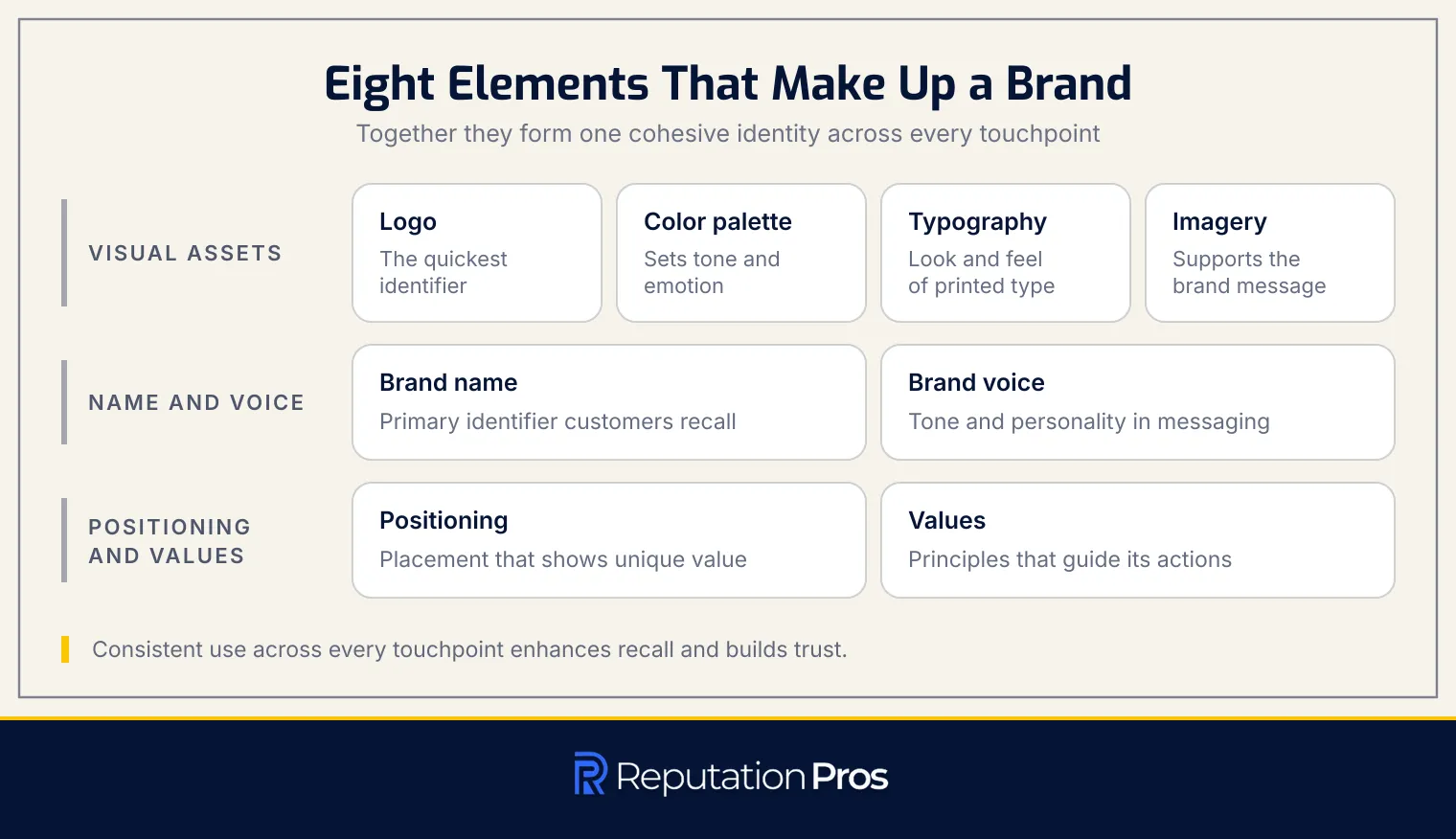
A brand is composed of several core elements that collectively create its identity and distinguish it in the marketplace. The core components are listed below:
- Brand Name: The primary identifier that conveys the brand’s essence and differentiates it from competitors.
- Logo: A visual symbol that represents the brand and aids in recognition.
- Color Palette: The specific set of colors used consistently across brand materials to evoke certain emotions and establish visual identity.
- Typography: The style and appearance of printed material that contributes to the brand’s look and feel.
- Brand Voice: The tone and style of communication used in messaging, which reflects the brand’s personality.
- Imagery: The visual content that supports brand messaging and enhances aesthetic appeal.
- Positioning: The strategic placement of the brand in the market to highlight its unique value proposition.
- Values: The principles and beliefs that guide the brand’s actions and connect with its audience.
The components work together to create a cohesive brand identity that resonates with consumers and supports business objectives.
How Does a Brand Name Carry Identity?
A brand name serves as the primary identifier that encapsulates a brand’s core identity and distinguishes it in the marketplace. A brand name is the most recognizable signal customers use to recall, discuss, and recommend a brand, functioning as a verbal shorthand for all the associations, values, and experiences connected to that business. An effective brand name carries meaning beyond mere identification, it can evoke emotions, communicate positioning, and signal the brand’s category or benefits to consumers.
The name becomes a vessel for the brand’s reputation, with strong brand names like Nike or Chick-fil-A instantly triggering specific perceptions about quality, performance, and customer experience in consumers’ minds. Over time, through consistent delivery and strategic communication, the brand name accumulates equity and becomes inseparable from the identity it represents.
How Do Visual Assets Signal a Brand?
Visual assets signal a brand by creating immediate recognition through consistent and distinctive design elements. Visual assets include the logo, color palette, typography, and imagery style, which together form a cohesive visual identity system. A logo serves as the quickest identifier, while colors and typography establish tone and emotional associations. Consistent use of these assets across all brand touchpoints, from packaging to digital platforms, enhances brand recall and builds trust. When visual identity aligns with customer expectations and the brand promise, it becomes a powerful tool for differentiation in competitive markets.
How Does Brand Voice Express a Brand?
Brand voice expresses a brand through its unique personality, tone, and communication style across all platforms. Brand voice rests on specific language choices, sentence structures, and emotional tones that align with the brand’s core values. A consistent brand voice helps audiences recognize the brand’s “sound,” distinguishing it from its visual identity and the products it offers. For example, a brand might use a professional and authoritative tone in its communications, reinforcing its expertise and reliability. In contrast, a casual and friendly tone might emphasize approachability and customer engagement. Together with visual assets and brand names, brand voice forms part of the expressive elements that frequently lead to confusion with the brand itself.
How Does a Brand Differ From Related Concepts?
Understanding a brand involves distinguishing it from several closely related concepts, each with unique characteristics and functions.
How Does a Brand Differ From a Product?
A brand differs from a product in fundamental ways. A product is a tangible or intangible item that a company sells, characterized by its functional features, specifications, and benefits that address customer needs. In contrast, a brand encompasses the entire perception, emotional connection, and identity surrounding that product or company. While products can be copied or replicated by competitors, brands represent unique associations, values, personality, and promises that distinguish one company’s offerings from another’s in the customer’s mind.
Products have lifecycles and can become obsolete or be discontinued, whereas brands endure and evolve over time, building equity that transcends individual product lines. For example, Apple sells products like iPhones and MacBooks, but the Apple brand represents innovation, premium design, and user experience, qualities that extend beyond any single device. The distinction is decisive because customers may choose a branded product over a functionally similar alternative based solely on their perception of and relationship with the brand, not the product’s features alone.
How Does a Brand Differ From Branding?
A brand represents the overall identity, perception, and reputation of a company as experienced by the public. Branding, however, is the strategic process used to create and maintain that brand identity. Branding includes activities such as designing logos, crafting messages, and managing marketing efforts to shape consumer perceptions. While a brand is the result of these efforts, branding is the continuous activity of influencing how the brand is seen. The contrast shows that branding is an ongoing process, whereas a brand is the outcome of that process in the market’s mind.
How Does a Brand Differ From Brand Identity and Brand Image?
A brand, brand identity, and brand image are distinct yet interconnected concepts within marketing. A brand represents the overall perception and reputation a company holds in the marketplace, shaped by consumer experiences and interactions. Brand identity, on the other hand, is the strategic expression a company creates, encompassing elements like logos, colors, and messaging to convey its intended image. Brand identity is the controlled side of how a company wishes to be perceived.
Brand image differs as it is the actual perception held by the public, formed through their experiences and interactions with the brand’s identity elements. While brand identity is crafted by the company, brand image is shaped by the audience’s interpretation. Thus, a brand exists at the intersection of identity and image, representing the collective understanding and relationship between the company and its consumers.
What Is the Purpose of a Brand?
A brand serves as a strategic tool that creates a distinct identity for a business, allowing it to differentiate from competitors. Brand identity reaches past visual assets like logos or names, but encompasses the values, promises, and experiences that a company consistently delivers to its customers. By establishing a recognizable and trusted presence in the market, a brand builds credibility and fosters customer loyalty.
The purpose of a brand extends beyond differentiation; it plays a decisive role in driving customer engagement and loyalty. A well-defined brand encourages repeat purchases by creating emotional connections with consumers, which transcend the functional benefits of the products or services offered. Emotional connection frequently translates into pricing power, where customers are willing to pay premium prices for products associated with quality, reliability, or status. Internally, a brand provides clarity and focus, guiding decisions across several business functions such as marketing, product development, and customer service, securing consistent expression and experience of the brand.
A brand is integral to building sustainable business value and competitive advantage. A strong brand reduces customer acquisition costs through word-of-mouth referrals and positive recommendations, as evidenced by metrics like the Net Promoter Score. A strong brand enhances resilience during market challenges, as customers with positive perceptions are more forgiving of occasional missteps. Thus, a brand becomes one of the most valuable intangible assets, laying the foundation for customer trust, competitive positioning, and long-term equity.
What Are the Types of Brands?
Brands can be categorized into several distinct types, each serving different strategic purposes and audiences. The primary brand types are outlined below.
- Product Brands: These brands focus on individual products or product lines, creating a distinct identity separate from the parent company. Product brands aim to build recognition, loyalty, and differentiation in the marketplace. Examples include Tide by Procter & Gamble and iPhone by Apple, where the product itself has developed its own reputation and customer base.
- Corporate Brands: These represent the entire organization, encompassing all products, services, and business activities under one unified identity. Corporate brands emphasize the company’s values, mission, and overall business approach. Examples include IBM and Google, where the company name itself carries substantial weight and influences perceptions of everything the organization does.
- Personal Brands: Built around individuals, personal brands represent the unique value, expertise, and personality that a person brings to their audience. Personal brands are decisive in the creator economy, professional services, and leadership contexts. Notable examples include Oprah Winfrey and Elon Musk, who have cultivated distinct personal brands that influence their business ventures and public perception.
Product Brands
Product brands refer to individual products or product lines that carry their own distinct identity, separate from the parent company that produces them. Product brands focus on specific offerings and establish their own recognition, reputation, and customer loyalty in the marketplace. A product brand is designed to help customers recognize, choose, and remember one product over competing alternatives.
For example, Procter & Gamble owns product brands like Tide, Pampers, and Gillette, each with its own positioning, visual identity, and customer base. Product-level branding lets companies target different market segments or customer needs without diluting the corporate brand. Product brands are measured and managed based on their individual performance, customer perception, and market share, allowing businesses to optimize each brand independently while benefiting from shared corporate resources and infrastructure.
Corporate Brands
Corporate brands represent the entire organization rather than individual products or services. Unlike product brands, which focus on specific offerings, corporate brands encompass the company’s values, culture, mission, and overall market presence. Companies like Apple and Google exemplify strong corporate brands where the company name itself carries substantial weight and influences perception across all their diverse product lines. Corporate brands serve as an umbrella that unifies multiple products, services, and business units under one cohesive identity.
Corporate branding is above all valuable for building trust at the organizational level, as stakeholders, including customers, investors, employees, and partners, form impressions based on the company’s overall track record, ethical practices, and corporate social responsibility. A strong corporate brand can provide competitive differentiation, enhance credibility for new product launches, and create lasting relationships that extend beyond individual transactions to encompass the entire enterprise.
Personal Brands
A personal brand represents the unique identity and reputation of an individual, distinct from corporate or product brands. A personal brand is built around how an individual presents themselves professionally, including their expertise, values, and the impression they leave on their audience. Personal brands are commonly developed by entrepreneurs, executives, influencers, and professionals who position themselves as thought leaders in their fields.
Personal brands are deeply tied to an individual’s personality and authentic voice. Personal brands grow through consistent communication across several platforms, such as social media profiles, speaking engagements, and published content. A consistent presence reinforces the individual’s unique value proposition and expertise. The audience a personal brand addresses is frequently highly engaged and loyalty-driven, forming connections based on trust and relatability, which directly influences how that audience perceives the individual across all touchpoints.
What Is Brand Perception?
Brand perception is the collective impression consumers hold about a brand, shaped by their interactions and experiences with it. Brand perception covers both rational judgments, such as the quality and value of the brand, and emotional responses, including trust and excitement. Perception is not set by what the company claims its brand to be, but rather by how customers interpret it through several touchpoints like advertising, customer service, and product use.
In the modern marketplace, brand perception is decisive as it influences purchasing decisions, brand loyalty, and competitive positioning. A positive brand perception can enhance brand equity, allowing companies to charge premium prices and maintain a strong market presence. Conversely, a negative perception can erode trust and damage the brand’s reputation, affecting sales and customer retention.
Brand perception is measured by combining survey instruments, focus groups, and social listening. Net Promoter Score, the most widely used single-question measure, came out of Frederick F. Reichheld’s “The One Number You Need to Grow” in Harvard Business Review, December 2003, which found willingness to recommend the best predictor of future growth among nineteen loyalty attributes. Keller’s brand-knowledge model supplies the other half of the picture, separating awareness from image so trackers can tell whether a brand is unknown or known and disliked.
How Does Brand Perception Form in a Customer’s Mind?
Brand perception forms through a series of interactions and experiences that a customer has with a brand. Each touchpoint, such as product usage, customer service encounters, marketing messages, and social media engagement, contributes to the overall image a customer holds. Touchpoint interactions are further shaped by external factors like online reviews, media coverage, and word-of-mouth recommendations.
Brand perception rests on brand knowledge, which Kevin Lane Keller split into brand awareness and brand image in “Conceptualizing, Measuring, and Managing Customer-Based Brand Equity,” Journal of Marketing, volume 57 issue 1, 1993. Keller defined customer-based brand equity as the differential effect of that knowledge on how consumers respond to a brand’s marketing, so cognitive evaluations such as product quality and pricing and emotional responses tied to personal experience both feed the same store of associations. Perception formation accelerates with the rapid exchange of information in digital environments, making it decisive for brands to manage their touchpoints well to maintain a positive perception.
How Does Brand Perception Differ From Brand Identity?
Brand perception differs from brand identity in fundamental ways. Brand identity is the set of elements a company designs to project a specific image, including its logo, colors, and messaging. Brand perception, however, is the interpretation and emotional response formed in the minds of consumers based on their experiences and interactions with the brand. While brand identity is controlled by the company, brand perception is shaped by external factors such as customer service, product quality, and word of mouth.
The gap between brand identity and brand perception can sharply impact a company’s success. A well-crafted identity may not lead to positive perception if customer experiences are negative. For example, a brand might present itself as luxury through its identity, but if customers encounter poor service, the perception will likely be negative. Understanding this difference is decisive for aligning marketing strategies with consumer expectations and making certain that the intended brand identity translates into the desired perception.
How Is Brand Perception Measured?
Brand perception measurement involves a combination of quantitative and qualitative methods to capture consumer attitudes and sentiments accurately. Several authoritative approaches are recognized for their effectiveness in this domain.
- Surveys: These are direct methods for gathering quantifiable feedback from target audiences. Platforms such as Google Forms and TypeForm facilitate the collection of structured data across diverse demographics, enabling businesses to assess specific brand perception dimensions efficiently.
- Brand Trackers: These tools provide longitudinal insights into brand health by monitoring perception changes over time. Surveys establish baseline metrics and highlight trends, allowing businesses to correlate perception shifts with marketing activities or external events.
- Focus Groups: Offering rich qualitative insights, focus groups explore consumer emotions and associations with a brand. Focus groups reveal the underlying reasons behind consumer attitudes, providing context that quantitative methods might miss.
- Social Listening and Monitoring: Tools like Brandwatch and Sprout Social analyze real-time sentiment and discussions across social media platforms. Social listening tools capture organic consumer conversations, providing unfiltered insights into public perception as it evolves.
By employing these methods, businesses can gain a full understanding of brand perception, enabling them to manage their brand narrative proactively.
Which Brand Perception Metrics Reveal How a Brand Is Seen?
Understanding how a brand is perceived involves several key metrics. Perception metrics give a clear read on customer attitudes and the brand’s market position.
- Net Promoter Score (NPS): This metric measures customer loyalty by asking how likely customers are to recommend the brand on a scale from 1 to 10. Scores of 8 or above indicate promoters, while scores below 7 identify detractors.
- Sentiment Analysis: This analysis captures the emotional tone and associations consumers express about the brand across social media and reviews, determining whether perceptions are positive, negative, or neutral.
- Brand Awareness and Recognition: This metric tracks how familiar target audiences are with the brand and whether they can recall or recognize it among competitors, indicating market presence and visibility.
- Brand Association Metrics: These metrics identify the specific attributes, values, and qualities consumers connect with the brand, revealing whether the intended brand identity aligns with actual customer perceptions.
The measured metrics translate directly into commercial consequences, predicting customer purchasing decisions, loyalty patterns, competitive positioning strength, and in the end the brand’s market value and revenue potential.
Why Does Brand Perception Determine Brand Value?
Brand perception is a decisive determinant of brand value because it directly influences consumer behavior and financial outcomes. When consumers perceive a brand positively, associating it with attributes such as quality, reliability, or prestige, they are more likely to pay premium prices and remain loyal, even when faced with cheaper alternatives. Perceived value reaches beyond the functional attributes of a product, driving profitability and market capitalization.
Interbrand’s Best Global Brands methodology puts a number on that link by blending three components: financial performance, a Role of Brand Index measuring how much of a purchase decision the brand itself drives rather than price or features, and a ten-factor Brand Strength score predicting future loyalty and demand. Perception enters the valuation directly through the latter two, which is why a recognized brand commands a financial premium over a generic equivalent.
Brand perception shapes long-term brand value by influencing customer lifetime value, acquisition costs, and competitive resilience. Positive perception reduces the marketing expenditure needed to attract customers, increases organic growth through word-of-mouth advocacy, and creates protective barriers against market volatility. Keller’s framework traces that accumulation to the same source: favorable, strong and unique brand associations are what let a brand appreciate rather than depreciate over time. Thus, perception management is necessary to sustaining and growing brand value. Treating brand perception as a driver of economic worth leads directly into the importance of maintaining a strong brand reputation.
How Does Brand Perception Become Brand Reputation?
Brand perception becomes brand reputation when individual customer impressions coalesce into a collective judgment over time. Brand perception reflects immediate thoughts and associations consumers have based on their experiences with a brand. Repeated perceptions gradually solidify into a brand reputation as they are shared and reinforced through several channels, such as online reviews, social media discussions, and word-of-mouth. When these perceptions are consistently validated and amplified across these platforms, they transition from personal impressions to a public consensus. Market consensus forms the brand’s reputation, a more enduring and stable view that influences customer trust, loyalty, and overall market positioning.
What Is Brand Reputation Management?
Brand reputation management is the strategic practice of monitoring, influencing, and protecting how a brand is perceived across several channels. Brand reputation management actively tracks customer feedback, social media conversations, reviews, and media coverage to maintain or improve the brand’s public image. By employing real-time monitoring tools and sentiment analysis, brand reputation management addresses negative feedback, mitigates crises, and amplifies positive sentiment. Reputation management keeps the brand aligned with its stated values and delivers consistent, trustworthy experiences.
Due to the complexity and resource intensity of this work, businesses frequently delegate brand reputation management to specialized agencies. Reputation management companies provide the expertise needed to continuously manage and coordinate reputation strategies across multiple platforms and touchpoints.
Why Do Businesses Hire a Reputation Management Company to Manage a Brand?
Businesses hire reputation management companies to make certain their brand’s perception is consistently monitored and protected. Reputation specialists hold advanced tools and expertise to track brand mentions across multiple platforms, including social media, review sites, and news outlets, in real time. Continuous monitoring lets them identify potential threats to a brand’s reputation before they escalate into crises. Reputation management firms also provide strategic interventions, such as content suppression and crisis response, to maintain a positive brand image. By outsourcing these tasks, companies allow their internal teams to focus on core operations while experts handle the complexities of reputation management, in the end preserving brand value and influencing customer trust and revenue.
How Does Brand Reputation Management Protect a Brand’s Perception?
Brand reputation management safeguards a brand’s perception by actively monitoring and responding to public discourse across several platforms. Perception protection involves tracking customer reviews, social media conversations, and media coverage to identify potential threats early. By addressing negative feedback promptly and reinforcing positive experiences, reputation management helps maintain a brand’s image. Reputation work involves correcting misinformation and aligning public expectations with the brand’s actual values and promises. Active management keeps the gap between brand identity and brand perception minimal, preserving trust and credibility. Through these efforts, brand reputation management plays a decisive role in sustaining customer loyalty and protecting brand value in the marketplace.
How Does Monitoring Track What People Say About a Brand?
Monitoring tracks what people say about a brand by continuously collecting and analyzing mentions across several digital platforms. Specialized tools scan social media, review sites, forums, news outlets, and podcasts to capture both direct and indirect brand references. Social listening tools like Brandwatch and Sprout Social track real-time sentiment by following brand mentions, hashtags, and keywords. Review mining tools such as Yext and MonkeyLearn identify recurring themes in customer feedback, detecting patterns in complaints and praise. Media monitoring tools provide a clear read into brand coverage in news articles and blogs, offering a full view of public discourse. Together, these systems create a 360-degree view of brand conversation, enabling companies to manage their narrative and respond proactively to perception shifts.
How Do Reputation, Brand, and Identity Relate?
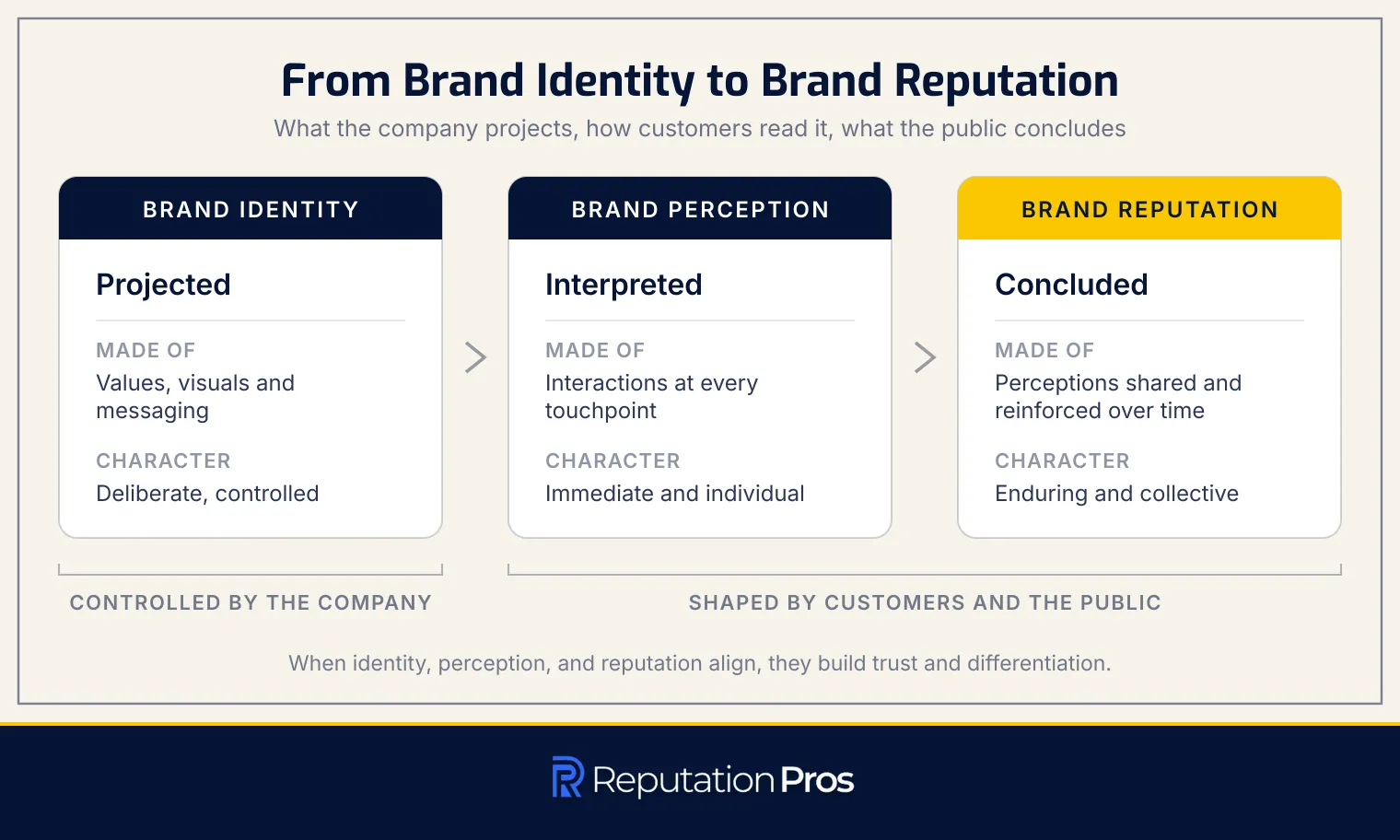
Reputation, brand, and identity are interconnected concepts that define a business’s public perception. Brand identity is the deliberate projection of a company’s values, visual elements, and messaging. Brand identity is what a company aims to communicate to its audience. Brand perception, on the other hand, is how consumers interpret and experience this identity through several interactions and touchpoints. Brand image is shaped by product quality, customer service, and marketing efforts.
Brand reputation emerges from the accumulation of these individual perceptions over time, forming a collective public judgment about the brand’s reliability and trustworthiness. Reputation is the outcome of consistent delivery on promises and the alignment between what a brand claims to be and what customers believe it to be. When identity, perception, and reputation align, they build trust and competitive differentiation. Conversely, misalignment can erode trust and weaken market position, necessitating deliberate reputation management to realign these dimensions.
What Are the Types of Reputation a Brand Carries?
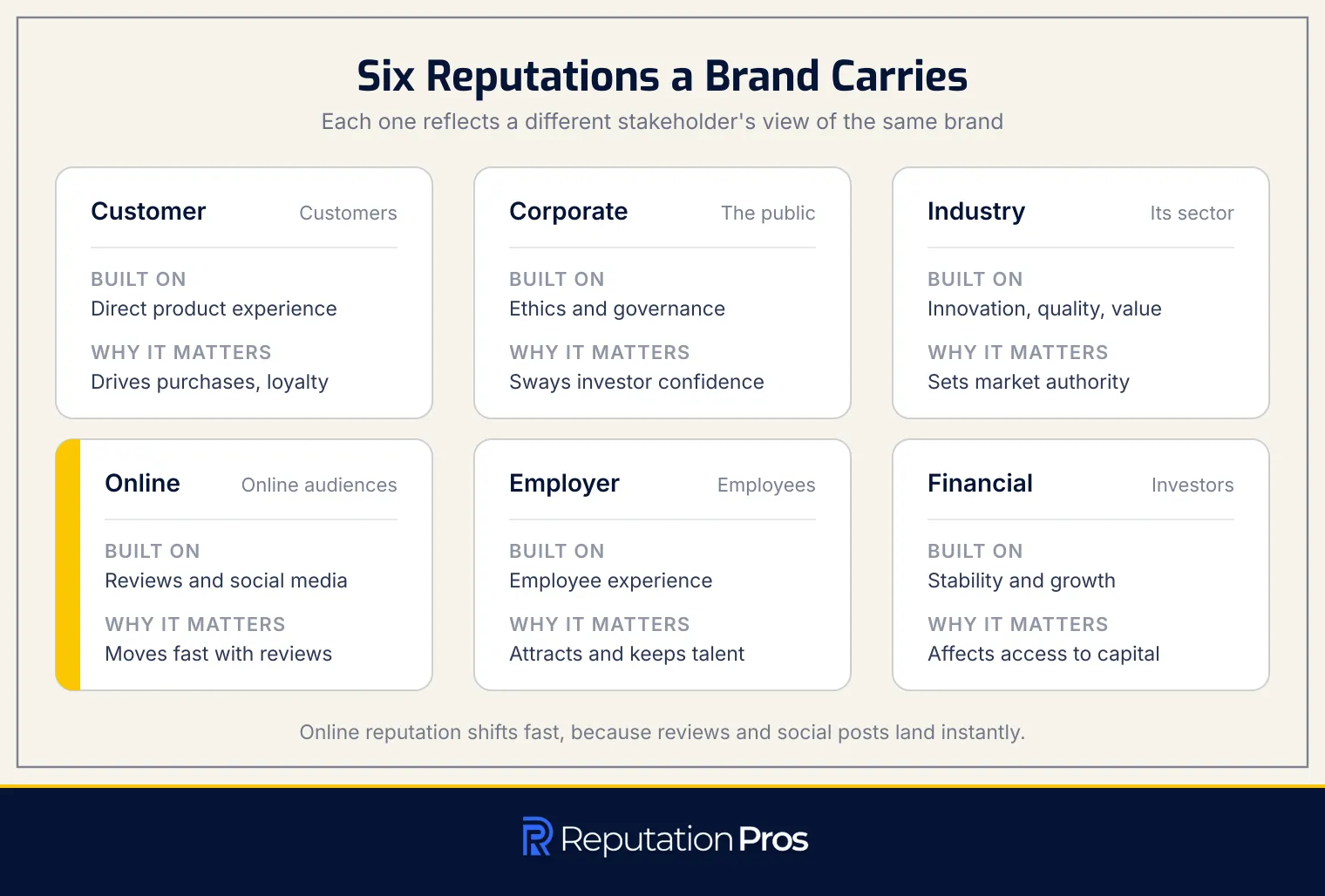
A brand carries multiple types of reputation, each reflecting different stakeholder perspectives and brand dimensions. Understanding these types helps in managing and enhancing a brand’s overall image.
- Customer Reputation: This type of reputation is based on consumers’ direct experiences with the brand’s products or services. Customer reputation influences purchasing decisions, loyalty, and word-of-mouth recommendations.
- Corporate Reputation: This reputation encompasses the broader public perception of the company behind the brand, including ethical practices, social responsibility, transparency, and corporate governance. Corporate reputation affects investor confidence and partnership opportunities.
- Industry Reputation: This focuses on how the brand is regarded within its specific sector or competitive landscape. Market reputation covers the brand’s position as an innovator, quality leader, or value provider, determining its competitive differentiation and market authority.
- Online Reputation: This reputation is formed through digital channels, including social media sentiment, online reviews, customer feedback, and media coverage. Online reputation shifts fast and carries weight because of instant online reviews and social media discourse.
- Employer Reputation: This reflects the brand’s standing as a workplace, influencing its ability to attract and retain talent. Employer reputation is shaped by employee experiences, company culture, compensation practices, and internal values alignment.
- Financial Reputation: This type is perceived among investors, analysts, and financial stakeholders regarding the brand’s stability, growth potential, and market value. Financial reputation affects stock performance, valuation, and access to capital.
How Is a Brand Built and Strengthened Over Time?
Building and strengthening a brand over time involves a systematic approach that focuses on consistency, engagement, and adaptation. Here are the key steps involved:
- Deliver Consistent Quality: Consistency in product and service quality is decisive. Every customer interaction should reinforce the brand’s promise, establishing trust and reliability.
- Maintain Coherent Messaging: A unified brand message across all platforms, including social media and customer service, helps create a clear and recognizable brand identity.
- Engage Proactively with Customers: Active engagement through social media, feedback channels, and direct communication builds emotional connections and demonstrates brand commitment.
- Monitor Brand Perception Continuously: On a set cadence, use tools like surveys and social listening to measure brand perception. Continuous measurement gives a clear read on how the brand is viewed and allows for timely adjustments.
- Address Negative Feedback Promptly: Responding transparently and swiftly to criticism can transform negative experiences into opportunities for improvement and can convert detractors into advocates.
- Invest in Customer Service Excellence: Employees act as brand ambassadors. Training them to deliver exceptional service can sharply shape customer experiences and perceptions.
- Align Corporate Actions with Brand Values: Make certain that the company’s actions reflect its stated values, enhancing authenticity and trustworthiness in the eyes of consumers.
- Adapt Messaging Based on Research: Conduct gap analysis to understand discrepancies between intended and actual brand perception. Use this information to refine strategies and stay relevant to customer needs.
The steps together build a strong, resilient brand that resonates with consumers and adapts to changing market dynamics.
Which Brand Strategy Decisions Shape How a Brand Is Perceived?
Brand strategy decisions sharply influence how a brand is perceived by its target audience. Key strategic decisions that shape brand perception are outlined below:
- Brand Positioning and Target Audience Definition: Establishing who the brand serves and how it differentiates from competitors is decisive. Positioning sets the foundation for all perception-building activities, such as Cadillac targeting luxury seekers.
- Product and Service Quality Standards: Consistent delivery on quality promises builds trust and credibility. Brands like Chick-fil-A maintain high service standards, directly shaping positive customer perceptions.
- Customer Engagement and Service Approach: How a brand interacts with customers, including responsiveness to complaints and transparency, impacts emotional connections and loyalty. Effective engagement fosters a strong brand relationship.
- Brand Messaging, Voice, and Visual Consistency: Maintaining consistent communication strategies and visual identity across all channels secures coherent customer associations, reinforcing the intended brand image in the marketplace.
Why Is a Brand Defined by Its Definition, Perception, and Reputation Together?
A brand is defined by the interplay of its definition, perception, and reputation. The brand definition establishes its core identity, including elements like the name, visual assets, and values that the company controls internally. Brand perception translates this identity into the subjective reality experienced by customers through interactions, emotional associations, and sensory touchpoints. Brand reputation solidifies this perception over time, becoming the collective judgment formed from consistent experiences, public discourse, and social proof.
The strategic decisions that build a brand, such as positioning, messaging, and customer experience design, must address all three dimensions simultaneously. A brand cannot be built solely through internal definition without managing how it is perceived and discussed publicly. Conversely, attempting to manipulate perception or reputation without a solid definitional foundation results in inconsistency and eroded trust. A brand’s true strength lies in the alignment of what it defines itself to be, how customers perceive it, and what reputation it earns over time through sustained delivery on its promises.