Brand Perception: What is it? How to Measure it?
 13 min read
On this page
Brand perception is the set of impressions, beliefs and feelings customers hold about a brand, formed from what they experience rather than from what the brand claims. Brand perception sits apart from brand image, which is the picture a company works to project, and from brand awareness, which records only whether customers recognise the name.
Perception accumulates across touchpoints. Product quality, pricing, service encounters, advertising and the opinions of other customers each contribute, and the resulting judgement governs trust, price tolerance and willingness to recommend.
Measuring brand perception follows a defined sequence: fix the dimensions worth tracking, run a survey against them, gather unprompted mentions from social and review channels, classify sentiment, benchmark against competitors and repeat on a schedule. Net Promoter Score, Customer Satisfaction and sentiment distribution convert the result into numbers a business can act on.
When measurement returns a negative reading, correction runs through the operation that produced it and then through the public record. Reputation management addresses the published narrative while the underlying issue is fixed, and channel signals continue to move perception after both are done.
What Is Brand Perception?
Brand perception is the collective interpretation customers place on a brand, built from their own experiences and from what they hear about it. Perception belongs to the customer: a company controls its identity and its messaging, but the meaning customers assign to both is formed independently and frequently differs from what was intended.
Keller’s customer-based brand equity model frames this precisely. In “Conceptualizing, Measuring, and Managing Customer-Based Brand Equity,” published in the Journal of Marketing in January 1993, Kevin Lane Keller defined brand equity as the differential effect of brand knowledge on how consumers respond to a brand’s marketing, and split brand knowledge into two components: brand awareness and brand image, the latter being the set of associations a customer holds.
How Does Brand Perception Differ From Brand Image?
Brand perception differs from brand image in who authors it. Brand image is the identity a company projects through visual design, messaging and positioning, decided internally and deployed outward. Brand perception is what customers actually conclude after meeting that projection and comparing it against their experience.
The distance between the two is diagnostic. A wide gap means the positioning is not surviving contact with the product or the service, and closing it requires changing the experience rather than restating the message.
How Does Brand Perception Differ From Brand Awareness?
Brand perception differs from brand awareness in what it measures. Brand awareness records whether customers recognise or recall the brand at all, answering whether the brand is known. Brand perception records what those customers believe once they know it, answering what the brand is thought to be.
The two move independently. A brand can hold near-universal awareness and still carry a damaged perception, which is why awareness metrics alone misread brand health.
How Does Brand Perception Form in a Customer’s Mind?
Brand perception forms through accumulation rather than through any single encounter. Direct experience of a product or a service interaction carries the most weight, and indirect exposure through advertising, peer recommendation and social content fills in the rest.
Keller’s model describes the storage mechanism: brand meaning is held as a network of associations in memory, and those associations differ in strength, favourability and uniqueness. Each new encounter is interpreted against the associations already in place, which is why the same interaction produces different conclusions in different customers.
Which Touchpoints Shape Brand Perception?
The touchpoints that shape brand perception are listed below:
- Direct experience: Product use and service encounters, where the brand promise is either confirmed or contradicted.
- Marketing communication: Visual identity, advertising and messaging, which set the expectation the experience is measured against.
- Reviews and word of mouth: Published customer accounts, which carry more weight than brand-controlled claims because the author has no stake in the sale.
- Social presence: How the brand behaves in public, including what it posts and how it answers criticism.
How Do Reviews and Word of Mouth Shape Brand Perception?
Reviews and word of mouth shape brand perception by supplying evidence the brand did not write. A published review carries an author, a date and a first-hand account, which makes it usable in a way brand copy is not.
Review reading is now standard behaviour: 82% of US adults at least sometimes read online customer ratings or reviews before buying something for the first time, as documented in the Pew Research Center report “Online Shopping and E-Commerce,” December 2016. Trust in that content is conditional, though. The share of consumers who trust online reviews as much as a personal recommendation fell from 79% in 2020 to 42% in 2025, according to the “Local Consumer Review Survey 2025” by Sammy Paget, BrightLocal, January 2025, so detail and authorship now influence perception more than the aggregate score.
Why Does Brand Perception Determine Business Outcomes?
Brand perception determines business outcomes because it governs whether a customer considers the brand, what they will pay for it and whether they return.
Kantar’s “Blueprint for Brand Growth,” built from BrandZ and Worldpanel data covering 6.5 billion consumer datapoints, reports that brands seen as meaningfully different to more people hold around five times the market penetration of those that are not, and that predisposing more people is associated with roughly twice the average selling price. These are Kantar’s own correlational findings rather than independently replicated results, so they indicate direction and scale rather than a guaranteed return.
Perception reaches past the customer too. Recruitment, partnership terms and supplier confidence all draw on the same public judgement, which widens the commercial consequence beyond sales.
How Does Brand Perception Influence Consumer Behaviour?
Brand perception influences consumer behaviour at the point of choice. A customer who holds a favourable view selects the brand against equivalent alternatives, tolerates a higher price and treats a service failure as an exception rather than as evidence.
The mechanism runs through both reasoning and feeling. Judgements about quality and value explain the choice, and associations about trust and values explain the loyalty, which is why perception predicts repeat purchase better than satisfaction with the last transaction alone.
How to Measure Brand Perception Step by Step?
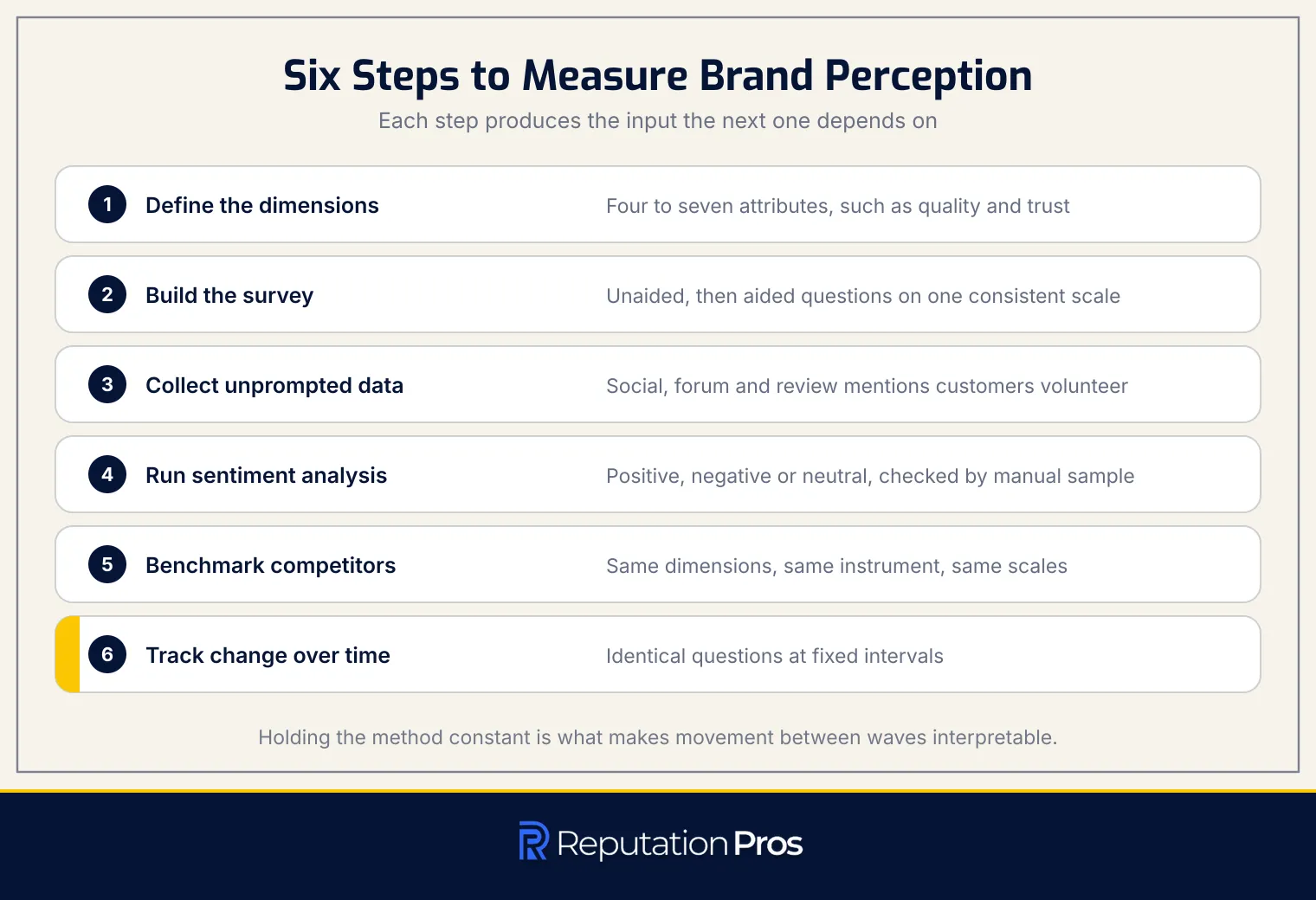
Measuring brand perception follows six steps, each producing an input the next one depends on.
Step 1 - Define the Perception Dimensions You Need to Track
To define the perception dimensions, identify the attributes customers actually judge the brand on, such as quality, trust, innovation and service, and align them with the brand’s positioning. Cover both reasoned attributes like product performance and felt attributes like prestige. Holding the set to four to seven dimensions keeps the measurement precise and comparable between waves.
Step 2 - Build a Brand Perception Survey
To build the survey, open with screening questions that sort respondents by familiarity and usage, then ask unaided questions such as which brands come to mind in the category to capture spontaneous association. Aided questions on awareness, consideration and preference follow, held to one consistent five or seven-point scale. Net Promoter Score and Customer Satisfaction Score give the instrument comparable numeric outputs.
Step 3 - Collect Unprompted Perception Data From Social and Review Mentions
To collect unprompted data, monitor the conversations where customers discuss the brand without being asked: social platforms, forums and review sites including Google, Yelp and Trustpilot. Track direct mentions that name the brand and indirect mentions that describe the product without tagging it. Unprompted data captures what customers volunteer, which is where problems surface before a survey cycle would find them.
Step 4 - Run Sentiment Analysis on Brand Mentions
To run sentiment analysis, set the monitoring scope to the brand name, product names and category terms, collect the mentions, remove duplicates and irrelevant matches, then classify each mention as positive, negative or neutral using a model that reads context rather than keywords. Segmenting sentiment by topic separates a product complaint from a service complaint. Manual review of a sample validates the classification, since automated sentiment misreads sarcasm and conditional phrasing.
Step 5 - Benchmark Perception Against Competitors
To benchmark perception, measure the same dimensions for competitors using the same instrument and the same scales. Comparison establishes whether a weak score is a brand problem or a category norm, which changes the response: a category-wide trust deficit calls for a different intervention than one confined to the brand.
Step 6 - Track Perception Change Over Time
To track perception change, repeat the survey at fixed intervals with identical questions, scales and sampling. Holding the method constant is what makes movement interpretable, because a methodology change produces apparent shifts that reflect nothing about the brand. Reading each wave against the previous one, the baseline and competitor benchmarks separates a sustained trend from sampling noise.
Which Metrics Quantify Brand Perception?
The metrics that quantify brand perception are listed below:
- Net Promoter Score: Likelihood to recommend on a 0 to 10 scale, sorted into promoters, passives and detractors.
- Customer Satisfaction Score: Satisfaction with a defined interaction, measured at the touchpoint rather than across the relationship.
- Awareness measures: Aided and unaided recall, establishing how much of the audience the perception applies to.
- Sentiment distribution: The positive, negative and neutral split across mentions, read as a distribution rather than a single average.
- Share of voice: The brand’s presence in category conversation relative to competitors.
- Customer lifetime value: The commercial consequence of perception, which rises as favourable perception produces repeat purchase.
What Tools Measure Brand Perception?
The tools that measure brand perception are listed below:
- Survey platforms: Qualtrics, SurveyMonkey and Typeform, used to field structured perception instruments and return NPS and CSAT.
- Social listening platforms: Brandwatch, Sprout Social and Hootsuite, which capture mentions across social, forum and news sources in real time.
- Sentiment classification tools: Software that scores mention text at volumes manual review cannot reach.
- Brand tracking suites: Platforms such as Talkwalker that combine listening, sentiment and competitive benchmarking in one view.
What Common Mistakes Distort Brand Perception Measurement?
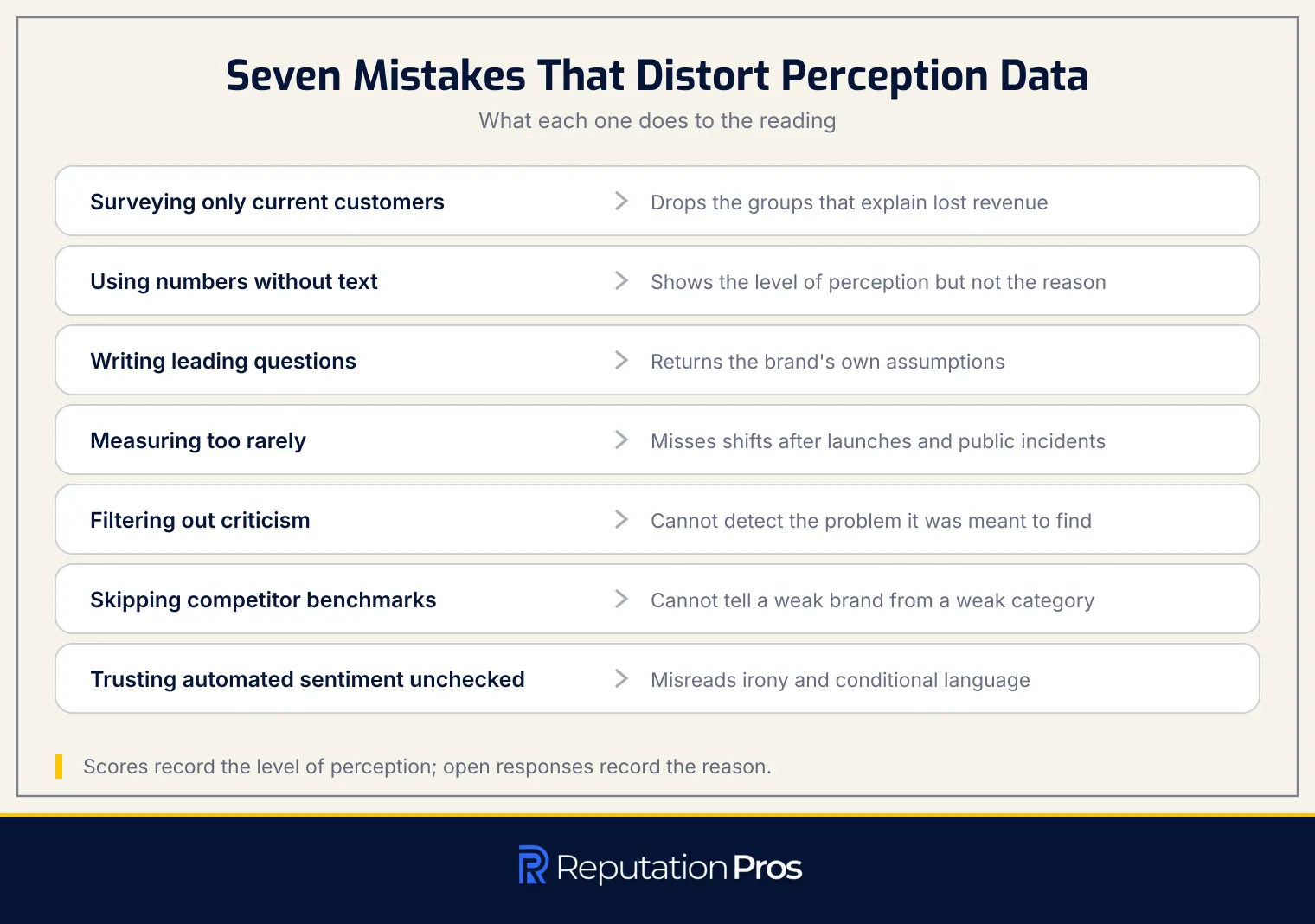
The mistakes that distort brand perception measurement are listed below:
- Surveying only current customers: Excluding prospects and lapsed customers removes the groups whose perception explains lost revenue.
- Using numbers without text: Scores record the level of perception, open responses record the reason, and a score without a reason is not actionable.
- Writing leading questions: A question that signals the preferred answer returns the brand’s own assumptions.
- Measuring too rarely: Annual-only measurement misses the shifts that follow launches, price changes and public incidents.
- Filtering out criticism: Removing low scores produces a reading that cannot detect the problem it was commissioned to find.
- Skipping competitor benchmarks: An isolated score has no context, so it cannot distinguish a weak brand from a weak category.
- Trusting automated sentiment unchecked: Models misread irony and conditional language, which inflates or deflates the result without warning.
How Do You Change a Negative Brand Perception?
- Name the problem publicly Acknowledging the issue in plain terms removes the dispute about whether it exists and makes the subsequent change credible.
- Fix what produced it Perception follows the operation, so a communications response to an unfixed product or service problem reproduces the perception it was meant to correct.
- Show the change rather than assert it Specific, checkable evidence of what is now different carries weight that a claim of improvement does not.
- Let customers carry the proof Current customer accounts are more persuasive than brand statements, because the author has nothing to gain.
- Re-measure and adjust Running the same instrument after the intervention establishes whether perception moved, and by how much.
How Does Social Listening Reveal Perception Shifts in Real Time?
Social listening reveals perception shifts by monitoring unprompted conversation continuously rather than sampling it at intervals. A survey reports where perception stood on the fielding date; listening reports movement as it happens, which is the difference between discovering a problem and watching it start.
Three signals carry the warning: a spike in mention volume, a change in the positive-to-negative split, and a new theme entering the conversation. Each appears before the shift reaches the brand’s own metrics.
How Does Brand Reputation Management Correct a Damaged Brand Perception?
Brand reputation management corrects a damaged brand perception by working on the public record and the cause at the same time. Reputation Pros audits what customers and search results currently say about the brand, addresses the published material that is driving the perception, and builds the accurate content that replaces it.
Sequence decides the outcome. Domino’s 2010 turnaround campaign is the standard illustration: the company acknowledged the criticism of its product directly, changed the recipe, and only then advertised the change. Acknowledgement without the fix reads as spin, and the fix without acknowledgement never reaches the people who had already decided.
How Is Brand Perception Data Turned Into a Reputation Strategy?
Brand perception data becomes a reputation strategy when each measured gap is assigned an owner, an action and a metric. The baseline comes from surveys, reviews, mentions and sentiment; the gaps are the dimensions where perception trails the brand’s positioning or its competitors.
Translation is what distinguishes a strategy from a report. A trust gap traced to service response time becomes a service-level change owned by the support function and measured by reply time and sentiment movement, not a messaging adjustment.
How Does Sentiment Analysis Classify Brand Mentions at Scale?
Sentiment analysis classifies brand mentions at scale by applying natural language processing to text volumes that manual reading cannot cover, scoring each mention as positive, negative or neutral. Aggregating those scores turns scattered commentary into a distribution that can be tracked between periods and segmented by topic.
How Does Sentiment Analysis Work Inside Reputation Management?
Inside reputation management, sentiment analysis works as a triage and measurement layer. Classification identifies which mentions need a response first, and the sentiment trend after an intervention establishes whether the response worked. Without it, a reputation team can report activity but not effect.
Which Signals Shape Brand Perception Across Channels?
The signals that shape brand perception across channels are listed below:
- Consistency: Uniform messaging and identity across channels, which makes the brand predictable and therefore trusted.
- Visual identity: Logos, colour and design, which communicate category and quality position before any copy is read.
- Social behaviour: What the brand publishes and how it answers criticism in public.
- Customer experience: Site usability, product performance and service quality, which confirm or contradict everything above.
How Does Brand Consistency Strengthen or Weaken Perception?
Brand consistency strengthens perception by making the brand predictable: a customer who receives the same standard across every channel has grounds to rely on it. Inconsistency weakens perception by removing that basis, because a customer who meets a different standard in each channel cannot tell which one represents the brand.
How Does Visual Brand Perception on Instagram Build Trust Signals?
Visual brand perception on Instagram builds trust signals through consistency and verifiability. A coherent visual treatment across colour, photography and subject makes the account recognisable, and customer-generated content supplies the evidence that other people have bought and used the product.
How Does Social Media Perception Translate Into Brand Value?
Social media perception translates into brand value by moving consideration before any direct contact with the brand. Visible engagement and peer recommendation raise the probability a prospect enters the funnel, and the same content raises the probability an existing customer stays.
How Does Brand Perception Differ From Brand Reputation and Awareness?
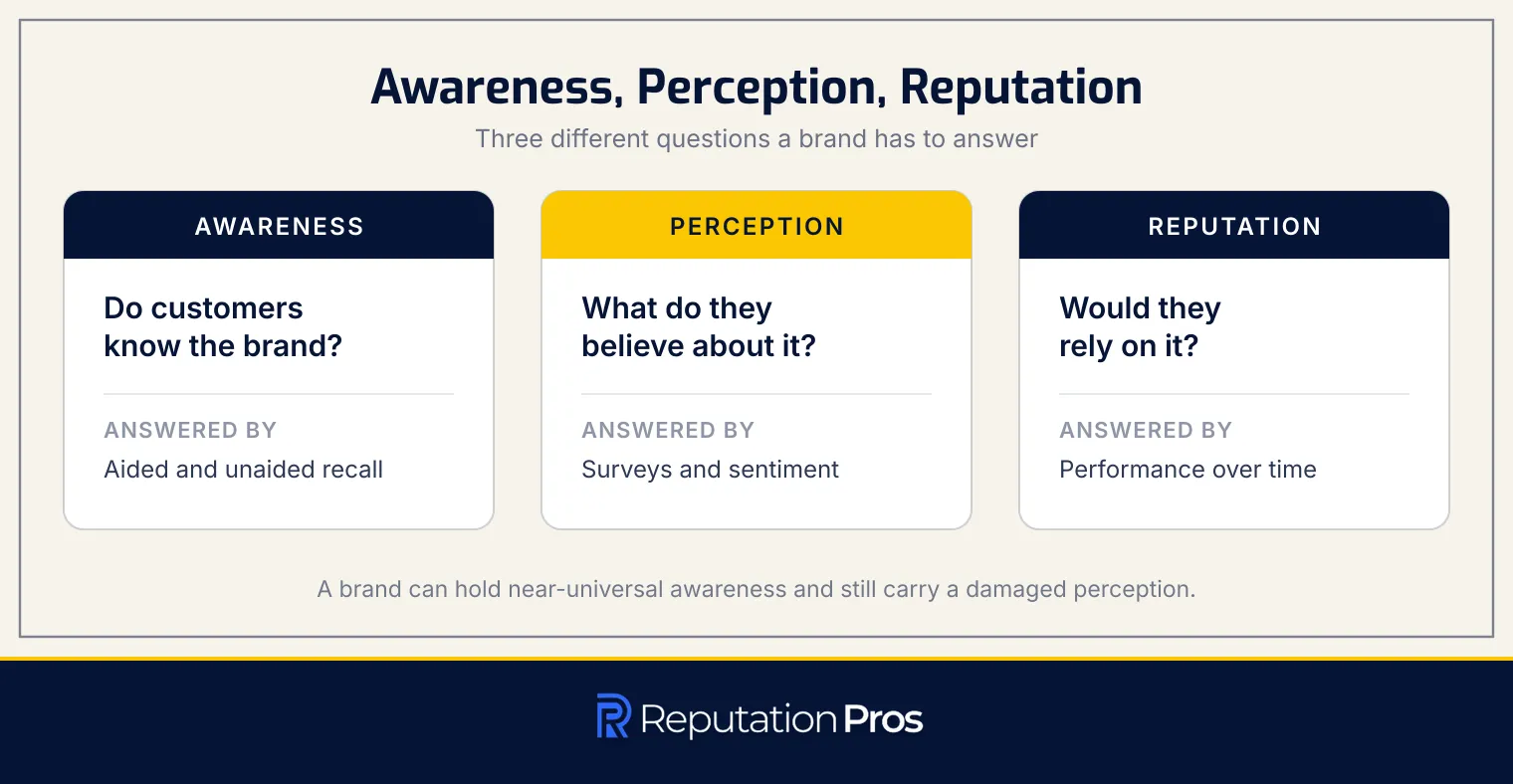
Brand perception, brand reputation and brand awareness answer three different questions. Awareness asks whether customers know the brand. Perception asks what they believe about it. Reputation asks whether they would rely on it, a judgement built over time from consistent performance rather than from any single impression.
Why Does Accurate Brand Perception Measurement Protect a Brand?
Accurate brand perception measurement protects a brand by exposing the gap between intended positioning and actual belief while that gap is still small. Measurement functions as an early warning: a perception shift detected in one wave can be addressed for the cost of a service change, whereas the same shift found through declining revenue is addressed for the cost of a recovery campaign.
Measurement protects the asset itself as well. Knowing which perception dimensions drive choice tells a brand which ones are worth defending, and tracking them against competitors on a schedule is what keeps brand perception an input to decisions rather than an explanation offered afterwards.