10 Most Trusted Brands and How They Keep High Reputation
 13 min read
On this page
The most trusted brands of 2026 are Dawn Dish Soap, Band-Aid, Google, Dove, PayPal, The Weather Channel, Heinz Ketchup, UPS, Hershey’s, and Kleenex. A most trusted brand earns consumer confidence by reliably meeting expectations, and Morning Consult measures that confidence as net trust: the share of consumers who trust a brand minus the share who do not. Morning Consult’s ranking places Dawn first, Band-Aid second, and Google third. Morning Consult’s 2026 ranking draws on surveys conducted from January 1 through May 15, covering more than 3,200 brands and averaging over 10,000 responses per brand.
Other rankings can produce different leaders because each one uses a different audience, question, and measure. USA TODAY’s 2026 list, for example, combined a nationwide survey of more than 23,000 U.S. consumers with an analysis of more than 760,000 brand reviews.
Trusted brands protect their reputation through consistent product quality, positive everyday interactions, honest communication during controversies, and visible responses to customer complaints. Poor products, hidden information, data mishandling, and defensive responses can weaken trust quickly. Crisis monitoring helps brands identify emerging complaints, while reputation management coordinates clear communication, corrective action, and customer recovery. Other rankings show that trust depends on what each survey measures, and reputation crises show that transparency and accountability limit lasting damage. Those lessons explain why familiar, dependable brands lead the 2026 list.
What Are the Most Trusted Brands in 2026?
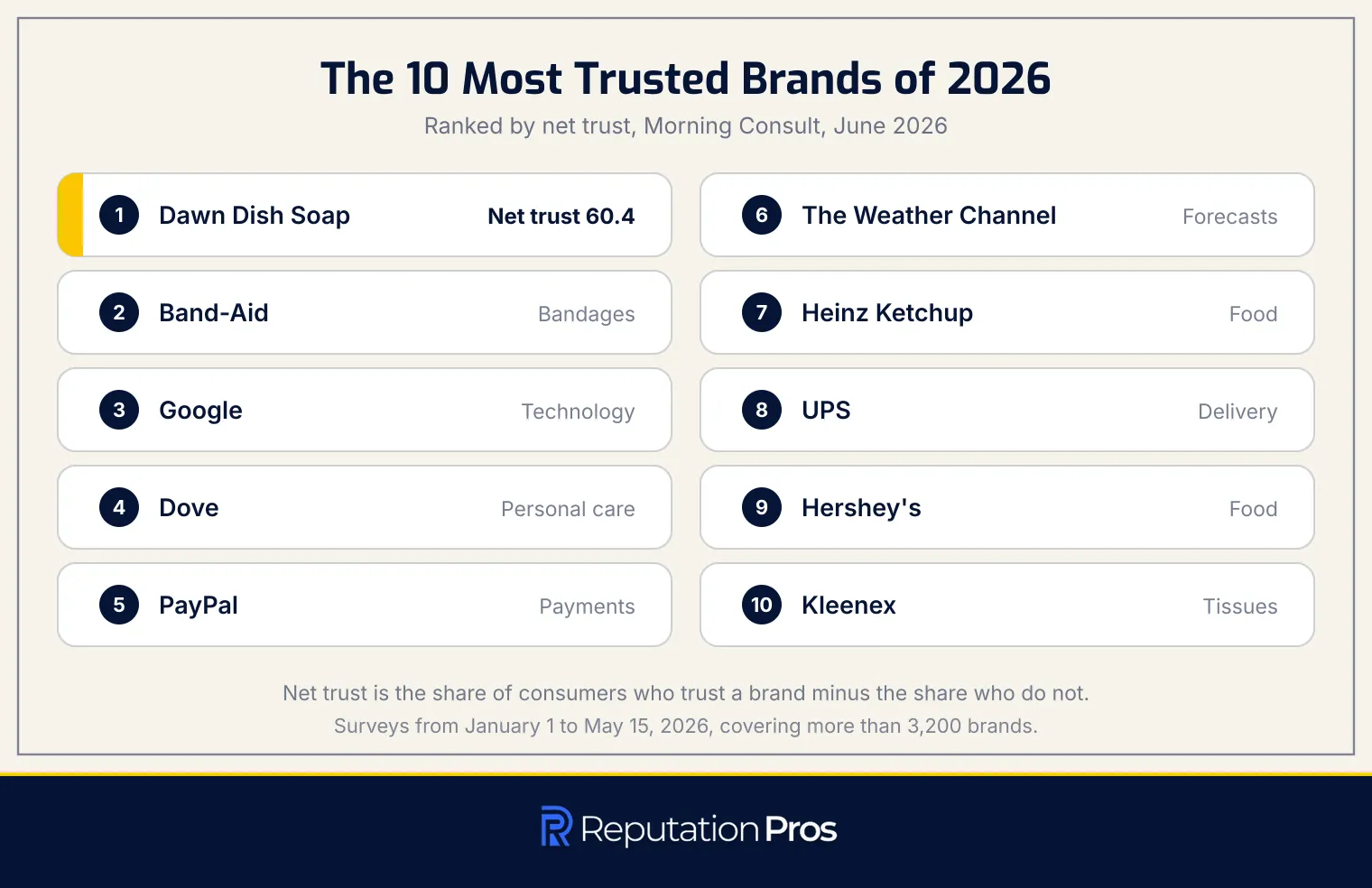
The most trusted brands in 2026 come from Morning Consult’s national consumer trust survey, which asks Americans how much they trust each brand to “do what is right,” according to the report “Most Trusted Brands 2026” by Morning Consult, June 2026. The ten most trusted brands in 2026 are listed below:
- Dawn Dish Soap
- Band-Aid
- Dove
- PayPal
- The Weather Channel
- Heinz Ketchup
- UPS
- Hershey’s
- Kleenex
Dawn Dish Soap
Dawn Dish Soap is trusted because of dependable grease-cutting performance and familiar everyday use. Morning Consult’s 2026 Most Trusted Brands ranking placed Dawn first for the second consecutive year, with a net trust score of 60.4. Dawn keeps its high reputation through consistent cleaning results and long-standing support for wildlife rescue. Dawn says it has worked with bird and marine mammal experts since 1978, and wildlife responders use the dish soap to clean animals affected by oil spills.
Band-Aid
Band-Aid is trusted because generations of families have used its adhesive bandages for minor cuts and scrapes. Earle Dickson developed the ready-to-use bandage in 1920, and Johnson & Johnson introduced it commercially in 1921. Band-Aid keeps its reputation with dependable wound-care products for different needs. Waterproof and flexible bandages, children’s designs, and OURTONE™ bandages for a wider range of skin tones extend the Band-Aid product line while retaining its familiar purpose.
Google is trusted because people use its services every day, including Search, Maps, Gmail, YouTube, and Android. Morning Consult ranked Google third in 2026, which makes Google the most trusted technology brand of the year. Google keeps its reputation through account security features, Safe Browsing, privacy controls, and transparency reports. Google users can review, export, and delete personal data, while privacy and advertising concerns remain areas that influence public trust in the search company.
Dove
Dove is trusted because of dependable personal-care products and a long-running message about inclusion and positive self-image. The Dove product range includes cleansing bars, body wash, deodorant, and hair care. Dove keeps its reputation through the Campaign for Real Beauty, launched in 2004, and the Dove Self-Esteem Project. Ongoing scrutiny of sustainability and past advertising controversies shows why the Unilever brand needs to align its actions with its public promises.
PayPal
PayPal is trusted because customers can pay online without sharing full card or bank details directly with merchants. Encryption, account security tools, and fraud monitoring help protect PayPal transactions, and eligible purchases that do not arrive or that differ materially from their descriptions qualify for reimbursement, according to PayPal’s Purchase Protection Program terms. PayPal keeps its reputation through transaction monitoring and a formal Resolution Center for reporting payment problems. Clear updates and timely dispute handling help PayPal customers resolve issues and sustain confidence in the payment service.
The Weather Channel
The Weather Channel is trusted because it provides practical forecasts for daily decisions and severe-weather preparation. Morning Consult placed The Weather Channel in its 2026 top 10, drawn from more than 3,200 tracked brands. The Weather Channel keeps its reputation by combining trained meteorologists, forecasting technology, and location-based updates across television, websites, and apps. ForecastWatch studies commissioned by The Weather Company have ranked the company as the most accurate global forecaster, which supports confidence in Weather Channel forecasts.
Heinz Ketchup
Heinz Ketchup is trusted for its familiar tomato flavor, thick texture, and consistent quality. First produced by H. J. Heinz in 1876, the ketchup has become a long-standing household and restaurant staple. Heinz keeps its reputation by growing its ketchup tomatoes from proprietary seeds and tracking them from seed to table. The recognizable Heinz bottle, label, and recipe reinforce a dependable product identity across generations.
UPS
UPS is trusted because of reliable package delivery, recognizable drivers, and consistent service. Packages that arrive on time and intact reinforce the UPS promise to households and businesses. UPS keeps its reputation through delivery tracking, customer support, and dependable performance during busy periods. UPS reported 98.9% on-time delivery during Cyber Week 2025 and 97.2% for December, citing ShipMatrix data, and the carrier describes eight consecutive years of leading holiday on-time performance.
Hershey’s
Hershey’s is trusted because of familiar chocolate products and consistent everyday experiences. Hershey’s and Heinz Ketchup are the only food brands in Morning Consult’s 2026 top 10. The Hershey Company keeps its reputation through product-quality oversight and food-safety controls. Hershey states that its Product Excellence Program meets or exceeds Global Food Safety Initiative standards, and any change to a familiar recipe tests the long-standing consumer trust behind the chocolate brand.
Kleenex
Kleenex is a facial tissue brand introduced in 1924. Kleenex tissue first served as a cold-cream remover, then became a disposable handkerchief after consumers adopted it for that purpose. Decades of use have made Kleenex familiar in homes, schools, offices, and clinics. Kleenex keeps its reputation through consistent softness, strength, and reliability, supported by products such as Ultra Soft and lotion tissues. The Kleenex brand protects that reputation by preserving familiar product qualities and answering customer concerns about quality, availability, or product changes in plain terms.
How Are the Most Trusted Brands Ranked?
The most trusted brands are ranked through national consumer surveys that ask shoppers which brands they trust. The 2026 Newsweek-BrandSpark ranking surveyed 35,215 U.S. consumers about 359 categories of products and stores, so the ranking reflects consumer experience rather than an expert panel’s judgment. Newsweek and BrandSpark International rank brands on top-of-mind, unaided responses from qualified shoppers for categories they actively shop, as described in “Newsweek and BrandSpark Most Trusted® Awards Announce the 4th Annual Most Trusted Brands in the UK for 2026,” published by BrandSpark International in January 2026. Rankings built from category-level consumer responses can differ from corporate trust rankings, which may combine customer, employee, investor, or public sentiment measures.
Which Brands Lead Other Trust Rankings?
The brands that lead other trust rankings differ because each survey measures reputation differently. The leaders of other trust rankings are listed below:
-
Axios Harris Poll 100: Trader Joe’s ranked first in 2025, Patagonia second, and Costco fifth. The ranking measures corporate reputation from the opinions of 16,585 people in the U.S., according to “Trader Joe’s claims top spot in corporate reputation rankings” by Sam Silverstein, Grocery Dive, May 2025.
-
Fortune World’s Most Admired Companies: Apple ranked first in 2025, followed by Microsoft and Amazon. Fortune and Korn Ferry assess companies through executive surveys across nine reputation attributes, as Korn Ferry notes in “Fortune and Korn Ferry Reveal the 2025 World’s Most Admired Companies List,” January 2025.
-
Infegy Trust Index: Data from “The World’s Most Trusted Brands of 2026” by Nancy Dexter-Milling, Infegy, February 2026, shows QVC, Toll Brothers, and American Financial Group leading an index that scores the net sentiment of trust conversations about the 2025 Forbes US 500 companies.
How Do the Most Trusted Brands Keep a High Reputation?
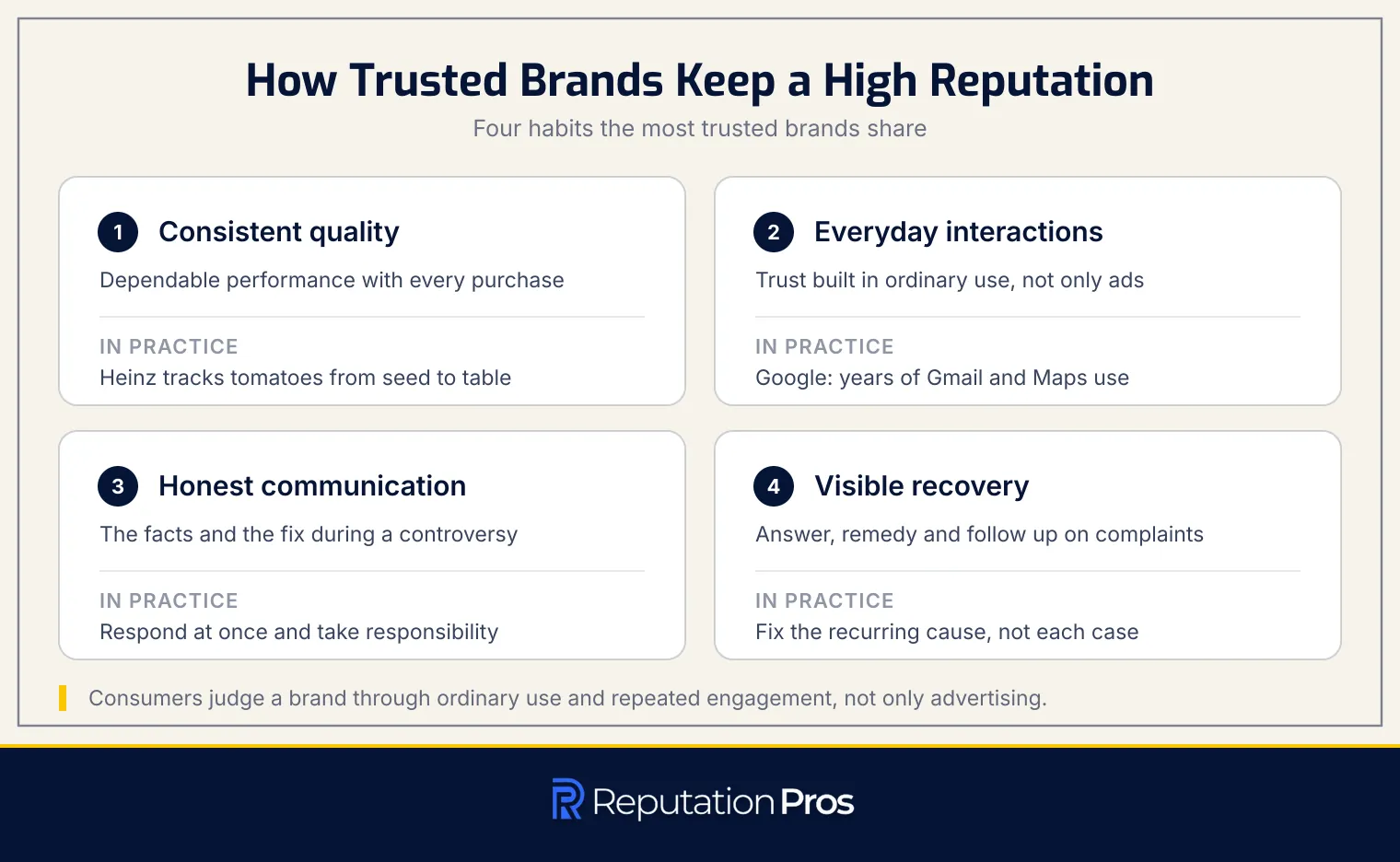
The most trusted brands keep a high reputation through consistent product quality, positive everyday interactions, honest communication during controversies, and visible recovery when customers complain.
Consistent Product Quality Over Decades
Consistent product quality over decades means delivering dependable performance with each purchase over many years. Reliable products meet customer expectations, reinforce brand trust, and reduce uncertainty when people choose familiar brands. Brands protect product quality through testing, quality controls, and clear performance standards. Careful improvements help products keep pace with changing needs while preserving the dependable experience customers expect.
Repeated Positive Everyday Interactions
Repeated positive everyday interactions build brand trust through reliable product performance, clear information, convenient service, and responsive communication. Consumers judge a brand through ordinary use and repeated engagement, not only through advertising or major purchases. Morning Consult’s Nicholas Laughlin links the high trust ratings of long-lived Google products such as Gmail and Google Maps to “positive, repeated interactions” with consumers over many years, according to “Dawn is the most trusted brand in America for the second year in a row: report” by Alyssa Meyers, Marketing Brew, June 2026. Relevant, authentic communication strengthens everyday interactions, while out-of-touch messaging can weaken engagement.
Honest Communication During a Controversy
Honest communication during a controversy protects brand trust by showing customers the facts and the fix. A brand should acknowledge the issue, share verified information promptly, accept responsibility where appropriate, and explain corrective actions. A 2024 BCG study by Marcos Aguiar, Oliver Schilke, and colleagues, “From Crisis to Comeback: The Long Road to Rebuilding Corporate Trust,” advises companies to respond immediately and take responsibility after a trust breach, because lost trust is hard to regain. Brands weaken credibility when they minimize harm, shift blame, or make promises without measurable action.
Visible Recovery When Customers Complain
Visible recovery when customers complain means a brand responds promptly and in plain terms to a complaint, explains its corrective action, and follows up until the issue is resolved. A fair refund, replacement, or other remedy can address the customer’s immediate problem and demonstrate accountability. Trusted brands track recurring complaints and fix their underlying causes rather than treating each case separately. Respectful communication and consistent follow-through can rebuild customer confidence, strengthen loyalty, and show other customers that the brand acts on feedback.
What Makes a Brand Lose Its Place Among the Most Trusted?
A brand loses its place among the most trusted when its products, services, or actions repeatedly fail customer expectations. The main causes of lost brand trust are listed below:
- Declining product quality. Defects, inconsistent performance, or cheaper materials weaken confidence in a brand’s reliability. Customers notice when products no longer meet the standards they expect.
- Safety failures and slow recalls. Contamination, faulty products, or health risks can quickly damage consumer confidence. Delayed warnings, unclear explanations, and slow corrective action deepen the harm.
- Dishonest or unclear communication. Misleading claims, hidden information, and shifting explanations create a gap between a brand’s statements and its actions. Evasive responses during a controversy further weaken credibility.
- Data breaches and privacy violations. Mishandled personal or financial information makes customers question whether a company deserves their trust. Technology and payment brands face particular exposure because customers rely on them to protect sensitive data.
- Repeated customer-service failures. Slow responses, unresolved complaints, and impersonal support turn service problems into lasting frustration. Customers lose confidence when a brand ignores concerns or provides inconsistent treatment.
- Broken promises and misleading marketing. Missed delivery dates, unfulfilled warranties, and unsupported quality or sustainability claims reduce perceived reliability. A brand’s reputation suffers when its performance contradicts its promises.
- Unethical conduct and leadership scandals. Corruption, discrimination, unsafe practices, or executive misconduct undermine confidence in a company’s values and oversight. Public trust declines when organizational behavior conflicts with stated principles.
- Insensitive advertising and inconsistent values. Stereotyping or offensive marketing can alienate customers and prompt public criticism. Brands weaken their credibility when their campaigns or business decisions contradict their declared values.
- Poor crisis response and slow recovery. Blame-shifting, silence, or incomplete corrective action can intensify the original problem. Clear acknowledgment, apologies, refunds, replacements, and visible improvements help address customer concerns.
Digital networks spread complaints and evidence of failures quickly, which makes the speed of reputational damage the next question.
How Fast Can a Trusted Brand Lose Its Reputation?
A trusted brand can lose much of its reputation within days or weeks when a public crisis reveals failures in safety, honesty, reliability, or responsibility, and a single major event can diminish trust levels by more than 25% in one month, as Boston Consulting Group reports in “From Crisis to Comeback: The Long Road to Rebuilding Corporate Trust,” November 2024. Reputational damage spreads faster when news coverage and social media magnify the incident, while the severity depends on the evidence, customer impact, and company response.
Brand trust softens the damage of a crisis without preventing it. Tylenol stayed in Morning Consult’s top 20 across all brands and remained the most trusted medicine brand in 2026 despite a public controversy in late 2025, which Morning Consult presents as evidence that trust is a vital buffer during crises. Prompt acknowledgment, transparent updates, and corrective action can limit lasting damage, while evasive communication and broken promises can deepen it.
How Does Crisis Monitoring Protect a Trusted Brand Reputation?
Crisis monitoring protects a trusted brand reputation by detecting early warning signs, including rising negative mentions, customer complaints, declining sentiment, and increased media coverage. Monitoring social media, review platforms, news outlets, and online discussions helps reputation teams assess the issue and identify affected customers and stakeholders. Monitoring tools protect reputation when teams connect alerts to clear escalation steps and assigned responsibilities. Prepared crisis communication procedures help brands respond quickly with accurate, transparent, and empathetic information, address underlying problems, and limit the spread of misinformation.
How Does Business Reputation Management Keep a Brand Highly Trusted?
Business reputation management keeps a brand highly trusted through continuous monitoring, consistent communication, and visible corrective action. Companies track customer feedback, reviews, media coverage, social sentiment, complaints, and emerging reputation risks to identify concerns early. When a problem arises, reputation teams acknowledge the issue, explain the facts honestly, accept responsibility when appropriate, and offer practical remedies. Companies protect trust by fixing underlying causes, listening to affected customers, and reporting progress after the immediate crisis ends.
What Can Other Reputation Rankings Teach About Trusted Brands?
Other reputation rankings teach that brand trust depends on the audience and criteria, with Fortune’s corporate reputation measures and ESG assessments offering different views of trust.
How Does Fortune Rank the Most Admired Companies?
Fortune ranks the Most Admired Companies through a corporate reputation survey conducted with Korn Ferry. Executives, directors, and securities analysts rate companies in their own industries on nine corporate reputation attributes, including innovation, quality of management, quality of products and services, financial soundness, and social responsibility. Fortune’s ranking measures peer opinion, so its leaders can differ from consumer-trust rankings.
Does ESG Performance Affect Brand Trust Rankings?
Yes, credible environmental, social, and governance (ESG) performance can strengthen consumer trust, though product quality and service remain important. A 2010 review by Shuili Du, C.B. Bhattacharya, and Sankar Sen, “Maximizing Business Returns to Corporate Social Responsibility (CSR): The Role of CSR Communication,” published in the International Journal of Management Reviews, found that companies gain stakeholder support from corporate social responsibility, but low stakeholder awareness and unfavorable attributions about a company’s motives limit those gains, so unsupported claims or greenwashing can undermine trust.
What Happens to Trusted Brands During a Reputation Crisis?
Trusted brands face a reputation crisis when public failures weaken customer confidence, and the cases below show how transparent communication, accountability, and corrective action shape whether trust recovers or erodes.
What Did Brands Learn From Notable Reputation Crises?
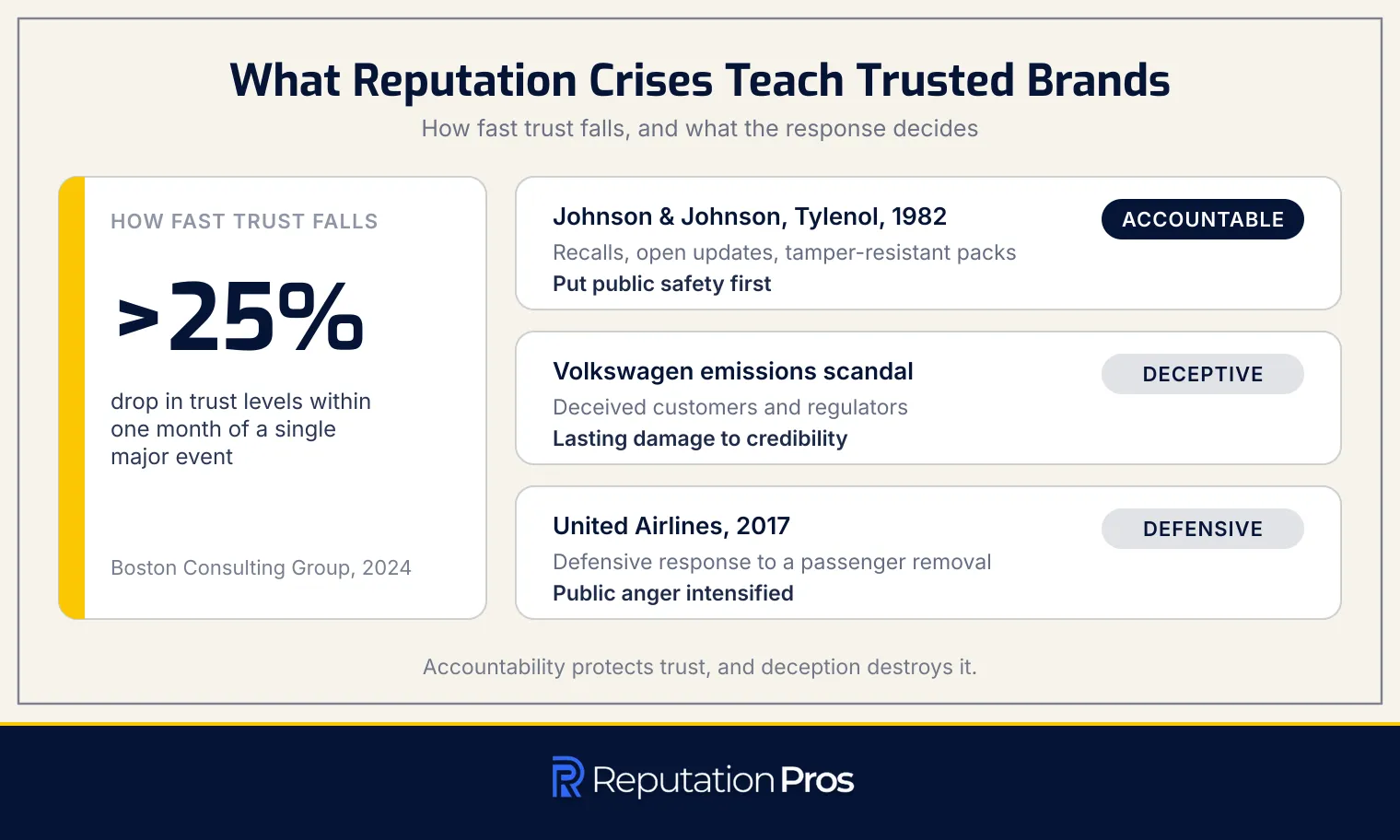
Brands learned from notable reputation crises that accountability protects trust and deception destroys it. Johnson & Johnson’s response to the 1982 Tylenol poisonings showed how recalls, transparent communication, and tamper-resistant packaging can put public safety first. Volkswagen’s emissions scandal, documented by the U.S. Environmental Protection Agency in “Volkswagen Light Duty Diesel Vehicle Violations for Model Years 2009-2016,” showed that deceiving customers and regulators can cause lasting damage to brand credibility, and United Airlines’ 2017 passenger-removal incident showed that a defensive response can intensify public anger.
How Do Product Recalls Test a Trusted Brand?
A product recall tests a trusted brand by placing its safety, quality, and responsibility promises under public scrutiny. A prompt, voluntary recall with clear customer instructions and corrective action can limit confusion and support reputation recovery. Brands weaken confidence when they delay, communicate vaguely, or fail to show that the remedy works.
Why Does Lasting Trust Keep the Most Trusted Brands on Top?
Lasting trust keeps the most trusted brands on top because it strengthens customer loyalty, recommendations, and resilience during disruption. Consistent performance and fair responses give customers reasons to choose a familiar brand again. Reputation crises show that trust does not remove risk but supports recovery. Trusted brands protect customers, acknowledge failures, communicate corrective actions, and demonstrate real change, reinforcing the everyday quality and customer care that sustain a high reputation.