What Is Trust? Importance for Brands and Individuals
 23 min read
 On this page
Trust is the expectation that another party will act as promised, especially when outcomes are uncertain. Trust rests on the ability and the intention of that party to fulfil commitments. Trust is vital for both brands and individuals, as it influences loyalty, retention, and advocacy for brands, while supporting relationships, wellbeing, and decision-making for individuals.
Trust is underpinned by four core dimensions: reliability, integrity, competence, and benevolence. Reliability involves consistent follow-through on promises. Integrity requires alignment between stated values and actions. Competence involves demonstrated expertise and quality delivery. Benevolence reflects genuine care for others’ interests. The four dimensions together make reliance on another party reasonable. Trust differs from confidence, credibility, and reputation. Confidence involves certainty without vulnerability. Credibility is based on perceived honesty and expertise. Reputation is a public signal built from collective judgments.
Trust builds slowly through consistent actions but breaks quickly when promises are violated, impacting customer behavior and brand reputation. Brands earn trust through quality, transparency, and privacy protection, and can rebuild it through staged recovery processes. For individuals, trust shapes personal relationships, wellbeing, and everyday decisions, with low trust leading to stress and hesitation. Evaluating trustworthy behavior involves examining track records, comparing words with actions, and considering social proof. Ultimately, brand trust parallels person-to-person trust on a larger scale, rooted in the shared expectation of reliable and intentional actions.
What Is Trust?
Trust is the expectation that another party will act as promised, especially when outcomes are uncertain. Trust rests on two components: the ability of the party to fulfill commitments and their intention to do so sincerely. In the context of brands, trust translates into consumer confidence that the company will consistently meet expectations, from product quality to data protection, even when the consumer cannot verify every claim before purchase.
Trust is decisive for both brands and individuals. For brands, trust fosters loyalty, retention, and advocacy, necessary for long-term success. Individuals benefit from trust in relationships, personal wellbeing, and decision-making, as it reduces uncertainty and promotes confidence. The dimensions of trustworthiness, reliability, integrity, competence, and benevolence, make reliance on another party reasonable.
Trust differs from related concepts such as confidence, credibility, and reputation. Confidence involves a strong expectation of a positive outcome, while trust includes vulnerability and choice. Credibility is based on perceived honesty and expertise, and reputation is a broader signal built from reviews and ratings.
Trust builds slowly through repeated confirmation but can break quickly after a failure, highlighting its fragility. Fragility of that kind carries substantial implications for brands, as trust influences consumer behavior and reputation. Brands earn trust through quality, transparency, and privacy protection and must follow a staged path to rebuild it after failure.
How Is Trust Defined as Reliance Under Uncertainty?
Trust is defined as reliance on another party when outcomes are uncertain and complete information is unavailable. Reliance of that kind involves accepting vulnerability, as trustors depend on the expected future behavior of others without the ability to control or fully predict it. Trust is not merely about optimism; it requires placing oneself in a position where another party’s actions will determine substantial outcomes, based on expectations about their intentions and capabilities.
The definition traces to Roger Mayer, James Davis and F. David Schoorman’s “An Integrative Model of Organizational Trust,” published in the Academy of Management Review in 1995, which framed trust as the willingness of one party to be vulnerable to another based on the expectation that the other will act as anticipated, irrespective of any ability to monitor or control them.
Trust emerges in contexts characterized by risk and interdependence, where one party must rely on another’s future actions without complete knowledge or control. Reliance under uncertainty lets relationships and transactions proceed despite uncertainty, forming the foundation for personal bonds and commercial exchanges.
Why Do Vulnerability and Risk Make Trust Necessary?
Vulnerability and risk make trust necessary because they expose individuals and organizations to potential loss when outcomes rely on another party’s actions. Trust is decisive in reducing fear and perceived risk by providing reassurance that the other party will act as expected. When consumers make purchasing decisions, they frequently lack complete information about product quality, seller intentions, or future service reliability. Trust enables them to proceed with transactions despite these uncertainties, lowering perceived risks and allowing for smoother decision-making. Without trust, every decision would require exhaustive verification, making routine interactions costly in time and effort.
What Are the Core Dimensions of Trustworthiness?
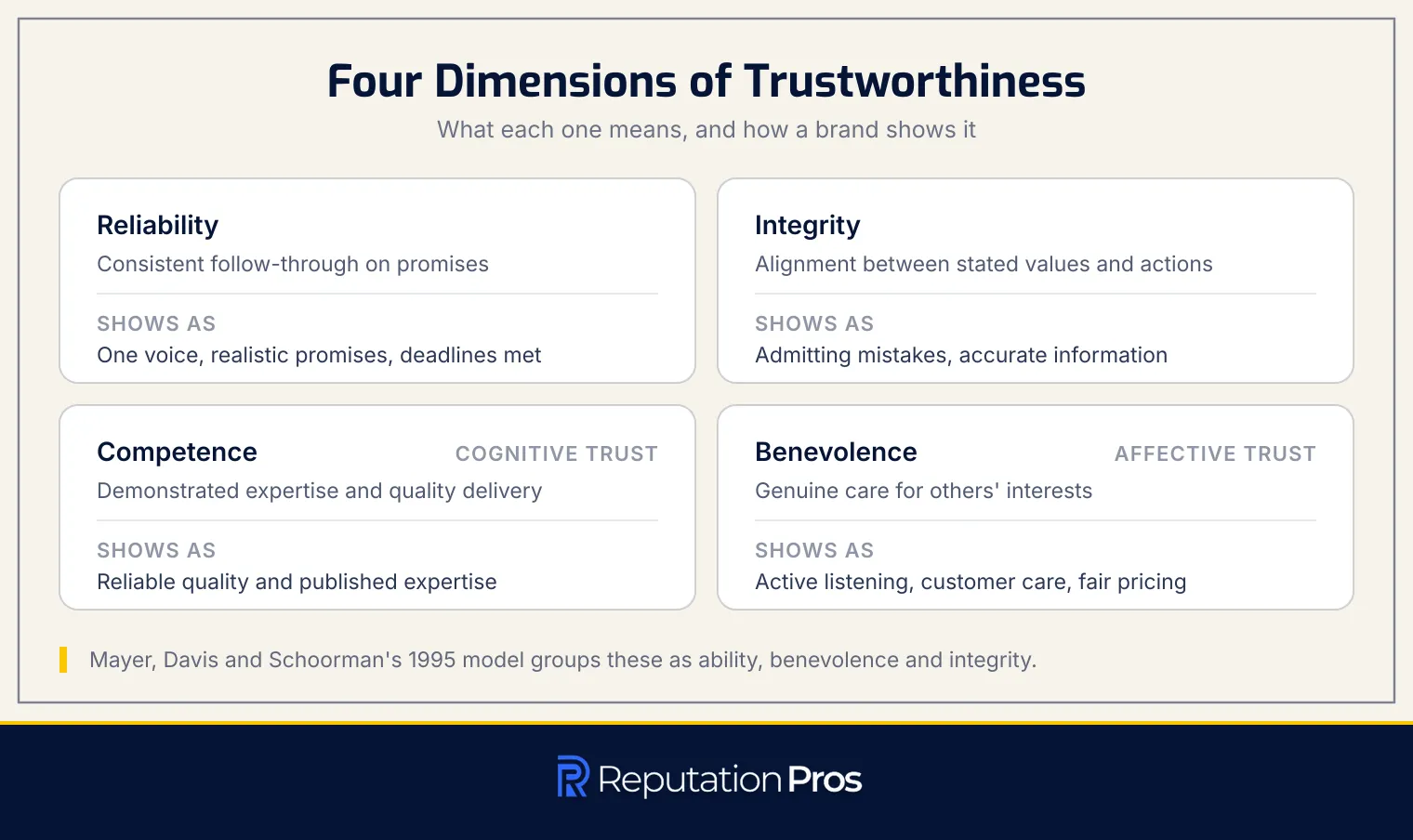
Trustworthiness consists of four core dimensions: reliability, integrity, competence, and benevolence. Each dimension is decisive in forming the foundation of trust.
- Reliability: This dimension reflects the expectation that a party will consistently fulfill promises and maintain dependable actions over time.
- Integrity: Integrity involves adherence to moral and ethical principles, so that actions align with stated values and commitments.
- Competence: This aspect underscores the ability of a party to perform tasks effectively and to the expected standard, demonstrating necessary skills and expertise.
- Benevolence: Benevolence is characterized by genuine concern for others’ well-being, acting with kindness and goodwill rather than self-interest.
Those dimensions map onto the ability-benevolence-integrity model Mayer, Davis and Schoorman set out in 1995, which identified ability as the trustee’s skills and competence, benevolence as the belief that the trustee acts in the trustor’s interest, and integrity as adherence to principles the trustor finds acceptable. Their paper was among the first to separate trust from trustworthiness and to place vulnerability at the centre of the construct. Observable behaviors in each dimension allow individuals and organizations to assess and demonstrate trustworthiness.
How Does Reliability Show Through Consistent Actions?
Reliability in a brand is demonstrated through consistent actions across all customer interactions. A brand maintains a consistent voice across channels, such as social media, email, and in-store communications, reinforcing predictability and building customer confidence. Setting realistic expectations is decisive; brands that promise only what they can deliver prevent trust damage that arises from over-promising. Follow-through on promises, such as meeting delivery deadlines and maintaining product quality, completes the reliability signal. Consistent delivery means customers never have to wonder whether the brand’s message will change from one interaction to the next.
How Does Integrity Show Through Ethical Conduct?
Integrity shows through ethical conduct when a brand’s actions consistently align with its stated values and principles. Alignment shows when brands make certain that their behavior reflects honesty, transparency, and accountability in all communications. For example, admitting mistakes, providing accurate product information, and being transparent about business practices are key indicators of integrity.
Responsible practices further enhance integrity, such as adhering to ethical sourcing, maintaining fair labor standards, and protecting consumer data. When brands prioritize ethical conduct, they demonstrate a commitment to doing the right thing, even when it is costly or unpopular. Consistency between words and actions builds the foundation of trust, signaling to consumers that the brand is reliable and trustworthy over time.
How Does Competence Show Through Demonstrated Expertise?
Competence shows through demonstrated expertise rather than claimed expertise. A brand proves competence by delivering reliable quality on every order, not by describing itself as an expert. Shared expertise extends the proof outward, where published guidance, documentation, and specialist knowledge let customers verify capability before they commit. Search engines formalise the same judgment through E-E-A-T, weighing experience, expertise, authoritativeness, and trustworthiness when ranking what a brand publishes. Competence feeds cognitive trust, the rational half of the trust decision, where a customer concludes from evidence that the brand can do what it says.
How Does Benevolence Show Through Considerate Intent?
Benevolence in brand behavior is demonstrated through considerate intent, which involves genuine care for customer wellbeing beyond profit. Benevolence shows through the practices listed below:
- Active Listening: Brands that engage in active listening to customer feedback and needs show they value customer perspectives.
- Customer Care: Prioritizing customer care by responding compassionately to concerns and providing support beyond transactional interactions builds trust.
- Fair Treatment: Fair treatment in service interactions and pricing policies reflects a commitment to equity and respect.
- Fair Pricing: Offering fair pricing that aligns with the value provided indicates a focus on customer satisfaction rather than exploitation.
- Affective Trust: Benevolence is closely linked to affective trust, the emotional bond formed when customers perceive that a brand genuinely prioritizes their welfare.
Those practices together build a deeper emotional connection with customers, enhancing brand loyalty and trust.
How Does Trust Differ From Related Concepts?
Trust differs from related concepts such as confidence, credibility, and reputation through its unique reliance on vulnerability and expectations. Below is a detailed comparison of these concepts, highlighting their foundational components and relationships to trust.
| Concept | What it rests on | Who holds it | How it forms | Relationship to trust |
|---|---|---|---|---|
| Trust | Reliance under uncertainty, based on expectations of action | The trustor, such as a customer, employee, or partner | Builds through repeated promise-keeping, consistency, and reduced perceived risk over time | Core relation; trust is the decision to rely on someone or something when outcomes are uncertain |
| Confidence | A felt assurance that outcomes will be delivered as expected | An individual or group | Forms from repeated success, familiarity, and perceived predictability | Overlaps with trust, but is usually broader and less tied to deliberate vulnerability |
| Credibility | Believability grounded in transparency, competence, and clear communication | An audience judging a person, source, or brand | Forms when messages are seen as honest, accurate, and expert | Feeds into trust by making promises believable, but credibility alone is not full trust |
| Reputation | Collective public opinion built from ratings, reviews, media coverage, and past behavior | The market, community, or stakeholder group | Forms over time from aggregated experiences and third-party signals | Creates the backdrop for trust, but reputation is shared perception rather than personal reliance |
The comparison shows how each concept operates within its own framework while contributing to or differing from the construct of trust.
How Does Trust Differ From Confidence?
Trust and confidence, though frequently used interchangeably, differ fundamentally in their reliance on vulnerability and choice. Trust involves a willingness to be vulnerable based on the expectation that another party will act in one’s best interest, especially when outcomes are uncertain. The relational side of trust requires an active choice to rely on someone else’s intentions and abilities.
In contrast, confidence is a sense of certainty that does not necessarily involve risk or dependency on another’s goodwill. Confidence can exist independently, based on past experiences or perceived probabilities, without requiring exposure to potential loss. The confusion between the two arises because both involve positive expectations. However, trust inherently includes a relational dynamic and the acceptance of uncertainty, making it more personal and emotionally weighted than confidence.
How Does Trust Differ From Credibility?
Trust and credibility are distinct yet related concepts in consumer relationships. Trust involves reliance and vulnerability, where one party depends on another to act favorably even when outcomes are uncertain. In contrast, credibility is the perception of a party’s expertise, transparency, and honesty, which makes it believable. Credibility rests on demonstrated expertise and clear communication about products and services. A brand can be credible, meaning it is believed to be knowledgeable, without being fully trusted to act in the consumer’s best interest. Credibility contributes to trust by establishing competence, but trust requires additional dimensions such as reliability and benevolence.
How Does Trust Differ From Reputation?
Trust and reputation, while related, operate on different scales and rely on distinct sources of information. Reputation is a collective signal formed from the aggregated opinions of many people. Reputation covers ratings, reviews, media mentions, and public commentary. Reputation reflects the broader market’s perception of a brand based on observable patterns and public perception. Reputation exists independently of any single customer’s experience and can be shaped by third-party voices, influencers, and news coverage.
Trust, in contrast, is a personal reliance on a named brand or individual to act as promised, above all when outcomes are uncertain. While a strong reputation can increase the likelihood of someone extending trust, trust itself is a personal decision requiring a willingness to accept vulnerability. A brand may have a strong reputation due to thousands of positive reviews, but an individual customer must still choose to trust the brand enough to make a purchase or remain loyal after a service failure.
Reputation informs trust but does not replace it; trust requires direct experience and repeated confirmation of a brand’s ability and intent to deliver on commitments.
How Does Trust Build and Decline Over Time?
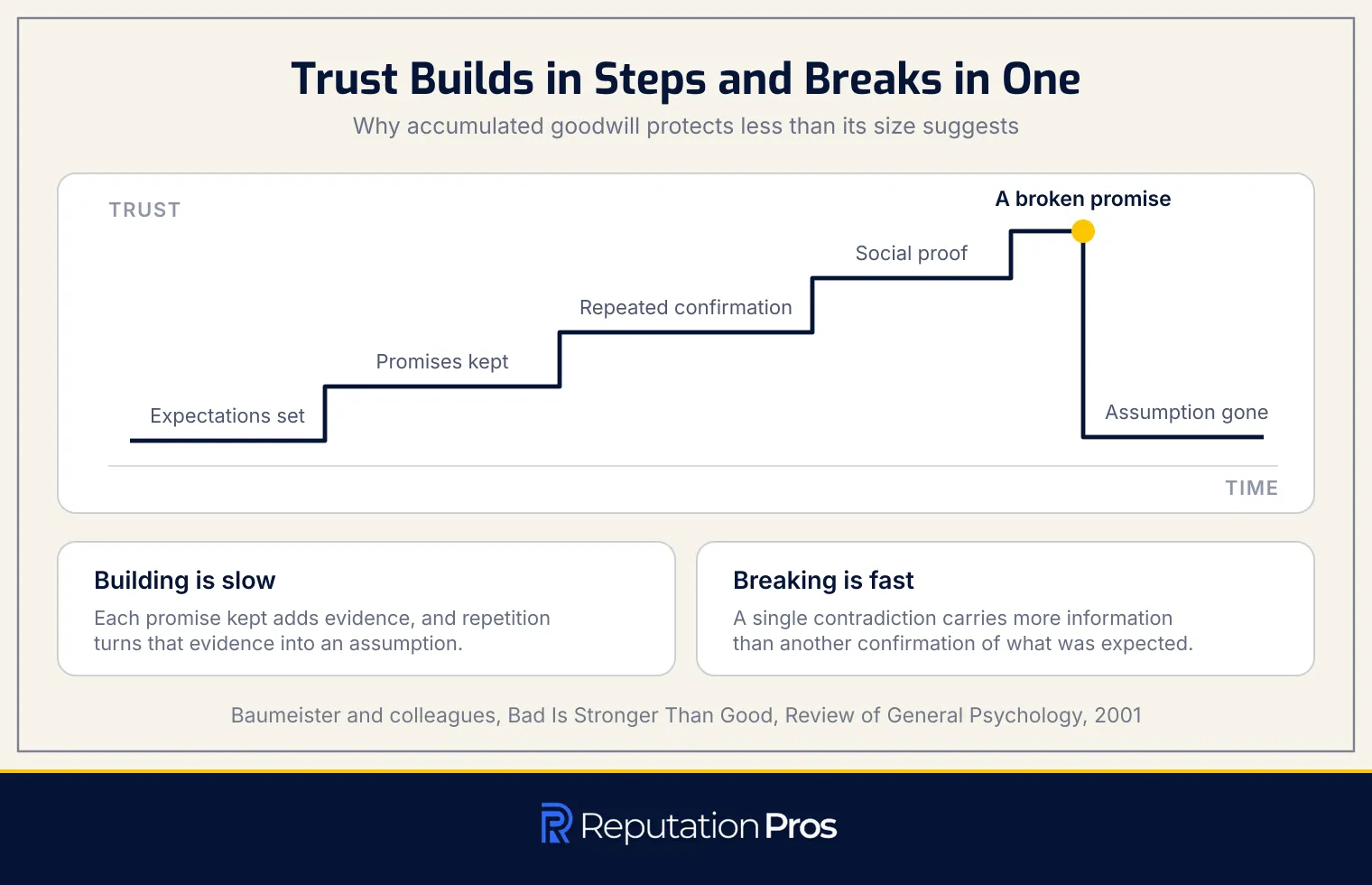
Trust builds in sequence. Expectations get set first, through what a brand or person promises. Promises kept convert those expectations into evidence. Repeated confirmation across many interactions turns evidence into an assumption, and social proof from other people’s experience accelerates the process for anyone arriving later.
Decline runs on a different clock. A broken promise removes the assumption immediately, because a single contradiction carries more information than another confirmation of what was already expected. Erosion compounds where breaches repeat, since each one confirms the first was not an exception.
Negativity bias explains the asymmetry. Roy Baumeister, Ellen Bratslavsky, Catrin Finkenauer and Kathleen Vohs found in “Bad Is Stronger Than Good,” published in Review of General Psychology in 2001, that bad impressions form faster and resist disconfirmation more stubbornly than good ones, and that bad information gets processed more thoroughly than good. Slow building against fast loss is what makes trust expensive to hold and cheap to lose, and it is the reason a brand’s accumulated goodwill offers far less protection than its size suggests.
Why Does Trust Matter for Brands?
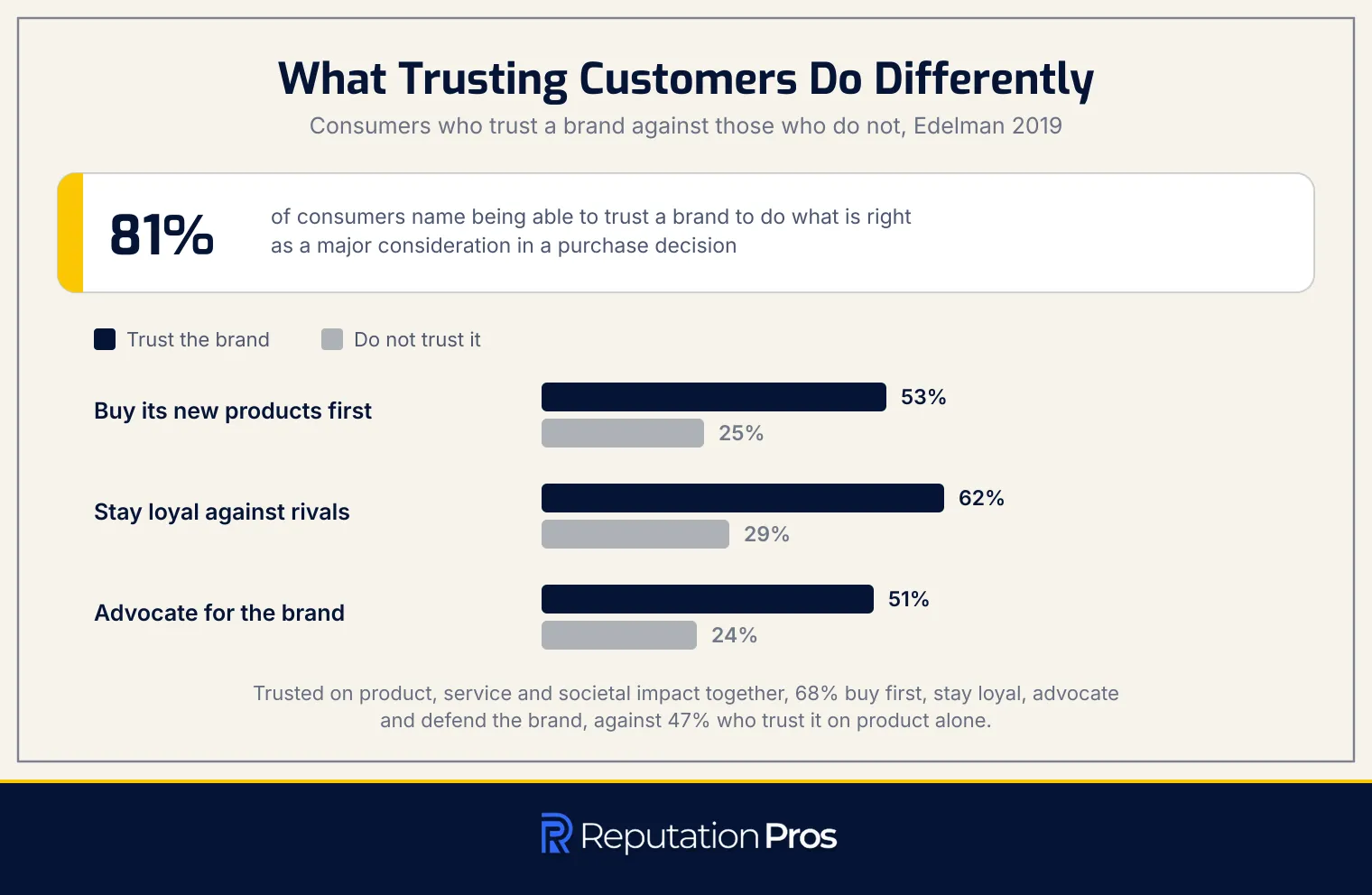
Trust is a fundamental prerequisite for both initial and repeat purchases in today’s competitive market. Edelman’s 2019 Trust Barometer Special Report, “In Brands We Trust?”, found that 81% of consumers name “I must be able to trust the brand to do what is right” as a major consideration in a purchase decision. Trust turns from a soft, intangible value into a tangible commercial asset that directly influences revenue and market positioning. When trust exists, customers are willing to make their first purchase despite uncertainties, and they return for additional purchases when their expectations are consistently met.
Brand trust functions as a key performance indicator (KPI) rather than just an aspirational quality. Trust carries measurable stakes, and the same Edelman report quantified them through behaviour rather than sentiment: consumers who trust a brand are more than twice as likely to be first to buy its new products, 53% against 25%, and more than twice as likely to stay loyal when a trendy competitor appears, 62% against 29%. Those figures mark trust as a concrete business metric impacting customer acquisition costs, retention rates, and lifetime value. Companies treating trust as a KPI can monitor it through tools like Net Promoter Score, customer satisfaction scores, sentiment analysis, and brand trust surveys, quantifying trust levels and adapting strategies accordingly.
The commercial value of brand trust spans multiple dimensions of business performance. Trusted brands hold advantages across acquisition and retention at once. Trust fosters customer loyalty and retention, reduces customer acquisition costs through positive word-of-mouth, lowers price sensitivity, and provides a competitive edge in crowded markets. Trust eases product launches, strengthens crisis resilience, enhances employer branding, and supports sustainable long-term growth. Rather than existing as an abstract reputational benefit, trust translates into tangible financial outcomes that can be measured, tracked, and optimized as part of a full brand strategy.
How Does Brand Trust Shape Customer Behavior?
Brand trust sharply influences customer behavior across several stages of the buyer journey. When consumers trust a brand, they are more likely to make repeat purchases and exhibit lower price sensitivity. Trust raises customer lifetime value, as consumers are willing to pay premium prices for products and services from brands they believe in. Trusted brands benefit from strong word-of-mouth marketing, with customers actively recommending them to friends and family.
Edelman’s 2019 Trust Barometer Special Report found that 81% of consumers treat being able to trust a brand to do what is right as a major purchase consideration, that trusting consumers are more than twice as likely to advocate for a brand, 51% against 24%, and that when a brand is trusted on product, customer service, and societal impact together, 68% will buy first, stay loyal, advocate, and defend it, against 47% who trust on product alone.
Trust acts as a decisive factor at each stage of the buyer journey, from awareness and consideration through purchase and post-purchase advocacy, driving both customer acquisition and retention.
How Does Brand Trust Strengthen Reputation?
Brand trust strengthens reputation by enhancing brand equity and customer advocacy. When consumers trust a brand, they are more likely to recommend it to others, creating organic marketing that is more persuasive than paid advertising. Trust provides resilience during a crisis, as trusted brands receive greater forgiveness and patience from consumers when mistakes occur. Trust extends to employer branding, making the organization more attractive to potential employees. Earned trust, built through consistent actions and alignment with brand values, is more effective than paid endorsements, as third-party validation is perceived as more credible.
What Makes a Brand Trustworthy?
A brand earns trustworthiness through several controllable signals that demonstrate its commitment to customers. The signals below establish a reliable and credible brand image.
- Product Quality: Consistent delivery of reliable, well-made products forms the foundation of trust, with quality ranking among the top reasons consumers give for trusting a brand.
- Fair Price: Offering value that matches or exceeds cost signals respect for customers and builds confidence in the brand’s intentions.
- Ratings and Reviews: Positive third-party feedback and transparent customer testimonials serve as public proof of a brand’s reliability and performance.
- Transparency: Honest communication about business practices, policies, ingredients, sourcing, and operations demonstrates openness and builds credibility.
- Privacy Protection: Responsible handling of customer data, including secure storage, limited collection, clear consent processes, and proper breach response, signals respect for customer vulnerability.
- Consistency Between Words and Actions: Aligning brand behavior with stated values and promises across all touchpoints reinforces integrity and prevents the erosion of trust.
- Responsible AI Use: Transparent disclosure of how AI is used in products, services, and data handling demonstrates ethical conduct in emerging technology and protects customer interests.
Each signal shapes consumer perception and fosters long-term loyalty, and together they make up a trustworthy brand presence.
How Does Product Quality Signal Brand Trustworthiness?
Product quality signals brand trustworthiness by providing consistent, tangible proof of a brand’s reliability and competence. When a brand consistently delivers high-quality products, it demonstrates its ability to meet consumer expectations, thus reducing uncertainty and building trust. Ratings and reviews serve as public proof of this quality, reinforcing consumer confidence. Fair pricing further enhances trust by showing the brand’s commitment to value and integrity. Product quality and value rank among the reasons consumers most frequently give for trusting a brand.
How Does Transparency Signal Brand Trustworthiness?
Transparency signals brand trustworthiness by demonstrating honest communication and clear policies. Brands that maintain open policies about pricing, terms of service, and return procedures make it easy for customers to understand agreements before purchase. Honest communication reduces uncertainty and shows that a brand has nothing to hide, creating a foundation for trust.
Transparency extends to welcoming and responding to customer feedback, both positive and negative. Responding openly signals that a brand values customer input and is committed to continuous improvement.
In the age of artificial intelligence, disclosing AI use in customer interactions, content creation, or decision-making processes is above all important. Brands that spell out when and how they use AI demonstrate respect for customer autonomy and reduce concerns about manipulation or deception. Transparency in business practice ranks among the factors that shape brand trust, and customers increasingly expect brands to be forthcoming about their operations, ingredient sourcing, manufacturing processes, and corporate decision-making.
How Does Privacy Protection Signal Brand Trustworthiness?
Privacy protection signals brand trustworthiness by demonstrating a company’s commitment to safeguarding personal data. Brands earn trust by limiting data collection to necessary information, obtaining explicit consent, and keeping data storage secure. Protection covers strong security measures and having a transparent breach response plan. Responsible handling of data in AI systems is decisive, involving clear disclosure of data use and strong security controls.
According to the General Data Protection Regulation (GDPR) and the California Consumer Privacy Act (CCPA), consumers have rights to know what data is collected and how it is used. Brands that comply with these regulations and exceed them by offering enhanced privacy controls and transparency position themselves as reliable partners in protecting consumer data.
How Can Brands Rebuild Trust After Failure?
Rebuilding trust after a brand failure requires a structured and deliberate approach. Recovery is urgent because a lost customer rarely announces the loss, and the brand learns of it through revenue rather than through complaint. The recovery process involves several key stages, each decisive to restoring consumer confidence.
Acknowledge the Failure Openly The first step is to openly acknowledge the failure. Transparency is decisive, as consumers expect brands to confront mistakes directly rather than deflect or delay response. Acknowledgment includes a clear statement of what went wrong.
Take Full Ownership and Apologize Sincerely Brands must take full responsibility for the issue and offer a sincere apology. The apology stays specific and free of excuses, demonstrating integrity and respect for affected customers. An apology that accepts responsibility can sharply enhance a brand’s trustworthiness.
Fix the Problem Using Customer Feedback To effectively address the issue, brands should actively listen to customer feedback. Listening means responding to complaints and using customer input to guide corrective actions. The stage shows benevolence, indicating that the brand prioritizes customer welfare over mere damage control.
Bring Actions Back in Line with Stated Values The recovery process must realign brand behavior with its stated values. Consistency between words and actions is necessary for rebuilding trust. Brands must address the root cause of the issue and make certain their actions reflect their public commitments.
Stay Consistent Over Time Trust is rebuilt through repeated positive experiences. Brands must demonstrate sustained reliability across multiple touchpoints and interactions, so that promises are consistently kept. Consistency over time is what regains consumer trust.
Track Recovered Trust Through Measurable Signals Finally, brands should measure the recovery of trust through several metrics, such as trust surveys, Net Promoter Score (NPS), customer retention rates, sentiment analysis, and review monitoring. Those measures gauge progress and adjust strategies as needed.
Rebuilt brand trust follows the same dimensions that govern trust between individuals: reliability, integrity, competence, and benevolence. The same sequence underpins every reputation recovery after a crisis.
Why Does Trust Matter for Individuals?
Trust is necessary for individuals as it underpins close relationships, personal wellbeing, and everyday decision-making. Trust allows individuals to form deep connections with partners, family, and friends by fostering openness and reliance without constant fear. Trust creates a sense of security and reduces stress, enabling individuals to navigate social interactions and personal challenges with confidence.
For personal wellbeing, trust contributes to lower stress levels and a sense of security, as individuals feel supported by their social environment. According to research, higher trust correlates with improved mental and physical health outcomes, as it reduces the need for constant vigilance and promotes resilience.
Trust simplifies decision-making by allowing individuals to rely on experts and recommendations, rather than verifying every option independently. Relying on trusted sources saves time and effort, making everyday decisions more efficient and less stressful.
The shared dimensions of trust, such as reliability, integrity, competence, and benevolence, link personal trust to brand trust, demonstrating its universal importance in both personal and commercial contexts. Whether in personal relationships or consumer interactions, trust functions as a decisive component that facilitates cooperation and confidence.
How Does Trust Support Relationships?
Trust supports relationships by fostering mutual benefit and openness among partners, family, and friends. When trust is present, individuals can rely on each other, sharing personal thoughts and emotions without fear of judgment or betrayal. Openness strengthens the connection, allowing relationships to grow stronger over time. Trust acts as a foundation for cooperation, enabling people to work together harmoniously toward common goals.
However, when trust is broken, it creates distance and suspicion. The damage from broken trust is substantial, frequently resulting in emotional withdrawal and reduced willingness to depend on the other person. Rebuilding trust requires time and consistent behavior change, as individuals seek assurance that the breach will not recur. The slow healing process highlights trust’s fragility and the importance of maintaining it within relationships.
How Does Trust Support Individual Wellbeing?
Trust supports individual wellbeing by fostering a sense of security and reducing stress. When individuals trust others, they experience less need for constant vigilance, which lowers overall stress levels. Security allows greater relaxation and engagement in social activities. Trust opens access to social support networks, which are decisive for mental and physical health. Individuals who trust their family, friends, and institutions are more likely to seek help and share vulnerabilities, enhancing their wellbeing.
The health effect of social connection is measurable. A 2010 meta-analytic review in PLoS Medicine by Julianne Holt-Lunstad, Timothy Smith and J. Bradley Layton, pooling 148 studies and 308,849 participants, found a 50% increased likelihood of survival for people with stronger social relationships, an influence on mortality comparable to well-established risk factors such as smoking. Trust, therefore, serves as a foundational element in promoting holistic health.
How Does Trust Affect Individual Decisions?
Trust sharply impacts individual decisions by serving as a cognitive shortcut. Trust reduces the need to verify every option, allowing quicker and more efficient decision-making. In everyday contexts, individuals frequently trust expert opinions, such as those from doctors or financial advisors, without independently verifying their recommendations.
- Reliance on Reviews and Recommendations: People frequently depend on consumer reviews and recommendations from friends and family when making purchasing decisions. Trust in external advice simplifies the decision.
- Risk of Misplaced Trust: While trust can streamline decision-making, misplaced trust can lead to poor choices and potential financial loss. Relying on unverified sources can result in vulnerability to misinformation.
Trust facilitates decision-making by reducing cognitive load but requires careful evaluation to avoid the risks associated with misplaced reliance.
What Are the Consequences of Low Trust?
Low trust results in numerous adverse effects for both brands and individuals, impacting commercial success and interpersonal relationships. The primary consequences are detailed below.
- Lost Customers and Revenue: Brands frequently face a substantial loss of customers and revenue when trust is compromised. Edelman’s 2019 Trust Barometer Special Report put trust at the centre of the purchase decision, with 81% naming it a major consideration, which means losing it removes the precondition of the sale rather than merely weakening the pitch.
- Higher Verification Costs: When trust is low, the cost of verification increases, as individuals and businesses spend more time and resources verifying claims and seeking proof before making decisions. Added scrutiny slows decision-making and increases operational friction.
- Stalled Decisions: Low trust leads to hesitation and stalled decisions, as consumers are less likely to proceed quickly through the buying journey. Uncertainty makes every promise feel riskier, causing delays in purchasing and other decision-making activities.
- Distance in Relationships: In personal and professional contexts, low trust creates emotional and communicative distance. Relationships suffer as individuals must independently verify information rather than relying on mutual trust, leading to reduced collaboration and openness.
The consequences mark the decisive role trust plays in facilitating effective transactions and maintaining strong relationships. Trust serves as a foundational element that, when absent, can sharply disrupt both commercial and personal interactions.
How Can People Evaluate Trustworthy Behavior?
Evaluating trustworthy behavior involves assessing several key factors that demonstrate reliability and integrity. Those factors determine whether an individual or brand is worthy of trust. The most effective methods for evaluation are outlined below.
- Check the track record: Review past behaviors and consistency over time to gauge reliability.
- Compare words with actions: Make certain that stated commitments align with actual behaviors.
- Read social proof: Examine reviews, ratings, and testimonials for a clear read into public perception.
- Watch how feedback and criticism are handled: Observe whether accountability and transparency are maintained during negative situations.
- Score behavior against four dimensions: Evaluate reliability, integrity, competence, and benevolence in interactions.
Brands can track these signals using metrics such as trust surveys, Net Promoter Score (NPS), sentiment analysis, and customer retention rates. Those measures quantify trustworthiness in the same way a person judges it.
How Does Trust Shape Professional Relationships?
Trust fundamentally shapes professional relationships by fostering open communication and collaboration. In work environments, trust between employees enables smooth cooperation, reducing friction and encouraging teamwork. When colleagues trust each other, they can rely on one another’s competence and integrity, which facilitates effective decision-making and project execution.
Leadership plays a decisive role in cultivating trust through consistent, ethical behavior and transparent communication. Managers who are honest and fair inspire confidence and motivate employees to align with organizational goals. Employees who trust their leadership are more likely to voice concerns, share ideas, and provide constructive feedback, contributing positively to the organization’s culture and reputation.
Professional trust extends beyond internal teams to include clients and stakeholders. Trust in these external relationships is built on the ability to deliver on commitments and maintain reliability. When businesses consistently meet client expectations, they strengthen long-term partnerships and enhance their reputation in the industry.
Employees who trust their organization frequently become advocates for the brand, promoting it in public forums and defending it during criticism. Employee advocacy extends brand trust, as employee endorsements frequently carry more weight than traditional marketing efforts.
Why Is Trust Important for Brands and Individuals?
Trust is fundamental for both brands and individuals as it facilitates reliance on another party’s ability and intention to fulfill promises under uncertain conditions. For brands, trust acts as a large-scale version of person-to-person trust, impacting thousands or millions of customer interactions. Brand trust underpins customer loyalty, repeat purchases, and advocacy, transforming it into a measurable commercial asset. For individuals, trust supports relationships, enhances wellbeing, and simplifies decision-making by reducing the need for constant verification.
The shared significance of trust lies in its influence on outcomes that matter to both entities. When trust is compromised, whether in personal relationships or between a brand and its customers, the repercussions are similar: increased distance, hesitation, and higher verification costs. The parallel shows brand trust is not a separate phenomenon but rather an extension of the same relational dynamics, built on consistent actions, ethical conduct, demonstrated expertise, and considerate intent.
Ultimately, trust is necessary for navigating uncertainty and must be earned through consistent alignment of promises, intentions, and capabilities with expectations.