SEO Reputation Management: Role, Importance and Tactics
 36 min read
 On this page
SEO reputation management is the practice of controlling what appears in branded search results and AI-generated answers concerning a company, its executives, and its products. SEO reputation management shapes the digital first impression by making sure positive, accurate content appears prominently, while negative or misleading information is suppressed or corrected. The role sits apart from broader online reputation management, which encompasses a wider range of digital channels beyond search engines.
The importance of SEO reputation management for businesses is substantial. That protects decisive outcomes such as sales conversions, lead flow, recruitment, investor confidence, and customer retention. Negative search results can lead to reduced credibility and conversion rates, as they frequently decrease branded click-through rates and cause potential leads to drop off during the research phase. Reputation signals that influence SEO performance include reviews, brand mentions, local reputation, citations, and NAP (Name, Address, Phone) consistency. Reviews provide fresh, keyword-rich content and trust signals that affect both rankings and user engagement.
Priority tactics in SEO reputation management include review management, continuous monitoring, addressing negative content, crisis response strategies, creating high-quality content, engaging in digital PR and link building, optimizing platforms beyond Google, and leveraging social media. AI search has introduced new complexities, as AI-generated answers frequently summarize reviews and brand mentions, making it necessary to secure accurate AI descriptions. A full plan involves setting timelines, assigning ownership, and maintaining a consistent monitoring cadence to sustain long-term brand visibility. Continuous monitoring allows early detection of new negative results, maintaining strong brand visibility and shaping what searchers see first.
How Does SEO Reputation Management Shape Search Results?
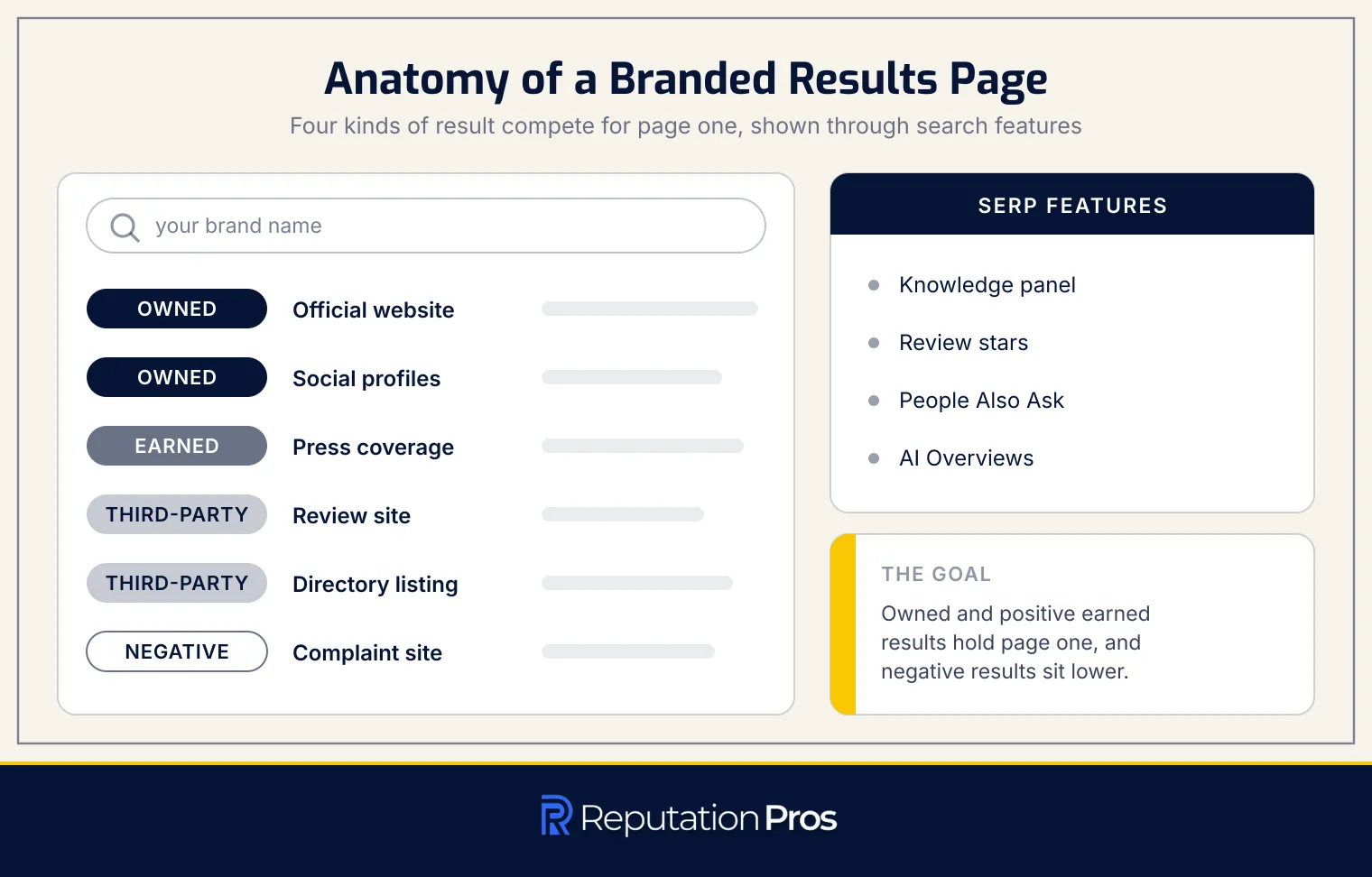
SEO reputation management influences search results by controlling the visibility of branded pages, profiles, and third-party mentions. That makes certain that positive or neutral assets appear prominently on the first page when someone searches a company, executive, or product name. The process also affects AI-generated answers that summarize a brand.
A branded results page usually consists of four types of content: owned results, earned results, third-party results, and negative results. Owned results include the official website and social profiles. Earned results encompass press coverage and interviews. Third-party results feature reviews and directory listings. Negative results might come from complaint sites or critical articles. The results are displayed through SERP features such as the knowledge panel, review stars, People Also Ask boxes, and AI Overviews.
SEO reputation management applies technical and content strategies to make certain that owned and positive earned results dominate page-one positions. Negative or misleading content is frequently pushed to page two or beyond or removed entirely if policy violations justify it. By optimizing for branded queries and strengthening entity signals, businesses control the narrative searchers encounter, the trust signals they receive, and ultimately the actions they take.
What Does Search Engine Optimization Mean for Reputation Management?
Search engine optimization (SEO) for reputation management involves applying SEO principles such as ranking, indexing, and entity signals specifically to branded queries. The approach differs from traditional SEO, which focuses on non-branded traffic acquisition. Reputation-focused SEO targets searches that include a company name, executive names, or product names, aiming to control which content appears prominently in search results.
SEO reputation management prioritises indexing owned properties and building authority signals for positive assets. That secures entity consistency across platforms so that search engines recognize and display the most favorable, accurate information when someone searches for the brand. The technical work involves optimizing branded pages to outrank negative or neutral third-party content, managing structured data to feed knowledge panels, and using link equity to elevate authoritative positive results above detractors.
What Does SEO Reputation Management Cover?
SEO reputation management involves several branded surfaces that are necessary for maintaining a positive online presence. Search surfaces shape how a brand is perceived in search results and AI-generated content.
- Company Name Searches: This includes search results that appear when users query the business or organization name, so that the brand is represented accurately and positively.
- Executive Names: Search results for founders, CEOs, and other key leadership figures are monitored to protect the reputation of individuals associated with the brand.
- Product Names: This covers search results for specific products, services, or offerings associated with the brand, securing accurate representation and positive visibility.
- Review Profiles: Listings and profiles on review platforms such as Google Business Profile, Yelp, Trustpilot, and industry-specific review sites are managed to maintain a positive reputation.
- AI-Generated Answers: Responses generated by AI systems, including AI Overviews, ChatGPT, Perplexity, and other large language model assistants, are monitored to make certain they reflect the brand accurately and positively.
How Does SEO Reputation Management Differ From Online Reputation Management?
SEO reputation management and online reputation management share common goals but differ in their scope and techniques. The primary distinction lies in their focus areas, with SEO reputation management concentrating on search engine visibility, while online reputation management covers a broader digital presence.
| Dimension | SEO Reputation Management | Online Reputation Management |
|---|---|---|
| Primary Goal | Control and strengthen branded search results and AI-generated answers to secure favorable visibility for companies, executives, and products. | Manage overall online perception across several channels, including reviews, social media, and news. |
| Channels Covered | Search engines (Google, Bing), AI tools (ChatGPT, Perplexity), knowledge panels, and review snippets. | Search engines, social media, review sites, forums, blogs, and news platforms. |
| Core Tactics | Branded SERP audits, content creation, digital PR, link building, and suppression of negative results. | Sentiment monitoring, responding to reviews, crisis communications, and public relations. |
| Metrics Tracked | Branded rankings, page-one ownership, review stars, click-through rates, and AI-answer accuracy. | Overall sentiment, review ratings, social media engagement, and public perception. |
| Overlap | Both aim to protect trust, reduce negative content impact, and strengthen third-party validation through reviews and mentions. | Both aim to protect trust, reduce negative content impact, and strengthen third-party validation through reviews and mentions. |
SEO reputation management serves as a specialized subset of online reputation management, applying search engine optimization principles specifically to branded queries, which is the core of how ORM and SEO differ.
What Role Does SEO Reputation Management Play in Brand Search Results?
SEO reputation management plays a pivotal role in shaping the first impression that search results convey about a brand. Page one of search results is decisive as it displays branded query variants such as the brand name, brand plus reviews, brand plus complaints, and executive names. The results act as the first point of contact for potential customers, partners, and investors. The entity layer that anchors these results includes structured data components like Organization schema, knowledge panel information, and Wikidata consistency. The components make certain that search engines accurately connect the brand’s name, logo, address, profiles, and related content to the correct entity.
Consistency in the entity layer is vital for maintaining control over branded search results. Discrepancies in business information, conflicting data across platforms, or gaps in structured data weaken a brand’s entity strength. Neglect lets third-party or negative content occupy valuable page-one real estate. By reinforcing entity signals and maintaining accurate, consistent information across all platforms, businesses can assert authority over their branded search outcomes. Claiming them reduces the chance of outdated, inaccurate, or negative content ranking prominently for queries involving the company or its executives.
Why Does SEO Reputation Management Matter to Businesses?
SEO reputation management is decisive for businesses because brand searches sharply influence purchasing decisions. Consumers research before they buy, and reviews carry most of that weight. BrightLocal’s Local Consumer Review Survey 2026 found that 97% of consumers read online reviews when deciding about a local business, that 74% check at least two review sites before deciding, and that 47% will not consider a business carrying fewer than 20 reviews. The same survey found 85% become more likely to use a business after reading positive reviews and 77% are put off by negative ones, which is how search reputation reaches the conversion rate.
In a zero-click environment, where search results provide immediate answers, businesses have limited opportunities to manage perceptions, making the content on page one even more decisive. Negative reviews or unfavorable coverage can immediately erode trust, increase hesitation at the comparison stage, and reduce the number of prospects who proceed to purchase.
Which Business Outcomes Can SEO Reputation Management Protect?
SEO reputation management protects several decisive business outcomes that directly impact organizational success and growth. The key outcomes protected by effective SEO reputation management are outlined below.
- Sales Conversions: By making sure positive brand content appears on page one of search results, businesses protect the purchase decisions of prospects who research the brand before buying, preventing negative content from disrupting the final stages of the sales funnel.
- Lead Flow: When branded search results display positive reviews, complete business profiles, and authoritative content, prospective customers are more likely to complete contact forms, request quotes, or initiate outreach, maintaining a steady pipeline of qualified leads.
- Recruitment: Strong search reputation helps attract talent, because candidates research an employer the same way customers research a product. Positive branded search results for both company and executive names create confidence among potential employees evaluating career opportunities.
- Investor and Partner Confidence: Institutional investors, venture capital firms, and potential business partners conduct thorough online due diligence before committing resources. Clean branded search results that demonstrate market credibility, positive customer sentiment, and professional management protect deal flow and partnership opportunities.
- Customer Retention: Existing customers who encounter negative search results when researching additional products or services may reconsider renewal decisions or expansion purchases. Managing branded search results helps maintain confidence among the current customer base and supports upsell and cross-sell initiatives.
How Do Negative Search Results Reduce Credibility and Conversions?
Negative search results reduce credibility and conversions by undermining trust at decisive decision-making stages. When potential customers encounter negative content, such as complaint sites or unfavorable reviews, during their pre-purchase research, it leads to a decline in branded click-through rates. Avoidance happens because consumers hesitate to engage with a brand’s online properties if negative information is prominent.
Research measures the effect directly. Marton Varga and Paulo Albuquerque’s study “The Impact of Negative Reviews on Online Search and Purchase Decisions,” published in the Journal of Marketing Research in 2024, used click-stream data from a major online retailer and found that consumers who encounter a negative review become more likely to stop gathering information about that product altogether, cutting the search short rather than weighing further evidence.
The presence of negative content on page one, especially for branded queries, creates doubt and encourages potential buyers to explore alternative options, resulting in measurable lead drop-off and lower conversion rates.
Which Reputation Signals Affect SEO Performance?
SEO performance is influenced by several decisive reputation signals. The signals help determine a website’s visibility and credibility in search engine results. The most substantial reputation signals are outlined below.
- Reviews: Reviews provide fresh, user-generated content that includes relevant keywords and location information. The volume, recency, and sentiment of reviews contribute to E-E-A-T (Experience, Expertise, Authoritativeness, Trustworthiness) by indicating a business’s activity and trustworthiness.
- Brand Mentions: Both linked and unlinked brand mentions serve as validation of a brand’s legitimacy and relevance. Mentions from authoritative sources reinforce a brand as a recognized entity, contributing positively to E-E-A-T.
- Backlinks: High-quality backlinks from reputable websites act as endorsements that elevate a site’s credibility. Editorial backlinks establish authority and trust, directly supporting E-E-A-T by signaling a website’s relevance and quality.
- Entity Consistency: Consistent representation of a brand’s entity information across platforms strengthens how search engines understand and trust that entity. Consistency covers matching information in Organization schema, Knowledge Graph data, and directory listings.
- Local Citations and NAP Consistency: Accurate local citations with consistent Name, Address, and Phone number (NAP) details validate a business’s legitimacy and support local SEO efforts. Inconsistent citations can harm a business’s visibility and reputation.
Reputation signals carry real weight in SEO performance and shape a brand’s visibility and credibility in search engine results.
How Do Customer Reviews Influence Searcher Trust and Rankings?
Customer reviews sharply impact searcher trust and search engine rankings. They serve as a key indicator of a business’s popularity and credibility. The review count, average rating, recency, and velocity of reviews contribute to this influence. A high volume of reviews signals trustworthiness and attracts both search engines and potential customers. Fresh reviews demonstrate ongoing customer engagement, indicating that the business is active and responsive. Owner responses to reviews, above all negative ones, show accountability and strengthen customer trust.
The limits are set by policy rather than preference: Google’s Maps user-generated content rules prohibit reviews not based on a real experience, reviews posted from multiple accounts at one person’s request, incentives offered in exchange for a review, and conflict-of-interest content, and they forbid merchants from discouraging negative reviews or selectively soliciting positive ones. The FTC’s Rule on the Use of Consumer Reviews and Testimonials, in force since 21 October 2024, carries civil penalties of up to $51,744 per violation and requires an officer or manager to disclose the relationship before writing or soliciting a review of their own business.
Keywords naturally embedded in review texts help search engines understand the business’s offerings, improving relevance for related queries. Review star ratings directly affect click-through rates by making search results more visually appealing. Google’s Search Quality Rater Guidelines treat reputation, including reviews, as evidence raters weigh when assessing Experience, Expertise, Authoritativeness and Trustworthiness. Google states that rater judgments do not directly change rankings; the guidelines describe what its systems aim to reward.
Listings carrying star ratings draw more clicks than listings without them. Review management therefore serves two purposes at once, strengthening both rankings and visibility.
How Do Brand Mentions Affect Online Credibility?
Brand mentions sharply strengthen online credibility by establishing the brand as a recognized entity. Both linked and unlinked mentions contribute to this effect. Linked mentions pass traditional authority through backlinks, strengthening SEO. Unlinked mentions, while lacking direct link equity, still signal brand recognition and awareness.
The authority and sentiment of the source mentioning the brand are decisive. Mentions from reputable, high-authority websites carry more weight than those from low-quality sources. Positive sentiment in these mentions bolsters credibility, whereas negative or neutral mentions may diminish it. Consistent mentions across multiple authoritative sources reinforce the brand’s legitimacy. The consistency supports Google’s understanding of the brand’s existence and relevance, influencing both traditional search results and AI-generated answers.
How Does Reputation Affect Local SEO?
Reputation sharply impacts local SEO by influencing map pack visibility and determining which local listing a searcher chooses. Ratings, reviews, and Google Business Profile completeness are key factors shaping a business’s prominence in local search results.
Google states in “Tips to improve your local ranking on Google” that local results rest on three factors: relevance, meaning how well a profile matches the search; distance, meaning how far the business sits from the searcher; and prominence, meaning how well known the business is, which Google says includes how many reviews it has. The same guidance confirms that more reviews and positive ratings can help local ranking, and that no business can request or pay for a better local position. Reputation is central to the prominence factor, where review count, average star rating, and review recency contribute to a business’s authority and trustworthiness. A business with a high star rating and numerous recent reviews usually ranks higher than competitors with lower ratings and fewer reviews.
Beyond rankings, reputation affects user behavior in local search results. Searchers frequently rely on star ratings, review counts, and recent review snippets from the map pack to decide which business to contact or visit. Searchers use the profile itself to decide, which is what converts a map-pack impression into a visit or a call. Incomplete listings, outdated reviews, or lower ratings can reduce visibility and the likelihood of being chosen by consumers, making reputation management decisive for any local SEO strategy.
How Does Local Reputation Influence Local Search Visibility?
Local reputation sharply impacts local search visibility through Google’s three-pillar framework: relevance, distance, and prominence. Relevance relates to how well a business matches a searcher’s query, while distance considers proximity to the searcher. Prominence, however, is a decisive factor influenced by review count and score. A business with numerous positive reviews and high ratings tends to achieve better map pack placement, even when not the closest option to the searcher.
Prominence reflects a business’s recognition and trustworthiness, incorporating factors such as backlinks and review volume. Google’s local search ranking factors, as documented in the Google Business Profile Help guidelines, confirm that prominence includes review count, review score, and other reputation signals. Businesses with strong local reputation signals are more likely to appear frequently in local search results, strengthening their visibility and attractiveness to potential customers.
How Do Local Citations and NAP Consistency Support Reputation?
Local citations and NAP consistency are decisive components of local SEO that strengthen a business’s online credibility and search visibility. A local citation refers to any online mention of a business’s name, address, and phone number (NAP). Maintaining NAP consistency means making sure these details are identical across all platforms, including directories, review sites, and social media.
- Exact NAP Matching: Ensures that the business name, address, and phone number are consistent across all listings, preventing confusion for search engines and potential customers.
- Claiming Core Directories: Involves registering and optimizing profiles on necessary directories like Google Business Profile, Yelp, and Bing Places to establish a reliable online presence.
- Data Aggregators: Utilize services like Infogroup and Localeze to distribute consistent NAP information across several platforms.
- Merging or Removing Duplicates: Eliminates duplicate listings that can split authority and dilute reputation signals, thereby improving search engine trust and local ranking.
Which SEO Reputation Tactics Should Businesses Prioritize?
Businesses should prioritize SEO reputation tactics in a structured order to effectively manage their online presence. The following list outlines the recommended tactics:
- Branded SERP Audit Begin with a full audit of branded search engine results pages (SERP). A page-one audit classifies the top 10 results as owned, neutral, or negative. The audit helps identify which pages are controllable and which require strategic actions like removal, suppression, or rebuilding.
- Review Management Actively manage customer reviews across platforms such as Google and industry-specific sites. Focus on increasing review volume, recency, and ratings while making sure responses are timely. The tactic builds trust and improves search visibility.
- Google Business Profile Optimization Ensure your Google Business Profile is complete and up-to-date. Include accurate name, address, and phone (NAP) details, business hours, and current photos. An optimized profile enhances local search visibility and credibility.
- NAP Consistency and Citation Management Maintain consistent NAP information across all directories and data aggregators. Claim and update core directory profiles, merge duplicates, and remove outdated listings to reinforce trust and search engine signals.
- Owned Asset Development Create and optimize owned content such as about pages, leadership bios, case studies, and FAQ pages. The assets should rank for branded queries and demonstrate expertise, authority, and trustworthiness (E-E-A-T).
- High-Authority Content and Digital PR Secure media placements and guest posts on authoritative sites. The efforts increase backlinks to positive assets and help suppress negative content by boosting the authority of owned properties.
- Link Building to Positive Assets Strategically build high-quality backlinks to owned properties like the homepage and positive press coverage. Internal linking raises the authority of those pages, helping them outrank negative results.
- Schema Markup and Entity Consistency Implement schema markup on your website and secure entity consistency across platforms like Wikidata and Google Knowledge Panel. Consistent entity data helps search engines recognise the brand as a credible entity.
- Negative Content Assessment Evaluate each negative search result to determine the appropriate action: removal, suppression, or rebuilding. Address issues transparently and implement operational improvements where necessary.
- Content Removal (When Eligible) Pursue content removal for eligible cases such as policy violations, outdated information, or legal grounds. Removal is effective for permanently addressing negative content.
- Reputation Rebuilding for Legitimate Criticism Address legitimate criticism through rebuilding efforts. Recovery means acknowledging issues publicly, implementing changes, and demonstrating improvements over time.
- Continuous Monitoring Establish a monitoring routine with daily alerts for branded queries, weekly review checks, and regular audits of SERP and AI-generated answers. Early detection allows for timely responses to new negative results.
- Social Media Reputation Management Maintain consistent and verified social media profiles. Use these platforms to handle public complaints, share positive content, and provide updates during reputation events.
- Platform-Specific Optimization Beyond Google Extend optimization efforts to platforms like Bing, YouTube, and industry review sites. Tailor tactics to each platform’s requirements to strengthen reputation management.
- AI Search Optimization Optimize for AI-generated answers by strengthening reputation signals such as review sentiment and brand mentions. Monitor AI Overviews and address inaccuracies promptly.
- Crisis Response Protocol Develop a crisis response plan with clear roles and actions for the first 48 hours. Prepare holding statements and owned response pages to manage reputation events effectively.
Following this priority order, businesses can effectively manage their SEO reputation, starting with a branded SERP audit and progressing through review management as the first ongoing tactic.
How Should Businesses Manage Online Reviews?
Managing online reviews effectively is decisive for maintaining a positive reputation and strengthening SEO performance. Businesses should adopt a systematic approach to handle reviews efficiently.
- Request Timing and Channels: Solicit reviews at optimal moments in the customer journey, such as after a positive service milestone like delivery or project completion. Use multiple channels, including email, SMS, and in-store prompts, to reach customers effectively.
- Response Speed: Respond to all reviews promptly, ideally within 24-48 hours for negative feedback and a few days for positive comments. Quick responses demonstrate engagement and care, signaling to both customers and search engines that the business values feedback.
- Handling Negative Reviews: Address negative reviews professionally by acknowledging the customer’s experience, offering to resolve issues offline, and explaining corrective actions taken. Avoid defensive language to maintain credibility and demonstrate accountability.
- Flagging Fake Reviews: Monitor for suspicious review patterns, such as sudden spikes or generic language, and report fake reviews using platform-specific mechanisms like Google’s flag feature or Yelp’s reporting system.
- Third-Party Review Sites: Claim and optimize profiles on relevant platforms like Google Business Profile and Trustpilot. Ensure consistent NAP (Name, Address, Phone) information across all sites and monitor these profiles for new reviews on a set cadence.
- Policy Limits on Review Gating and Incentivized Reviews: Avoid review gating, which filters customers to only ask satisfied ones for reviews, and do not offer incentives for reviews. Google’s guidelines explicitly prohibit these practices to secure unbiased feedback.
- Review Markup Eligibility: Understand that self-serving review markup on a brand’s website is not eligible for Google’s star-rich results. Star ratings in search results come from aggregated third-party reviews, not testimonials controlled by the business itself.
Following these guidelines makes certain that businesses manage online reviews effectively, strengthening their reputation and supporting SEO efforts.
How Can Businesses Monitor Their Search Reputation?
Monitoring search reputation involves several key steps to secure a full understanding of your brand’s online presence. The following actions are necessary for effective search reputation management.
- Define the Branded Query Set: Identify all relevant branded search terms, including company name, product names, executive names, and common misspellings. Include modifiers like “reviews,” “complaints,” and “scam” to capture potential negative sentiment.
- Set Up Google Alerts and Social Listening: Configure Google Alerts for immediate notifications on brand mentions. Use social listening tools like Mention or Brandwatch to monitor discussions across social media, blogs, and forums. Alerting catches early signs of reputation issues.
- Track Branded Rankings: Utilize rank-tracking tools such as SEMrush or Ahrefs to monitor your brand’s position in search results. Focus on the top 20 results to identify any negative content that may be gaining traction.
- Establish a Fixed Monitoring Cadence: Implement a schedule for regular checks. Conduct daily alerts for new mentions, weekly reviews of platforms like Google Business Profile, monthly audits of search engine results pages (SERPs), and quarterly assessments of AI-generated answers.
A structured cadence lets businesses detect and address potential reputation threats promptly, maintaining a positive brand image online.
Which Search Reputation Signals Should Businesses Monitor?
Businesses should monitor several key search reputation signals to maintain effective control over their branded search presence. Each signal provides a clear read into different aspects of a company’s online reputation and visibility.
- Branded Rankings: Track where your company, executive, and product queries appear on page one. Rank tracking shows whether positive content holds those positions or if negative results are gaining visibility.
- Newly Ranking URLs: Identify fresh content entering branded results. New entrants include review sites, news articles, and complaint pages that can impact perception and require timely response or suppression.
- Sentiment: Measure the tone of ranked content, classifying it as positive, neutral, or negative. Monitoring sentiment shifts in top-ten results reveals changes in overall brand impression.
- Review Velocity: Monitor the pace at which new reviews are received across platforms like Google Business Profile. A sudden increase in negative reviews or a drop in volume can signal potential reputation risks.
- Brand Mentions: Track the frequency and contexts in which your company appears in articles, forums, and social media. The authority and sentiment of these mentions affect your credibility and entity strength.
- AI-Answer Accuracy: Evaluate what AI-generated tools like ChatGPT and Perplexity say about your brand. Inaccurate or negative AI-generated answers can shape perception before a searcher clicks on traditional results.
When a negative result is flagged, businesses must quickly decide how to address it, through removal if it violates policies, suppression by strengthening positive content, or reputation rebuilding when the criticism reflects real operational issues.
How Can Businesses Address Negative Search Content?
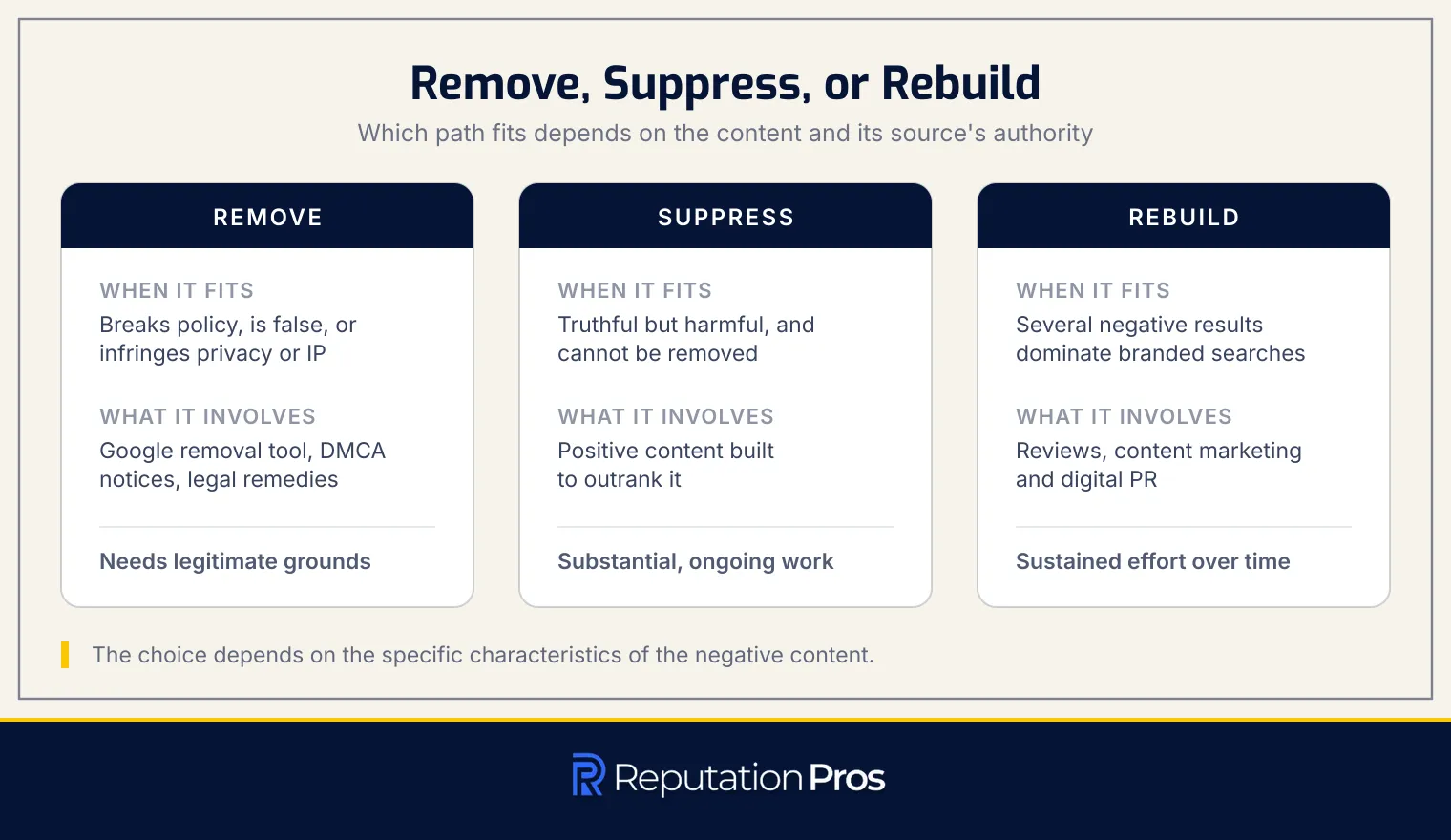
Businesses can address negative search content through three strategic paths: removal, suppression, and reputation rebuilding. Each path is suited to different circumstances based on the content’s nature and its source’s authority.
Removal The path applies when negative content violates platform policies, contains false information, or infringes on privacy or intellectual property rights. Core actions involve requesting deletions through Google’s personal-information removal tool, filing DMCA notices, or pursuing legal remedies. Removal is limited to cases with legitimate legal grounds and can be time-intensive.
Suppression Suppression is appropriate when negative content is truthful but harmful and cannot be removed. That involves creating and optimizing positive content to outrank negative results. Actions include strengthening company websites, executive bios, and social media profiles to occupy prominent search positions. Suppression requires substantial resources and ongoing optimization efforts.
Reputation Rebuilding Rebuilding suits cases where several negative results dominate branded searches. That involves generating positive signals across the web to reshape perception. Key actions include systematic review generation, content marketing, and digital PR campaigns. Rebuilding requires sustained effort and resource commitment over time.
The choice of path depends on the specific characteristics of the negative content and the desired outcome.
How Can Positive Content Outrank Negative Results?
Creating positive content that outranks negative search results involves strategic management of digital assets across several platforms. The process begins with filling page one of search results with owned properties.
- Fill Page One with Owned Properties: Establish a strong presence by creating and optimizing site pages, social media profiles, press coverage, and video content. The assets should address brand-related queries comprehensively.
- Point Links at Positive Assets: Enhance the authority of owned properties by acquiring high-quality backlinks. Utilize digital PR campaigns to earn mentions and links from reputable sources, and build strong internal linking within your site.
- Strengthen Assets with Schema and Entity Signals: Implement structured data markup to improve search engine understanding. Use Organization schema for websites and Person schema for executive pages, maintaining consistent NAP information across platforms.
By executing these tactics, businesses can effectively manage their online reputation and make certain that positive content dominates search results.
When Can Negative Search Results Be Removed?
Negative search results can be removed under specific conditions that align with platform policies or legal frameworks. Each removal path has distinct eligibility criteria, so that only content violating certain rules can be taken down. The main removal paths include:
- Google Personal-Information Removal: Applies when search results expose sensitive personal data, such as financial information or identification numbers. Requests are made through Google’s legal forms, and the content may still remain online even if deindexed from name-based searches.
- Refresh Outdated Content Tool: This tool is used when a page has changed or been removed, but Google’s search results still show outdated snippets or cached information. That is a refresh request rather than a content takedown.
- DMCA Takedown: This is applicable when the negative result involves copyrighted material posted without authorization. The copyright owner or authorized agent can submit a legal removal request under the Digital Millennium Copyright Act.
- Court Orders: Court orders can compel the removal of search results when a legal judgment determines the content is defamatory, violates privacy rights, or breaches other legal standards. The order must be valid in the jurisdiction where removal is requested.
- EU Right to Be Forgotten: This allows individuals in the European Union to request removal of search results containing personal information that is inadequate, irrelevant, excessive, or no longer relevant. Google reviews these requests case by case.
- Review-Policy Violations: Reviews can be removed when they violate platform content rules, such as containing spam, fake content, or prohibited material. Only reviews that break these policies are eligible for removal.
Google’s own guidance sets the boundary on what removal achieves: its “Remove my private info from Google Search” page states that Google can only remove material from its own results, and that content taken out of Search may still sit on the internet and remain reachable through links, social media, or another engine. The European right-to-be-forgotten route derives from the Court of Justice of the European Union’s May 2014 ruling that individuals may ask search engines to delist certain results about them. The removal paths rest on official guidelines from sources such as Google Search Central and legal frameworks like the EU GDPR Article 17, so that the process is both fair and legally compliant.
How Should Businesses Respond to a Reputation Crisis?
Immediate Actions in the First 48 Hours When a reputation crisis strikes, the first 48 hours are decisive for damage control. Businesses must swiftly assemble a crisis response team comprising PR, legal, customer service, and executive leadership. The response team conducts rapid fact-checking, preserves evidence, and issues a holding statement that acknowledges the situation without making unverified promises. The holding statement goes on owned channels such as the company website and social media profiles to secure message consistency and visibility.
Building a Controlled Narrative Creating an owned response page on the company website is necessary. The response page ranks for crisis-related queries and presents the company’s official stance, factual context, and ongoing updates. Optimizing it for branded terms keeps it prominent in search results, providing a controlled narrative rather than leaving the conversation to third parties.
Stakeholder Communication and Actions to Avoid Keeping stakeholders informed with verified facts and next steps is decisive. Businesses should update employees, customers, investors, and partners consistently across appropriate channels. Avoid the actions that deepen a crisis, such as arguing publicly, deleting criticism, engaging in astroturfing, or amplifying the story with unnecessary responses. Maintaining a factual, coordinated, and centralized approach helps stabilize the narrative and protect search visibility.
How Does High-Quality Content Improve Search Reputation?
High-quality content improves search reputation by creating owned pages that rank well in branded queries, showcasing the brand’s credibility and authority. The pages include about and leadership pages, case studies, FAQ pages on reputation queries, and expert articles. Each content type carries strong E-E-A-T signals, Experience, Expertise, Authoritativeness, and Trustworthiness, which are decisive for search engines to evaluate the quality and trustworthiness of a website.
About and leadership pages establish credibility by detailing the company’s history and leadership credentials. Case studies demonstrate expertise through real-world examples and measurable outcomes. FAQ pages directly address reputation-related queries, showing transparency and responsiveness. Expert articles, which cite authoritative sources, position the brand as a knowledgeable entity in its industry.
By optimizing these content types with schema markup and consistent brand signals, businesses can make certain that their owned content dominates branded search results, effectively pushing down negative or neutral third-party content.
How Can Digital PR and Link Building Improve Search Reputation?
Digital PR and link building strengthen search reputation by securing earned media placements that rank well for branded queries. Placements in reputable publications occupy valuable search result positions and also provide external validation of a brand’s credibility. When authoritative sources feature a brand, they create a protective layer around its search results, making it more challenging for negative content to dominate.
The process of link building strengthens owned assets by directing authoritative links to them. Earned coverage lifts the authority of a brand’s website, leadership pages, and positive case studies, helping them to outrank negative results. Search engines interpret these linked assets as more relevant and credible, strengthening their visibility in branded searches. By combining earned media placements with strategic link building, businesses can effectively manage their search reputation, so that positive content is more visible to searchers.
How Can Businesses Optimize Reputation Beyond Google?
Businesses can optimize reputation beyond Google by focusing on several platforms that influence consumer perception and decision-making. Each platform requires specific strategies to secure consistent and positive brand representation.
- Bing: Optimize branded pages for relevance, quality, and authority. Ensure Bing Places for Business profiles are complete with accurate NAP information, categories, and photos.
- YouTube: Create and manage a branded channel with videos addressing common questions, showcasing products, and resolving complaints. Use video titles and descriptions to capture branded search variations.
- Reddit: Monitor brand discussions on relevant subreddits. Engage authentically in conversations, addressing misinformation or criticism where appropriate.
- Wikipedia: Maintain accurate entries for the brand and key figures, keeping them in line with notability and neutrality guidelines. Correct errors through appropriate channels.
- Industry Review Sites: Keep profiles on platforms like G2 and Trustpilot updated. Encourage satisfied customers to leave reviews and professionally respond to feedback.
- Marketplaces: Manage product listings and seller pages on platforms like Amazon and eBay. Address negative feedback through marketplace resolution processes.
- LLM Assistants: Ensure AI systems like ChatGPT and Perplexity retrieve accurate brand information by maintaining consistency across platforms and publishing high-quality content.
How Can Social Media Support Search Reputation?
Social media plays a decisive role in strengthening search reputation by securing branded page-one positions and maintaining consistent brand identity. Complete brand profiles on major platforms like Facebook, LinkedIn, and Twitter frequently rank on the first page of search results for branded queries. The profiles occupy valuable search engine results page (SERP) real estate, which might otherwise be filled by third-party content or negative results. Consistent handles, bios, and profile details across platforms reinforce brand identity and strengthen entity signals that search engines use to understand and represent a business.
Public complaint handling on social media serves dual purposes: resolving customer issues and demonstrating responsiveness to searchers evaluating the brand. When complaints are addressed professionally and publicly, they provide visible proof of customer care, building trust with both current and prospective customers.
Social listening tools function as an early-warning system by detecting reputation threats, brand mentions, and sentiment shifts before they gain traction in search results. Real-time monitoring lets businesses respond proactively to emerging issues, frequently preventing minor complaints from escalating into ranking negative content. By maintaining an active, professional social media presence with consistent branding and responsive engagement, businesses strengthen their overall search reputation while creating additional touchpoints that support positive brand perception.
How Does AI Search Change SEO Reputation Management?
AI search fundamentally alters SEO reputation management by prioritizing generated answers over traditional search results. AI-generated answers synthesise data from many sources, including reviews, brand mentions, and forum sentiments, to construct a full brand narrative. AI systems like AI Overviews, AI Mode, ChatGPT, and Perplexity utilize consistent entity data to secure the accuracy of these narratives. The shift requires businesses to maintain consistent NAP (Name, Address, Phone number) details and strengthen authentic reviews to influence AI-driven perceptions.
AI search tools rely heavily on reputation signals. Reviews from platforms such as Google Business Profile and Trustpilot directly inform AI-generated content about brand quality and trustworthiness. Brand mentions in news articles, forums, and social media contribute additional sentiment and context. Consistent mentions reinforce the brand as a recognized entity, while entity consistency across platforms like Organization schema markup and Wikidata anchors AI understanding of a brand’s identity, location, and attributes.
The accuracy of AI-generated answers is now a decisive metric in SEO reputation management. Businesses must make certain that AI models describe their company, executives, products, and reputation accurately and comprehensively. The metric becomes part of a broader search reputation scorecard, reflecting the correctness and fairness of AI responses. As AI search continues to evolve, businesses must adapt traditional SEO practices to optimize for AI-generated content, so that their brand’s narrative remains positive and accurate across all platforms.
How Can Businesses Measure Search Reputation?
Measuring search reputation involves the use of a structured scorecard that tracks key performance indicators (KPIs) to assess a brand’s presence in search results. The scorecard covers several decisive KPIs, each providing a clear read into different aspects of the brand’s online reputation.
- Page-one ownership share: This measures the percentage of top search results that are owned by the brand, compared to neutral or negative third-party content. Tracking involves a manual SERP audit or rank tracking tool applied to branded queries, with classification of each result as owned, positive, neutral, or negative. The scorecard gets reviewed monthly.
- Sentiment split: This KPI evaluates the balance of positive, neutral, and negative content appearing in branded search results. That involves a manual review of page-one results, categorizing sentiment signals, and calculating the distribution percentage. Monthly review is recommended.
- Average rating: This reflects the overall star rating across major review platforms such as Google Business Profile and Yelp. Businesses should aggregate ratings from these platforms and calculate a weighted average weekly.
- Review response rate: This measures the percentage of reviews that receive a public response from the business. That is calculated by dividing the number of reviews with responses by the total reviews received across all platforms, with weekly tracking advised.
- Review response time: This tracks how quickly a business responds to new reviews and complaints. That involves measuring the time interval between review publication and response, with weekly calculations of the average response time.
- Branded CTR (Click-Through Rate): This KPI indicates the click-through rate for branded search queries, reflecting whether searchers trust the results enough to click. Google Search Console can be used to compare branded impressions and clicks, with monthly reviews.
- AI-answer accuracy: This assesses whether AI-generated answers accurately and positively represent the brand. That involves querying AI platforms with branded terms and evaluating the factual accuracy and sentiment of the responses. A quarterly review is suggested.
The scorecard transforms abstract reputation concerns into measurable KPIs, allowing businesses to track their reputation over time and make informed decisions on whether to remove, suppress, or rebuild their online presence in response to newly flagged negative results.
How Should Businesses Build an SEO Reputation Management Plan?
Building an SEO reputation management plan involves a structured approach that progresses through distinct phases of audit, action, and monitoring. The process begins with a full branded SERP audit to establish a baseline of current search results, identifying which entries are owned, neutral, or negative. The audit helps set clear goals and KPIs, such as increasing page-one ownership share or improving average review ratings.
- Branded SERP Audit: Conduct a detailed analysis of search results for the company name, executive names, and product names. Classify each result as owned, neutral, or negative to understand the current environment.
- Goal Setting: Define specific, measurable objectives aligned with business outcomes, such as improving branded visibility or increasing positive review response rates.
- Tactic Selection: Choose appropriate strategies based on the audit findings. For negative results eligible for removal, pursue takedown requests. For others, use suppression tactics by strengthening positive owned assets or engaging in rebuilding strategies.
- Execution Timeline: Develop a realistic timeline that sequences actions by priority, from immediate profile optimizations to long-term content creation and link-building efforts.
- Ownership Assignment: Assign clear roles for each tactic, such as SEO for optimization, PR for media outreach, and legal for compliance issues. Ensure a single point of accountability to coordinate efforts.
- Monitoring Cadence: Establish a regular schedule for monitoring changes in rankings, reviews, and AI-generated content. The cadence covers daily alerts, weekly review checks, and quarterly AI-answer audits to detect new risks early.
By following this structured plan, businesses can effectively manage their online reputation, so that it aligns with their strategic goals and adapts to the evolving digital environment.
How Long Does SEO Reputation Management Take to Show Results?
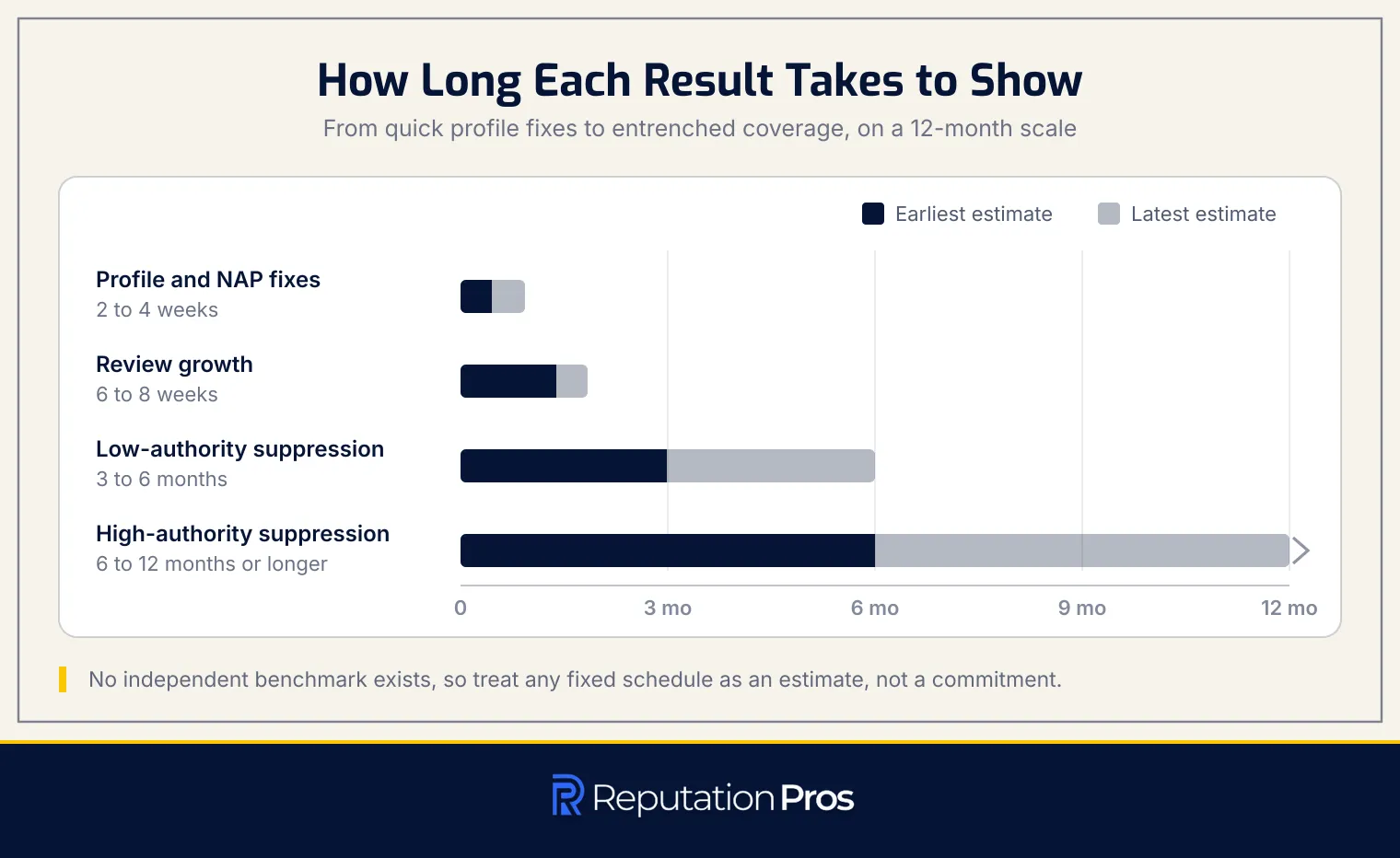
SEO reputation management demonstrates results through phased timelines, varying by task complexity. Quick fixes, such as optimizing Google Business Profile listings and correcting NAP inconsistencies, usually show improvements within 2 to 4 weeks. Building review growth through systematic programs generally results in visible gains within 6 to 8 weeks. Suppression of low-authority negative content frequently requires 3 to 6 months, as search engines need time to index and rank new positive assets. For entrenched high-authority negative content, such as major news coverage or established complaint sites, suppression efforts may demand 6 to 12 months or longer. No independent benchmark sets those timelines, and published figures come from providers rather than from neutral measurement, so treat any fixed schedule as an estimate rather than a commitment.
Who Should Own SEO Reputation Management?
SEO reputation management requires a coordinated effort across multiple departments, each with specific responsibilities. The roles involved in this process are outlined below.
- SEO Teams: These teams handle the technical execution of SEO reputation management tactics. The remit covers branded search rankings, SERP audits, implementing schema markup for entity consistency, and optimizing owned properties to rank for branded queries. They also manage the technical infrastructure supporting positive content ranking and coordinate link-building efforts aimed at reputation assets.
- PR and Communications Teams: These teams manage external messaging, crisis response protocols, and media relations. They generate positive earned media placements, handle executive reputation management, and craft narrative strategies for brand responses to negative coverage. They also coordinate stakeholder communications and manage relationships with journalists and publishers for removal requests or corrections.
- Customer Experience Teams: This group owns the operational components that directly generate reputation signals. Their responsibilities include managing review request workflows, review response management, and customer feedback collection and analysis. They also handle service recovery processes that prevent negative reviews and drive quality improvements from recurring complaint themes.
- Legal Teams: Legal teams are engaged when content removal is pursued through formal channels. They handle cease-and-desist letters, court orders, DMCA takedown requests, defamation claims, and evaluate EU right-to-be-forgotten eligibility. They also review response language during crises to secure compliance and minimize liability exposure.
- Overall Accountability: This usually sits with the marketing leadership or a dedicated reputation manager. The named owner coordinates across functions, sets strategic priorities, allocates resources, reports reputation metrics to executive leadership, and makes certain tactical execution aligns with broader brand and business objectives. In smaller organizations, the SEO or digital marketing manager may carry full ownership, while larger enterprises frequently establish a cross-functional reputation committee with a senior sponsor who has authority to mobilize resources during a crisis.
How Do In-House Teams and Agencies Support Reputation Management?
In-house teams and specialized agencies collaborate to manage SEO reputation effectively. In-house teams usually focus on daily tasks such as monitoring reviews, engaging on social media, and updating content. In-house teams handle the routine work, keeping up regular interaction with customers and maintaining brand presence. Agencies, like Reputation Pros, are brought in for more complex issues. They handle tasks such as audits, suppression campaigns, digital PR, and crisis management. Agencies are above all useful when negative search results are entrenched, or when specialized expertise is required to manage multiple branded queries. Red flags when choosing an agency include promises of guaranteed removal or fake reviews, which can lead to penalties. Cost drivers for agency services include the number of branded queries involved and the severity of the negative content.
How Does Reputation Management Support Brand Trust?
Reputation management strengthens brand trust by securing consistent positive search results, visible responses to criticism, and third-party validation. Positive search results present a cohesive and authoritative brand narrative that reassures searchers. Addressing criticism openly signals accountability and customer care, demonstrating that the brand values feedback and resolves issues effectively. Third-party validation, such as independent reviews and media coverage, provides external confirmation of the brand’s credibility and reliability. Trust signals reduce uncertainty during decision-making process, strengthening customer confidence in the brand. Earned trust then shows up as stronger marketing performance, as it boosts consideration rates and conversion efficiency.
How Does Brand Trust Support Digital Marketing Performance?
Brand trust sharply enhances digital marketing performance by increasing ad click-through rates, conversion rates, and customer retention. Trusted brands experience higher engagement because consumers are more likely to interact with advertisements they perceive as credible. Trust reduces the perceived risk of a purchase, thereby improving conversion rates.
Michael Luca’s Harvard Business School working paper “Reviews, Reputation, and Revenue: The Case of Yelp.com” found that a one-star increase in a restaurant’s Yelp rating produced a 5% to 9% rise in revenue, an effect concentrated among independent restaurants rather than chains. Brand trust lowers the cost per acquisition, as less effort is needed to persuade consumers at each stage of the marketing funnel. Trust brings repeat purchases, as customers are more likely to return to brands they trust, strengthening long-term loyalty and customer lifetime value.
How Does Digital Marketing Connect Customer Experience and Reputation?
Digital marketing establishes a decisive link between customer experience and online reputation by setting expectations and capturing feedback. Marketing efforts, such as advertisements, social media content, and email campaigns, create specific expectations regarding product quality and service standards. When the actual customer experience aligns with these expectations, positive reviews and favorable brand mentions are more likely to follow. However, discrepancies between marketing promises and delivered experiences can lead to negative feedback, which directly impacts a company’s online reputation.
Addressing the root causes of customer complaints is decisive to maintaining a positive reputation. Businesses should use feedback from reviews and social media to identify and resolve operational issues, such as product quality concerns or customer service inefficiencies. By doing so, they can prevent negative experiences from becoming public criticisms. The feedback loop created by customer experiences and reviews serves as valuable input for refining marketing strategies and improving service delivery. A continuous loop of feedback and adjustment helps businesses maintain a strong reputation and strengthen customer satisfaction.
How Can Customer Feedback Improve Digital Marketing Decisions?
Customer feedback serves as a vital tool for refining digital marketing strategies. By establishing a systematic feedback loop, businesses can transform reviews and survey responses into actionable insights that strengthen marketing effectiveness.
- Collecting Reviews and Survey Responses: Gather feedback from several touchpoints, including post-purchase emails and third-party platforms, to create a full dataset of customer experiences.
- Tagging Recurring Themes: Identify common themes such as product quality or customer service issues using sentiment analysis tools, which help categorize feedback for targeted action.
- Routing Insights into Marketing Channels: Use the tagged themes to refine ad messaging, adjust offers, and improve customer service processes, so that marketing aligns with customer expectations.
- Tracking the Effect on Ratings and Conversions: Monitor changes in average ratings, review velocity, and conversion metrics to assess the impact of feedback-driven improvements on business performance.
How Does SEO Reputation Management Sustain Long-Term Brand Visibility?
SEO reputation management sustains long-term brand visibility by building enduring digital assets. The assets include optimized website pages, claimed business profiles, and earned media placements that accumulate authority and ranking strength over time. Consistent entity signals across platforms, such as matching name, address, and phone (NAP) data, reinforce the brand’s reliability in Google’s knowledge graph and AI systems. Steady review velocity indicates ongoing customer activity, signaling business health to search algorithms. Early detection of new negative results through continuous monitoring allows businesses to respond swiftly, preserving the positive composition of page-one results. Together, these practices transform reputation management into a proactive strategy that protects brand equity across search engines and AI platforms.
Why Does SEO Reputation Management Need Continuous Monitoring?
SEO reputation management requires continuous monitoring because branded search results frequently change. New URLs can enter these results due to fresh news coverage, competitor content, or user-generated posts. Algorithm updates and shifts in AI-generated answers can also alter which results appear first. Changes in review velocity and sentiment further impact how a brand is perceived. Continuous monitoring is necessary for maintaining a positive online presence. By tracking branded rankings on a set cadence, conducting review checks, and performing SERP audits, businesses can detect negative content early. Early detection allows timely response, securing long-term brand visibility and protecting the first impression searchers form.