What Is a Sock Puppet Account? Definition, Types, Examples, and Risks
 21 min read
 On this page
A sock puppet account is an online identity operated under concealed common control to manufacture the appearance of independent third-party support. Concealment is the defining property: the operator hides the link between accounts so that what is one voice reads as several.
Sock puppet accounts differ from pseudonymous accounts, disclosed alternates, burners, bots, and impersonation accounts, each of which lacks either the concealed linkage or the intent to simulate independence. The types divide by purpose: voting and ballot-stuffing puppets, opinion-manipulation and strawman puppets, harassment and block-evasion puppets, and political or state-sponsored networks.
The risks land on three groups. Individuals face block-evading harassment, manufactured pile-ons, and reputational attack. Businesses face fake review campaigns, competitor astroturfing, and regulatory exposure. Public discourse absorbs manufactured majorities, suppressed dissent, and propaganda laundered through apparently independent voices. Platform rules and federal regulation both reach sock puppetry, and documented cases run from a supermarket chief executive to state-sponsored troll farms. Detection rests on correlating several signals at once, because no single signal is conclusive.
What is a sock puppet account?
A sock puppet account is an online identity controlled by one individual or group to create the illusion of independent third-party support. Multiple accounts operate under concealed common control, so the connection between them stays hidden and each persona appears autonomous.
The term borrows the hand-puppet metaphor, where one operator animates several puppets to voice a conversation with itself. Sock puppetry gained its name in the 1990s on Usenet and early internet forums, where users replied to their own posts under pseudonymous accounts or staged agreement in a thread.
Operators use sock puppet accounts to manipulate opinion, evade restrictions, and inflate apparent support for a position. Ordinary alternate accounts exist for anonymity; a sock puppet exists for deception, and the distinction rests entirely on intent to mislead about whether the accounts are independent.
What defines a sock puppet account’s concealed control and deceptive identity?
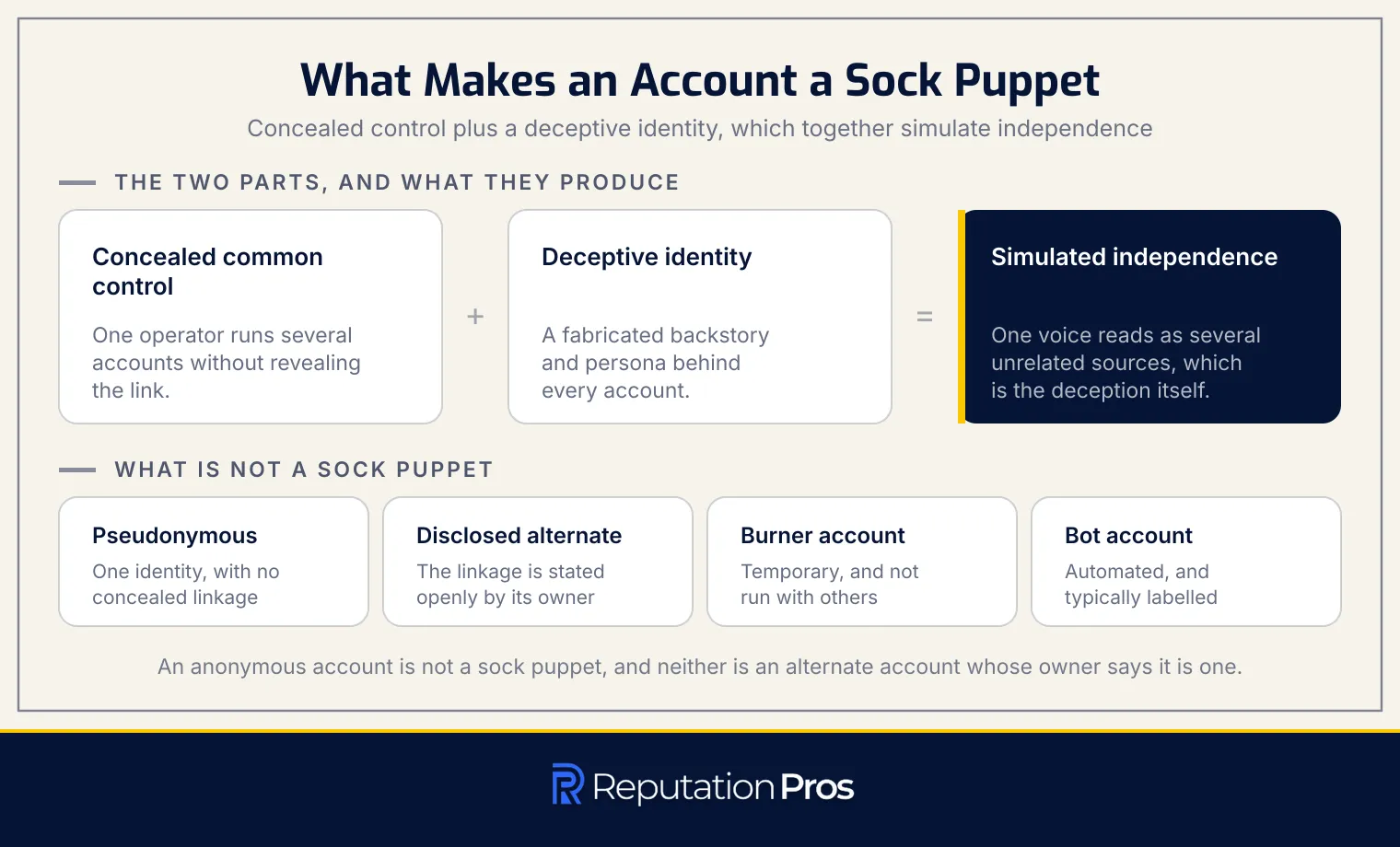
A sock puppet account is defined by undisclosed common control paired with a deceptive identity. Concealed control means one operator runs several accounts without revealing the link. The deceptive identity is built from a fabricated backstory and persona, which makes support or criticism appear to come from unrelated sources. Simulated independence is the hallmark that separates sock puppetry from legitimate use of an alternate account.
Three variants sit within that frame. A sockpuppet is a false identity created to back its operator’s position. A meatpuppet is a real person recruited to act on the operator’s behalf. A strawman sock advances deliberately weak or extreme positions so the operator’s real view reads as reasonable by comparison. Concealment of control is the common thread, and it is what separates all three from a disclosed alternate account or a privacy-motivated burner.
How does a sock puppet account differ from other accounts?
A sock puppet account differs from other accounts through undisclosed common control: one operator runs several accounts without revealing the connection, which manufactures the appearance of independent voices. The comparison is set out below.
| Account Type | Disclosure Status | Common Control | Typical Purpose | Counts as Sock Puppetry |
|---|---|---|---|---|
| Pseudonymous account | Identity protected but singular | No | Privacy, safety, or preference | No |
| Disclosed alternate account | Linkage openly stated | Yes | Content separation, role-specific use | No |
| Burner account | Temporary, often anonymous | No | One-time use, disposable interaction | No |
| Bot account | Automated, typically labeled | No | Automated posting, data collection | No |
| Role or shared account | Organizational, disclosed | Multiple | Team, brand, or official use | No |
| Impersonation account | Falsely claims another’s identity | May be single or coordinated | Identity theft, fraud, reputation harm | No (different deception) |
| Sock puppet account | Connection concealed | Yes | Manufactured consensus, self-support, vote manipulation | Yes |
Concealed common control is the differentiator. An anonymous account is not a sock puppet, and neither is an alternate account whose owner says it is one.
How does a sock puppet account work?
A sock puppet account works by separating its technical fingerprint from the operator’s other accounts while performing an independent persona. Each account uses a distinct email address and is reached through different IP addresses or devices, with VPNs and proxy servers masking the network signature that would otherwise link them.
Ageing and persona construction carry the illusion further. An operator builds a fictional name, location, and set of interests, then lets the account accumulate ordinary activity so it blends in before it is used. Posting schedules are staggered deliberately, since simultaneous activity across accounts is the pattern moderators look for first.
Large operations industrialise the work. AI-generated personas supply synthetic profile images and written backstories at volume, and automated posting tools manage cadence across many accounts at once, which lets one operator maintain a crowd.
What use cases do sock puppet accounts serve?
The use cases sock puppet accounts serve are listed below:
- Block evasion: a banned user returns under a new account to regain access to a community or a target.
- Vote and review manipulation: several accounts inflate ratings, stack polls, and manufacture consensus in community votes.
- Strawman argumentation: the operator plants weak or extreme positions under a false identity, then defeats them from the main account.
- Astroturfed promotion: businesses and public figures generate fake endorsements and grassroots support, concealing the commercial interest behind them.
- Harassment: one operator runs several personas to create a pile-on that reads as widespread condemnation.
- Covert research or safety use: researchers and investigators adopt fictitious identities to reach restricted material while protecting their own security.
Which platforms are commonly affected by sock puppet accounts?
The platforms most commonly affected by sock puppet accounts are those where visible participation and reputation signals carry value. They are listed below:
- Wiki encyclopedias: Wikipedia’s collaborative editing and consensus decision-making make manufactured agreement directly useful.
- Q&A and discussion forums: Quora and traditional bulletin boards expose voting and reputation systems to manipulation.
- Reddit: sock puppets move subreddit voting, comment threads, and moderation discussions.
- X: coordinated inauthentic behaviour is well documented, and the platform has long maintained that spam and fake accounts sit below 5% of its monetisable daily active users, while outside estimates have run considerably higher.
- Facebook: fake accounts persist at scale despite continuous enforcement.
- Marketplace and app-store review systems: Amazon, Google Play, and the Apple App Store attract fake reviews aimed at ratings.
- Discord: servers are used for community manipulation and coordinated raids.
- TikTok: increasingly targeted for political content and commercial promotion.
- Employer-review sites: Glassdoor and Indeed attract fabricated reviews aimed at how a workplace appears to candidates.
How are sock puppet accounts used by or against companies?
Companies encounter sock puppet accounts from both directions. Executives create anonymous accounts to defend decisions or talk up their own company on forums and review sites without disclosing the affiliation. Businesses commission paid review farms to inflate product ratings and marketplace rankings. Competitors run accounts that post negative reviews and false claims about rival products.
Some businesses maintain networks of employee-operated accounts posing as satisfied customers, and marketing and PR agencies run astroturfing campaigns that fabricate grassroots support while concealing who paid for it. Each of those carries regulatory exposure as well as reputational risk, because the deception is the violation regardless of whether the underlying product claim is true.
What are the types of sock puppet accounts?
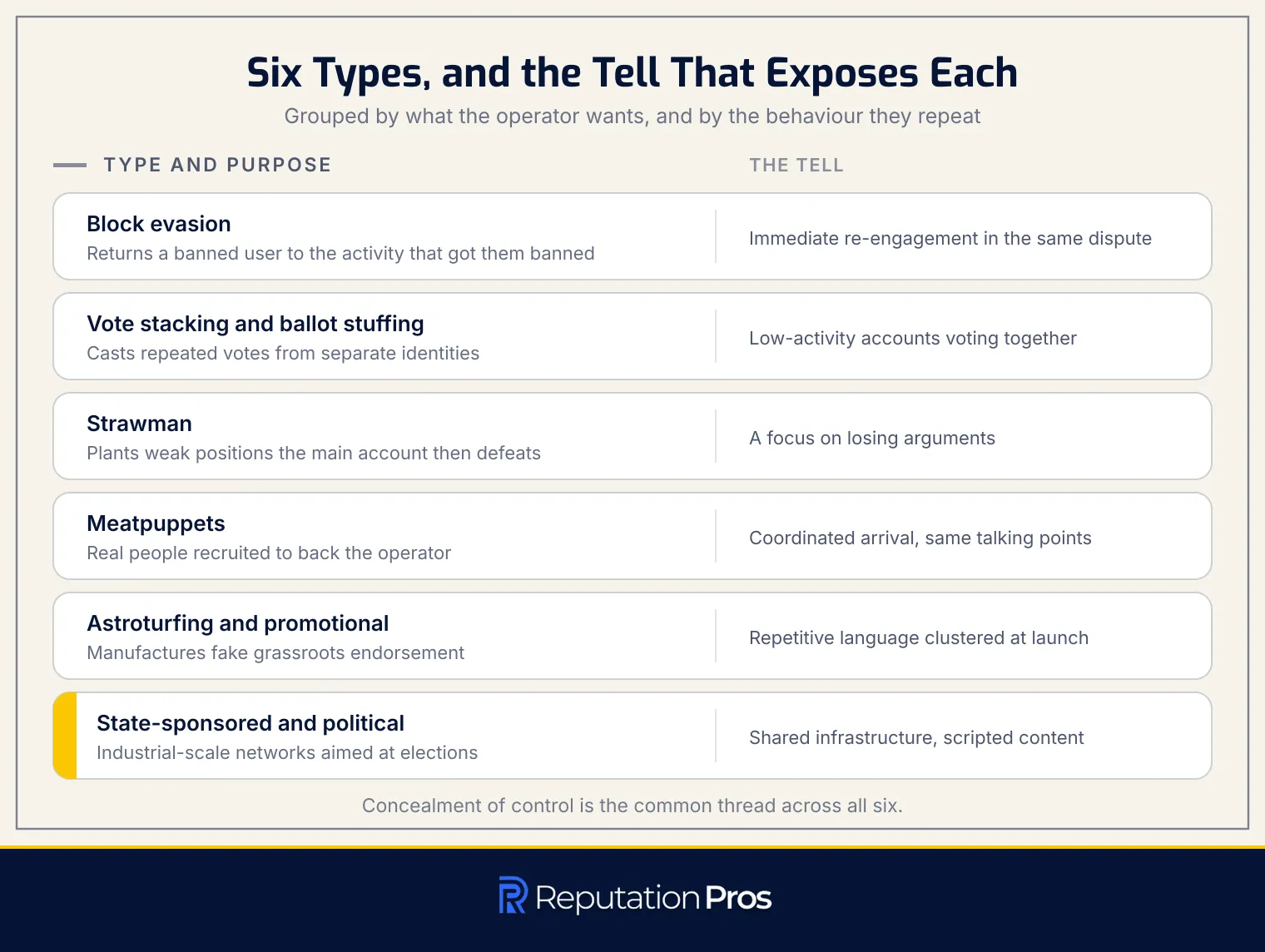
The types of sock puppet accounts are listed below, grouped by operational purpose and by the behaviour that exposes each one.
Block evasion sock puppets. Created to bypass a ban, these accounts return the same user to the activity that caused the restriction. Immediate re-engagement in the same threads or disputes after a ban is what exposes them.
Vote stacking and ballot stuffing sock puppets. These manipulate voting systems, polls, and review scores by casting repeated votes from separate identities. Coordinated voting patterns give them away, usually several low-activity accounts voting together on one issue.
Strawman sock puppets. These introduce weak or extreme positions that the operator’s main account then publicly defeats. A focus on losing arguments, combined with immediate interaction with one particular account, identifies them.
Meatpuppets. Real individuals recruited to support the operator’s agenda, which produces false consensus without a single operator holding every login. Coordinated arrival patterns and identical talking points reveal the recruitment.
Astroturfing and promotional sock puppets. These manufacture grassroots support through fake endorsements posted from apparently independent accounts. Repetitive promotional language and posting clustered around a product launch expose them.
State-sponsored and political sock puppet operations. Coordinated networks running at industrial scale to influence elections and spread propaganda at scale. Shared infrastructure indicators and content similarity pointing to centralised scripting are the detection signals.
What is a voting sock puppet account?
A voting sock puppet account is an account created to influence a voting outcome by simulating independent voices. Ballot stuffing is the core behaviour, where one operator casts multiple votes under different identities to skew a poll or a consensus decision, producing a false impression of support or opposition.
Voting sock puppets concentrate on platforms with voting mechanisms: Reddit upvotes and downvotes, Wikipedia deletion discussions, and review sites where ratings translate into sales. Coordinated voting patterns identify them: similar voting times, the same targets, and little engagement outside the votes themselves. Their effect is to corrupt the crowdsourced quality signal that the platform’s readers rely on.
What is an opinion-manipulation sock puppet account?
An opinion-manipulation sock puppet account is a fictitious identity used to shape perception by manufacturing apparent consensus. Several accounts appear to agree independently on a viewpoint, a product, or an idea. Planting strawman arguments is a common tactic, where the operator advances a weak position under a false identity and then refutes it from the main account, making the real stance look moderate.
These accounts carry undisclosed self-promotion, where a person praises their own work while posing as a satisfied user, and undisclosed paid advocacy, where compensation for pushing a product or position goes unmentioned. The deception in every case is the same: manufactured voices presented as independent third parties, which exploits social proof.
What is a harassment or block-evasion sock puppet account?
A harassment or block-evasion sock puppet account is one used to bypass a restriction and resume contact with a target. Block evasion violates platform rules directly, since a suspended user creating a new account defeats the enforcement that removed them.
These accounts produce manufactured pile-ons, where one operator runs several personas to attack a target at once. The effect on the target is the point: apparent hostility from many independent people causes more harm than the same volume from one identified account, and the target is forced into a cycle of identifying and blocking each new persona as it appears.
What is a political or state-sponsored sock puppet account?
A political or state-sponsored sock puppet account is an identity operated by a government or political organisation to manipulate public opinion. These operations run coordinated inauthentic behaviour through persona-management software that lets a small team control many fabricated identities. Troll-farm activity pushes propaganda and disinformation at volume, concentrated around election cycles, and the aim is a false sense of consensus that obscures where the message originated.
Why do sock puppet accounts matter?
Sock puppet accounts matter because they distort perceived consensus and erode trust in visible opinion. Fabricated identities amplifying one viewpoint create an illusion of widespread agreement that misleads readers and decision-makers alike.
The scale is not marginal. Meta reports through its Community Standards Enforcement Report that it actions fake accounts by the hundreds of millions every quarter and still estimates that roughly 4% of its more than three billion monthly active users are fake, which means enforcement at that volume suppresses the problem rather than ending it. For an individual reader, that means apparent support or criticism may be orchestrated, and the volume of agreement behind a position carries less information than it appears to.
What risks do sock puppet accounts create for individuals?
The risks sock puppet accounts create for individuals are listed below:
- Block-evading harassment: a harasser returns under new accounts after being blocked, defeating the tool meant to stop them.
- Manufactured pile-ons: fake accounts simulate widespread criticism, producing social pressure and public shaming out of one person’s effort.
- Reputational attack: false information spread across apparently independent accounts damages credibility in both personal and professional contexts.
- Romance or scam pretexting: fabricated personas build trust and then exploit it for romance scams and financial fraud.
- Misled purchase or trust decisions: fake reviews and endorsements steer people toward poor decisions and unreliable sources.
What risks do sock puppet accounts create for businesses?
The risks sock puppet accounts create for businesses are listed below:
- Fake review campaigns: artificially inflated ratings and fabricated negative reviews mislead consumers and breach federal rules on deceptive practices, exposing a business to civil penalties alongside lost trust.
- Competitor astroturfing and smear operations: fabricated praise for one business or false claims about a rival distort the market and invite claims under unfair competition law.
- Insider- and executive-operated accounts: company insiders posting favourable reviews or attacking competitors create conflicts of interest and regulatory scrutiny.
- Employer-review manipulation: fabricated positive reviews on Glassdoor and similar sites affect hiring and draw complaints and regulatory action for misrepresentation.
- Regulatory and disclosure exposure: deceptive practices run through sock puppet accounts carry fines and enforcement action. The FTC’s Rule on the Use of Consumer Reviews and Testimonials, in force since 21 October 2024, authorises civil penalties of up to $51,744 per violation, and state regulators have acted for longer still: New York’s “Operation Clean Turf” ended in September 2013 with 19 companies agreeing to stop writing fake reviews and paying more than $350,000 in penalties.
What risks do sock puppet accounts create for public discourse?
The risks sock puppet accounts create for public discourse are listed below:
- Manufactured majority illusion: networks create the appearance of widespread support, which misleads observers about where opinion actually sits and makes fringe positions read as mainstream.
- Suppression of dissent: coordinated narratives drown out legitimate disagreement, narrowing what a reader ever encounters.
- Propaganda laundered through apparently independent voices: state-sponsored disinformation disguised as grassroots opinion exploits the trust people extend to peers, which works better than overt propaganda. Meta defines the pattern as coordinated inauthentic behaviour, coordinated effort to manipulate public debate for a strategic goal in which fake accounts are central to the operation, and publishes the networks it removes in its quarterly Adversarial Threat Reports.
- Degraded moderation and voting processes: manipulated votes and moderation decisions corrupt the governance mechanisms platforms rely on to police themselves.
What rules and legal risks apply to sock puppet accounts?
Sock puppet accounts carry both terms-of-service and legal exposure. Most social platforms, forums, and review sites prohibit undisclosed multi-account coordination outright, with suspension or a ban as the standard consequence. Beyond platform rules, sock puppetry reaches civil and criminal liability depending on the harm and the jurisdiction.
United States v. Drew shows the limits of federal prosecution for fraudulent account creation, where the charges were dismissed on vagueness grounds. People v. Golb produced a criminal conviction for identity theft and harassment after a law student used sock puppet accounts to impersonate and defame academic rivals. New Directions for Young Adults v. Davis illustrates civil liability for defamation and tortious interference where fake accounts damaged a competitor.
Federal regulation now addresses fake reviews directly. The FTC’s Rule on the Use of Consumer Reviews and Testimonials, codified at 16 CFR Part 465, prohibits businesses from creating or selling fake reviews and specifically bars an officer or manager from writing a review of their own business, or soliciting one from an employee or a relative, without a clear and conspicuous disclosure of the relationship. Sock puppet operations can support liability for defamation, criminal impersonation, wire fraud, and securities violations where accounts move a stock price or investor sentiment. Anonymity does not shield an operator from liability once concealed accounts cause harm.
What are examples of sock puppet accounts?
The documented examples of sock puppet accounts run from individuals to state operations.
John Mackey, chief executive of Whole Foods, posted as “Rahodeb” on Yahoo Finance message boards for around eight years, praising Whole Foods while disparaging Wild Oats Markets, the competitor Whole Foods later moved to acquire. The alias surfaced through an FTC filing in the regulator’s antitrust suit against the acquisition, and Whole Foods’ board completed its own investigation in October 2007 and referred its findings to the Securities and Exchange Commission.
Orlando Figes, the British historian, used aliases on Amazon to praise his own books and attack rival historians, admitting the conduct and settling defamation claims after legal action exposed him.
Lee Siegel, a writer, created the persona “sprezzatura” to defend himself against critics in the comment section of his own blog, which led to his suspension from The New Republic.
Scott Adams, creator of Dilbert, used the account “PlannedChaos” on Metafilter to defend and praise himself before the community identified him.
Russian state-sponsored troll farms, the Internet Research Agency foremost among them, ran large sock puppet networks across Facebook and Twitter to manipulate opinion and sow discord around the 2016 US presidential election.
The Wiki-PR case of 2013 involved a commercial editing service running hundreds of accounts on Wikipedia for paid advocacy, ending in the blocking of more than 250 accounts. The Orangemoody scheme of 2015 saw roughly 380 accounts manipulating Wikipedia articles for commercial gain, among the largest operations the platform has detected.
What signs may indicate a sock puppet account?
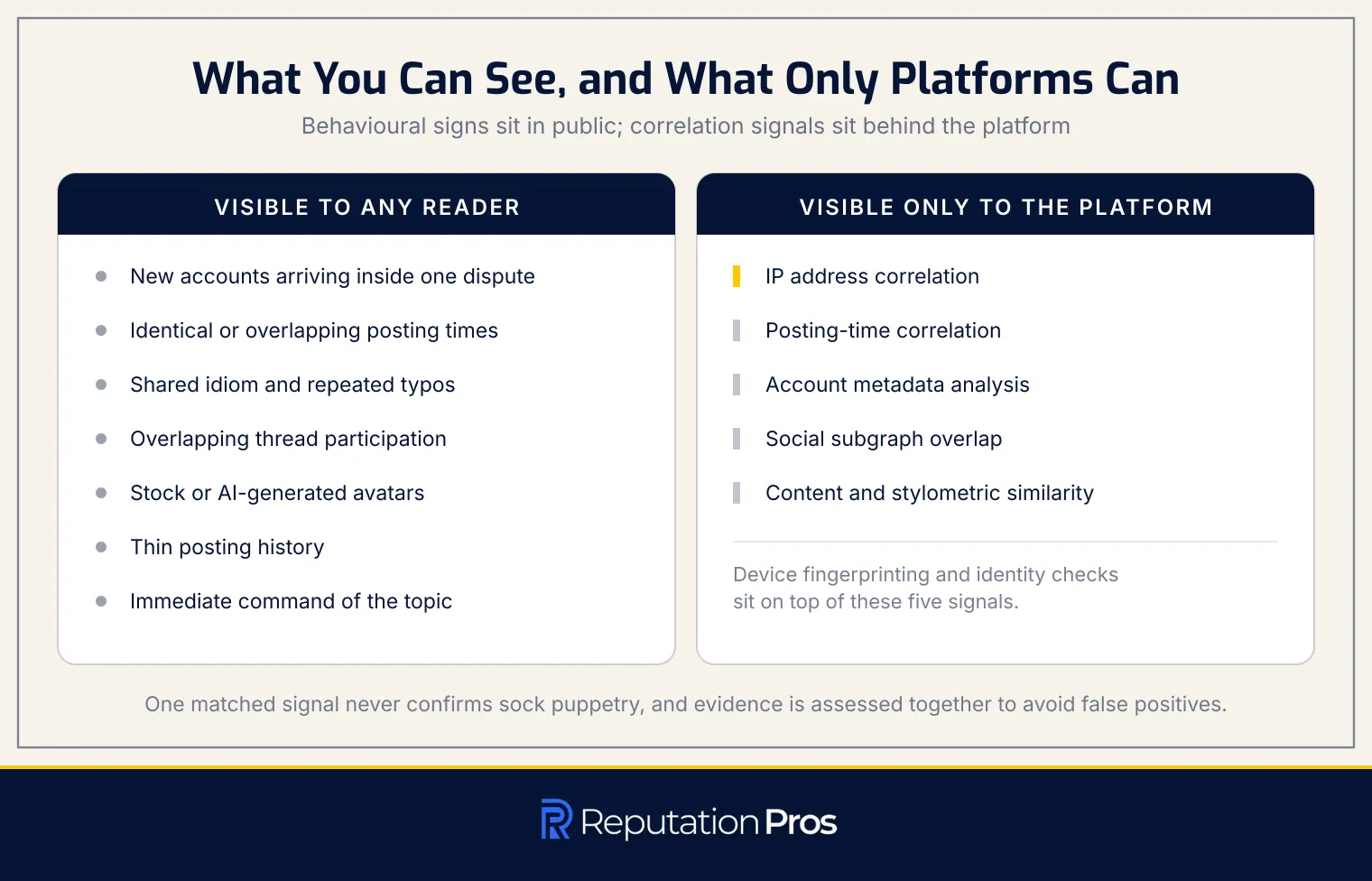
The signs that may indicate a sock puppet account are listed below:
- New or low-age accounts arriving inside one dispute: accounts created for a targeted controversy or vote.
- Identical or overlapping posting times: one operator switching between accounts, or posting from several at once.
- Shared idiom and repeated typos: distinctive language patterns and consistent errors pointing to common authorship.
- Overlapping thread participation: several accounts appearing in the same discussions and holding identical positions.
- Stock or AI-generated avatars: fabricated personas using generic or synthetic profile images.
- Thin posting history: minimal prior activity behind an account that arrives with a purpose.
- Immediate command of the topic: detailed knowledge of an ongoing dispute with no posting history that would explain it.
How are sock puppet accounts detected?
Sock puppet accounts are detected by correlating several signals at once. The signals are listed below:
- IP address correlation: several accounts reaching the platform from one address.
- Posting-time correlation: accounts active in identical windows.
- Account metadata analysis: similarities across creation dates, email patterns, and device identifiers.
- Social subgraph overlap: repeated engagement with the same communities, threads, and targets.
- Content and stylometric similarity: matching writing patterns and vocabulary indicating shared authorship.
Platforms add device fingerprinting and identity checks on top of those signals. Behavioural signals hold up under measurement: a 2017 study presented at the World Wide Web Conference by Srijan Kumar, Justin Cheng, Jure Leskovec and V.S. Subrahmanian, “An Army of Me: Sockpuppets in Online Discussion Communities,” examined nine discussion communities and found that sockpuppets start fewer discussions, write shorter posts, use first-person pronouns more, sit in more clustered ego-networks, and are likelier than ordinary users to appear in the same discussion at the same time as another account run by the same person. One matched signal never confirms sock puppetry on its own, and evidence has to be assessed together to avoid false positives.
How should suspected sock puppet accounts be assessed?
Suspected sock puppet accounts should be assessed by weighting each signal against the innocent explanation that could produce it. The assessment is set out below.
| Signal Observed | What It Indicates | Confidence Weight | Innocent Explanation to Rule Out | Appropriate Action at That Confidence |
|---|---|---|---|---|
| Shared IP address | Accounts may operate from the same network location | Medium | Shared household, school or office network, NAT gateway | Document and combine with other signals before escalating |
| Matched posting times | Accounts active during identical time windows | Medium | Same timezone, common platform peak hours | Monitor pattern consistency over an extended period |
| Style similarity | Similar writing patterns, vocabulary, typos, or linguistic markers | Medium-High | Non-native speakers with similar language education | Combine with stylometric analysis and other technical signals |
| Subgraph overlap | Accounts interact with the same users, threads, or content repeatedly | High | Genuine acquaintances, shared interest communities | Cross-reference with account age and interaction authenticity |
| Account age and thin history | New or minimally-used accounts entering specific disputes | Low-Medium | Legitimate new users, lurkers becoming active | Assess in context of other signals and behavioural purpose |
Several corroborating signals are required before concluding that accounts are sock puppets rather than independent users, and the full pattern gets documented before anyone acts, because a premature public accusation carries its own risk. False positives arise routinely from shared households, from Network Address Translation and institutional networks presenting one address for many users, from genuine acquaintances who naturally read the same threads, and from non-native speakers whose narrower vocabulary produces surface-level style similarity. Each of those gets ruled out before enforcement follows.
How should users respond to suspected sock puppetry?
Users who suspect sock puppetry should work through a fixed sequence, listed below:
- Document the evidence thoroughly: capture screenshots, save links, and record timestamps, which is what establishes a pattern rather than an impression.
- Report through the platform’s official channel: the site’s reporting tools route the case to people who can see IP addresses and account metadata that no outside observer can.
- Escalate to moderators or administrators: where a community is affected, moderators hold both the authority and the tooling to investigate.
- Avoid public accusations: a public accusation that turns out wrong disrupts the community and carries defamation risk of its own.
- Protect the targeted account: where harassment is involved, blocking and muting give the target immediate relief while the report is processed.
- Allow the enforcement process to proceed: platform review resolves the case through tagging, blocking, or banning, on evidence an outside reporter cannot access.
Where a platform leaves the content up, the remaining option is suppressing it with content that outranks it.
How can communities limit deceptive account activity?
The measures communities can use to limit deceptive account activity are listed below:
- Disclosure requirements for alternate accounts: requiring users to state the connection between their accounts removes concealed control as an option rather than detecting it afterward.
- Account-age and rate gates on votes and reviews: minimum age and activity thresholds before an account can vote or review make freshly created puppets useless for the purpose they were made for.
- Corroboration rules in consensus decisions: requiring several established accounts with independent histories behind a consequential decision prevents manufactured agreement from carrying it.
- Automated correlation checks: continuous analysis of posting patterns, IP addresses, and subgraph overlap flags suspicious coordination for human review.
- Moderator escalation paths: clear reporting channels put suspected sock puppetry in front of moderators who hold the data to judge it.
- Transparent enforcement logs: publishing enforcement actions and the evidence behind them deters repeat abuse and makes the process auditable by the community.
Applied together, those measures raise the cost of running a puppet network above what most operations will pay.
What is online identity authenticity?
Online identity authenticity is the alignment between an online identity and the operator actually behind it. Authenticity differs from anonymity and pseudonymity: an anonymous or pseudonymous account stays authentic as long as it does not misrepresent who controls it or fabricate independence. Honest representation of control is the test, not disclosure of a legal name.
Authenticity is a trust property rather than a real-name requirement. A pseudonymous account whose identity claims stay consistent is authentic, and an account carrying a real-seeming name is inauthentic the moment it operates in undisclosed coordination with others to simulate independent support. The distinction that matters is concealment for safety against concealment for influence, which is the line anyone working to protect an online identity reputation has to hold.
How do platforms govern coordinated account behavior?
Platforms govern coordinated account behaviour through multi-account policies backed by technical enforcement. The policies prohibit undisclosed coordination between accounts under one operator, above all where it manipulates votes, amplifies content artificially, or evades a suspension, and they require disclosure of alternate accounts where those accounts participate in the same discussion or decision. Account-age and rate gates keep new accounts away from high-value actions until they have a history.
Technical enforcement runs on correlation signals: IP overlap, posting-time patterns, device fingerprinting, subgraph analysis, and content similarity. Accounts flagged by those systems go to internal denylists, face additional verification, or lose access to particular actions. Suspension-evasion rules carry the heaviest penalties, since an account created to defeat enforcement usually draws a permanent ban and an IP-level block.
How can users evaluate online credibility?
The checks that let users evaluate online credibility are listed below:
- Account age and history spread: an older account with varied, consistent posting reads as more credible than a new one with narrow activity.
- Corroboration across independent sources: a claim supported elsewhere carries weight that an unsupported claim does not.
- Consistency of claimed knowledge: a credible account’s command of a subject matches its stated identity rather than shifting topic and tone abruptly.
- Engagement patterns: authentic users interact organically, where coordinated timing and synchronised participation with particular accounts signal the opposite.
- Disclosure of interest: an account that states its affiliations and financial ties can be weighed accordingly, and an undisclosed connection is itself the signal.
Those checks test whether an account’s apparent identity matches its behaviour, which is the judgment a reader can make without platform-level data.
Why does account transparency matter in online communities?
Account transparency matters in online communities because it marks the line between concealment for safety and concealment for manipulation. Someone hiding their identity against harassment or persecution is doing something categorically different from someone hiding coordination to influence opinion, and transparency requirements are what let a community tell the two apart.
Disclosed alternate accounts, parody accounts, official staff accounts, and research accounts all demonstrate that transparency and legitimate multi-account use coexist. When an account’s link to a primary identity or an institution is stated openly, other users can weigh its contributions on the right terms. None of those creates the false impression of independent support that defines sock puppetry, because the common control is known from the start. The problem was never anonymity, pseudonymity, or multiple accounts; it is concealed control combined with intent to deceive.
How does account transparency help identify a sock puppet account?
Account transparency helps identify a sock puppet account by making concealed control visible by contrast. A transparent account discloses the link between its identities, which allows anyone to verify whether one person runs them. A sock puppet account is built to avoid exactly that check.
A transparent account carries a verifiable history, consistent biographical detail, and an acknowledged relationship to any related account, all of which can be tested against its claimed identity. Where those markers are missing and the correlation signals point the other way, the absence of transparency is itself part of the evidence.