What Is Social Capital?

 24 min read
 On this page
Social capital is defined as the resources people access through their relationships, comprising three core components: networks, norms, and trust with reciprocity. Social capital is considered a form of capital because, like financial or human capital, it can be invested in and yields returns over time. Unlike those forms, social capital resides in relationships between people rather than within individuals, so it cannot be owned by one person alone.
Social capital works through two mechanisms: networks carry information and opportunities, while trust and reciprocity sustain cooperation. The literature identifies three types (bonding, bridging, and linking) and three dimensions (structural, relational, and cognitive).
Social capital improves access to jobs and information, enables collective action, and strengthens public health and upward mobility. It also carries risks, including the exclusion of outsiders and nepotism. Social scientists explain it through three major frameworks, those of Bourdieu, Coleman, and Putnam, and measure it through trust surveys and network methods.
How Do Social Scientists Define Social Capital?
Social capital is fundamentally the resources individuals and groups access through their social networks. Despite this shared understanding, social scientists do not agree on a single definition due to varying disciplinary perspectives. The perspectives range from individual benefits to collective goods, highlighting the complexities of the concept. The idea of social capital traces back to L.J. Hanifan in 1916, who emphasized community involvement and goodwill, and has since evolved through contributions from notable figures such as Jane Jacobs, who focused on urban neighborhoods, and Glenn Loury, who examined racial inequality. The OECD’s 2001 definition encapsulates the core components of social capital as “networks together with shared norms, values, and understandings that support cooperation within or among groups.” Major theoretical frameworks have emerged from scholars like Pierre Bourdieu, who explored how networks reproduce social inequality; James Coleman, who analyzed its role in creating human capital; and Robert Putnam, who linked social capital with civic engagement and democratic performance. The three frameworks show the varied interpretations of social capital across disciplines. Understanding social capital as resources embedded in relationships provides a foundation for distinguishing it from other forms of capital, such as human and financial capital, which reside in individual skills and monetary assets, respectively.
How Does Social Capital Differ From Human and Financial Capital?
Social capital, human capital, and financial capital differ sharply in several dimensions. The following table outlines their key distinctions:
| Dimension | Social Capital | Human Capital | Financial Capital |
|---|---|---|---|
| Where it resides | In relationships and networks between people | Within individuals (skills, knowledge, capabilities) | In monetary assets and financial instruments |
| Ownership | Cannot be owned by individuals; belongs to relationships | Owned by individuals | Owned by individuals or entities |
| Tradability | Cannot be directly traded or transferred | Limited tradability (credentials signal value) | Highly tradable and transferable |
| Effect of use | Strengthens and grows with use through repeated interaction | Can be stronger through practice; may depreciate if outdated | Depletes with use (spending reduces amount) |
| Effect of disuse | Erodes and weakens without maintenance | Atrophies or becomes obsolete without practice | Remains stable but may lose value to inflation |
| Conversion into other capitals | Provides access to jobs (human capital) and income (financial capital) through networks | Can be monetized into financial capital; attracts networks (social capital) | Can purchase education (human capital) or access to networks (social capital) |
Social capital is unique as it resides within the relational networks between individuals, making it non-tradable and collectively owned. Human capital, encapsulating skills and knowledge, is individually owned and has limited tradability. Financial capital, represented by monetary assets, is highly tradable and individually owned. Each type of capital has distinct effects when used or neglected, influencing their conversion into other forms of capital.
How Does Social Capital Work?
Social capital functions by transforming relationships into valuable resources through two primary mechanisms. First, networks serve as channels that convey information and opportunities, connecting individuals to job leads, advice, and influential contacts that would otherwise be inaccessible. Second, norms of trust and reciprocity uphold cooperation by building expectations of mutual assistance, thereby reducing the necessity for formal agreements and encouraging resource sharing over time. The mechanisms reinforce one another: networks provide the structural pathways for resource flow, while trust and reciprocity act as the social adhesive maintaining these pathways’ reliability. The effectiveness of social capital depends on the interplay between network structure and relational norms. A well-connected network offers limited benefits if distrust impedes information sharing, while strong trust within an isolated group restricts access to diverse resources. Social capital is most potent when network ties span different social groups and when trust and reciprocity norms activate those ties. The combination opens a broader range of resources, such as job referrals, expert knowledge, emotional support, and collective problem-solving capabilities, than either mechanism could provide alone. Understanding how social capital works requires examining each mechanism in detail, starting with networks as the channel through which relationships deliver resources.
How Do Networks Carry Information and Opportunities?
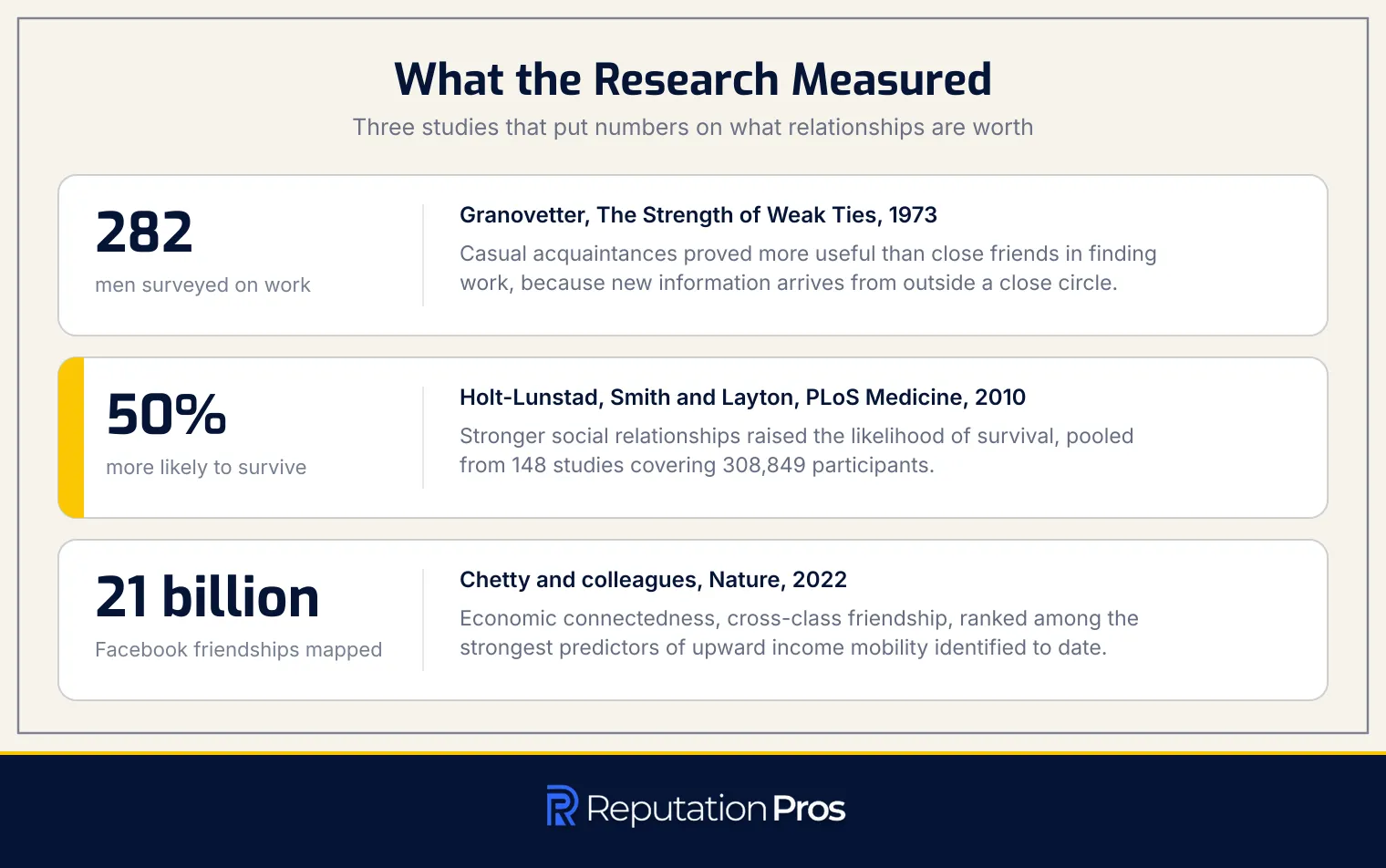
Networks serve as necessary conduits for information flow, job referrals, influence, and vouching for others. Mark Granovetter’s “The Strength of Weak Ties,” published in the American Journal of Sociology in 1973, describes the process. Surveying 282 men on how they found work, Granovetter found that casual acquaintances proved more useful than close friends, because novel information reaches a person through the ties that sit outside their own tightly connected circle, meaning that acquaintances frequently provide access to novel opportunities outside one’s immediate social circle. Weak ties bridge different social groups, enabling individuals to gain new information and job leads that close contacts may not offer. Burt’s structural holes theory further illustrates that individuals who connect otherwise disconnected groups can use diverse information and broker connections, thereby gaining strategic advantages. Lin’s social resources theory emphasizes that the value of a network lies in the resources accessible through one’s contacts, which can include occupational status, specialized knowledge, or authority. Both theories mark the role of networks in enhancing access to opportunities and resources that are not easily obtainable through direct contacts alone.
How Do Social Capital Components Sustain Cooperation?
Social capital components sustain cooperation through mechanisms such as trust and reciprocity. Trust reduces uncertainty in social exchanges, allowing individuals to cooperate without extensive contracts. Reciprocity, both generalized and specific, creates obligations and expectations that bind people. In closed networks, norms are enforced through social sanctions, so that members honor commitments. Closed networks enable monitoring of behaviour, maintaining cooperation even without formal institutions. Repeated interactions reinforce reciprocal obligations and build trust necessary for collective action. The distinction between closed and open networks ties back to different network configurations in social capital types.
What Are the Main Types of Social Capital?
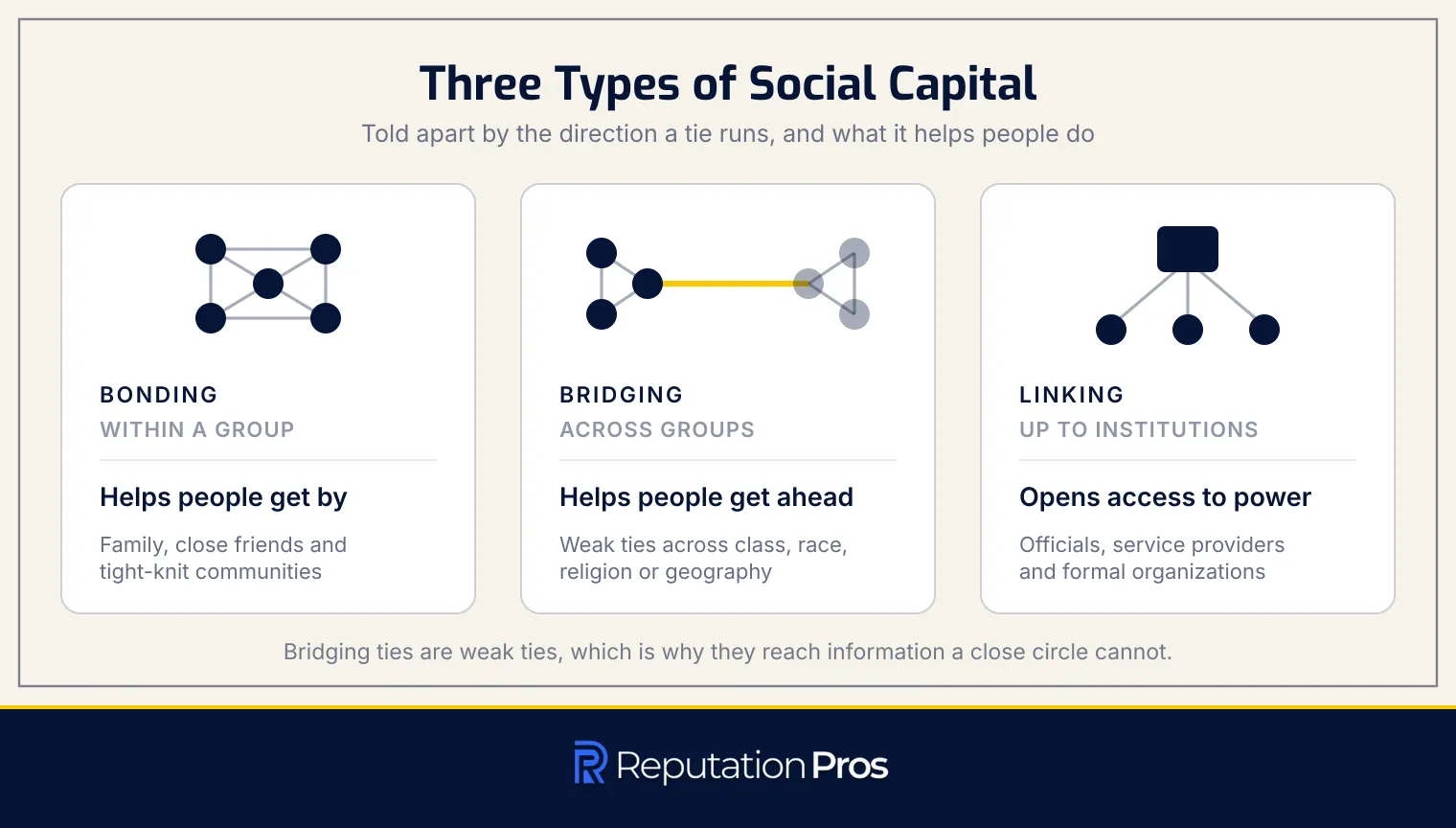
Social capital is classified into three primary types based on the direction and nature of social ties: bonding, bridging, and linking social capital. Each type serves distinct functions and connects different groups, providing access to several resources and opportunities.
Bonding Social Capital Bonding social capital involves strong, dense ties among people who are similar, such as family members, close friends, or members of tight-knit communities. Horizontal connections inside homogeneous groups offer emotional support, solidarity, and practical help, enabling individuals to “get by” during challenging times.
Bridging Social Capital Bridging social capital refers to ties that span across different social groups, connecting people who differ in background, identity, or social position. Bridging connections, described as weak ties, cross boundaries of class, race, religion, or geography and help individuals “get ahead” by opening access to new information, opportunities, and resources not available within their immediate circles.
Linking Social Capital Linking social capital captures vertical ties that connect individuals and communities to people and institutions in authority, such as government officials, policymakers, service providers, or formal organizations. Linking connections open access to resources, public services, decision-making processes, and political voice that would otherwise remain out of reach, above all for marginalized or disadvantaged groups.
Bonding Social Capital
Bonding social capital refers to the dense connections among individuals who share similar characteristics or backgrounds, such as family members, close friends, and tight-knit communities. Strong ties provide necessary emotional support and practical help, above all during times of need.
- Dense Ties: Bonding social capital is characterized by close-knit relationships where members on a recurring basis interact and support one another.
- Emotional Support: This type of social capital offers emotional comfort and solidarity, helping individuals navigate personal challenges.
- Practical Assistance: Members frequently rely on each other for practical help, such as childcare or financial support.
- Mutual Obligation: These relationships build a sense of reciprocity and mutual obligation, so that support is exchanged over time.
- In-Group Cohesion: While bonding social capital strengthens group cohesion, it may limit exposure to diverse perspectives outside the immediate circle.
Bonding social capital is decisive for providing a safety net within homogeneous groups, offering resources and support that help members “get by” in everyday life.
What Dimensions of Social Capital Exist?
Social capital is composed of three main dimensions: structural, relational, and cognitive. Each dimension describes a unique aspect of social relationships and how they manifest in real-world interactions.
Structural Dimension The structural dimension focuses on the overall pattern of connections within a network. The structural dimension describes who is connected to whom, the density of these ties, and the configuration of the network. The structural dimension shows in the actual links among family members, coworkers, neighbors, or organizations. Network structure governs how easily information flows and who can access resources. For instance, a tightly woven network might support quicker information dissemination among its members.
Relational Dimension The relational dimension captures the quality of connections, including trust, norms, and reciprocity that develop through repeated interactions. The relational dimension shows up as the emotional bonds people share, the confidence in each other’s reliability, and the sense of mutual obligation. Trust and reciprocity are key components, making individuals more willing to cooperate and share resources. A community with strong relational ties might have members who on a recurring basis assist each other, reinforcing social norms and obligations.
Cognitive Dimension The cognitive dimension refers to the shared understandings and common perspectives among people in a network. The cognitive dimension covers shared language, codes, narratives, and interpretations that help people make sense of each other and coordinate actions. In practice, this dimension is visible through common goals, values, and collective identity, such as the shared vision that drives participants in a social movement. A team with high cognitive social capital might have members who easily communicate and align on objectives due to shared values and language.
Nahapiet and Ghoshal’s (1998) framework effectively captures how these dimensions of social capital support knowledge exchange and creation within organizations and communities.
Why Does Social Capital Matter?
Social capital plays a decisive role in transforming relationships into tangible benefits for individuals and communities. Social capital raises wellbeing by opening access to information, job opportunities, and social mobility. At the individual level, social capital offers emotional support and valuable referrals. At the community level, it supports coordination and collective action, strengthening civic life and economic outcomes. The advantages of social capital extend to health and economic opportunities. Strong networks and trust-based relationships improve access to decisive information, employment pathways, and social support, which buffer against hardships. Communities with high social capital demonstrate greater cohesion, effective cooperation, and improved resource mobilization. During crises, such as the COVID-19 pandemic, these communities efficiently shared information and coordinated responses. Beyond immediate benefits, social capital fosters upward mobility and serves as a foundation for individual achievement and collective action. Networks bridging different social groups open doors to opportunities, while bonding ties within communities provide necessary support during challenging times. Serving both functions makes social capital decisive in addressing poverty, improving public health, and building inclusive economic development.
What Advantages Does Social Capital Provide?
Social capital provides numerous advantages to individuals and groups through the networks and relationships they maintain. The benefits raise both personal and communal wellbeing, supporting several opportunities and support systems.
- Information Access: Social capital enables individuals to access valuable information about opportunities, resources, and norms through their connections.
- Job Opportunities: Networks frequently lead to job referrals and recommendations, helping people secure employment more effectively.
- Social Support: Close ties offer emotional and practical support, reducing isolation and enhancing resilience during challenging times.
- Easier Collective Action: Shared trust and connected networks simplify coordination, allowing groups to pool resources and achieve common goals efficiently.
The advantages mark the many-sided role of social capital in building personal growth and community development.
How Does Social Capital Affect Health?
Social capital sharply influences health through several mechanisms. The mechanisms include social support, the dissemination of health norms, access to services, and collective efficacy. Social support provides emotional and practical assistance, which can buffer stress and promote healthier behaviors. Trusted networks support the spread of health norms, encouraging the adoption of beneficial practices. Access to services is improved through social connections, linking individuals to health resources and institutional support. Collective efficacy allows communities to mobilize around shared health concerns, advocating for better conditions. The mortality effect is quantified. A 2010 meta-analytic review in PLoS Medicine by Julianne Holt-Lunstad, Timothy Smith and J. Bradley Layton pooled 148 studies covering 308,849 participants and found a 50% increased likelihood of survival among people with stronger social relationships, an effect on mortality the authors placed alongside well-established risks such as smoking. Ichiro Kawachi’s work in social epidemiology links the same networks to better self-rated health and mental health outcomes. Studies confirm that strong social capital serves as a protective factor against social isolation, which affects a substantial portion of adults, above all during crises like the COVID-19 pandemic.
How Can Social Capital Help People Escape Poverty?
Social capital plays a substantial role in helping individuals escape poverty through two primary mechanisms: cross-class friendships and group-based strategies. Cross-class friendships, frequently referred to as “economic connectedness,” enable upward mobility by linking low-income individuals with those from higher-income backgrounds. Cross-class friendship opens access to information about opportunities, job referrals, and exposure to diverse social norms around education and employment. Raj Chetty and colleagues demonstrated the effect at scale across two 2022 papers in Nature, “Social capital I: measurement and associations with economic mobility” and “Social capital II: determinants of economic connectedness,” built from 21 billion Facebook friendships mapped to US ZIP codes, high schools and colleges. They found economic connectedness, the share of high-socioeconomic-status friends among people of low status, among the strongest predictors of upward income mobility identified to date. Group-based strategies are another effective pathway out of poverty. Group-based strategies include self-help groups, cooperatives, savings and loan associations, and pass-it-on livelihood models. Collective approaches let individuals pool resources, share knowledge, and create economic opportunities that would be difficult to achieve alone. Development institutions, such as the World Bank, have highlighted how these models use bonding social capital within communities and build linking capital to formal financial institutions. Pooling enables poor households to stabilise income, accumulate assets, and invest in activities that promote long-term economic resilience.
What Are Examples of Social Capital?
Social capital manifests in several forms across individual, group, and societal levels. Each example illustrates how social capital operates through bonding, bridging, or linking ties.
- Individual Level: Job Referral Through a Friend (Bridging) A college graduate discovers a job opening through a former classmate in a different industry. The weak tie provides access to the opportunity, leading to employment.
- Individual Level: Family Financial Support During Hardship (Bonding) An individual who loses their job receives temporary housing and meals from close family members. The dense kinship network offers material and emotional support, helping meet basic needs during job search.
- Individual Level: Community Leader Advocating for a Resident (Linking) A tenant facing eviction contacts a neighborhood association director with connections to city housing officials. The vertical tie supports intervention, granting access to legal aid and delaying eviction.
- Group Level: Rotating Savings Group (Bonding) Members of an immigrant community pool monthly contributions, with each member receiving the full pot in turn. Trust and reciprocity norms within the group enable larger purchases or investments without formal credit.
- Group Level: Business Network Across Sectors (Bridging) Small business owners from several industries meet monthly at chamber of commerce events, exchanging client referrals and business advice. The diverse professional ties lead to increased revenue and market reach.
- Group Level: Youth Program Connected to Government Services (Linking) An after-school program director maintains relationships with health department and workforce development agency officials, securing free health screenings and job training for teens. Institutional ties improve health outcomes and employment readiness.
- Society Level: Volunteer Organizations Responding to Disaster (Bridging and Bonding) Following a hurricane, faith-based groups, civic clubs, and neighborhood associations coordinate relief efforts. The layered networks support the distribution of supplies and labor, enhancing community recovery.
- Society Level: Parent-Teacher Associations Influencing School Policy (Linking) Active PTAs organize to meet with district administrators and school board members, advocating for curriculum changes and increased funding. Vertical ties to decision-makers result in improved educational resources.
- Society Level: Online Professional Community Facilitating Global Collaboration (Bridging) Researchers from different countries participate in an open-access scientific forum, sharing data and methodologies. Weak ties spanning diverse contexts accelerate scientific discovery and innovation.
How Does Social Capital Support Civil Society?
Social capital strengthens civil society by building voluntary associations, enhancing civic engagement, and improving democratic performance. Robert Putnam’s study of Italian regions illustrates that regions with dense civic networks and strong trust levels demonstrate superior democratic outcomes. Such regions gain cooperation and accountability, as citizens engage actively in civic organizations and community initiatives. Voluntary associations act as “schools of democracy,” where individuals develop civic skills, build trust, and practice collective decision-making. Civic organisations bridge citizens and political institutions, amplifying voices and supporting public participation in governance. Communities with strong civic engagement networks frequently experience greater government responsiveness, higher political participation, and more effective public services. The link between social capital and civil society marks its role in creating resilient, participatory communities.
How Does Social Capital Support Community Development?
Social capital supports community development by providing necessary social infrastructure. Community infrastructure consists of relationships, trust, and shared norms that support coordination and problem-solving among community members. Communities with strong social capital can mobilize local assets, strengthen civic participation, and pursue goals such as improved safety, services, and economic opportunities.
Social Infrastructure Social infrastructure refers to the networks and connections within a community that enable effective collaboration. Shared spaces include community centres, parks, and public spaces that encourage interaction and build trust among residents.
Collective Capacity to Act Collective capacity is the ability of a community to work together towards common objectives. High trust and cooperation strengthen that capacity and cooperation, allowing communities to address local challenges and implement development initiatives successfully.
Asset-Based Community Development (ABCD) Asset-Based Community Development is an approach that leverages existing relationships and resources within a community. Rather than focusing on deficits, ABCD identifies and mobilizes the skills, networks, and assets already present, building sustainable development and community-led initiatives.
By building on existing strengths, communities can create lasting change and improve residents’ quality of life.
What Are the Risks of Social Capital?
Social capital, while beneficial, carries several risks that can negatively impact individuals and communities. The risks arise from the same close-knit relationships that frequently provide support and cooperation.
- Exclusion of Outsiders: Tight-knit groups can create barriers that prevent non-members from accessing resources, leading to inequality.
- Excessive Claims on Group Members: Membership in a network may result in frequent demands for help, which can drain personal resources and hinder individual growth.
- Restrictions on Individual Freedom: Strong group norms can limit personal choices, enforcing conformity and discouraging deviation from accepted behaviors.
- Downward Leveling Norms: Groups may develop expectations that discourage success, suppress ambition, and prevent upward mobility.
- Nepotism and Corruption: Close connections can lead to favoritism, undermining merit-based systems and reducing fairness and efficiency.
Understanding these risks highlights the importance of building bridging ties that connect diverse groups, reducing exclusion and widening access to opportunities.
How Can Communities Build Social Capital?
Communities can strengthen social capital through several strategies that build connection, trust, and collaboration among diverse groups. The approaches build networks that support both bonding and bridging social capital.
- Shared Public Spaces: Parks, libraries, and community centers support regular interactions, building both bonding and bridging social capital by bringing together diverse groups in neutral environments.
- Regular Community Events: Neighborhood meetings, festivals, and block parties create opportunities for repeated contact, transforming casual encounters into lasting relationships that support community cohesion.
- Volunteering: Engaging in volunteer activities connects individuals with shared goals, broadening networks and strengthening civic engagement through cooperation and reciprocity.
- Arts and Cultural Activities: Community arts programs and cultural festivals unite residents through shared experiences, promoting inclusivity and building trust across different social groups.
- Programs Bringing Different Groups Together: Initiatives like mentorship programs and intergenerational activities encourage dialogue and mutual understanding, necessary for bridging social capital and expanding access to diverse networks.
By implementing these strategies, communities can effectively build and sustain social capital, enhancing their capacity for collective action and resilience.
How Does Social Capital Work in Organizations?
Social capital in organizations functions through brokerage across structural holes, knowledge transfer between teams, and internal trust. Brokerage allows individuals to span gaps between disconnected groups, supporting information flow and creating strategic advantages. Knowledge transfer relies on established relationships and trust, enabling employees to share expertise and accelerate problem-solving. Internal trust among colleagues reduces monitoring costs, speeds decision-making, and fosters innovation by creating a safe environment for idea sharing. Research shows that organizations with high internal social capital demonstrate better collaboration and performance outcomes (Nahapiet & Ghoshal, 1998). Leaders play a decisive role in cultivating this environment by building trust and supporting connections across departments.
How Does Leadership Shape Social Capital?
Leadership sharply influences social capital by building trust, connecting disparate groups, and modeling reciprocity norms. Leaders act as trust architects, creating environments where relationships thrive and cooperation becomes standard. Leadership demonstrates consistent, fair, and transparent behaviour, which strengthens relational ties within organizations and communities. Leaders serve as brokers who bridge structural holes, supporting connections between isolated teams or groups. Brokerage matters most in diverse settings, enabling information flow, resource sharing, and collaboration opportunities. Leadership behavior directly impacts social capital accumulation; inclusive and transparent actions strengthen bonding and bridging social capital, while exclusionary practices can erode these networks.
What Are the Major Social Capital Frameworks?
Social capital frameworks are pivotal in understanding how relationships generate value. Three major frameworks, developed by Pierre Bourdieu, James Coleman, and Robert Putnam, offer distinct perspectives on social capital. Each framework addresses different levels of analysis, core definitions, and outcomes.
| Theorist | Key Work | Level of Analysis | Core Definition | Main Outcome Studied |
|---|---|---|---|---|
| Pierre Bourdieu | The Forms of Capital (1986) | Individual, class, and power relations | Social capital comprises actual and potential resources linked to durable networks of institutionalized relationships. | Class reproduction and conversion of capital across social positions |
| James Coleman | Social Capital in the Creation of Human Capital (1988) | Individual and family/community structure | Social capital is not a single entity but features of social structure that support certain actions. | Human capital formation, especially educational achievement |
| Robert Putnam | Making Democracy Work (1993) | Community, region, society | Social capital includes networks, norms, and trust that support coordination and cooperation for mutual benefit. | Civic engagement, democratic performance, and community effectiveness |
The frameworks show how social capital functions across several contexts, from individual to societal levels, highlighting its role in class dynamics, educational outcomes, and civic life.
How Did Pierre Bourdieu Define Social Capital?
Pierre Bourdieu defined social capital as the aggregate of actual or potential resources linked to possession of a durable network of institutionalized relationships of mutual acquaintance and recognition. In “The Forms of Capital” (1986), Bourdieu conceptualized social capital as a mechanism for class reproduction, where privileged groups maintain and transmit advantages across generations through exclusive networks. Central to his framework is the concept of convertibility, which allows social capital to transform into other forms of capital, above all economic and cultural capital. Convertibility is what makes social connections instruments of power and social stratification rather than merely benign community resources.
How Did James Coleman Explain Social Capital?
James Coleman defined social capital through a functional lens, focusing on its role in supporting productive activities. In his influential 1988 work, “Social Capital in the Creation of Human Capital,” Coleman highlighted network closure as a key mechanism. Network closure refers to dense, interconnected relationships that strengthen the effectiveness of norms, obligations, and sanctions. Closure supports the creation of human capital, above all in educational settings, by building trust and shared expectations. Coleman’s perspective emphasizes that social capital resides in the relations among people, enabling conditions for learning and skill development.
How Did Robert Putnam Connect Social Capital With Civic Life?
Robert Putnam connected social capital with civic life by defining it as networks, norms, and trust that enable coordination and cooperation for mutual benefit. In his seminal work, Making Democracy Work (1993), Putnam demonstrated that strong social capital contributed to better governance in Italian regions. He argued that dense civic networks facilitated democratic performance by building engagement and trust among citizens. In Bowling Alone (2000), Putnam documented the decline of civic participation and associational life in the United States, attributing this weakening of social capital to reduced community engagement and trust. Both works mark social capital as a collective good that strengthens civil society but also highlight the challenges posed by its erosion.
How Is Social Capital Measured?
Social capital is measured through two primary approaches: survey measures and network methods. Survey measures assess social capital by examining trust, civic participation, group membership, and community engagement. Such surveys carry questions about generalised trust, which refers to trust in strangers, and particularized trust, which involves trust in known individuals. Prominent surveys like the World Values Survey (WVS) and the General Social Survey (GSS) frequently use these indicators to gauge social capital levels. Network methods, on the other hand, focus on mapping the actual relationships individuals have and the resources accessible through these connections. Tools such as the name generator identify a person’s contacts, while the position generator measures access to several occupational positions. The resource generator catalogs named resources available through social ties. Network-based methods give a detailed picture of how individuals can use their social connections for resource access. Despite these established methods, measuring social capital remains challenging due to its broad and somewhat vague nature. Circular reasoning can occur when outcomes like civic participation are used as both indicators and consequences of social capital. The lack of a universally accepted standard index complicates comparison across studies.
How Is Trust Measured in Surveys?
Trust in social capital research is commonly measured through surveys that differentiate between generalized and particularized trust. Generalized trust refers to the belief that most people can be trusted, while particularized trust focuses on trust in named individuals or groups. The standard survey question for measuring generalized trust asks: “Generally speaking, would you say that most people can be trusted or that you need to be very careful in dealing with people?” The question appears in the World Values Survey (WVS) and the General Social Survey (GSS), which are leading tools for assessing social trust globally. The World Values Survey documentation pairs that item with related questions on fairness and helpfulness, and the General Social Survey has carried the same generalised-trust wording for decades, which is what makes trust comparable across countries and across time.
How Do Network Methods Capture Resource Access?
Network methods capture resource access through three primary instruments: the name generator, the position generator, and the resource generator. The name generator asks respondents to identify named individuals in their networks with whom they can discuss important matters or rely on for support. The position generator, developed by Nan Lin, measures access to diverse occupational positions by asking if respondents know people in several jobs, thus indicating the breadth of resources available through their social connections. The resource generator, refined by van der Gaag and Snijders, directly inquires whether respondents have access to named resources such as advice, job information, or practical help, thereby mapping the tangible support accessible through their social ties.
How Does Social Capital Relate to Reputation?

Social capital relates to reputation because reputation is the information about a person or organization that travels through their network. Every tie that carries a job lead or a referral also carries an account of who someone is and whether they can be trusted, and that account decides whether the tie gets used. James Coleman made the connection in his 1988 paper, arguing that reputation cannot form in an open network, where no one is positioned to observe behaviour and apply sanctions, which is why closed networks enforce trustworthiness so effectively.
Reputation works as the entry price for social capital. A vouched-for newcomer inherits part of the voucher’s standing, and a person with a damaged reputation finds referrals drying up before any relationship formally ends. The three types respond differently: bonding ties tend to absorb a reputational shock, bridging ties are the easiest to lose because acquaintances have little invested, and linking ties to institutions are the most sensitive of all.
How Does Online Reputation Affect Social Capital?
Online reputation affects social capital by answering, in advance, the question a new tie would otherwise ask. Search results, reviews, and social profiles now reach people before any introduction does, so a weak tie forms an opinion from what a name search returns. A negative result shrinks bridging capital quietly, since the contacts it deters never make themselves known, while accurate, current content lets new ties extend trust sooner.
How Is Social Capital Sustained and Eroded Over Time?
Social capital is sustained through continuous investment in relationships, characterized by repeated interactions and reciprocity. Repeated interactions, including community activities and mutual exchange, reinforce trust and strengthen the networks and norms that form the foundation of social capital. Regular participation in social activities and the practice of reciprocity, where favors and support are returned, help maintain the vitality of these networks over time. However, social capital can erode when these interactions diminish or when external factors disrupt relationship networks. Key drivers of erosion include residential mobility, which can fragment established networks as individuals move and lose contact with their communities. Rising inequality can also create social distance, reducing opportunities for cross-class interactions. Civic disengagement, marked by declining participation in community organizations, further weakens social ties. The rise of online relationships presents a mixed impact; while digital connections can extend networks across geographic boundaries, they may also result in weaker, more superficial ties compared to face-to-face interactions. Research, such as Putnam’s documentation of declining associational membership in the United States, illustrates how these forces can diminish the stock of social capital available to individuals and communities. Ultimately, the sustainability of social capital hinges on the ongoing maintenance of relationships, as the resources it provides are embedded in these connections. When relationships weaken or dissolve due to disuse or disruption, the capital they hold dissipates as well.