What Is Reputational Damage?
 16 min read
 On this page
Reputational damage is harm to an organisation’s or an individual’s credibility and trustworthiness as stakeholders perceive it, separate from damage to physical assets. Reputation is an intangible asset tied to competitive advantage, and damage occurs when a gap opens between what stakeholders expect and what they observe.
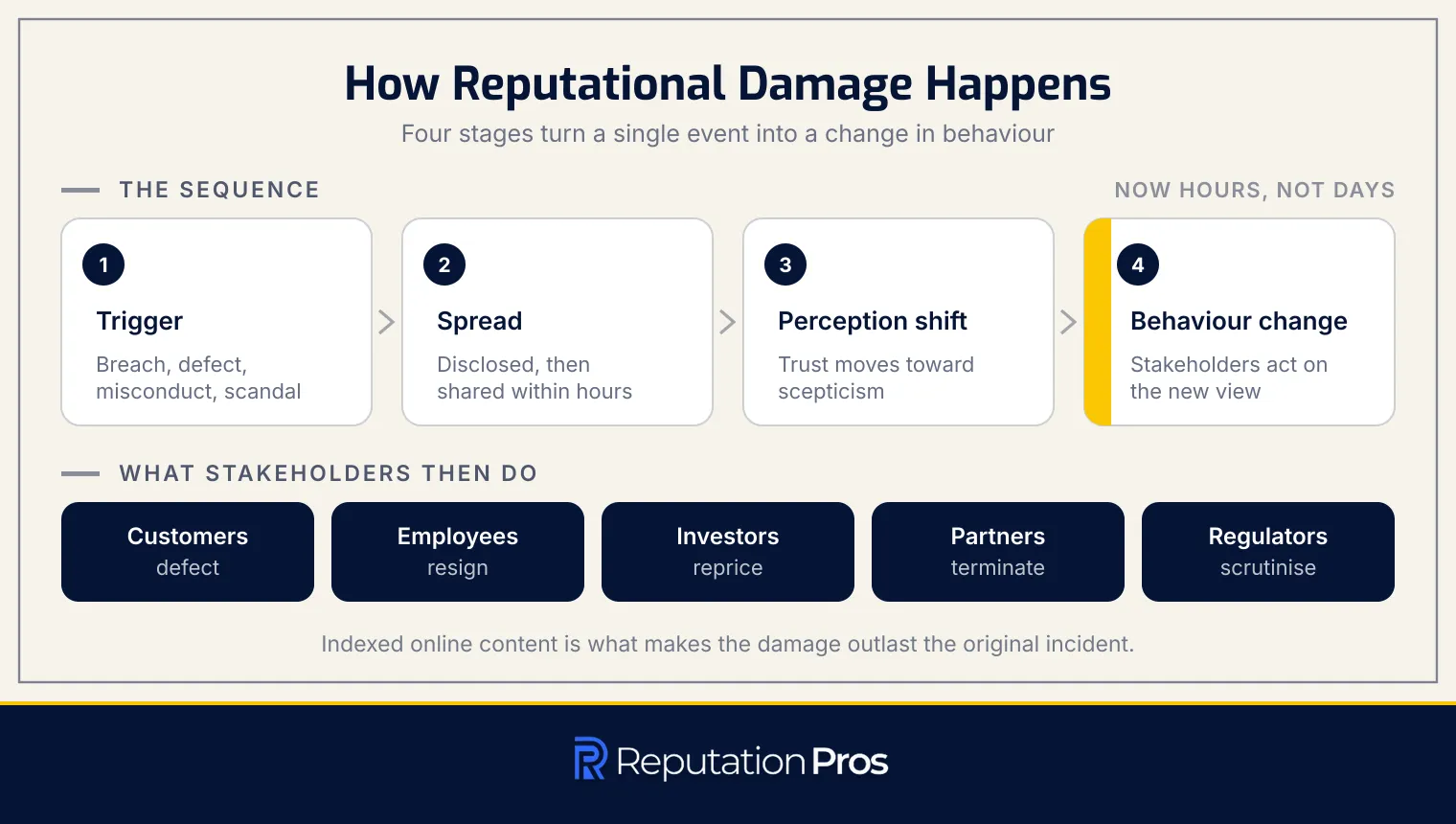
Reputational damage starts with a triggering event such as a data breach or executive misconduct, which is then disclosed and spread across social media and news outlets until stakeholder perception shifts. That shift produces behaviour change: customers defect, employees resign, investors reprice, partners terminate, and regulators pay closer attention.
The dominant types are data breaches and cybersecurity failures, public scandals, and executive misconduct, and the consequences reach revenue, share price, cost of capital, and talent. Exposure extends past companies to individuals, professionals, institutions, and the platforms that host harmful content. Measurement combines perception surveys, sentiment tracking, and financial proxies, and duration depends on severity, response speed, and recurrence, with indexed online content outlasting the incident itself. Response, repair, and prevention are the controllable variables, while online reviews and misinformation keep shaping perception long afterward.
What Is Reputational Damage?
Reputational damage is harm to an organisation’s or an individual’s image and credibility, distinct from damage to tangible assets. Reputation works as an intangible asset carrying the trust and goodwill built up over time, and damage occurs when observed conduct diverges from stakeholder expectations through operational failure, ethical breach, a security incident, or controversy.
A triggering event starts the sequence, whether a data breach, product defect, executive misconduct, or public scandal. Disclosure and rapid spread across social media, news outlets, review platforms, and search engines compress the interval between incident and impact, moving stakeholder perception from trust toward scepticism. Perception then converts into behaviour: customer defection, employee resignation, investor repricing, partner termination, and intensified regulatory scrutiny.
Those consequences lift reputational damage out of communications and into material business risk, covering revenue and customer loss, valuation decline, higher cost of capital, regulatory attention, and talent loss. Measurement relies on perception surveys, sentiment tracking, media monitoring, and financial proxies. Indexed online content is what makes the damage outlast the original incident, leaving response speed, accountability, and crisis communication as the variables an organisation still controls. Whether the damage can be repaired depends on sustained alignment between what the organisation does and what its stakeholders value.
How Does Reputational Damage Differ From Reputational Risk?
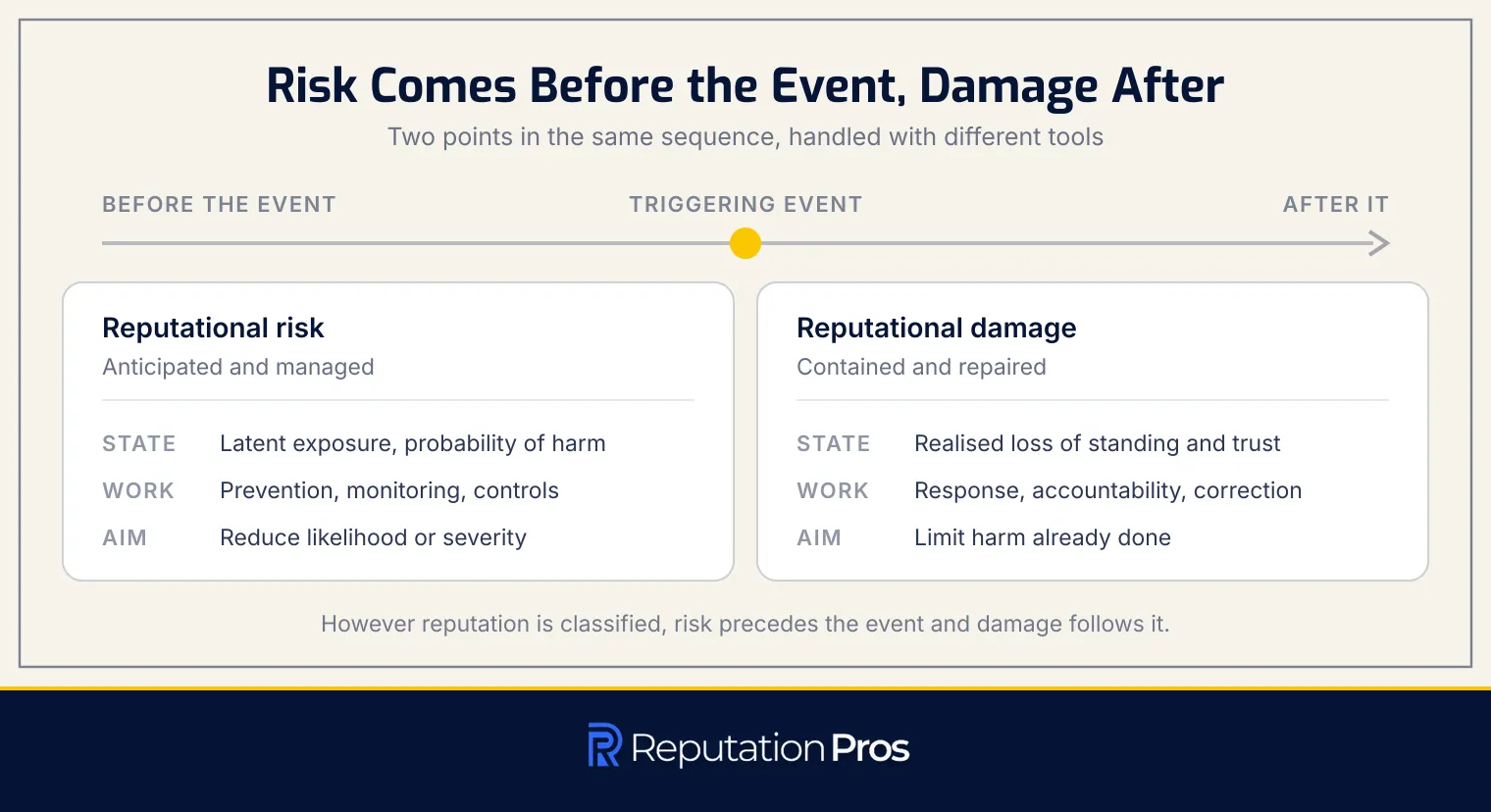
Reputational damage and reputational risk sit at different points in the same sequence. Reputational risk is the latent exposure and probability of harm before an adverse event, the anticipated threat organisations identify and manage through frameworks and controls. Reputational damage is the realised loss of standing, credibility, and trust once a triggering event has occurred and become known. Risk is anticipated and managed; damage is contained and repaired.
The distinction matters operationally. Risk management concentrates on prevention, monitoring, and reducing the likelihood or severity of a potential event. Damage control concentrates on response speed, accountability, corrective action, and communication to limit harm already done. Governance debate continues over whether reputation is an independent risk or a consequence of operational, compliance, and strategic failures, and the functional difference holds either way: risk precedes the event, damage follows it.
How Does Reputational Damage Happen?
Reputational damage happens through a four-stage sequence: a triggering event, disclosure and spread, a perception shift, and behaviour change. The incident might be a data breach, a product failure, executive misconduct, or a false accusation. Information then spreads through social media, news outlets, review platforms, and search engines, and customers, employees, investors, partners, and regulators reassess the organisation’s credibility against the gap between expectation and conduct.
Digital communication compresses that sequence sharply. What once unfolded over days now unfolds within hours, because social platforms distribute instantly and traditional media monitor those platforms for stories. The compressed timeline feeds a cyclical pattern where each stage reinforces the next, deepening harm while it goes unmanaged.
The Trust-Perception Cycle
The trust-perception cycle is a continuous loop in which stakeholder expectations and organisational conduct act on each other. Conduct falling short of expectations shifts perception negatively, and the shifted perception changes behaviour. Changed behaviour brings heightened scrutiny, which worsens perception again. Each turn of the cycle compounds the last, which is why regaining trust requires deliberate intervention rather than time alone.
Trigger a Trust Breach
A trust breach occurs when a triggering event exposes a gap between stakeholder expectations and actual conduct. The events fall into recognisable categories: product or service defects, data breaches, misconduct, and false accusations. Two factors decide whether an incident escalates into broader damage. Visibility governs how widely the event becomes known, and severity governs the extent of harm and the degree to which norms or legal standards were breached. High visibility paired with high severity produces a public credibility problem fastest.
Spread Negative Information
Negative information spreads through distribution channels: social platforms, review sites, news coverage, and search results. Once published, damaging content gets indexed, which creates a persistent record that stays visible long after the event. Persistence is what carries reputational impact past the incident, and repetition across platforms is what turns a single report into something readers treat as settled.
Reinforce Negative Perceptions
Repeated exposure to a damaging narrative hardens stakeholder belief. Recurrence across search results, news articles, social posts, and reviews raises both the salience and the perceived truth of the claim, until stakeholders treat it as established fact. Silence or denial worsens the position, because an unanswered account reads as a conceded one. Heightened scrutiny follows the initial incident, and stakeholders then judge every subsequent action through that harder lens.
Change Stakeholder Decisions
Altered perception changes what stakeholders do. Customer defection comes first, as consumers move to competitors and revenue falls. Employee attrition follows, with staff leaving over perceived instability, raising recruitment costs and disrupting operations. Investor repricing sees shares sold or higher returns demanded, cutting market capitalisation and raising the cost of capital. Partner and supplier termination occurs as counterparties protect their own reputations. Regulatory attention intensifies, bringing fines and stricter compliance that strain resources and signal distress to the market.
What Are the Types of Reputational Damage?
The primary types of reputational damage are listed below.
Defective product or service quality. Quality and safety failures erode consumer confidence quickly, as Toyota’s mass recall over unintended acceleration demonstrated across both its finances and its standing.
Corporate crime and compliance failure. Breaches of legal or regulatory standards, such as Wells Fargo’s unauthorised accounts scandal, signal disregard for ethical norms and bring fines, investigations, and sustained loss of customer trust.
Data breach and security failure. Incidents exposing sensitive data undermine custodial trust, because stakeholders conclude the organisation could not protect what it was given.
Executive or employee misconduct. Unethical behaviour by leaders or staff, including harassment and fraud, ties the organisation’s identity to that conduct.
Supplier and third-party failure. Vendor and partner failures reflect back on the brand, since stakeholders hold it accountable for the integrity of its whole supply chain.
Environmental and ESG failure. Pollution and labour abuses contradict stated values, and their visibility puts an organisation’s social licence to operate at stake.
Fraud. Deliberate financial or consumer deception signals poor governance and creates a perception of dishonesty that resists repair.
Values-action hypocrisy. Conduct contradicting a stated mission reads as insincerity, which drives trust loss in preventable crises.
Policy reversals. Sudden, unexplained changes to public commitments signal instability or bad faith, where consistency between message and action would hold trust.
Reputational Damage From a Data Breach or Cybersecurity Incident
Reputational damage from a data breach occurs when attackers compromise sensitive information such as customer personal data, payment records, health information, or login credentials. The breach triggers a disclosure duty that publicises the organisation’s failure to protect what it held, which is what converts a security incident into a custodial trust problem. Healthcare, financial services, and critical infrastructure absorb the sharpest damage, because data sensitivity and regulatory obligation both run highest there.
The financial side is measurable. IBM’s Cost of a Data Breach Report 2025 put the global average cost of a breach at $4.44 million, down 9% from $4.88 million the previous year as faster detection and containment took hold, with detection and escalation the largest single cost component at $1.47 million. The reputational side unfolds across mitigation, remediation, and recovery. Mitigation contains the breach and stops further access. Remediation secures systems and closes the vulnerabilities. Recovery rebuilds stakeholder confidence through transparent communication and demonstrated security improvement, and it runs longest, because indexed content about the breach stays searchable well past the incident response.
Reputational Damage From Public Scandal or Executive Misconduct
Reputational damage from public scandal or executive misconduct attaches the conduct of an individual to the identity of the organisation. Stakeholders read leadership behaviour as evidence of culture, which is why misconduct at the top travels further than an equivalent failure lower down. Wells Fargo’s unauthorised accounts scandal showed the pattern. The Consumer Financial Protection Bureau fined the bank $100 million in September 2016 for secretly opening unauthorised deposit and credit card accounts, with the bank’s own analysis identifying more than two million accounts that may not have been authorised, and separate penalties of $35 million to the Office of the Comptroller of the Currency and $50 million to the City and County of Los Angeles followed.
Why Does Reputational Damage Matter?
Reputational damage matters because it converts directly into financial and operational loss. Revenue falls as customers defect, valuation falls as investors reprice, capital costs rise, remediation and legal expenses accumulate, and partners withdraw. The same event reaches the workforce, making recruitment harder and retention weaker at exactly the point the organisation needs capacity to recover.
How Does Reputational Damage Affect Revenue and Company Valuation?
Reputational damage affects revenue and company valuation through several channels at once. Sales and customer attrition hit first, as trust erosion cuts repeat purchases and raises churn. Share price and market capitalisation follow, and in severe crises the fall can approach half a company’s market value, as BP’s collapse after Deepwater Horizon showed. Cost of capital rises as investors demand a premium for perceived risk. Legal and remediation expenses, covering settlements, regulatory fines, and system upgrades, compound the loss. Contract and partnership losses follow as counterparties distance themselves to protect their own standing.
How Does Reputational Damage Affect Customer Trust and Employee Retention?
Reputational damage affects customer trust and employee retention by undermining confidence in an organisation’s reliability and ethics at the same time. Customers who perceive a breach of trust reduce repeat purchases, and the effect runs sharpest in sectors where security and ethics are the product, such as finance and healthcare. Employees read the organisation’s reputation as a statement about its culture, so damage signals instability or a gap between stated and actual values, and staff leave. The two effects compound: weakened operational capacity arrives exactly as hiring becomes harder and more expensive.
Who Can Experience Reputational Damage?
The entities that can experience reputational damage are listed below:
- Businesses: companies of every size, exposed through product failures, data breaches, and executive misconduct.
- Individuals and professionals: executives, employees, and self-employed professionals whose personal credibility and client relationships absorb the damage from allegations or misconduct.
- Public figures: celebrities and prominent leaders, who face heightened scrutiny and a higher burden of proof in defamation cases.
- Private figures: private individuals, who hold stronger legal protection yet remain exposed to malicious reviews and unfounded accusations.
- Nonprofits and NGOs: organisations dependent on donor trust, where financial mismanagement or scandal costs support and legitimacy together.
- Platforms and marketplaces: services hosting third-party content, which absorb damage from the harmful content and fraud their users generate.
- Institutions: schools, hospitals, and financial institutions, whose credibility and operational stability depend on meeting stakeholder expectations.
How Is Reputational Damage Measured?
Reputational damage is measured by combining perception tracking with business performance data. Surveys and sentiment analysis track how customers, employees, and investors view the organisation over time, and review scores on Google and Yelp give aggregate sentiment that moves visibly after a negative event.
Media monitoring and search visibility tracking measure the volume and tone of coverage, showing how far negative information spread and how long it persists. Financial proxies translate perception into economics: revenue decline, customer churn, and share price movement.
Legal contexts demand documented evidence rather than trend data, including lost contracts, income records, witness testimony, and expert valuation, each tied explicitly to the damaging event, because that is what it takes to prove reputation damages in court. Establishing baseline reputation metrics before an incident is what makes deviation and recovery measurable afterward.
How Long Does Reputational Damage Last?
Reputational damage lasts from months to years, and indefinitely where failures recur. Duration depends on the severity of the incident, the speed and quality of the response, and whether similar incidents happen again. Indexed online content is the main reason damage persists: negative news articles, social posts, and reviews stay searchable long after the event, producing a long tail in which stakeholders meet historical content during due diligence even after corrective measures are complete. A swift, consistent response compresses recovery, while delay, denial, and repetition extend the harm.
How Does a Company Response Affect Reputational Damage?
A company’s response affects reputational damage more than almost any other controllable factor. Speed dominates: organisations that acknowledge an issue within the first day face less lasting harm, because rapid acknowledgment demonstrates control before perception hardens. Substance matters just as much, and companies that address the problem directly, accept responsibility, and set out corrective action rebuild trust faster than those that deny or deflect.
Consistency between public statements and subsequent action completes the picture. Statements matched by action signal reliability; inconsistencies and reversals compound the original damage by signalling that the organisation cannot be relied on. Stakeholders judge a response on what was said and on what followed.
How Can Organizations Repair Reputational Damage?
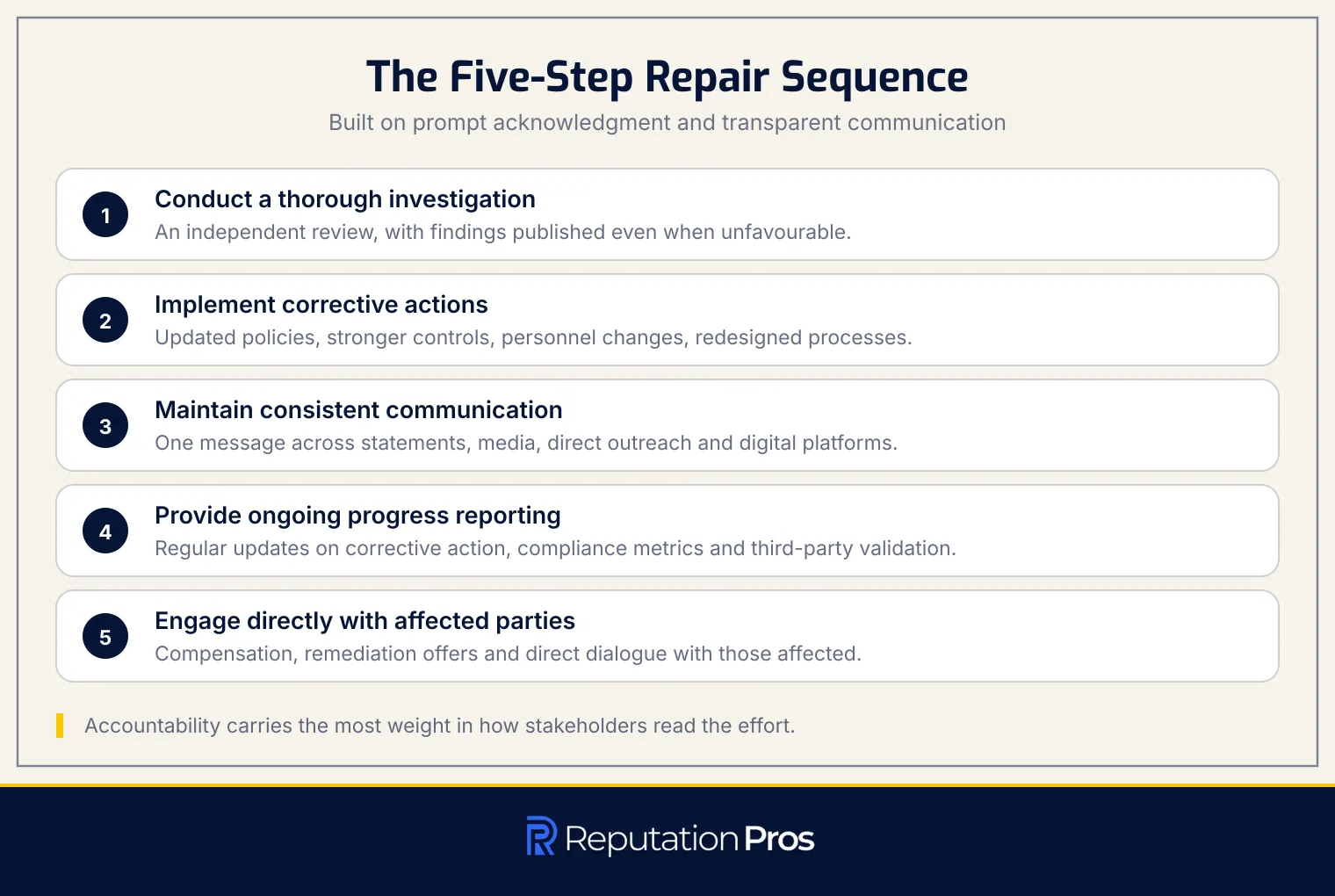
To repair reputational damage, organisations work a structured sequence that addresses the root cause and demonstrates accountability, beginning with prompt acknowledgment and transparent communication.
Conduct a thorough investigation. An independent review establishes what went wrong and who was responsible, and publishing the findings even when unfavourable is what makes the rest of the sequence credible.
Implement corrective actions. Visible change restores trust, through updated policies, strengthened controls, personnel changes, and redesigned processes, each concrete, verifiable, and proportional to the damage.
Maintain consistent communication. Messaging holds consistent across official statements, media, direct outreach, and digital platforms, because contradictory messages undermine the repair effort itself.
Provide ongoing progress reporting. Regular updates on corrective action, compliance metrics, and third-party validation sustain the demonstration of change over the period trust actually takes to rebuild.
Engage directly with affected parties. Compensation, remediation offers, and direct dialogue with customers, employees, and partners personalise the accountability.
Accountability carries the most weight of the five in how stakeholders read the effort.
How Do Accountability and Corrective Action Rebuild Trust?
Accountability and corrective action rebuild trust by naming the failure and changing what allowed it. Open acknowledgment of what went wrong establishes responsibility. Control changes, whether new procedures or governance structures, address the root cause. Visible follow-through, evidenced by action rather than commitment, is what convinces stakeholders the change is real.
Ongoing reporting on progress and setbacks sustains the restoration, letting stakeholders verify that corrective measures work. Sustained transparency plus evidence of change is what shifts perception from distrust back toward confidence, over a timeline set by the severity of the incident, the consistency of the corrective action, and the absence of repeat failures.
How Can Organizations Prevent Reputational Damage?
To prevent reputational damage, organisations build controls before an incident rather than responses after one. Governance structures assign ownership of reputational risk, and risk registers identify the exposures most likely to produce harm. Compliance programmes and internal controls close the operational and ethical gaps that trigger incidents. Vendor and third-party due diligence extends that scrutiny across the supply chain, since stakeholders hold the brand responsible for its partners.
Monitoring supplies early warning, tracking search results, reviews, social conversation, and press coverage so an emerging issue surfaces while it is still small. A pre-built crisis plan, with a named spokesperson and defined escalation path, converts detection into response without the delay that hardens perception. Baseline reputation metrics, captured while conditions are normal, make any later deviation measurable.
How Does Crisis Communication Reduce Reputational Damage?
Crisis communication reduces reputational damage by managing perception while the event is still unfolding. A pre-built plan with a designated spokesperson keeps messages consistent across channels, which prevents the conflicting information that breeds distrust.
Prompt response is decisive, because delay reads as evasiveness or indifference. Transparency matters more than reassurance: acknowledging the problem and naming the remaining uncertainties is more credible than premature confidence.
The value rests in how stakeholders read organisational behaviour under stress. A quick, consistent, honest account demonstrates control and accountability, while silence or inconsistent messaging accelerates the erosion. Crisis communication is the primary variable an organisation controls immediately after a triggering event.
How Do Online Reviews Affect Reputation?
Online reviews affect reputation by functioning as a durable public record of customer experience. Google, Yelp, and Trustpilot give prospective customers an aggregate rating that acts as a purchase filter before any other consideration. BrightLocal’s Local Consumer Review Survey 2026 found that 97% of consumers read online reviews when deciding about a local business, 85% become more likely to use one after reading positive reviews, and 77% are put off by negative ones. Businesses that answer reviews, positive and negative alike, demonstrate accountability, and a professional reply to criticism limits its effect where silence reads as indifference.
Fake and malicious reviews distort that record, whether from competitors or from individuals intent on harm. Platforms publish policies for reporting and removing fraudulent content, and the process is slow. Ratings carry measurable revenue consequences. Michael Luca’s Harvard Business School working paper “Reviews, Reputation, and Revenue: The Case of Yelp.com” found that a one-star increase in a restaurant’s Yelp rating produced a 5% to 9% rise in revenue, an effect concentrated among independent restaurants rather than chains. Managing a review presence deliberately is what preserves reputational resilience.
How Does Misinformation Affect Reputation?
Misinformation affects reputation by distorting perception through false statements of fact. Those statements fall into the legal categories of defamation: slander for spoken defamation, libel for written or published. Malicious allegations circulate through social media, news outlets, and search results, and the persistence of indexed results means misinformation stays reachable long after a claim is debunked.
Correction and takedown routes vary by platform and jurisdiction, running through formal takedown requests, defamation action, and content moderation appeals. The legal threshold differs by who was harmed. In Gertz v. Robert Welch, Inc., 418 U.S. 323 (1974), the Supreme Court held that private individuals need show only fault rather than the actual malice public officials and public figures must prove, and that states may not permit presumed or punitive damages absent knowledge of falsity or reckless disregard for the truth. False statements capable of quantifiable damage include allegations of disease, infidelity, fraud, criminal behaviour, and unethical conduct. Residual harm continues even after correction, which is what makes monitoring and rapid response part of reputation management rather than an optional extra.
Can Reputational Damage Be Repaired?
Yes, reputational damage can be repaired, on conditions. Recovery depends on the severity of the incident, the speed of the response, and the consistency of corrective action. Organisations that act promptly, accept accountability, and implement visible corrective measures improve their odds substantially. Recovery usually arrives in stages, partial first and fuller over time as trust rebuilds. What usually separates partial from full recovery is whether the damage came from a single incident or from a pattern of failures. Reputational damage is a manageable condition rather than a permanent state, and it responds to deliberate intervention sustained over time, the same principle behind any effort to rebuild a damaged online reputation.