How to Prove Reputation Damages
 22 min read
 On this page
To prove reputation damages, assemble the preserved false statement, proof that it was published and understood to refer to you, and documented losses traced back to it. Reputation damages are the compensable legal harm caused by a defamatory falsehood affecting standing in the community, professional opportunity, and public esteem, and they form a required element of a defamation claim rather than an addition once liability is settled.
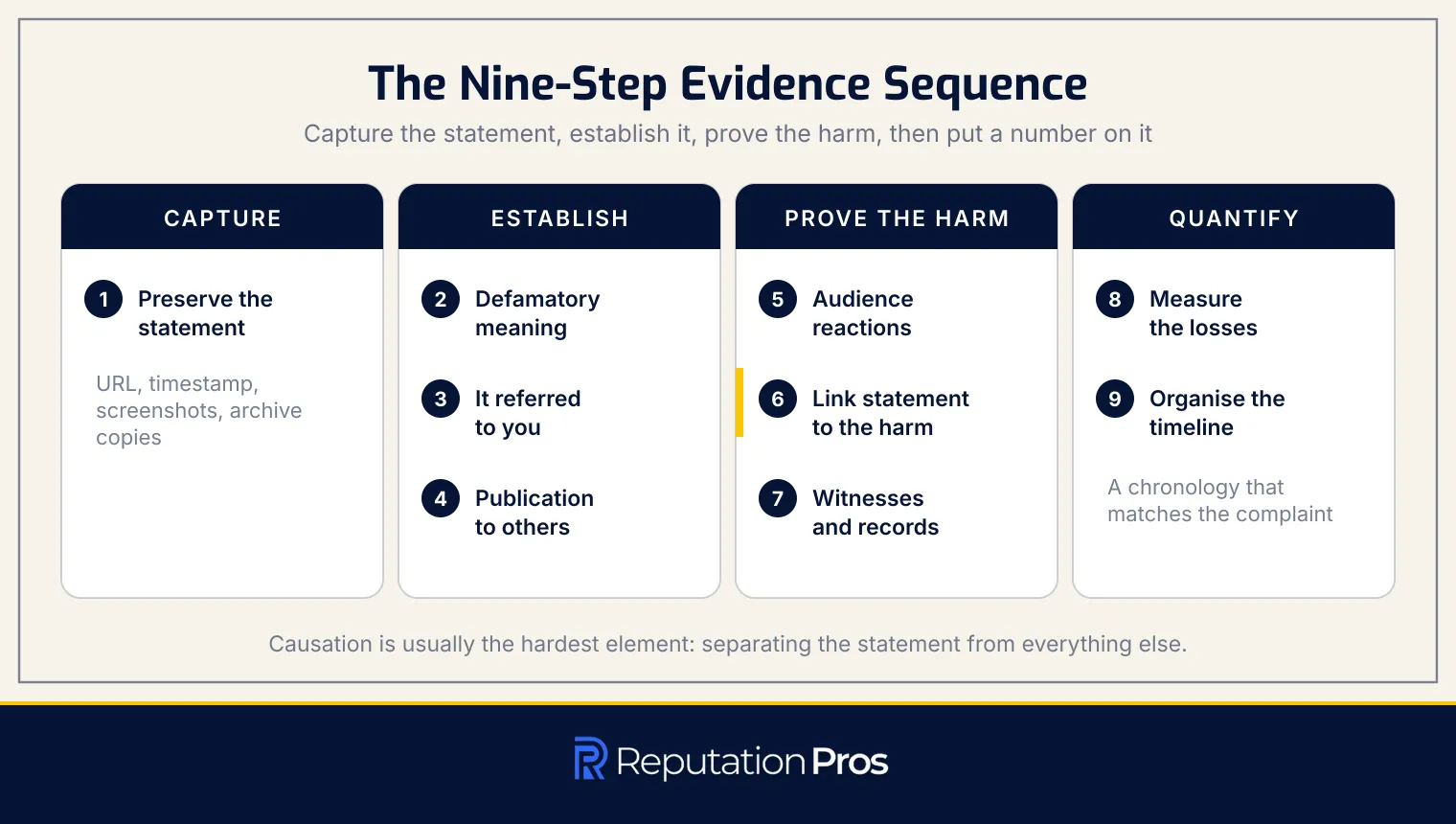
The proof runs in sequence. Preserve the statement with its URL, timestamp, screenshots, and archive copies. Establish its defamatory meaning, its falsity, and that it referred to you. Prove publication to a third party, document how the audience reacted, link those reactions to the harm, and gather the witnesses and records that corroborate the loss. Measure financial and nonfinancial losses, then organise everything into a chronology matching the complaint.
Damages divide into general or presumed, special, nominal, and punitive. Each claim requires a false statement of fact, publication, identification, fault, and actual harm, with the fault standard set by the claimant’s status: private figures prove negligence, public figures prove actual malice. Causation is usually the hardest element, since the claimant must separate the statement’s effect from market conditions and pre-existing problems. Valuation may need a forensic accountant or a reputation expert, the proof differs between businesses and individuals, and online visibility keeps the harm running. Where financial loss cannot be shown, presumed or nominal damages remain available. Counsel belongs in early, because the limitation period is short and evidence degrades.
1. Preserve the harmful statement
To preserve the harmful statement, capture it in its original form so it stays unaltered and verifiable. Preservation covers the URL, the visible timestamp, and full-page screenshots, supported by archived copies from a third-party service such as the Internet Archive’s Wayback Machine. Metadata including publication date and author information establishes authenticity and reveals any later alteration.
A litigation-hold duty arises once litigation is reasonably anticipated, obliging both sides to prevent deletion or modification of relevant material. A preservation or cease-and-desist letter formalises that duty and creates a timestamped record of notice. Chain of custody matters throughout: the original must remain untouched and every copy must trace back to the unmodified source, with forensic capture tools and affidavits from witnesses who saw the original reinforcing the record.
2. Identify the defamatory meaning
To identify the defamatory meaning, determine whether the statement lowers the claimant in the estimation of others. Some statements carry that meaning on their face; others reveal it only once extrinsic facts are supplied.
Libel per se covers statements whose defamatory meaning is apparent without context, including accusations of criminal activity, loathsome disease, unchastity, or harm to a trade, profession, or business. Harm is presumed in those categories, and the claimant may recover without proving itemised economic loss.
Libel per quod covers statements that become defamatory only alongside extrinsic facts, where an otherwise innocuous sentence turns injurious once the reader knows more. The claimant must then establish those extrinsic facts and usually prove special damages. Which category applies shapes both the legal strategy and the remedies available.
3. Prove the statement referred to you
To prove the statement referred to you, show that its audience reasonably understood it as being about you, whether or not you were named. The “of and concerning” requirement can be satisfied through extrinsic facts and context, including a job title, a location, or a photograph.
A statement need not name the claimant to be actionable. Identification holds where the statement carries facts the audience can connect, as with a reference to “the manager of XYZ Company who mishandled funds” at a company with one manager.
Group defamation limits that principle. An individual generally cannot claim on a statement aimed at a group unless the group is small enough that the statement reads as referring to each member. Under the small-identifiable-group rule, a statement about “the three partners at ABC Law Firm” may give each partner a claim, while a statement about a large or indefinite group gives none, because no single member can show the audience understood it to mean them.
4. Prove publication to third parties
To prove publication to third parties, show the statement reached at least one person other than the claimant. One recipient satisfies the element, and wide dissemination is unnecessary: a private email forwarded to a colleague or a post visible to a handful of followers clears the threshold, provided the recipient understood the defamatory meaning.
Republication liability extends the original publisher’s exposure when someone repeats or shares the statement. The original speaker may answer for foreseeable onward distribution, and the republisher takes on independent liability. Most jurisdictions apply the single-publication rule, treating an initial mass distribution as one event so the limitation period runs from first release rather than from each copy sold or viewed.
Internet reposting complicates the rule. The rule stops every page view from restarting the clock, while a substantive revision, a repost to a new platform, or sharing by a different user can amount to a separate publication that renews liability and extends the window.
5. Document audience reactions
To document audience reactions, record what third parties did rather than what the claimant felt. Behavioural evidence from the people who received the statement is the strongest proof of reputational harm. The reactions worth documenting are listed below:
- Cancelled contracts: agreements terminated after the statement appeared.
- Lost referrals: a measurable fall in referrals from clients or partners.
- Unfollows and subscriber drops: a decline in followers or subscribers immediately after publication.
- Hostile comment threads: backlash in comment sections showing a shift in perception.
- Review-score drops: a sudden fall in ratings on review platforms.
Each creates a documented trail connecting the statement to a change in how others treat the claimant, which is what carries a damages case past subjective testimony.
6. Link the statement to the harm
To link the statement to the harm, build a timeline showing the harm followed from the publication rather than from something else. Temporal proximity comes first, establishing that the harm arrived shortly after the statement and producing a before-and-after comparison.
Control comparisons isolate the effect. Measuring performance in unaffected periods or channels against the period following the statement rules out market downturns and seasonal variation. Courts apply either the but-for test, asking whether the harm would have occurred without the statement, or the substantial-factor test, asking whether the statement contributed substantially even alongside other causes.
Public figures face a heavier burden, proving causation by clear and convincing evidence, the same standard that governs actual malice. Documented specifics carry the most weight: a contract withdrawn days after publication, or a client naming the statement as the reason for ending the relationship, each corroborated by witnesses and records made at the time.
7. Collect witness and business records
To collect the witnesses and records that prove harm, gather firsthand accounts alongside the documents that quantify them. The sources are listed below:
- Customers and referral sources: testify to stopping business or withholding recommendations after exposure to the statement, which links it directly to lost opportunity.
- Employers and colleagues: describe the effect on professional standing, including lost promotions and changed workplace dynamics.
- Business records: profit-and-loss statements, CRM and pipeline records, invoices, and tax returns quantify revenue decline coinciding with publication.
- Employment or termination files: evidence adverse employment action tied to the statement.
Witness accounts combined with documentary records build the evidentiary file that supports the claim.
8. Measure financial and nonfinancial losses
To measure the losses, separate economic harm from dignitary harm and document each differently. Economic losses cover lost profits from cancelled contracts and reduced sales, lost wages from termination or demotion, mitigation costs for public relations and reputation management, and reputation repair expenses, all supported by financial records and expert testimony.
Nonfinancial losses cover humiliation, mental anguish, and diminished standing in the community, evidenced through medical records, psychological evaluations, and testimony from colleagues and family. Once identified, losses get organised chronologically so each one connects visibly to the statement.
9. Organize the evidence and damages timeline
To organise the evidence and damages timeline, build a chronological framework linking each item to the element it proves. Date the file from first publication, which anchors everything that follows.
Index each item to its element, whether falsity, publication, identification, audience reaction, causation, or amount of loss. Indexing speeds retrieval during proceedings and exposes gaps before opposing counsel finds them. The complaint stays consistent with the evidence, since claimed harm the records cannot support weakens everything else.
A well-built damages file preserves the original statement, then layers on who saw it, how they reacted, and what changed as a result, turning scattered documentation into a defensible causal chain.
What are reputation damages?
Reputation damages are the compensable harm awarded for injury to a person’s or an entity’s standing in the community caused by a false statement. Reputation is a protected legal interest, and in defamation law damages form a required element that must be proven at trial unless the statement falls into a category where harm is presumed, such as libel per se.
Reputation damages divide by medium: libel covers written or published statements, slander covers spoken ones. Both require proof that the statement was false, communicated to third parties, and caused identifiable harm. The measure covers economic losses such as lost income and business opportunity alongside non-economic harm such as humiliation and diminished community standing.
What types of reputation damages can you claim?
The types of reputation damages are set out below.
| Damage Type | What It Compensates | Proof Required | When It Is Available |
|---|---|---|---|
| General/Presumed Damages | Harm to reputation, standing in the community, humiliation, and mental anguish | No specific proof of financial loss required when the statement qualifies as defamation per se | Available when the false statement falls within a per se category: accusations of criminal conduct, loathsome disease, sexual misconduct, or harm to one’s trade, profession, or business |
| Special (Economic) Damages | Quantifiable financial losses directly caused by the defamatory statement, such as lost revenue or contracts | Identified and itemized economic losses supported by financial records, contracts, invoices, and expert testimony | Available in all defamation cases where the plaintiff can demonstrate specific monetary losses with a clear causal link to the defamatory statement |
| Nominal Damages | Symbolic vindication of the plaintiff’s name and acknowledgment that defamation occurred | Proof that defamation occurred but no proof of actual financial or reputational harm | Available when the plaintiff establishes the elements of defamation but cannot prove actual damages |
| Punitive Damages | Punishment of the defendant for exceptionally egregious conduct and deterrence of similar future behavior | Proof of actual malice, ill will, or malicious intent; requires a predicate award of compensatory damages in most jurisdictions | Available when the defendant acted with actual malice, common-law malice, or willful misconduct; subject to constitutional limits, statutory caps, and ratio restrictions relative to compensatory awards |
What is the difference between presumed damages and special damages?
The difference between presumed damages and special damages is what each requires the claimant to prove. Presumed damages allow recovery without proof of economic loss where the statement falls into a defamation per se category such as accusations of criminal conduct or harm to a trade, because the law infers reputational harm from the nature of the statement.
Special damages require itemised, quantifiable proof of economic loss flowing from the statement, such as lost profits or wages substantiated by financial records. Presumed damages are inferred; special damages must be documented.
When are punitive damages available for reputation harm?
Punitive damages for reputation harm are available where the defendant acted with actual malice or ill will, meaning the defendant knew the statement was false or acted with reckless disregard for its truth. Most jurisdictions require a compensatory award as a predicate before punitive damages attach, and many impose statutory caps and ratio limits.
Constitutional limits sit above the state caps. In State Farm Mutual Automobile Insurance Co. v. Campbell, 538 U.S. 408 (2003), the Supreme Court held that few awards exceeding a single-digit ratio between punitive and compensatory damages will satisfy due process, striking a $145 million punitive award resting on $1 million in compensatory damages, while allowing that a higher ratio may stand where an exceptionally egregious act produced only small economic damages. Gertz v. Robert Welch, Inc., 418 U.S. 323 (1974), sets the floor beneath that ceiling, barring states from permitting presumed or punitive damages where liability rests on anything less than knowledge of falsity or reckless disregard for the truth. Availability and ceilings then vary by state, with some imposing hard caps and some barring punitive damages in defamation altogether.
What must you prove for reputation damages?
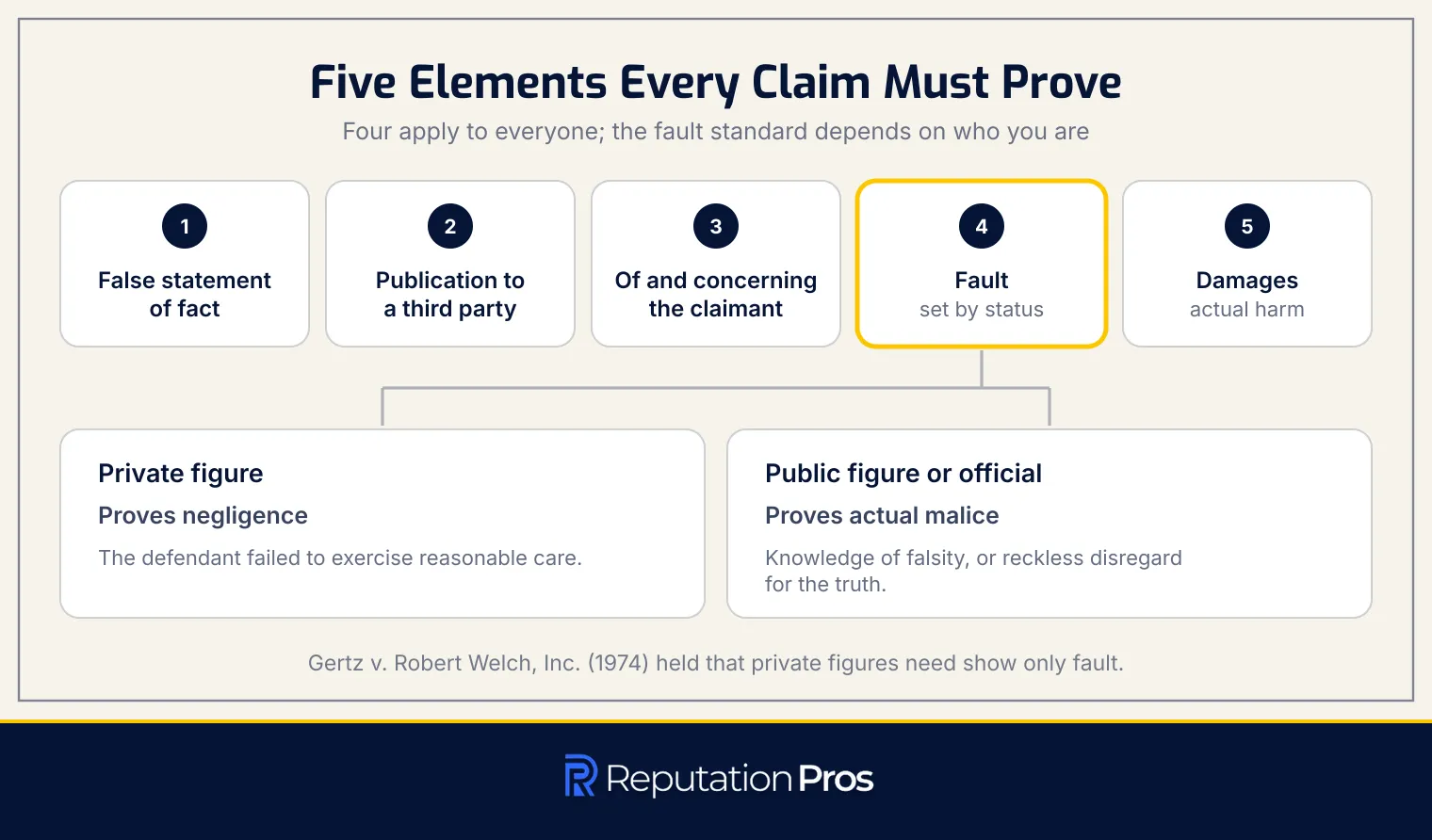
To prove reputation damages, a claimant must establish five elements.
1. False statement of fact. The statement must be objectively false and verifiable rather than opinion or subjective characterisation, since only statements provable true or false are actionable.
2. Publication to a third party. The statement must have reached at least one person besides the claimant, and internet reposting extends both exposure and the publication analysis.
3. Of and concerning the claimant. The audience must have understood the statement to refer to the claimant, provable through extrinsic facts and context, with group defamation raising the difficulty where a statement targets many people.
4. Fault. The standard follows the claimant’s status. Private figures prove negligence, meaning the defendant failed to exercise reasonable care. Public figures and public officials prove actual malice, meaning knowledge of falsity or reckless disregard for the truth, a higher standard that protects speech in public debate. Gertz v. Robert Welch, Inc. established that division, holding that private individuals need show only fault rather than the actual malice standard applied to public figures.
5. Damages. The claimant must show actual harm to reputation, whether economic loss, injury to professional standing, or emotional distress. Defamation per se presumes harm; special damages require quantified losses tied to the statement.
What evidence establishes the elements of a reputation damages claim?
The evidence that establishes each element is set out below.
| Element | Evidence that Proves It | Where that Evidence Comes From |
|---|---|---|
| Falsity | Documents, recordings, screenshots, emails, contracts, or expert analysis demonstrating the statement’s inaccuracy or unverifiability. | The challenged post/article/message itself, plus records that contradict it, such as official filings, business records, employment records, and witness testimony. |
| Publication | Screenshots, copies of emails/texts, web archives, platform analytics, or witness testimony confirming the statement reached a third party. | The publication medium: social media, email, website pages, print copies, messages, reposts, or testimony from the person who received it. |
| Identification | Context evidence showing readers understood the statement referred to the claimant, including job title, location, and unique facts. | The statement itself plus outside facts that point to the claimant, such as employer records, organizational structure, and witness testimony. |
| Fault | Internal communications, prior warnings, ignored corrections, or evidence showing the defendant’s knowledge of falsity or negligence. | The defendant’s communications, drafting materials, newsroom or publishing records, messages from complainants, and testimony about what the defendant knew or should have known. |
| Damages | Lost contracts, lost wages, reduced revenue, customer churn, termination records, or medical/therapy records documenting emotional distress. | Business records, tax returns, invoices, payroll records, employment files, bank statements, CRM data, medical records, therapy notes, and witness testimony from customers, employers, or colleagues. |
The strongest claims show an unbroken chain across all five elements rather than heavy proof on one and gaps elsewhere.
How do you prove defamatory meaning, falsity, and false statements of fact?
To prove defamatory meaning, falsity, and a false statement of fact, show the statement reads as a harmful factual assertion. A statement is defamatory on its face where its ordinary meaning conveys reputational harm directly, as an accusation of crime does. A statement is defamatory by innuendo where extrinsic facts reveal the harm, as ambiguous language suggesting misconduct can.
The burden of proving falsity generally falls on the claimant where constitutional protections apply, and the claimant must show the statement false rather than just harsh or incomplete. Courts separate verifiable factual assertions from non-actionable characterisation, and only a statement provable true or false is actionable. Calling someone a liar in a context implying a named falsehood can be actionable, while calling someone incompetent during a heated exchange usually reads as opinion.
How do you distinguish protected opinion from a false statement of fact?
To distinguish protected opinion from a false statement of fact, apply the verifiability test: a statement provable true or false is actionable, and a pure opinion incapable of verification is protected. Rhetorical hyperbole, meaning exaggeration no reasonable person would read as factual, is protected too.
Prefacing a statement with “in my opinion” does not confer protection where the statement implies undisclosed defamatory facts. The question is whether a reasonable reader would understand it as asserting a verifiable fact. Milkovich v. Lorain Journal Co., 497 U.S. 1 (1990), settled the point, holding that the First Amendment creates no separate opinion privilege and that a statement is actionable where its connotation is sufficiently factual to be susceptible of being proved true or false.
How do you prove actual reputational harm with witnesses and documents?
To prove actual reputational harm, show observable changes in third-party behaviour rather than the claimant’s feelings. The proof falls into three categories.
Behavioural evidence carries the most weight: customers cancelling contracts, referral sources withdrawing, employers pulling job offers.
Documentary proof quantifies it, through profit-and-loss statements, CRM and pipeline records, invoices, and employment or termination files showing shifts that coincide with publication.
Witness testimony from customers, colleagues, and community members establishes the connection between the statement and the change.
Courts weight what people did above what people felt, which makes behavioural proof the foundation.
Which witnesses and records prove that your reputation was harmed?
The witnesses and records that prove reputational harm are listed below:
- Customers and referral sources: testify to lost business opportunities following the statement.
- Employers and colleagues: evidence workplace consequences including demotion and termination.
- Profit and loss statements: show revenue decline after the incident.
- CRM and pipeline records: document lost leads and cancelled contracts.
- Invoices: identify the transactions reduced or cancelled.
- Employment or termination files: record adverse employment action tied to the statement.
- Tax returns: establish the financial baseline against which income drops are measured.
- Medical or therapy records: support emotional distress claims with evidence of treatment.
How do you prove causation for reputation damages?
To prove causation, establish a direct link between the statement and the harm. Temporal proximity comes first, with adverse effects following publication closely. Comparing affected against unaffected periods isolates the statement’s impact and rules out market movement or pre-existing problems. Courts apply the but-for test, asking whether the harm would have occurred without the statement, or the substantial-factor test, asking whether the statement was a substantial rather than marginal cause.
Causation is the weakest link in most defamation claims, because separating the statement’s effect from everything else happening at the same time is genuinely difficult. Public figures carry the heavier burden of proving actual malice alongside it. Once causation holds, financial records and expert analysis convert the demonstrated harm into a figure.
How do you calculate special damages?
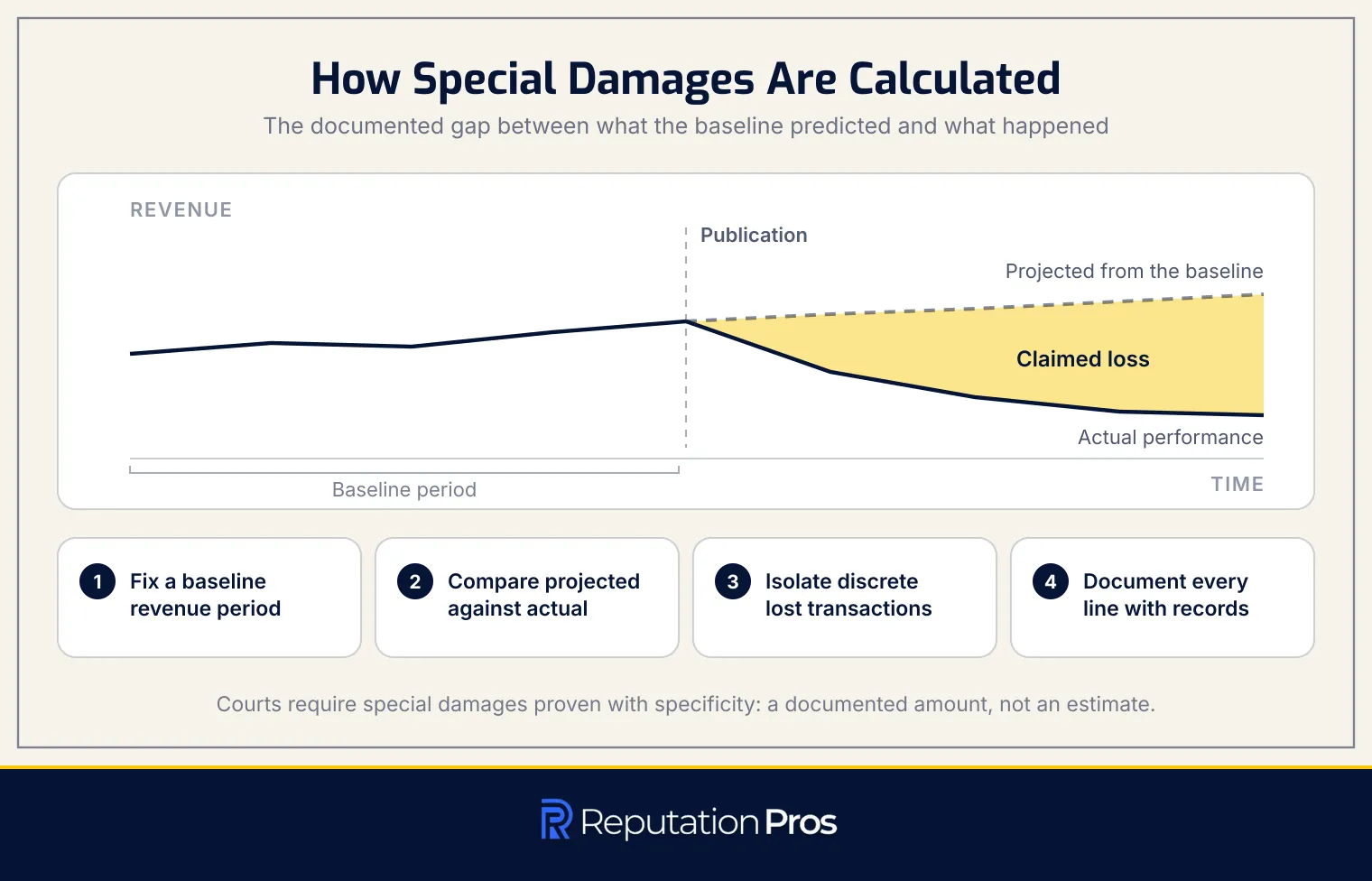
To calculate special damages, plead the loss with particularity and document every line. The steps are listed below:
- Fix a baseline revenue period: establish a pre-publication benchmark reflecting typical performance, using historical revenue, margins, and contract values.
- Compare projected against actual performance: measure results after the statement against what the baseline predicted, adjusting for normal growth, seasonality, and market conditions.
- Isolate discrete lost transactions: identify the named contracts, sales, and opportunities lost to the statement, excluding general declines unconnected to it.
- Document the figure behind each line: support every claimed loss with invoices, contracts, correspondence, purchase orders, employment agreements, tax returns, or banking records.
Courts require special damages proven with specificity, meaning a documented amount rather than an estimate.
When should you use an accountant, economist, or reputation expert to value damages?
Use an expert once the valuation exceeds what records show on their face. A forensic accountant analyses lost profits, diminished business value, and complex revenue calculations. An economist handles lost earning capacity over time, including career setback and lifetime income reduction. A digital-reputation or search analyst applies where harm runs through search visibility, review suppression, or measurable drops in digital engagement.
Each expert must clear the reliability threshold in Federal Rule of Evidence 702 or its state equivalent, which requires testimony resting on sufficient facts or data, produced by reliable principles and methods, and reliably applied to the facts of the case. Courts generally apply the Daubert standard or a state analogue, excluding testimony built on speculation or unsupported assumption.
How do you prove reputation damages for a business?
To prove reputation damages for a business, demonstrate measurable commercial harm, since a business cannot claim emotional distress and must work in quantifiable economic terms.
Trade libel, or commercial disparagement, requires proof that a false statement targeted the business’s goods or services and induced third parties not to deal with it, producing special damages through lost sales, cancelled contracts, or worsened vendor terms.
Corporate defamation covers false statements about the entity itself, such as accusations of fraud or insolvency, and turns on measurable harm to reputation and creditworthiness rather than dignitary injury.
The supporting evidence is listed below:
- Profit-and-loss statements showing revenue decline.
- Terminated agreements or stalled negotiations proving lost contracts.
- Revised payment terms indicating supplier credit tightening.
- Loan denials or increased borrowing costs tied to reputational concerns.
- Employee attrition connected to the controversy.
Which theory applies changes both the proof required and the damages available, so the evidence follows the nature of the false statement.
How do you prove reputation damages as an individual?
To prove reputation damages as an individual, evidence the effect across professional, social, and emotional dimensions.
Professional standing and licensure. Denied promotions, terminations, and loss of professional licences, supported by employment records, rejection letters, and correspondence from licensing boards showing a change in trajectory tied to the statement.
Employment and hiring outcomes. Rejection letters referencing the statement, testimony from hiring managers, and analytics showing reduced professional network engagement.
Community standing. Withdrawal from civic roles and social groups, supported by testimony from community members and affidavits from neighbours describing the change in perception.
Emotional distress. Medical records documenting anxiety or depression attributed to the statement, with testimony from healthcare providers and observations from family and friends about behavioural change.
How do social-media posts, reviews, and search results prove ongoing reputational harm?
Social-media posts, reviews, and search results prove ongoing reputational harm through persistent visibility. Online content stays accessible indefinitely and ranks prominently, so the statement keeps reaching new audiences long after publication. Views, shares, and comments quantify that exposure, converting an abstract harm into evidence, and a negative review holding the first page of results works as a standing barrier during anyone’s due diligence.
Anonymous posters can be identified through subpoenas compelling platforms to disclose user identities. The platforms themselves generally are not liable for what users post. Section 230 of the Communications Decency Act, codified at 47 U.S.C. § 230, provides that an interactive computer service is not treated as the publisher of content supplied by another person, though the protection does not extend to content the service developed itself. Legal recourse therefore targets the original speaker rather than the host.
What should you do when you cannot prove direct financial loss?
When direct financial loss cannot be proven, pursue presumed, general, or nominal damages. Presumed damages apply where the statement qualifies as defamation per se, such as a false accusation of criminal activity or professional misconduct, and the law infers reputational harm without proof of economic loss. The objective then shifts toward vindicating the claimant’s name and correcting the record publicly.
Such claims differ from those built on documented losses. A claim resting on lost contracts seeks special damages tied to quantified economics; a claim resting on presumed damages asks the court to recognise injury without a traceable financial trail. Awards tend to be modest, and the claim remains viable where the statement falls within a per se category.
When should you hire a defamation attorney to prove reputation damages?
Hire a defamation attorney as soon as a potentially defamatory statement is identified. Limitation periods are short, commonly a single year, which makes delay costly. Early counsel matters most where the evidence is thin, since a weak claim can draw an anti-SLAPP motion carrying fee-shifting exposure. Early engagement preserves screenshots, URLs, and witness accounts before they degrade.
Defamation attorneys usually work hourly against an upfront retainer, with contingency arrangements possible where the economic evidence is strong. Once retained, counsel assesses viability, the applicable fault standard, and the realistic damages.
How do attorneys calculate damages in a defamation lawsuit?
Attorneys calculate damages in a defamation lawsuit by weighing the factors listed below:
- Reach and circulation: broader publication and larger audience exposure raise the award, with mass media and viral distribution at the top end.
- Persistence of the statement: content that stays accessible, keeps ranking in search, and gets reshared compounds injury and extends mitigation.
- Gravity of the charge: accusations of serious criminal conduct, professional incompetence, or moral turpitude command higher awards.
- Defendant’s conduct: actual malice or reckless disregard supports higher compensatory awards and opens the door to punitive damages.
- Claimant’s standing: a strong prior reputation supports larger recovery, since the contrast between before and after is clearer.
- Retraction or apology: a timely, genuine retraction reduces damages by limiting reach and persistence.
- Mitigation efforts: what the claimant did to limit the loss, through public relations, search work, or corrective advertising, with failure to mitigate reducing recovery.
- Libel-proof plaintiff defence: where reputation was already severely damaged, courts may limit recovery to nominal damages or dismiss, examining whether the pre-existing harm was general or tied to the same subject matter.
Those factors track the general-damages framework set out in the Restatement (Second) of Torts § 621 and the constitutional limits Gertz placed on recovery absent proof of fault.
What is the statute of limitations to recover reputation damages?
The statute of limitations to recover reputation damages is generally one year, reflecting how quickly defamation claims go stale, though some states allow two or three. The single-publication rule runs the period from the date of first publication rather than from each later view or share, and it applies even where the statement stays accessible online.
Jurisdictions differ enough that the governing state’s own statute controls: California fixes one year for libel and slander under Code of Civil Procedure § 340(c), while Massachusetts allows three under General Laws chapter 260, section 4. Filing inside the period is what preserves the claim.
What remedies are available in a defamation lawsuit?
The remedies available in a defamation lawsuit are listed below:
- Compensatory damages: economic losses including lost income and reputation repair costs, alongside non-economic losses covering emotional distress and lost standing.
- Punitive damages: available where the defendant acted with actual malice or ill will, subject to state caps and ratio limits.
- Injunctive relief: orders preventing ongoing or future publication, which courts grant sparingly given First Amendment constraints and reserve for clear continuing harm.
- Retraction or correction: a court-ordered or negotiated retraction correcting the record, which some jurisdictions require as a precondition for recovering certain damages.
- Content takedown: removal of defamatory material from platforms through legal demand or negotiation.
- Anti-SLAPP fee-shifting: in states with anti-SLAPP statutes, a defendant who successfully strikes a complaint arising from protected speech may recover attorney’s fees, which puts real financial risk on a claimant without solid evidence.
How can you strengthen proof of reputation damages?
To strengthen proof of reputation damages, build the record while events are current rather than reconstructing it later. Maintain contemporaneous logs from the moment the statement appears, since courts favour records created in real time. Preserve every version of the statement and every repost, capture the platform metrics that evidence reach, and keep financial records clean enough to show a baseline against which loss is measured. Identify witnesses early, while memories are fresh and while customers and colleagues still recall what they read and what they did about it.