Types of Defamation: Slander and Libel
 14 min read
 On this page
Defamation is divided into two main types: libel, the written or published form, and slander, the spoken form. Defamation itself is defined as a false statement of fact that harms a person’s reputation, and the two types split by the medium of communication.
Libel covers defamatory statements made in writing or other fixed media, such as newspapers, blogs, and social media posts. Online defamation counts as libel because digital platforms act as a form of publication where content is stored and stays accessible. Slander covers spoken false statements that occur in verbal conversations, broadcasts, or live speeches. The primary difference between libel and slander sits in the medium: libel is permanent and tangible, while slander is transient and oral.
Defamation is further categorized by how damages are treated: defamation per se and defamation per quod. Defamation per se covers statements that are inherently harmful, such as false accusations of criminal behavior, and damages are presumed. Defamation per quod requires the plaintiff to prove actual damages, since the harm is not apparent on the statement’s face. Online content lands on the libel side because of its published nature, and removal of defamatory content answers both libel and slander by taking down the harmful material and preventing further damage. The list of defamation types below opens the breakdown.
What Are the Types of Defamation?
Defamation splits by the form of communication and by the nature of the harm caused. The types of defamation are listed below:
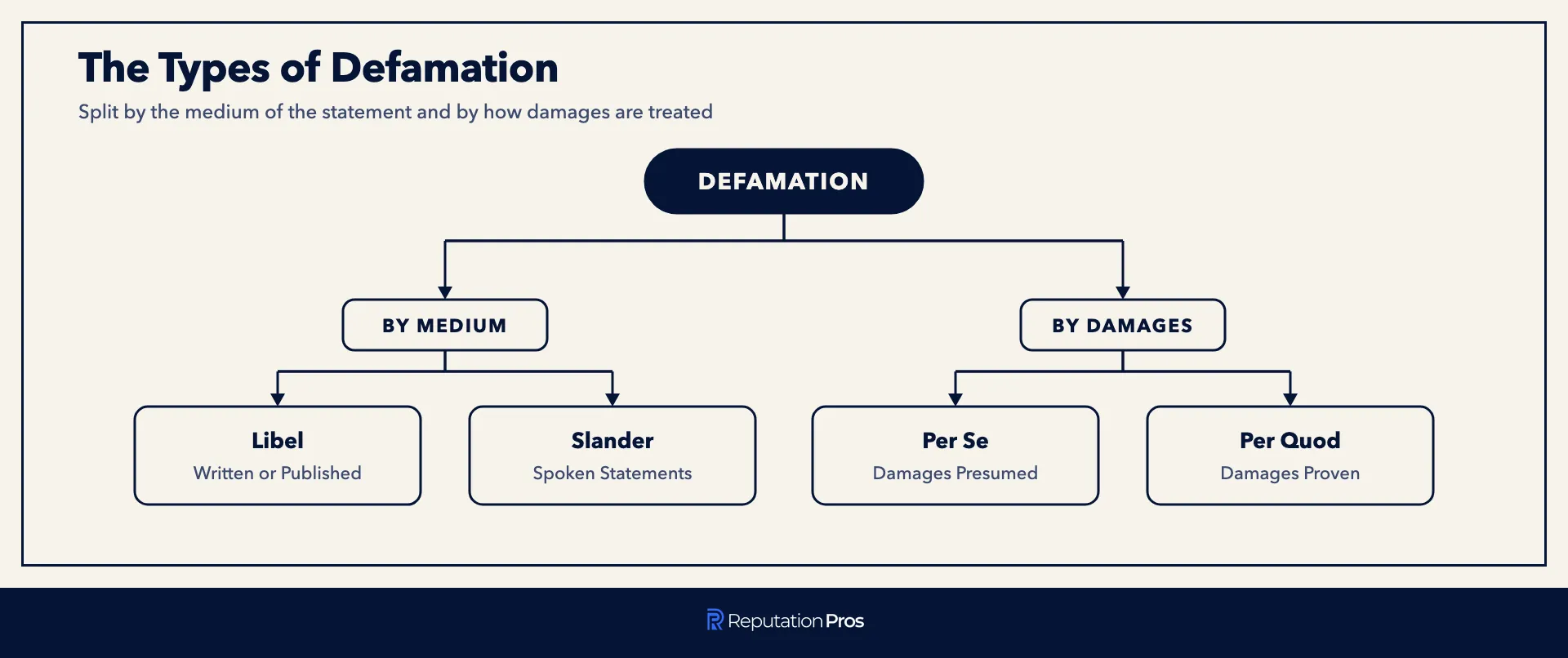
- Libel: Written or published false statements that damage a person’s reputation, including defamatory content in newspapers, books, or online platforms.
- Slander: Spoken false statements that harm someone’s reputation, delivered in speeches, verbal conversations, or broadcasts.
- Defamation Per Se: Statements that are inherently harmful, such as false accusations of criminal activity or professional incompetence, where damages are presumed without proof.
- Defamation Per Quod: Statements that require the plaintiff to demonstrate actual harm or damages, because the defamatory nature is not immediately evident.
Libel, the written form, opens the comparison.
Libel: Written or Published Defamation
Libel is the written or published form of defamation. Libel communicates false statements in a permanent form, such as writing, images, or digital media, that harms an individual’s reputation. Libel differs from slander, the spoken form, by its fixed and enduring nature. The permanence lets libelous content reach a broader audience and persist over time, which multiplies the damage to the subject’s reputation.
Libel spans traditional print formats like newspapers, magazines, and books, as well as digital platforms such as social media posts, blogs, and websites. The defining trait of libel is that the content can be accessed repeatedly, which makes libel more harmful than slander. Libel cases rest on written evidence that can be presented in court, a tangible record of the defamatory statement. Online defamation lands in the libel category because the content is published in a fixed format and stays accessible to a wide audience.
Forms of Libel
Libel reaches reputations through several written and published media. The forms of libel are listed below:
- Printed Publications: Defamatory statements in newspapers, magazines, books, and brochures that reach a wide audience.
- Digital and Online Content: Defamatory statements published on websites, blogs, social media platforms, and online forums, where reach lets the content spread fast.
- Visual Materials: Defamatory images, photographs, cartoons, and videos that falsely portray individuals in a negative light.
- Broadcast Media: Written scripts or content used in television and radio programs that spread false statements broadly.
Why Online Defamation Is Usually Libel?
Online defamation is usually classified as libel because digital content is published in a fixed, written form. Cornell Law School’s Legal Information Institute defines libel in its Wex entry “Libel” as defamation “expressed by print, writing, pictures, signs, effigies, or any communication embodied in physical form”, which is why most online defamation cases fall under libel. Unlike slander, which involves fleeting spoken words, online statements on websites, social media, and blogs stay recorded and accessible to third parties over time. The classification carries weight because libel’s enduring nature causes greater reputational harm.
Slander: Spoken Defamation
Slander is the spoken form of defamation, made of verbal statements that falsely harm an individual’s reputation. Unlike libel, which involves written or published defamatory content, slander occurs through oral communication: conversations, speeches, or any transient verbal expression. The temporary nature of spoken words makes slander harder to prove than libel, because spoken statements leave no lasting record.
To establish a claim of slander, the plaintiff must demonstrate that a false statement of fact was communicated to a third party, resulting in reputational harm or other damages. In most cases, plaintiffs must show actual damages, such as economic losses or measurable harm, unless the statement falls under slander per se. Slander per se covers statements that are inherently damaging, such as false accusations of criminal activity or professional incompetence, which need no proof of specific damages.
Forms of Slander
Slander spreads through spoken statements that harm a person’s reputation. The common forms of slander are listed below:
- False Accusations in Conversations: Verbal claims made during personal or business discussions that damage an individual’s reputation.
- Public Speeches or Presentations: Defamatory remarks delivered orally at public events, such as conferences or town halls.
- Broadcasts and Podcasts: Spoken falsehoods shared through radio, television, or podcasts, though recorded broadcasts may be classified as libel.
- Verbal Statements at Public Gatherings: False allegations made in settings like board meetings or social gatherings, where third parties hear them.
The two types, written libel and spoken slander, meet in the direct comparison below.
What is the difference between libel and slander?
The difference between libel and slander is the medium through which the defamatory statement is communicated. Libel involves written or published statements, such as newspaper articles, online posts, or social media content. Written statements stay permanent and reach a wide audience over time, which makes libel easier to prove in court. Slander involves spoken statements, transient exchanges in conversations or verbal remarks that carry less permanence than libel.
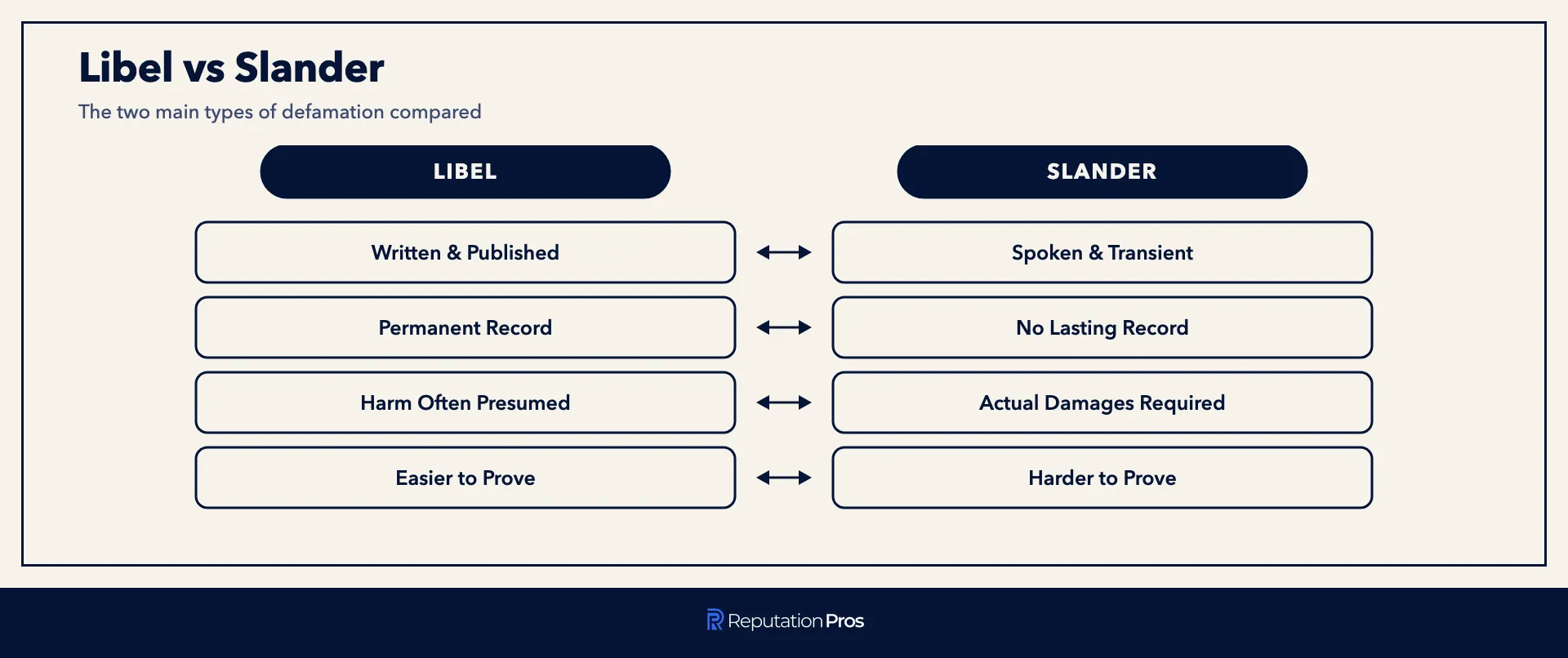
The distinction between libel and slander shapes how damages are proven. Courts presume the harmful nature of the statement in many libel cases, so plaintiffs do not always need to demonstrate specific harm. Slander cases usually require the plaintiff to show actual harm or economic loss resulting from the spoken words. The proof requirement makes slander harder to win, because the claim rests on witness testimony or evidence of the statement’s impact.
What Is Defamation Per Se?
Defamation per se is the category of statements that are inherently damaging to a person’s reputation, requiring no proof of actual harm. The law presumes reputational damage because of the serious nature of the statements, so plaintiffs bypass the need for evidence of specific damages.
Unlike defamation per quod, which requires proof of harm through extrinsic facts, defamation per se relies on the statement’s obvious harmfulness. The distinction simplifies the plaintiff’s burden, narrowing the proof to the statement’s falsity and its publication. Defamation per se involves allegations that strike at professional, moral, or social standing, statements the law treats as damaging without further context, such as accusations of criminal behavior or professional incompetence.
What are the categories of Defamation Per Se?
Defamation per se covers statements the law treats as inherently damaging without additional proof of harm. The categories of defamation per se are listed below:
- Accusations of Criminal Behavior: False claims that someone has committed a crime.
- Allegations of Having a Loathsome Disease: False statements that someone suffers from a contagious or socially stigmatizing illness.
- Statements Affecting Professional Competence or Business Reputation: False claims that harm a person’s professional standing or question integrity and ability in a trade or business.
- Accusations of Sexual Misconduct or Unchastity: False statements alleging immoral or improper sexual behavior, a category historically applied to women.
What Is Defamation Per Quod?
Defamation per quod is the category of statements that are not overtly defamatory but become harmful when read alongside additional context or facts. Unlike defamation per se, where the defamatory nature of the statement is immediately apparent, defamation per quod requires the plaintiff to provide extrinsic evidence of the statement’s defamatory impact.
In defamation per quod cases, the plaintiff must prove actual damages, such as financial losses or harm to professional relationships, resulting from the statement. The proof requirement demands evidence showing how the statement, combined with specific circumstances or audience knowledge, caused reputational harm. For example, a seemingly harmless statement becomes defamatory when the context reveals a negative implication about the subject’s character or business practices.
Defamation per quod is harder to prove than defamation per se because the claim depends on specific, quantifiable harm. The standard assigns liability only when a statement’s harmful impact is backed by concrete evidence, which separates defamation per quod from the automatic presumption of harm in defamation per se.
How Do the Types of Defamation Differ in Proving Damages?
The types of defamation differ in proving damages through the split between defamation per se and defamation per quod. In defamation per se cases, harm is presumed because of the inherently damaging nature of the statement, such as false accusations of criminal activity or professional incompetence. In an action for libel per se, damages may be recovered without pleading or proving special damages, according to the Wex legal encyclopedia entry “Libel Per Se” published by Cornell Law School’s Legal Information Institute.
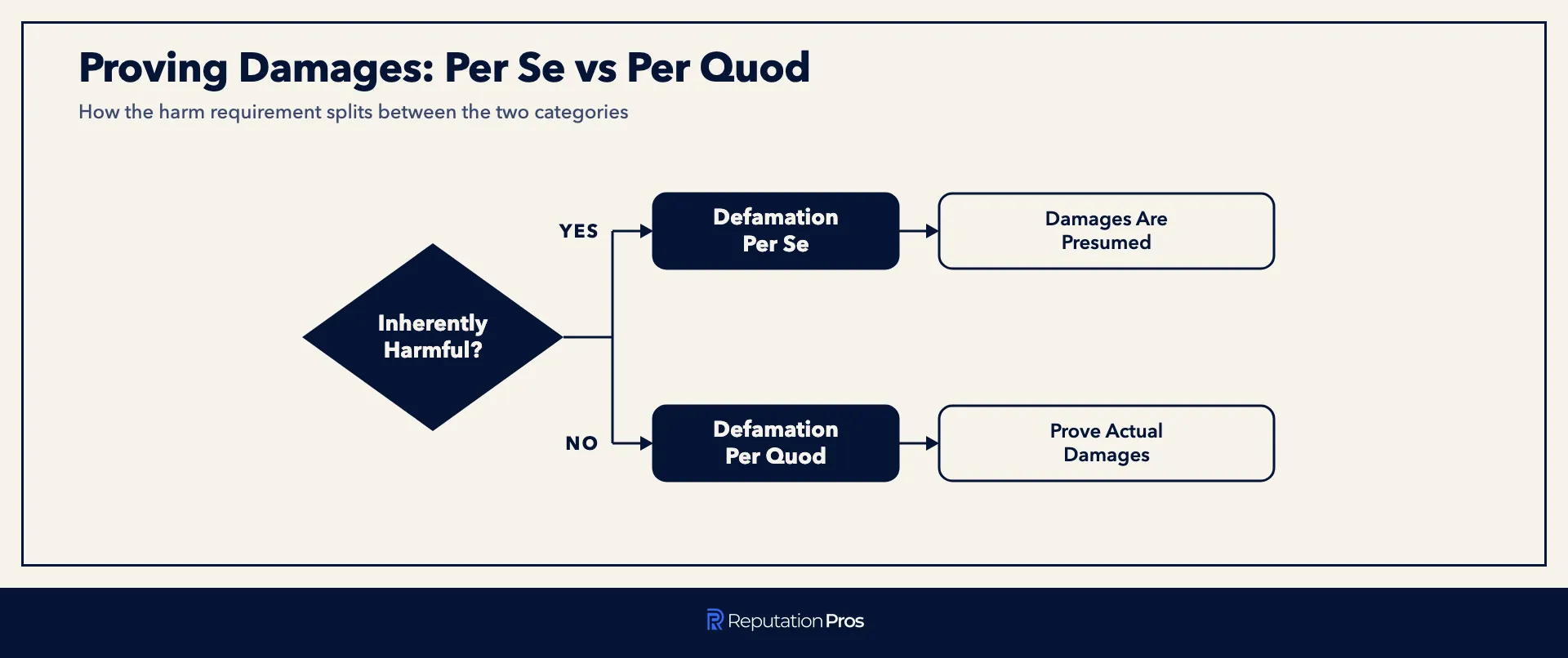
Defamation per quod requires plaintiffs to prove actual damages by showing quantifiable economic harm, such as lost income or business opportunities, that resulted from the defamatory statement. The evidence requirement makes defamation per quod cases harder to win. Public figures carry the added burden of demonstrating actual malice on top of damages.
Which Type of Defamation Applies to Online Content?
Online content falls under libel rather than slander. The classification holds because online statements are written or published, permanent, and accessible to a wide audience. Defamatory posts on social media platforms, blogs, and review sites count as libel. The permanence and wide distribution of online content make online defamation especially harmful, since defamatory statements persist and keep reaching new readers. Removing the content quickly limits the reputational damage and stops further spread of the false information.
How Reputation Pros Removes Every Type of Defamatory Content
At Reputation Pros, we remove every type of defamatory content, libel and slander alike. Our removal work covers written or published defamation such as online articles and social media posts, as well as spoken defamation that has been recorded or transcribed. Legal channels, content takedown requests, and platform-specific protocols deliver the removal, protecting and restoring client reputations across both types of defamation: slander and libel.
As a reputation management company, we also take care of suppressing negative mentions, news, and articles that cannot be taken down at the source. Suppression pushes harmful pages further down the search results with positive, authoritative content, so the negative material loses visibility even when full removal is not possible.