What Is Reputation Management?
 20 min read
 On this page
Reputation management is the practice of monitoring, shaping, defending, and repairing how an entity is perceived across online and offline channels. Reputation management uses a strategic approach to influence public perception through activities such as content creation, review management, and public relations. Reputation management applies to businesses, brands, and individuals, aligning public perception with the entity’s actual identity, values, and performance.
The scope of reputation management covers four core components: monitoring, shaping, defending, and repairing. Monitoring tracks mentions and reviews across platforms, while shaping focuses on creating positive narratives. Defending addresses negative content and crises, while repairing restores a damaged reputation. The four components form a continuous cycle that supports strategic planning and commercial importance. Reputation management connects closely with Online Reputation Management (ORM), which targets digital channels. The article serves business owners, executives, individuals, and marketers who need to grasp reputation management before evaluating services or agencies. Key questions addressed include the four components of reputation management, the seven dimensions of reputation, the cost of hiring a reputation manager, and how to choose a reputation management company.
What is the definition of Reputation Management?
Reputation management is the coordinated practice of influencing how people perceive a person, brand, or organization through strategic control of content, reviews, search results, and public communications. Reputation management integrates public relations, search engine optimization (SEO), review management, and customer experience into a unified operational framework. The primary goal of reputation management is to align public perception with the entity’s actual identity, values, and performance.
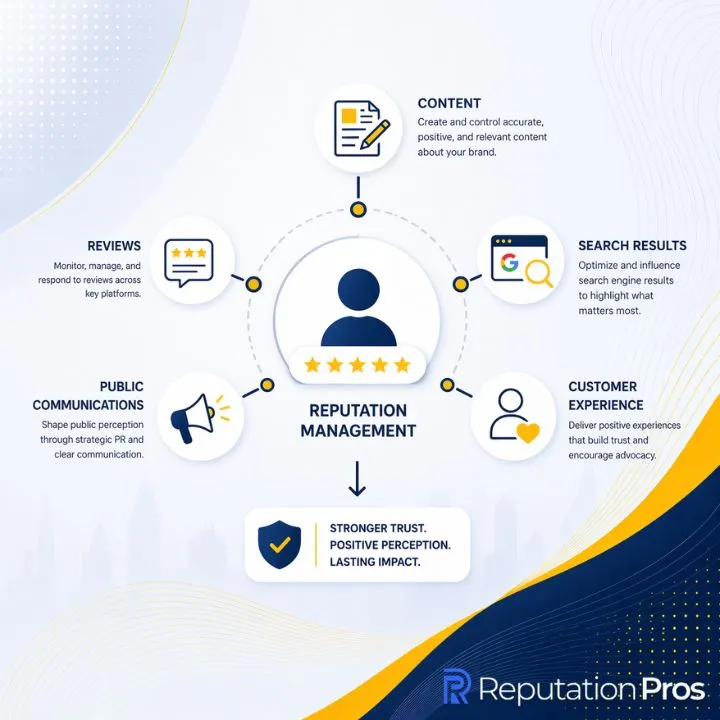
Reputation management applies to both offline and online domains. Offline reputation involves traditional methods such as word-of-mouth discussions and press coverage. Online reputation focuses on digital channels, including search engine results, customer reviews on platforms such as Google, and social media interactions. Reputation management makes sure that stakeholders encounter accurate representations of the entity, which reduces the impact of misinformation and strengthens trust. The digital aspect of reputation management connects to Online Reputation Management (ORM), which manages perception solely through web-based signals such as search results and review sites.
What Does Reputation Management Mean?
Reputation management is the process of controlling and improving what people find, read, and say about a person or business. Reputation management includes five key activities: monitoring, building, protecting, influencing, and repairing. Reputation management exists because public perception shapes trust, revenue, hiring, and partnerships. Reputation management treats reputation as an intangible business asset that can be measured and managed in a structured way. Reputation management aligns public perception with the actual identity, values, and performance of the entity involved.
How Reputation Management Differs from Online Reputation Management (ORM)
Reputation management is the overarching discipline that covers all efforts to monitor, shape, defend, and repair an entity’s public perception across both online and offline channels. Reputation management includes press relations, offline word-of-mouth communications, investor relations, and customer service interactions. Online Reputation Management (ORM) is a specialized subset of reputation management focused solely on the digital sphere. ORM targets search engine results, review platforms, social media channels, online news outlets, forums, and knowledge panels.
Reputation management and ORM converge in practice despite the distinction in scope. The majority of modern reputation signals originate online, which makes ORM a core component within the broader reputation management framework. Businesses and individuals prioritize ORM tactics as digital interactions shape public perception more each year, while maintaining broad strategies to manage reputation at full scope.
What is the Evolution of Reputation Management From Public Relations to the Digital Era?
Reputation management originated as a branch of public relations focused on controlling press narratives and media coverage. The discipline relied on traditional PR tactics such as press releases and media relations to shape public perception. The early 2000s marked a major shift as search engines such as Google became the primary source for first impressions. The shift to search engines required integrating search engine optimization (SEO) techniques to manage search results, which replaced traditional media as the main influence on reputation.
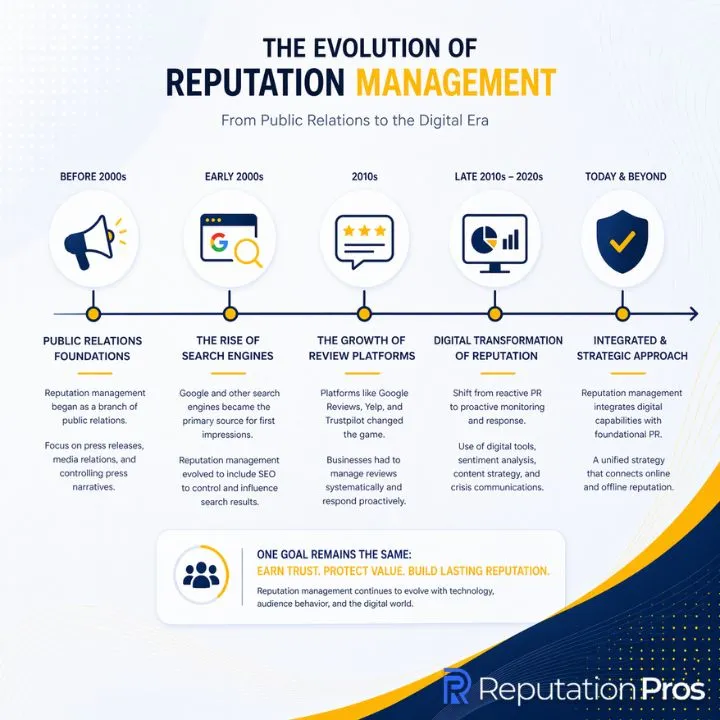
The rise of review platforms such as Yelp, Google Reviews, and Trustpilot further transformed reputation management. Businesses had to adopt systematic review management practices and move beyond reactive public relations to proactive online monitoring and response. Today, reputation management covers SEO, sentiment analysis, content strategy, and crisis communications. Reputation management integrates digital tools with foundational PR principles, which reflects the convergence of online and offline reputation strategies. For a detailed history, refer to the “Reputation Management” Wikipedia entry, which serves as the canonical encyclopedic source.
What Are the Four Elements of Reputation Management?
Reputation management consists of four fundamental components: monitoring, shaping, defending, and repairing. The four components operate as a continuous cycle that helps an entity maintain a positive public image.
- Monitoring: Tracks mentions, reviews, and sentiment shifts continuously across multiple platforms. Monitoring serves as the foundation for all other actions because monitoring detects potential threats before the threats escalate. Tools such as Google Alerts and social listening platforms support monitoring.
- Shaping: The proactive creation of positive content and narratives to influence public perception. Shaping includes publishing authoritative content, earning press coverage, and optimizing social media profiles. Shaping helps control how an entity appears in search results and public discussions.
- Defending: The reactive response to negative content and reputation crises. Defending involves actions such as legal takedown requests, crisis communications, and search suppression. The speed of defending is key, because rapid response reduces long-term damage.
- Repairing: Focuses on restoring a damaged reputation through content removal, search result suppression, and positive content creation. The repairing timeline can vary, with minor issues resolved in weeks and major incidents taking months or even years to address.
The four components of reputation management work together to sustain and strengthen an entity’s reputation and align public perception with the entity’s true identity and values.
Monitoring Brand and Entity Mentions
Monitoring brand and entity mentions tracks mentions, reviews, and conversations continuously across search engines, review sites, social media, and news outlets. Monitoring detects new reviews, brand mentions, sentiment shifts, impersonation accounts, and negative content surfacing in real-time. Key monitoring tools and methods include Google Alerts for basic keyword tracking, brand monitoring software, social listening platforms, and manual search engine results page (SERP) checks. Monitoring is foundational because every other component of reputation management (shaping, defending, and repairing) operates blind without detection.
Shaping and Influencing Public Perception
Shaping public perception is the intentional creation of positive content and narratives that define how an entity appears online. Shaping matters for building and maintaining a favorable digital footprint before any issues arise. Reactive strategies address problems after problems occur, while shaping is a continuous, forward-looking discipline that establishes authority, credibility, and positive perception.
Key tactics for shaping perception include publishing authoritative content such as blog posts, white papers, and thought leadership articles that demonstrate know-how and value. Earning press coverage in reputable publications adds third-party validation and extends reach beyond owned channels. Building positive customer reviews across relevant platforms creates social proof that influences purchase decisions. Optimizing social media profiles keeps consistency and professionalism across all touchpoints. Building author and executive presence through bylined articles, speaking engagements, and media appearances humanizes the brand and establishes individual credibility that reflects on the organization.
Shaping influences search results by creating and raising high-quality content. Entities can control more of the search engine results page (SERP) real estate that appears when someone searches for the entity’s name or brand. Proactive content strategy pushes down negative or irrelevant results while raising messages that align with the entity’s desired identity and values. Shaping connects to the broader reputation management strategy: shaping represents the proactive component of a full reputation plan and defines what the entity stands for rather than simply responding to what others say about the entity.
Defending Reputation During Attacks and Crises
Defending reputation is a reactive response to negative content and reputation crises. Defending focuses on immediate damage control to minimize long-term harm. Common defensive actions include legal takedown requests to remove defamatory content, crisis communications to manage public messaging, and review disputes to challenge inaccurate feedback on platforms such as Google Reviews. Search suppression techniques push negative results lower in search engine rankings by optimizing positive content. Coordinated rebuttal campaigns counter misinformation across multiple channels.
The speed of response matters heavily in defending reputation. Rapid intervention within hours or days can limit the viral spread of negative narratives and reduce long-term reputation damage. Quick responses prevent negative content from dominating search results and social media, which would erode public trust. For entities dealing with an active crisis, specialized online crisis management services offer structured protocols and immediate intervention that contain and resolve high-stakes reputation emergencies.
Repairing and Rebuilding Damaged Reputation
Repairing and rebuilding a damaged reputation follows a structured process that restores public perception after major harm. Repairing begins with content removal, where legally feasible, to eliminate negative reviews or damaging press. Search result suppression follows, pushing negative content below the first page of search results and raising the visibility of positive information. Creating new, positive content matters for rebuilding trust, which involves publishing favorable articles, taking part in positive media interactions, and generating new, authentic customer reviews. A thorough reputation audit assesses the extent of the damage and monitors progress over time.
Repair timelines vary depending on the severity of the incident. Minor issues such as isolated negative reviews might recover within weeks. Major incidents involving widespread negative press or legal disputes may take months or even years to resolve. Repairing requires sustained effort and connects to specialized Online Reputation Repair Services, which offer know-how in executing complex recovery campaigns. Online Reputation Repair Services support businesses and individuals facing major reputation challenges and provide the strategic and technical support needed for effective restoration.
What are the types of Reputation Management by Subject involved?
Reputation management can be classified into distinct categories based on the entity being managed: the web as a whole, a business, a brand, or an individual. The reputation management category matters because the type of entity determines which tactics and strategies apply. The types of reputation management by subject involved are listed below.
- Web as a Whole: Web-scale reputation management covers the entire online environment. Web-scale reputation management focuses on search engine results, social media, forums, and news sites. The goal is positive visibility and suppression of negative content.
- Business Reputation Management: Business reputation management applies to companies of any size, from small local businesses to large corporations. Business reputation management covers customer reviews, press coverage, and financial disclosures. Businesses treat reputation as a balance-sheet asset, where customer and employee reviews are key signals.
- Brand Reputation Management: Brand reputation management focuses on the perception of brands as distinct entities from their owning companies. Brand reputation management centers on advertising consistency, customer experience, and influencer coverage. Brand reputation measures how consumers perceive the brand’s positioning and quality.
- Personal Reputation Management: Personal reputation management applies to private individuals and public figures such as executives, doctors, and lawyers. Personal reputation management covers Google search results, Wikipedia presence, news coverage, and social media profiles. Personal branding and profession-focused review sites such as Avvo or Healthgrades matter heavily.
The four reputation management categories face different audiences, risks, and search engine result page (SERP) features. Each type requires custom strategies to manage and strengthen reputation.
What are the main Activities in a Reputation Management Process?
The main activities in a reputation management process are listed below.
- Monitoring: Monitoring tracks mentions, reviews, and discussions about an entity continuously across search engines, review sites, social media, and news outlets. Monitoring helps detect potential threats and opportunities for engagement.
- Review Management: Review management is the systematic handling of customer feedback on review platforms. Review management involves responding to reviews, encouraging positive feedback, and addressing negative comments to improve public perception.
- Search Engine Reputation Management (SERM): SERM focuses on shaping what appears in search results for branded queries. SERM involves raising positive content, optimizing profiles, and suppressing negative search results to strengthen visibility.
- Social Media Reputation Management: Social media reputation management manages the entity’s presence and perception on social platforms such as Facebook, Instagram, and Twitter. Social media reputation management includes content publishing, comment moderation, and influencer monitoring to maintain a positive image.
- Crisis Management: Crisis management is the strategic response to sudden reputation threats such as viral negative content or false accusations. Effective crisis management requires quick assessment, containment, and communication to mitigate damage.
The five activities align with the four components of reputation management: monitoring, shaping, defending, and repairing. A successful reputation management strategy integrates all five activities for proactive detection, consistent response, and measurable improvement in public perception.
Reputation Monitoring
Reputation monitoring is the continuous surveillance of mentions, reviews, search results, and sentiment signals across digital channels. Reputation monitoring covers branded keyword searches, review platforms, social media, news feeds, forums, and auto-suggest features. The frequency of monitoring varies by risk level: daily for public figures, weekly for most businesses, and hourly during live crises. Reputation monitoring serves as the foundation for reputation management and helps entities maintain control over their online perception before issues escalate.
Brand Mention and Keyword Tracking
Brand mention tracking is the automated detection of any use of the brand name or its variants across monitored channels. Tools such as Google Alerts, Brand24, Mention, Brandwatch, and Meltwater handle brand mention tracking. Brand mention tracking platforms scan online spaces in real-time and deliver notifications based on customized keywords and parameters. The volume of mentions correlates to brand reach and risk exposure. High mention volume indicates strong brand awareness while increasing potential reputation threats. Keyword tracking extends beyond the brand name to include executives, products, and competitor names. Full keyword tracking supports early detection of emerging reputation issues and enables effective responses.
Sentiment Analysis and Tone Detection
Sentiment analysis is the classification of mentions as positive, negative, or neutral using natural language processing. Automated sentiment scoring identifies at-risk mentions worth human review by analyzing text for emotional tone and potential damage. However, sentiment analysis alone is insufficient and requires human interpretation for sarcasm and context. For a full grasp of sentiment analysis methodology, refer to resources on brand sentiment analysis.
Online Review Management
Online review management is the systematic process of monitoring, responding to, and generating customer reviews across multiple platforms. Online review management matters heavily for shaping public perception and improving business outcomes.
- Google Reviews: A primary platform for local businesses that influences search visibility and consumer trust.
- Yelp: Known for restaurant and service reviews that impact local SEO and customer decisions.
- Trustpilot: Focuses on e-commerce and service industries and provides credibility through verified reviews.
- Facebook: Offers social proof through business page reviews that affect brand perception.
- Industry-Focused Sites: Platforms such as Healthgrades for healthcare, Avvo for legal services, and TripAdvisor for hospitality, each providing niche-level findings and ratings.
Review management impacts conversion rates, SEO rankings, and local search visibility. Positive reviews reduce perceived purchase risk and build trust, while negative reviews can deter potential customers. Effective review management sustains a balanced, positive online presence and strengthens the business’s reputation and revenue potential.
For businesses that want professional assistance, Online Review Management Services offer full packages for handling reviews at speed. Online Review Management Services include tools and strategies for maintaining an active feedback loop, which matters for sustaining a positive brand image.
Responding to Negative Reviews on Google, Yelp, and Industry Platforms
Responding to negative reviews requires a strategic approach to mitigate potential damage. A review response is a public, on-platform reply to negative feedback. The best-practice response pattern follows several key steps.
- Acknowledge the Issue: Begin by noting the customer’s concern and show that the feedback is taken to heart.
- Express Empathy: Demonstrate care and empathy for the customer’s experience, which helps humanize the response.
- Address the Defined Issue: Respond to the points raised in the review with factual information and context.
- Offer a Resolution: Propose a clear next step to resolve the issue, which may involve inviting the customer to discuss the matter offline.
- Move the Conversation Offline: Encourage further discussion through private channels such as email or phone to prevent prolonged public discourse.
A measured public response improves perception among readers, even readers who saw the original negative review. Common mistakes to avoid include using defensive language, issuing legal threats, or posting generic copy-paste replies. Defensive language, legal threats, and copy-paste replies exacerbate the issue by portraying the business as unresponsive or unprofessional.
Generating and Requesting Positive Customer Reviews
Generating and requesting positive customer reviews is the systematic solicitation of feedback from satisfied customers to strengthen an online reputation. Review generation uses several compliant tactics that maintain alignment with platform guidelines and avoid penalties. The main review generation tactics are listed below.
- Post-Purchase Email Requests: Follow-up emails after a purchase encourage customers to leave a review.
- In-Store Prompts: Signs or spoken requests at the point of sale invite customers to share their experience online.
- SMS Review Links: Text messages with direct links to review platforms simplify the review process for customers.
- QR Codes on Receipts: QR codes that customers can scan give quick access to review pages.
Review velocity, or the rate of new reviews over time, impacts Google rankings. Maintaining a steady flow of reviews signals ongoing customer engagement and trust. Compliance matters heavily, because incentivizing reviews with payments or discounts is prohibited by most platforms and FTC guidelines.
Search Engine Reputation Management (SERM)
Search Engine Reputation Management (SERM) is the discipline of shaping what appears on the first page of search results for branded queries. SERM controls search engine real estate to influence public perception of an entity. Core SERM tactics include ranking positive owned content, publishing authoritative third-party pieces, optimizing profiles, and suppressing negative results through higher-ranking content. SERM tactics make sure that search engines display favorable information and strengthen the entity’s reputation. Page one of Google is the reputation battlefield for most entities because the majority of users do not look beyond the first page. Dominating page one with positive content matters heavily for reputation management success. For a full grasp, refer to the detailed explanation of Search Engine Reputation Management (SERM).
Suppressing Negative Search Results in Google
Suppressing negative search results pushes unfavorable content below the first page of Google search results through higher-ranking positive content. Suppression relies on optimizing multiple content types to outrank negative listings. The main content types used for suppression are listed below.
- Owned Sites: Personal or corporate websites created and optimized with authoritative content.
- Optimized Social Profiles: Stronger visibility and activity on platforms such as LinkedIn and Facebook.
- Press Coverage: Favorable media mentions and articles secured in reputable publications.
- Guest Posts: Content published on authoritative third-party sites to build credibility.
- Wikipedia Entries: Accurate and positive information that is present and well-maintained.
- Video Content: Platforms such as YouTube used to distribute useful and informative videos.
Suppression is a slower remedy compared to direct content removal because suppression depends on search engine algorithms re-indexing and ranking new positive signals over time. Suppression campaigns show measurable changes in search engine results pages (SERPs) within 3 to 9 months.
Social Media Reputation Management
Social media reputation management monitors and manages an entity’s perception across key social platforms. Social media platforms covered include Facebook, Instagram, Twitter/X, LinkedIn, TikTok, YouTube, and Reddit. Social media reputation management matters heavily because social media has become a primary channel for public perception formation and amplification.
Core tactics of social media reputation management include content publishing, comment moderation, direct message (DM) responses, influencer monitoring, and viral content management. Content publishing creates and shares positive narratives to shape public perception. Comment moderation addresses negative feedback without delay to maintain a positive image. DM responses provide one-on-one engagement and resolve issues in private before issues escalate. Influencer monitoring tracks endorsements or criticisms from high-reach accounts, which can shift public perception. Viral content management involves strategies to mitigate or magnify trends affecting reputation.
Social media reputation management intersects with community management and customer service. Effective community management builds audience interactions, while customer service resolves issues in public or private channels and keeps consistent brand voice and quick threat detection. Integration across these functions maintains trust and strengthens the entity’s reputation across social media platforms.
Reputation Crisis Management
Reputation crisis management is the coordinated response to sudden, high-impact threats to an entity’s public image. Reputation crises can arise from different situations, including viral negative content, CEO misconduct, product recalls, data breaches, false accusations, and lawsuits. Each crisis type requires immediate action to prevent long-term damage.
In managing a reputation crisis, the first 48 hours matter heavily. The response pattern starts with assessing the threat’s scope by gathering facts and monitoring its spread. Containment follows, limiting further exposure through internal coordination. A public response with transparent, factual statements comes next, followed by escalation to legal or PR teams if needed. Continuous monitoring of public sentiment keeps the response effective and helps manage emerging developments. The structured crisis response minimizes long-term harm and restores public trust.
What are the main Reputation Management Strategy and Planning?
A reputation management strategy is a documented plan that sets goals, identifies risks, assigns tactics to channels, and defines key performance indicators (KPIs) to guide an organization in monitoring, shaping, defending, and repairing its public perception. A reputation management strategy serves as the operational blueprint that transforms reactive reputation efforts into a systematic, measurable discipline.
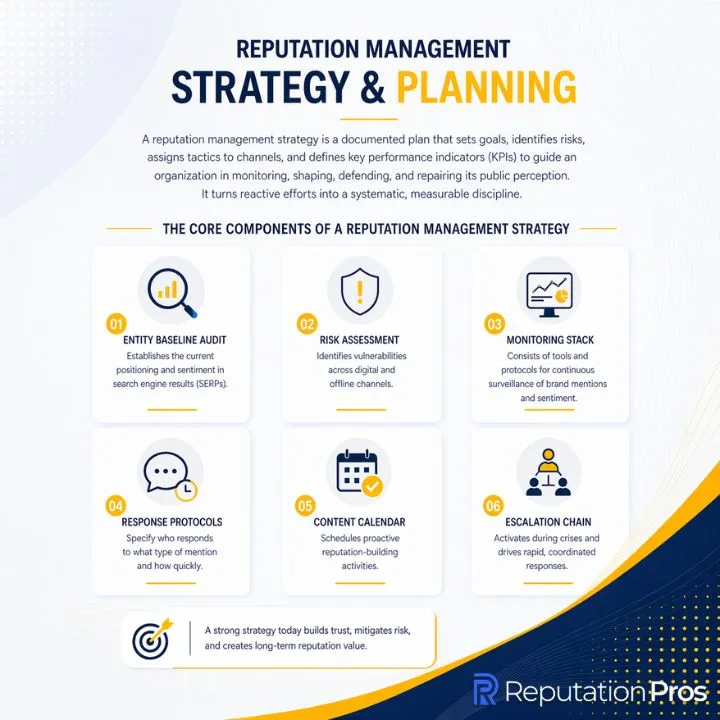
The Core Components of a Reputation Management Strategy are listed below.
- Entity Baseline Audit: Establishes the current positioning and sentiment in search engine results pages (SERPs).
- Risk Assessment: Identifies vulnerabilities across digital and offline channels.
- Monitoring Stack: Consists of tools and protocols for continuous surveillance of brand mentions and sentiment.
- Response Protocols: Specify who responds to what type of mention and how quickly.
- Content Calendar: Schedules proactive reputation-building activities.
- Escalation Chain: Activates during crises and drives rapid, coordinated responses.
Why a Documented Reputation Management Strategy Outperforms Reactive Tactics?
A documented strategy drives consistent responses across teams and time periods, establishes clear ownership and accountability for reputation activities, and enables measurable progress through defined metrics. A documented strategy reduces response time during high-impact reputation events. The strategy interacts with the four core components of reputation management (monitoring, shaping, defending, and repairing) by specifying trigger conditions that determine when each component activates. For example, the strategy defines the threshold at which negative review volume triggers a defensive response campaign, or the cadence at which proactive content publication (shaping) occurs to maintain positive SERP positioning.
Proactive vs. Reactive Reputation Management
Proactive reputation management focuses on establishing a positive presence before any crises arise, while reactive management deals with issues after issues occur. Proactive strategies include ongoing content creation, regular review requests, and setting up monitoring alerts. Proactive actions help build a strong reputation that withstands potential threats. Industry experts suggest that investing in proactive measures can reduce the cost of reactive efforts by 5 to 10 times. Signs of an over-reactive approach include constant crisis management without a content calendar or established SERP baseline. A healthy proactive program features consistent content production, scheduled reviews, and a documented response playbook. The proactive stance minimizes long-term risks and builds a more resilient reputation framework.
How to Build a Reputation Management Plan Step by Step
Building a reputation management plan follows a systematic approach that keeps alignment with business goals and effective monitoring of public perception. The steps below create a full plan.
- Audit: Begin with a thorough audit of your current online presence. The audit analyzes your search engine results page (SERP) state, review scorecards from multiple platforms, and any existing sentiment analysis data. The audit provides a baseline for identifying strengths and weaknesses in your current reputation.
- Goal-Setting: Establish clear, measurable goals for your reputation management efforts. Reputation management goals should align with your broader business objectives and address defined areas identified during the audit. Goals might include improving review scores, increasing positive brand mentions, or strengthening customer engagement.
- Channel Selection: Identify the channels most relevant to your audience and reputation goals. Relevant channels may include social media platforms, review sites, industry forums, and news outlets. Selecting the right channels focuses your efforts where they will have the most impact.
- Tactic Assignment: Assign defined tactics to each chosen channel. Tactic assignment might involve content creation for social media, working with customer reviews, or conducting public relations campaigns. Each tactic should influence public perception in a favorable direction and align with your goals.
- Measurement Framework: Develop a framework for measuring the success of your reputation management activities. The measurement framework sets key performance indicators (KPIs) and uses analytics tools to track progress. Regular measurement allows timely adjustments to strategies and tactics.
- Review Cadence: Establish a regular review cadence to assess the effectiveness of your plan. Review cadence involves periodic evaluations of your goals, tactics, and outcomes. Regular reviews keep reputation management efforts aligned with business objectives and help the plan adjust to changing circumstances.
Most small businesses find the audit step challenging because of its scope and the need for specialized tools and know-how. Bringing in external help can provide the needed findings and support the development of an effective reputation management plan.
Why Is Reputation Management Important for Businesses and Individuals?
Reputation management matters heavily because public perception shapes key business outcomes such as revenue, hiring, partnerships, and customer trust. A positive reputation strengthens business outcomes and becomes a vital asset for any entity. According to a Harvard Business School study, each additional star on review platforms can increase revenue by up to 9%. The Harvard finding highlights the financial impact of maintaining a strong reputation. Reputation shapes hiring, because 70% of skilled candidates avoid companies with poor reputations. A positive public image matters for attracting top talent and building business growth.
What is the Impact of Online Reputation on Revenue and Conversions?
Online reputation shapes revenue and conversion rates for businesses. Harvard Business School research indicates that each additional star in a Yelp rating correlates with a 5–9% increase in revenue. The Yelp-revenue correlation highlights the importance of maintaining high ratings to build consumer trust and drive purchases. Conversion rates on landing pages improve with visible reviews and high ratings, which reduces buyer hesitation and signals credibility. Trust badges and review widgets are now standard in e-commerce, using social proof to strengthen customer confidence. For local businesses, review volume shapes Google Map Pack rankings. Higher-rated profiles with consistent positive feedback are prioritized, which raises search visibility and drives foot traffic and sales.
Reputation Management and Customer Trust
Reputation management shapes customer trust by using reputation signals such as reviews, press coverage, and social proof. Reputation signals reduce perceived purchase risk, encourage repeat business, and strengthen customer loyalty. The cost of acquiring a new customer can be up to 25 times greater than retaining an existing one, which makes reputation management a high-value practice. Trust mechanisms built through reputation management include third-party validation, verified reviews, and authoritative press mentions. The trust mechanisms build confidence and credibility among consumers. A positive online reputation correlates with increased repeat customer behavior, because higher ratings and endorsements shape client decisions and conversions.
Reputation Management and Employee Attraction and Retention
Reputation management shapes employee attraction and retention. Glassdoor, Indeed, and LinkedIn reviews now serve as key recruiting decision factors for 70% of skilled candidates. Employer review platforms provide a view into workplace culture, management, and employee satisfaction. A strong employer reputation lifts offer acceptance rates and increases referral volume, which signals a desirable work environment that attracts top talent. Employee advocacy on social media magnifies employer reputation, because positive endorsements from current employees create authentic trust signals. Employee advocacy shapes both prospective hires and customers and reinforces the company’s reputation. A well-managed reputation attracts skilled candidates and builds employee loyalty and retention.
How Much Does a Reputation Manager Cost?
Reputation management costs vary based on the scope and depth of services required. Small businesses pay a monthly retainer ranging from $500 to $2,000. Mid-market companies can expect costs between $2,000 and $10,000 per month. For enterprise-level organizations or those dealing with active crisis management, monthly fees exceed $10,000. Project-based pricing is available for defined tasks such as content removal, review suppression, or repair campaigns. Pricing variations are driven by the volume of negative content, the speed of required results, industry scope, and whether the engagement is personal or corporate. For a detailed breakdown, refer to the Online Reputation Management Pricing Guide.
What are the Factors That Influence Reputation Management Pricing?
Reputation management pricing is influenced by several key factors. The primary cost drivers include the entity type, such as whether the service is for a personal or business reputation, and the volume of negative content that needs to be addressed. The target resolution timeline plays a major role, because expedited services require more resources and incur higher costs. The depth of industry-focused regulations can impact pricing, because sectors such as healthcare or finance may involve detailed compliance requirements. Emergency and crisis management services carry premium pricing because of the immediate and intensive resource allocation required. For a detailed breakdown of per-service rates, refer to resources on reputation management pricing by service type.
What Are the 7 Dimensions of Reputation?
The RepTrak framework identifies seven key dimensions of reputation, which measure how stakeholders perceive an organization. The seven reputation dimensions are Products/Services, Innovation, Workplace, Citizenship, Governance, Leadership, and Performance. The seven dimensions matter for managing corporate reputation with clarity. The 7 dimensions of reputation are listed below.
- Products/Services: Products/Services evaluates the quality, value, and reliability of a company’s products and services.
- Innovation: Innovation assesses the company’s ability to adjust and create new products, which reflects its forward-thinking approach.
- Workplace: Workplace looks at how the company treats and develops its employees, including work environment and employee satisfaction.
- Citizenship: Citizenship examines the company’s social and environmental responsibility, focusing on contributions to society and ethical behavior.
- Governance: Governance evaluates transparency, ethical behavior, and fairness in the company’s operations and leadership.
- Leadership: Leadership assesses the quality and strategic direction provided by the company’s executive team.
- Performance: Performance measures perceptions of profitability, growth prospects, and competitive position in the industry.
The RepTrak model, developed by the Reputation Institute, uses the seven dimensions to provide a full, data-driven approach to reputation measurement and benchmarking. The RepTrak framework helps organizations track strengths and weaknesses across stakeholder views and offers a multi-dimensional view that goes beyond simple metrics such as customer satisfaction.
How to Choose the Best Reputation Management Company
Choosing the best reputation management company involves evaluating several key criteria for effective service. The main criteria for choosing a reputation management company are proven case studies, pricing transparency, full service scope, industry experience, timeline guarantees, and regular reporting cadence. The main criteria for choosing the best reputation management company are listed below.
- Proven Case Studies: Look for agencies with documented before-and-after results that demonstrate ability to manage reputation. Proven results include suppressing negative content and improving brand perception.
- Pricing Transparency: Confirm the company offers clear pricing structures. Transparent pricing should include detailed breakdowns of costs, whether retainer-based or project-based, to avoid unexpected expenses.
- Full Service Scope: Verify that the agency provides a full range of services, including monitoring, repair, content removal, and Search Engine Reputation Management (SERM).
- Industry Experience: Select a company with experience in your defined industry, because experienced agencies know distinct challenges and regulatory requirements.
- Timeline Guarantees: Choose an agency that offers realistic timeline guarantees and service-level agreements for timely delivery of results.
- Regular Reporting Cadence: Confirm the agency provides consistent updates and reports on progress to keep you informed.
Be cautious of red flags such as guaranteed content removal claims, which are unrealistic in most cases, and the use of black-hat SEO tactics that could harm your reputation. Validate an agency’s claims by requesting SERP case studies, checking the BBB rating, and verifying employee reviews on Glassdoor. During the scoping call, discuss your current SERP baseline, negative content inventory, target timeline, budget range, and internal team coordination to align expectations.
Why Choose Reputation Pros for Reputation Management?
Reputation Pros delivers full reputation management services, integrating monitoring, review operations, search suppression, content removal, and crisis response within a single retainer. Key differentiators include a specialized track record in content removal, a transparent reporting dashboard, and a dedicated account strategist. Reputation Pros excels in serving mid-market businesses and public-facing professionals, above all those facing persistent negative content on Google’s page one, active review-platform issues, or live reputation crises that require coordinated responses.
DIY vs. Hiring a Reputation Management Company
DIY reputation management is effective for early-stage small businesses with no negative content. DIY reputation management allows basic control over online presence without external help. DIY tasks include basic monitoring, Google Business Profile management, review requests, and social media response. However, hiring a reputation management company becomes necessary when content removal, SERP suppression, or crisis response is needed.
What are the main Signs You Should Hire a Reputation Management Agency?
Hiring a reputation management agency becomes necessary when certain conditions overwhelm internal capabilities. Key signs include facing an active press attack, dealing with viral negative content, or encountering persistent negative content on page one of Google search results. Further triggers involve lawsuit-driven media coverage or C-suite departures generating unwanted press attention.
Review volume overload is a major indicator, where a business receives 50 or more new reviews per month. Managing responses, monitoring sentiment, and addressing negative feedback can become unmanageable for in-house teams without dedicated resources. At 50-plus reviews per month, the operational burden of timely, professional responses across multiple platforms exceeds what most internal teams can handle.
What Reputation Managers and Consultants Do?
Reputation managers coordinate monitoring, content, and response work across the entity’s digital surface. The reputation manager role involves managing tools, setting response protocols, and keeping consistent messaging. Reputation consultants take a strategic advisory role that focuses on audits, strategy design, vendor selection, and crisis leadership. Internal reputation managers differ from agency consultants by focusing on a single entity, while consultants offer strategy across multiple clients.
What are the main Industries That Commonly Use Reputation Management services?
Industries with the highest adoption of reputation management services include healthcare, hospitality, legal, financial services, and professional services. The main industries that commonly use reputation management services are listed below.
- Healthcare: Healthcare providers must manage their reputation to maintain patient trust and comply with regulatory standards. Key platforms such as Healthgrades and Vitals matter heavily for monitoring patient reviews and feedback.
- Hospitality: Hotels and restaurants depend on platforms such as TripAdvisor and Google Travel for customer reviews, which shape bookings and occupancy rates. Effective reputation management maintains high review ratings and positive guest experiences.
- Legal Services: Attorneys and law firms use reputation management to handle reviews on platforms such as Avvo and Martindale-Hubbell. Positive peer ratings and client feedback matter heavily for maintaining credibility and attracting new clients.
- Financial Services: Banks and financial advisors rely on reputation management to build trust with clients. Negative press or reviews can lead to loss of business and regulatory scrutiny, which makes proactive management key.
- Professional Services: Consultants, accountants, and other professionals use reputation management to strengthen their public image and attract clients. Industry-focused review sites and LinkedIn recommendations play a major role in shaping professional reputation.
The five reputation-heavy industries use specialized review platforms and custom strategies to manage reputation, which supports compliance and maintains consumer trust.