15 Ways a Reputation Can Be Damaged
 30 min read
 On this page
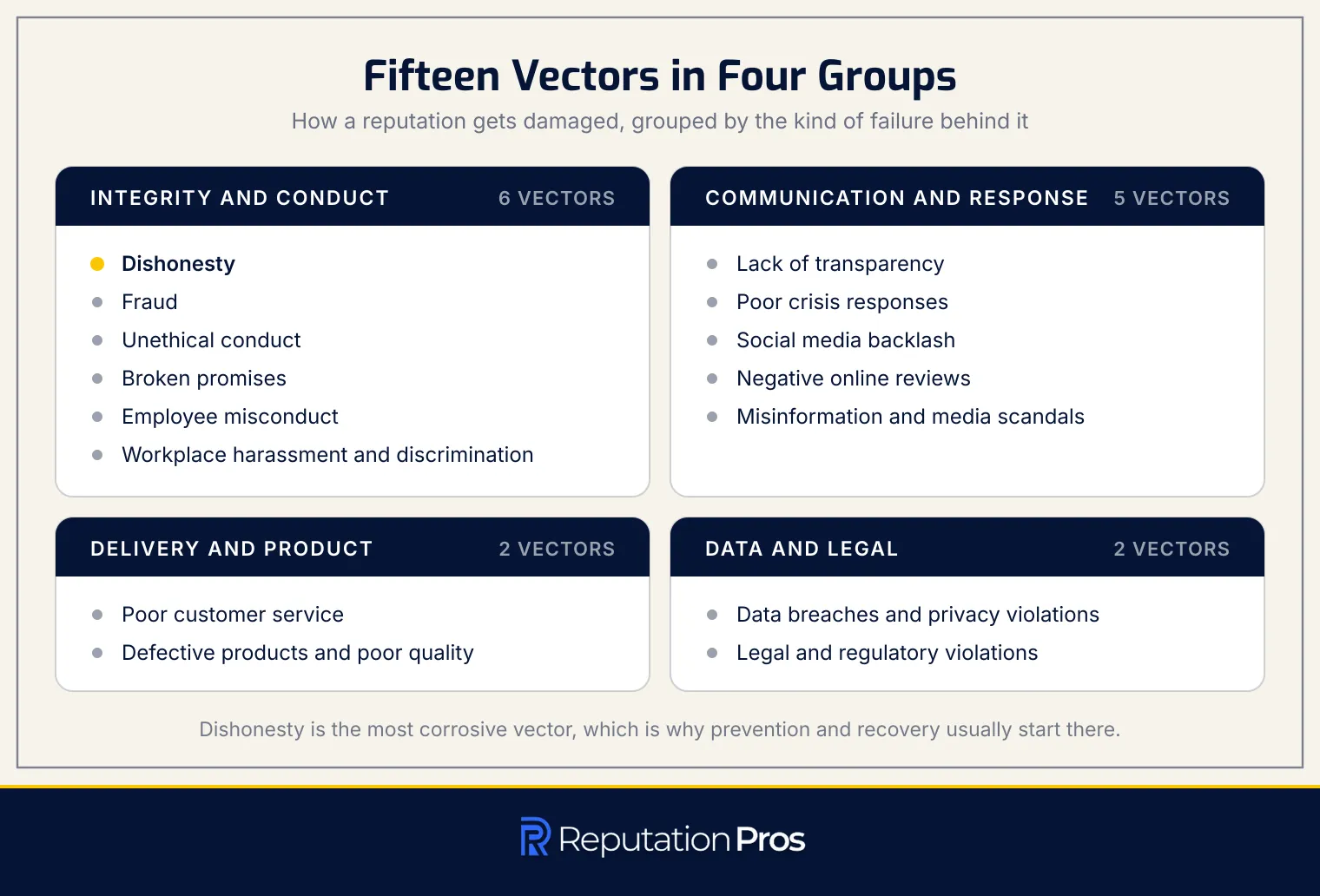
Reputational damage is defined as the loss of perceived standing and trust among the people who judge a person or an organization. Reputational damage occurs through fifteen recurring vectors. A reputation is an intangible asset held by both individuals and organizations, built over years and frequently lost within hours. The fifteen vectors can be grouped into four main categories: integrity and conduct failures, delivery and product failures, data and legal failures, and communication and response failures.
- Dishonesty: Breach of expectations and misalignment between claimed and actual behavior.
- Fraud: Falsified accounts and unethical sales practices.
- Unethical Conduct: Acts that are legally permissible but ethically questionable.
- Broken Promises: Failure to deliver on commitments and public pledges.
- Poor Customer Service: Inadequate handling of customer interactions and complaints.
- Defective Products and Poor Quality: Products that fail safety standards or require recalls.
- Data Breaches and Privacy Violations: Exposure of sensitive information and failure to notify affected parties.
- Employee Misconduct: Inappropriate actions by staff, impacting the organization’s image.
- Workplace Harassment and Discrimination: Mishandling of complaints and retaliatory actions.
- Legal and Regulatory Violations: Breaches of law leading to fines and litigation.
- Lack of Transparency: Concealment of information and delayed admissions.
- Poor Crisis Responses: Ineffective handling of public relations during crises.
- Social Media Backlash: Negative viral content affecting public perception.
- Negative Online Reviews: Unaddressed criticisms reducing consumer trust.
- Misinformation and Media Scandals: False claims and media-driven crises.
At its core, reputational damage is about the erosion of trust held by stakeholders, including customers, employees, investors, regulators, partners, media, and the public. An incident becomes damaging through a process involving a trigger, exposure, amplification, stakeholder reaction, and behavioral change. The vectors that occur most frequently are poor customer service, negative reviews, social media backlash, and data breaches due to their rapid spread and immediate public judgment. Early identification of reputational damage can be achieved through monitoring brand sentiment, search result shifts, and customer feedback. The resulting loss of trust is measured by changes in customer retention, conversion rates, brand preference, and financial performance. Managing reputational risk involves governance, monitoring, and disciplined response strategies. Trust, once lost, is rebuilt through acknowledgment, corrective actions, and consistent behavior over time. Reputation management includes public relations, review management, search optimization, and continuous monitoring to prevent future damage. Prevention and recovery efforts frequently begin with addressing dishonesty, as it is the most corrosive vector.
1. Dishonesty
Dishonesty damages a reputation by breaching stated expectations and revealing a gap between claimed character and actual behavior. When an individual or organization portrays certain values but acts contrary to them, it creates a credibility asymmetry. Credibility runs asymmetric: trust is slow to build and quick to lose, and stakeholders quickly recognize and react to the discrepancy. The damage intensifies when dishonesty is followed by concealment rather than disclosure, as concealment compounds the original act by signaling a pattern of evasion rather than accountability. A clear example of reputational damage through dishonesty is the Volkswagen emissions scandal. Volkswagen programmed diesel engines to pass emissions tests while allowing higher pollution levels during normal driving. The scandal exposed the gap between Volkswagen’s public environmental claims and its actual practices, resulting in severe reputational harm, regulatory penalties, and a lasting loss of stakeholder trust. Volkswagen shows how dishonesty compounded by concealment damages a reputation deeply, making later statements far harder to believe.
2. Fraud
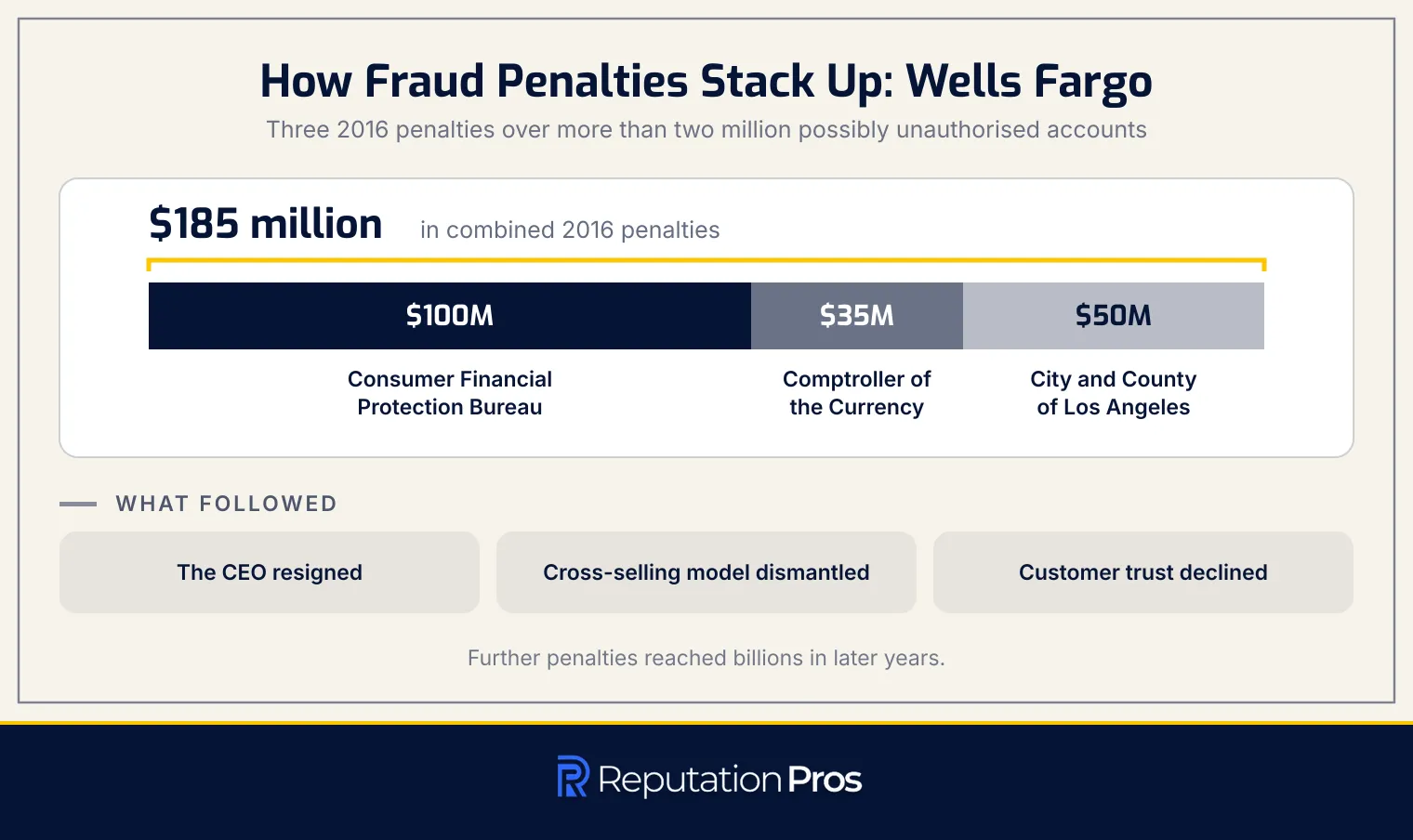
Fraud damages a reputation by revealing deliberate deceit for financial or personal gain, eroding trust that is difficult to rebuild. When companies falsify financial accounts or manipulate sales figures, they signal to stakeholders that their reported performance is fictitious, and internal controls are inadequate. A falsified account signals to stakeholders that reported performance is fiction, which draws regulatory action, substantial fines, and public censure, which permanently tarnish the corporate record. The leadership frequently faces accountability, resulting in executive resignations, dismissals, or even prosecutions, further compounding the reputational harm. A well-known example of fraud impacting reputation is the Wells Fargo unauthorized accounts scandal. Employees opened millions of unauthorized accounts between 2002 and 2016 to meet aggressive sales targets. The scandal drew $185 million in combined 2016 penalties: $100 million from the Consumer Financial Protection Bureau, $35 million from the Office of the Comptroller of the Currency, and $50 million to the City and County of Los Angeles, with further penalties reaching billions in later years. The scandal resulted in the resignation of the CEO, a dismantling of the bank’s cross-selling model, and a substantial decline in customer trust, as evidenced by account closures and negative brand perception studies. The Consumer Financial Protection Bureau documented the conduct in its September 2016 enforcement action, finding that employees had opened accounts without consent to hit sales targets, with the bank’s own analysis identifying more than two million deposit and credit card accounts that may not have been authorised.
3. Unethical conduct
Unethical conduct damages a reputation by exposing actions that, while legally permissible, violate ethical standards expected by stakeholders. Unethical conduct surfaces where a wide gap opens between an organization’s stated values and its actual practices. Those discrepancies show most plainly in misleading claims about Environmental, Social, and Governance (ESG) responsibilities, or what is commonly known as greenwashing. Greenwashing occurs when a company exaggerates its sustainability efforts to appeal to environmentally conscious consumers and investors. The exposure of unethical conduct frequently involves supplier and labor practices that fall short of ethical standards. For example, sourcing from factories with poor working conditions or paying wages below a living standard can severely tarnish a company’s image. The situation worsens when whistleblowers or investigative journalists reveal these practices, highlighting the disparity between public statements and real-world operations. A notable incident illustrating this is the DWS ESG controversy, where allegations of inaccurate sustainability reporting led to regulatory scrutiny and a settlement with the U.S. Securities and Exchange Commission. DWS shows how ethically questionable conduct erodes public trust even before formal legal action is taken. Unethical conduct is above all damaging because it reveals a misalignment between a company’s professed values and its operational realities. Stakeholders, including customers, employees, and investors who prioritize ethical alignment, may withdraw their support and loyalty. The 2013 Rana Plaza factory collapse in Bangladesh serves as a stark example, where over 1,100 garment workers died due to unsafe conditions. Rana Plaza exposed major Western fashion brands sourcing from suppliers with catastrophic safety failures, leading to global outcry and lasting reputational damage. Even brands not directly involved faced increased scrutiny, as the incident became synonymous with supply chain responsibility failures.
4. Broken promises
Broken promises damage a reputation by creating a gap between what was promised and what was delivered. The gap signals unreliability and erodes stakeholder trust. When service levels, warranties, or public pledges are not met, stakeholders perceive the failure as a breach of trust. That perception costs confidence in the organization’s future commitments. The damage from broken promises intensifies when commitments are abandoned without explanation. Stakeholders, including customers, employees, and investors, react not only to the missed commitment but also to the pattern of unreliability it suggests. For example, Volkswagen’s 2015 emissions scandal is a notable incident where environmental claims were exposed as misleading, resulting in substantial reputational damage. Volkswagen shows how a broken promise reaches past the immediate failure, affecting the overall credibility of the brand. At its core, reputational damage from broken promises is about trust collapsing when a promise is treated as a guarantee but is not honored. The wider the promise and the more public the failure, the faster the loss of confidence spreads. A broken promise carries long-lasting effects on an organization’s reputation and stakeholder relationships.
5. Poor customer service
Poor customer service damages a reputation by creating a cycle of negative experiences that erode customer trust and brand loyalty. Repeated service failures, such as slow response times and inadequate resolution, signal to customers that the business does not prioritize their needs. Rude or indifferent front-line behaviour deepens that perception, which further alienates customers. As a result, dissatisfied customers frequently spread their negative experiences through word of mouth and online reviews, amplifying the reputational damage. The mechanism of reputational damage from poor customer service involves several key components. Customers expect timely help and effective complaint handling, so when these expectations are unmet, the gap between promised service and actual experience widens. The widening gap drives churn, where individuals choose to leave or avoid the brand altogether. An illustrative example is the United Airlines incident, where poor handling of a passenger complaint escalated into a public relations crisis, highlighting the company’s lack of care and accountability. Such incidents demonstrate how poor customer service can transform operational weaknesses into lasting reputational harm.
6. Defective products and poor quality
Defective products and poor quality can sharply damage a reputation by violating the trust between consumers and manufacturers. When a product fails, especially in terms of safety, it necessitates a recall, which is a formal process to remove the product from the market, notify consumers, and mitigate harm. Recalls can be voluntary or mandated by safety authorities and involve several steps, including defect identification, public disclosure, and coordination of product returns or repairs. The timing of defect disclosure is decisive; delays can exacerbate reputational damage as they suggest a prioritization of sales over consumer safety. A well-documented instance of reputational damage due to defective products is the Takata airbag recall. Takata’s airbags were found to be defective, with a risk of explosion upon deployment, leading to one of the largest recalls in automotive history. Takata exposed systemic failures in quality control and resulted in substantial financial losses and long-term reputational damage for the company. The U.S. National Highway Traffic Safety Administration (NHTSA) played a key role in overseeing the recall process, underscoring the importance of regulatory compliance in maintaining product safety and consumer trust.
7. Data breaches and privacy violations
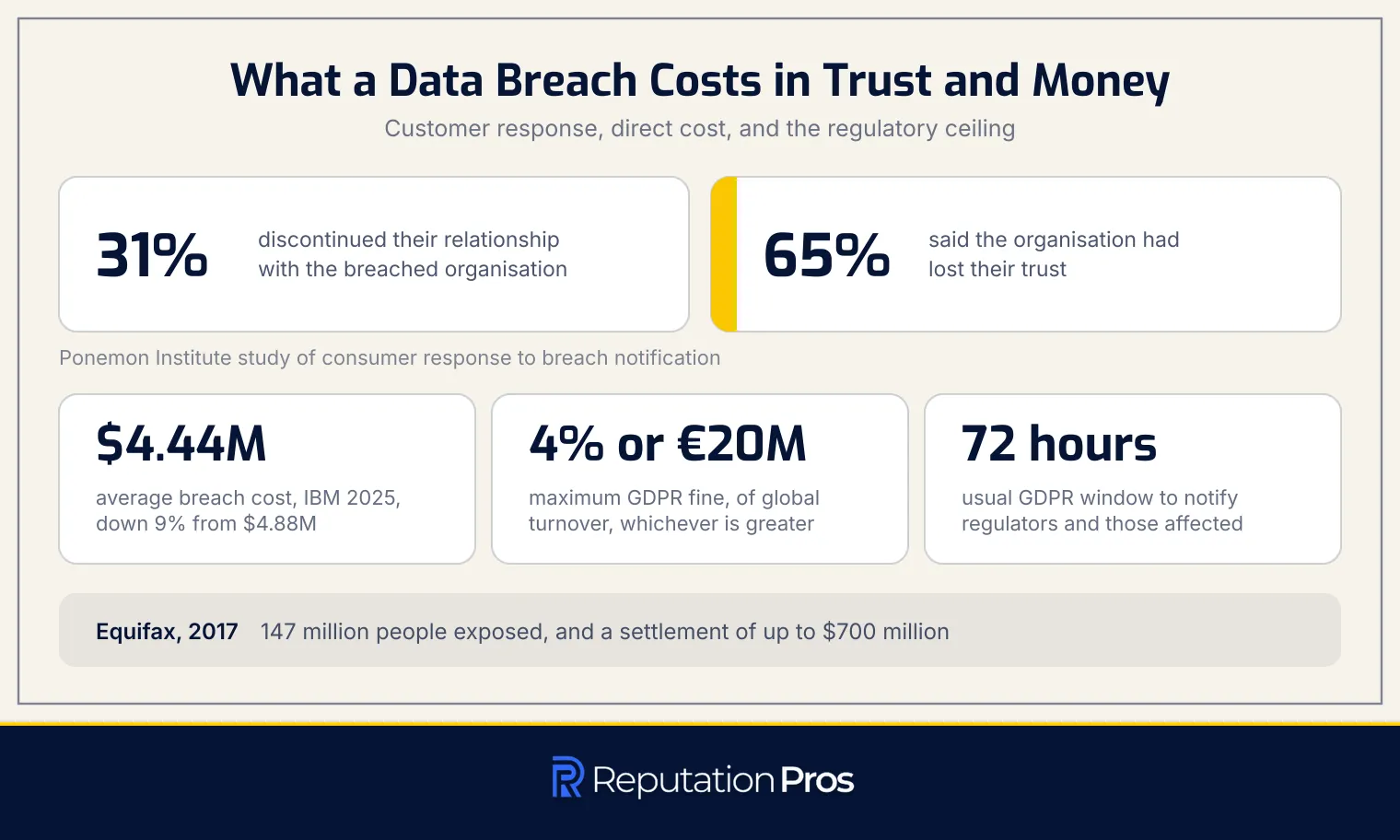
Data breaches and privacy violations sharply damage a reputation by exposing sensitive information, which undermines trust in an organization’s ability to protect personal data. The severity of reputational harm is proportional to the volume and sensitivity of the records exposed. For instance, financial credentials, health data, and identity documents carry more weight than basic contact details. Organizations are legally required to notify affected individuals and regulatory authorities promptly, usually within 72 hours under frameworks like the EU General Data Protection Regulation (GDPR). Failure to meet these notification duties compounds the original breach with procedural violations, further damaging reputation. The aftermath of a data breach frequently includes customer churn, where affected individuals discontinue their relationship with the organization. A Ponemon Institute study of consumer response to breach notification found that 31% of consumers discontinued their relationship with the breached organisation and 65% said the organisation had lost their trust. The direct cost runs alongside the trust loss: IBM’s Cost of a Data Breach Report 2025 put the global average at $4.44 million, down 9% from $4.88 million the year before. Regulatory penalties follow; under GDPR, fines can reach up to 4% of annual global turnover or €20 million, whichever is greater. The 2017 Equifax breach is a notable example, where the exposure of 147 million individuals’ personal data led to substantial legal and regulatory consequences, including a settlement of up to USD 700 million. Equifax established data security as a trust obligation, with customers judging not only the occurrence of a breach but also the transparency and speed of the organization’s response.
8. Employee misconduct
Employee misconduct damages a reputation by transforming internal issues into public trust crises. Transformation happens when an employee’s behaviour, whether on duty or off duty, conflicts with the values or standards an organization upholds. The damage intensifies when misconduct is linked to safeguarding failures, such as inadequate vetting or ignored complaints. Safeguarding failures signal that the organisation puts its reputation over the welfare of those it serves. A notable example is the Oxfam scandal in 2018, where senior staff engaged in sexual misconduct during a mission in Haiti. The organization’s failure to fully disclose the behavior led to a substantial backlash, including withdrawal of government funding and public donations, severely harming its reputation. The path from misconduct to reputational damage involves several stages. Initially, the conduct occurs and may be reported internally or discovered externally. The organization is then judged on its response, including whether it enabled or tolerated the behavior. If stakeholders perceive a lack of accountability, they may withdraw support, further damaging the reputation. Off-duty conduct reaches reputation too, especially if the employee is publicly associated with the organization. The speed and transparency of the organization’s response are decisive in mitigating damage.
9. Workplace harassment and discrimination
Workplace harassment and discrimination damage a reputation by revealing an organization’s failure to maintain a respectful and fair environment. When complaints get mishandled or investigations stay superficial, it reflects a lack of genuine commitment to employee welfare. Retaliation against those who report issues further compounds the damage, signaling that the organization prioritizes its image over a safe workplace. Harassment damage becomes public once cases reach tribunals or courts, where internal failures are documented and become part of the permanent record. The reputational impact extends beyond legal proceedings. Tribunal judgments and media coverage make certain that these issues remain accessible and visible to potential employees, clients, and investors. Employer-review platforms like Glassdoor capture ongoing employee sentiment, making patterns of harassment and discrimination evident. A notable example is the Activision Blizzard scandal. Allegations of systemic harassment and discrimination led to lawsuits and substantial public backlash, demonstrating how internal misconduct can rapidly escalate into a public credibility crisis.
10. Lack of transparency
A lack of transparency damages a reputation by creating an expectation gap between what stakeholders believe they are entitled to know and what an organization chooses to disclose. When information is withheld, delayed, or obscured, it invites speculation and third-party narratives that can be more damaging than the facts themselves. Transparency involves a continuum: voluntary disclosure signals accountability, while concealment suggests something worse is being hidden. Delayed disclosure can turn a manageable issue into evidence of a cover-up, compounding reputational harm with distrust rooted not in the original incident but in the decision to withhold it. The damage intensifies when silence is perceived as evasion. Stakeholders, including customers, investors, employees, and regulators, fill information voids with their own explanations, frequently tending toward the negative. Once a narrative forms in this vacuum, correcting it becomes exponentially harder than early, honest disclosure would have been. The reputational cost of non-transparency lies not only in the concealed fact itself but in the erosion of credibility that follows. If an organization cannot be trusted to disclose difficult information voluntarily, stakeholders question what else remains hidden. A recognisable incident of this type occurred when Volkswagen concealed the use of defeat devices in diesel engines for years, withholding evidence of emissions violations from regulators and the public. When the concealment was exposed in 2015, the reputational damage stemmed not only from the environmental and regulatory breach but from the prolonged dishonesty and active suppression of material facts, which destroyed stakeholder trust far beyond what the original engineering failure alone would have caused.
11. Poor crisis responses
A poor crisis response damages a reputation by transforming a contained incident into a protracted scandal. The response window, frequently measured in hours, determines whether an organisation is seen to be in control or in denial. Denial and deflection extend the news cycle, while spokesperson discipline and the quality of holding statements signal whether leadership understands the gravity of what has occurred. An apology that arrives late, shifts blame, or qualifies the harm done is read as confirmation that the subject does not accept responsibility. Follow-through on remediation, the commitments made once the apology is delivered, determines whether trust can be rebuilt or whether the response is judged as performative. The gap between what a crisis required and what the response delivered becomes the story itself. When an organisation issues a defensive statement, refuses to name the failure, or delays disclosure until journalists have already published, the response compounds the original harm. A mismanaged crisis signals broader failings in governance, culture, and accountability. The reputational cost is not limited to the incident; it extends to every subsequent claim the organisation makes about its values, because stakeholders now have evidence that those values were not honoured when tested. A recognisable example is United Airlines’ response to the forced removal of a passenger from an overbooked flight in 2017. The initial statement defended employees and blamed the passenger, a position that intensified public anger and extended media coverage. Only after sustained backlash did the CEO issue an unqualified apology and commit to policy changes. The delay and tone of the early response became inseparable from the incident itself, illustrating how a crisis mishandled in the first hours defines the reputational damage that follows.
12. Social media backlash
Social media backlash damages a reputation by amplifying a single incident into a widespread narrative. The mechanics of virality play a decisive role, where content that triggers emotional reactions, such as outrage or moral indignation, is rapidly shared across platforms. Amplification runs on reposts, influencer engagement, and the algorithmic prioritization of emotionally charged content. Screenshots and screen recordings preserve the incident, which keeps it permanent even if the original content is deleted. Durability extends the life of the backlash and makes it a persistent reputational threat. Employee and customer-generated content can intensify the damage. When employees share internal communications or when customers post service failures, the content gains authenticity and credibility. Employee and customer content reads as more genuine than official statements, making it more persuasive to the public. Boycott and hashtag dynamics further exacerbate the situation, as coordinated movements attract media coverage and apply commercial pressure on the affected organization. A recognizable incident of social media backlash is the United Airlines controversy in 2017, where the forcible removal of a passenger was captured on video and shared widely, leading to a substantial drop in market value and public trust.
13. Negative online reviews
Negative online reviews damage a reputation by directly influencing consumer perceptions and purchase decisions. Platforms like Google Business Profile, Trustpilot, Yelp, and TripAdvisor are decisive as they algorithmically prioritize recent reviews, volume, and star ratings. A single-star movement in average rating carries measurable revenue consequences: Michael Luca’s Harvard Business School working paper “Reviews, Reputation, and Revenue: The Case of Yelp.com” found a one-star increase in a restaurant’s Yelp rating produced a 5% to 9% rise in revenue, concentrated among independent restaurants rather than chains. Unanswered reviews suggest indifference, allowing negative narratives to persist unchallenged. Coordinated fake-review attacks further distort genuine sentiment, misleading potential customers. A notable example is Amy’s Baking Company, which suffered a reputational crisis after aggressive responses to negative Yelp reviews went viral, showing how poor review management can escalate isolated complaints into lasting harm. BrightLocal’s Local Consumer Review Survey 2026 found that 97% of consumers read online reviews when deciding about a local business, 85% become more likely to use one after positive reviews, and 77% are put off by negative ones.
14. Misinformation and media scandals
Misinformation and media scandals damage reputations by creating a gap between reality and perception. Misinformation crises usually start with rumour, where unverified claims gain traction faster than facts. Such situations are exacerbated by coordinated false claims, frequently spread by competitors or malicious actors across multiple platforms, creating an illusion of widespread consensus. Synthetic and AI-generated media, such as deepfake videos, further complicate matters by providing seemingly credible but entirely false evidence of actions or statements that never occurred. The correction and right-of-reply routes available to those targeted by misinformation are frequently slower and less visible than the original false claim. Media outlets may issue corrections or retractions, but these usually receive a fraction of the attention that the initial story attracted, leaving the false narrative embedded in search results and public memory. Legal remedies such as defamation claims exist but are time-consuming, expensive, and jurisdictionally limited, and they do little to address the reputational harm that has already occurred by the time a case is heard. Social media platforms offer reporting mechanisms for false content, but enforcement is inconsistent, and removal does not erase the screenshots, shares, and commentary that have already circulated. A notable example is the 2016 “Pizzagate” conspiracy theory, which falsely alleged a Washington, D.C. pizzeria was involved in child trafficking. The misinformation spread rapidly across social media and fringe websites, leading to an armed incident at the restaurant. Despite being debunked by law enforcement and media, the business suffered lasting reputational harm, illustrating how coordinated false claims can inflict damage that persists long after the truth is established.
15. Legal and regulatory violations
Legal and regulatory violations sharply damage a reputation through public records of non-compliance, fines, and lasting distrust. Regulatory violations create a permanent record reachable through court and regulator databases, impacting how stakeholders perceive an organization. Such records are frequently included in company filings and background checks, serving as a formal signal of governance failures. For example, the Wells Fargo fake-accounts scandal resulted in fines and executive exits, illustrating the severe reputational impact. The 2020 British Airways data breach fine by the UK Information Commissioner’s Office further exemplifies this, with the £20 million penalty highlighting failures in data protection compliance. Those records keep shaping stakeholder judgment long after the incident, emphasizing the importance of maintaining regulatory compliance to protect reputation. Reputational damage, fundamentally, is the measurable loss of trust following behavior that falls short of stakeholder expectations.
What is reputational damage?
Reputational damage is defined as the loss of perceived standing and trust that occurs when the public image of a person or organization no longer aligns with how stakeholders judge their actual character or behavior. Reputational damage reaches individuals and organisations alike, as reputation is an intangible asset built over time and can be lost rapidly. Reputational damage differs from reputational risk, which is the potential for future harm, and from defamation, which involves false statements causing harm. The loss of trust inherent in reputational damage is determined by stakeholders such as customers, employees, investors, and regulators, who reassess their confidence based on the gap between expectation and reality.
Which stakeholders determine a person’s or business’s reputation?
A person’s or business’s reputation is shaped by several stakeholder groups, each applying distinct criteria. The main stakeholders and their judgment criteria are outlined below.
- Customers and Clients: Evaluate based on product quality, service experience, and reliability.
- Employees and Prospective Talent: Assess workplace culture, leadership integrity, and alignment of stated values with actual practices.
- Investors and Shareholders: Focus on governance standards, financial transparency, and long-term value protection.
- Regulators and Government Bodies: Judge legal compliance, reporting obligations, and cooperation during investigations.
- Media and the Public: Examine transparency during crises and the consistency between public statements and actions.
- Supply Chain Partners and Vendors: Consider contractual reliability, ethical procurement practices, and fairness.
- Industry Peers and Professional Networks: Review adherence to conduct standards and collaboration quality.
Each stakeholder group influences reputation by highlighting the gap between expectations and actual behavior.
How does reputational damage actually happen?
Reputational damage occurs through a sequence that transforms an incident into lasting harm. The process begins with a trigger, which is an act or failure that breaches stakeholder expectations. Once the trigger occurs, it moves to exposure, where the incident becomes visible beyond its immediate context, frequently through media coverage or social sharing. Exposure leads to amplification, where news cycles and social platforms multiply its reach. Stakeholders, including customers and investors, then form judgments based on observed discrepancies between expectations and reality, resulting in behavioural change such as reduced patronage or investment. The expectation gap, where actual behavior deviates from perceived standards, makes reputational damage possible. Damage can be latent, accumulating gradually through repeated minor failures, or acute, triggered by a visible crisis causing immediate stakeholder reaction. Once exposed, the incident enters a decisive stage where the speed and quality of response determine whether the damage is contained or spreads further.
How do exposure and online amplification turn an incident into lasting harm?
Exposure and online amplification transform an isolated incident into enduring reputational damage by several mechanisms. Search engines index and rank negative content prominently, so that damaging information remains visible long after the event. News outlets and aggregators frequently republish stories, creating multiple copies that increase the potential for harm. Social media platforms further magnify incidents through algorithms that resurface old content, introducing it to new audiences. Archived screenshots and cached versions preserve the original posts, maintaining a permanent record even if the source material is deleted or corrected.
What are the most common ways a reputation can be damaged?
Reputation can be damaged through several vectors, each impacting stakeholders differently and spreading at varying speeds. Below is a table summarizing the most common vectors recognized for their frequency and impact.
| Damage Vector | How It Usually Starts | First Stakeholder to React | Speed of Spread |
|---|---|---|---|
| Dishonesty | Misrepresentation or concealment of fact | Employees or business partners | Moderate |
| Poor customer service | Service failure or complaint mishandling | Customers | Moderate |
| Negative online reviews | Dissatisfied customer posts on a public platform | Prospective customers | Fast |
| Social media backlash | Controversial statement, product, or brand action | Online communities and activists | Extreme (hours) |
| Data breaches | Security failure or cyberattack | Regulators or affected customers | Fast |
The five vectors recur because they touch stakeholders directly and spread rapidly through digital channels. Each vector follows a predictable pattern but varies sharply in escalation speed and stakeholder response.
How do negative online reviews damage a reputation?
Negative online reviews damage a reputation by influencing consumer purchase decisions. Lower star ratings, high review volume, and recent feedback sharply shift consumer trust, leading potential buyers to choose competitors. Unanswered reviews exacerbate the issue, signaling poor responsiveness and confirming negative impressions. The cumulative effect cuts search visibility and conversion rates, creating a persistent digital record that deters potential customers long after the initial service failure.
How does social media backlash damage a reputation?
Social media backlash damages a reputation by rapidly amplifying a single post through widespread sharing and commentary. The reach of social media ensures that even after content is removed, screenshots and reposts preserve the incident, leading to enduring harm. The permanence of these digital records means that a temporary misstep can result in long-lasting reputational damage.
How do data breaches damage trust and reputation?
Data breaches damage trust and reputation primarily through the organization’s handling and disclosure of the incident. When a breach occurs, stakeholders assess the speed and transparency of the organization’s response. Delayed or unclear notifications can erode trust, as stakeholders may perceive the incident as a failure in stewardship. The organization’s duty of care is questioned, leading to reputational harm that extends beyond the technical failure itself.
How does dishonesty damage trust?
Dishonesty damages trust by breaching stated expectations and creating a credibility gap between claimed character and actual behavior. When an individual or organization is dishonest, it undermines the foundational trust that stakeholders place in them. Credibility once lost is far harder to restore than to maintain. The asymmetry of trust means that rebuilding it requires consistent transparency and integrity over time, which is more challenging than preserving an existing reputation. Concealment of dishonest actions compounds the original breach, frequently causing more reputational damage than if the truth had been disclosed initially. When dishonesty is discovered rather than confessed, it suggests a deliberate attempt to mislead, which stakeholders interpret as a deeper character flaw rather than an isolated mistake. A notable example of this is the Volkswagen emissions scandal, where the company used defeat devices to manipulate emissions tests. The concealment of this deception led to substantial reputational damage, as stakeholders perceived the act as a calculated breach of trust.
How can reputational damage be identified early?
Reputational damage can frequently be identified early through a series of observable signals that indicate emerging threats. Early signals let an organisation act before damage becomes irreversible.
- Sudden changes in online sentiment: A noticeable shift in the tone and volume of mentions on social media and review platforms can suggest growing dissatisfaction.
- Increased volume of complaints or negative reviews: A spike in customer service tickets or low-star reviews, especially when recurring themes are present, indicates escalating issues.
- Media inquiries on sensitive topics: Journalists probing into conduct or compliance matters not yet public can signal that a story is developing.
- Decline in branded search volume or search term shifts: A drop in searches for a brand name or the appearance of negative autocomplete suggestions reflects waning interest or rising controversy.
- Employee attrition or difficulty recruiting: Unexplained staff departures or challenges in attracting talent suggest internal concerns becoming externally known.
- Withdrawal or hesitation from partners, suppliers, or investors: Delayed contract renewals or increased due diligence requests indicate reputational concerns affecting business relationships.
- Regulatory or legal correspondence: Early contact from regulators or legal entities signals scrutiny before public disclosure.
- Viral or coordinated negative content: Content gaining traction or being shared by influential accounts can mark the start of a reputational crisis.
- Increased mentions in whistleblower or activist channels: Appearance on platforms used by whistleblowers or watchdogs suggests internal issues being externalized.
- Drop in Net Promoter Score or customer satisfaction metrics: A sustained decline in loyalty or recommendation scores indicates trust erosion.
- Changes in stock price, credit rating, or insurance premiums: Market signals reflecting investor concern about intangible risks, including reputation.
- Negative commentary from former employees or customers: Public statements by past employees or customers shape perception for current stakeholders.
- Increased scrutiny in earnings calls, shareholder meetings, or public forums: Questions on governance or culture during public events signal circulating doubts.
- Unexplained loss of business or declined tenders: Clients choosing competitors without clear reasons frequently point to reputational concerns.
- Internal warning signs: low morale, silence, or fear of speaking up: Staff reluctance to raise concerns indicates known but unmanaged issues internally.
Early warning signals show whether an issue remains latent or has begun altering behavior and sentiment. Once these signals appear, the next step is measuring the trust already lost.
How can a person or business assess lost trust?
Assessing lost trust involves evaluating several indicators that reflect changes in stakeholder perception and behavior. The indicators together show the scale of reputational impact and the extent of trust erosion.
- Market Value Movement: Market value movement measures investor confidence and future earnings expectations. A decline in share price or market capitalization indicates weakened trust and a perceived increase in risk.
- Customer Churn and Lifetime Value: Churn tracks the rate at which customers discontinue their relationship and the projected revenue loss. Increased churn and decreased lifetime value signify a direct loss of customer trust.
- Sentiment Share: Sentiment share weighs positive, neutral, and negative discussion in media and online platforms. A shift towards negative sentiment suggests a deteriorating public perception.
- Branded Search Volume: Branded search volume measures public interest and intent to verify or avoid the brand. A spike in search volume with negative modifiers indicates active reputation harm.
- Recruitment Difficulty and Attrition: Recruitment difficulty measures the organisation’s pull to potential hires and current employees. Increased recruitment challenges and higher attrition rates reflect a loss of trust within the talent market.
- Price Premium: Price premium measures willingness to pay more based on brand trust. A reduction in price premium shows diminished differentiation and consumer confidence.
- Cost of Capital and Insurance: Cost of capital reflects how lenders and insurers price risk. Higher borrowing costs and insurance premiums indicate perceived increased risk due to reputational damage.
The indicators together read the severity of reputational damage and guide efforts to rebuild trust.
How should reputational risks be managed?
Reputational risks should be managed through a structured governance framework that integrates risk management into the organization’s broader strategy. Governance begins with board oversight and the appointment of clear ownership, frequently held by the chief executive or chief risk officer. Named owners monitor threat vectors and assess vulnerabilities across all potential damage pathways. ISO 31000:2018, the International Organization for Standardization’s risk management standard, frames risk management as systematic, structured, and tailored to the organisation’s context, which is what lets reputation sit in the risk register as a measurable asset rather than an abstraction.
- Risk Identification Continuous risk identification involves drawing on stakeholder feedback, media monitoring, employee surveys, and regulatory horizon scanning. Continuous identification surfaces emerging threats before they materialize, allowing for proactive management.
- Risk Assessment Once identified, risks must be assessed for likelihood and impact. A reputational risk matrix can be used to prioritize these risks based on their potential damage to trust, market position, and stakeholder confidence.
- Mitigation Measures Mitigation measures should be embedded across operations. Mitigation covers integrity controls to prevent dishonesty and fraud, establishing product quality assurance protocols, enhancing data governance, and setting customer service standards.
- Training and Awareness Training programs should equip employees at all levels to recognize reputational risks and report concerns without fear of retaliation. Understanding their role in protecting organizational trust is decisive.
- Regular Testing and Simulations Simulations and tabletop exercises make certain that response capabilities match the speed at which reputational damage can spread. Simulation matters most in digital environments where reaction windows are measured in hours.
- Governance and Reporting Governance structures should include routine reporting to the board, annual risk register reviews, and post-incident debriefs. Board reporting and post-incident debriefs capture lessons and update controls to prevent future incidents.
- Third-Party Risk Management Third-party risk needs managing too, as supplier conduct and partner behavior can directly impact the organization’s reputation. Contracts should include reputational clauses, and due diligence should assess partner values alignment.
A strong reputational risk management program not only reduces the frequency and severity of incidents but also shortens the time between trigger and response. A strong programme positions the organisation to contain damage and rebuild trust if damage has already occurred.
How can trust be rebuilt after reputational damage?
Rebuilding trust after reputational damage requires a structured and consistent approach. The process involves multiple steps that must be followed diligently to restore confidence among stakeholders.
Fast Diagnosis Begin by quickly assessing the extent of the damage. Identify who was affected and what business consequences have emerged. Rapid evaluation establishes the scope of the issue.
Clear Acknowledgment Acknowledge the problem without minimizing or deflecting facts. Credibility is lost faster than it is restored, so transparency is necessary.
Specific Remediation Outline a clear plan detailing what actions will be taken, who will carry them out, and by when. Naming actions shifts the work from apology to delivery.
Root Cause Fix Address the underlying issues that led to the reputational damage. Root-cause work changes processes, policies, controls, or leadership behaviour.
Transparent Communication Maintain open communication with regular updates and honest answers to questions. Where applicable, use third-party validation to bolster credibility.
Accountability and Oversight Assign responsibility at the leadership level and demonstrate that there are real consequences and oversight mechanisms in place.
Continuous Repair Efforts Trust recovery is a long-term campaign, frequently spanning months to years. Organizations should not expect to return to previous trust levels quickly.
Progress Measurement Track trust indicators on a fixed cycle such as sentiment, customer retention, and search visibility to monitor improvement.
Evidence of Recovery Publish improvements and changes in operations, controls, or practices. Stakeholders need to see tangible evidence of change.
Protection of Recovery Phase Prevent new incidents during the recovery period, as a second failure can reset trust-building efforts to zero.
A realistic recovery horizon is long, measured in years rather than quarters, and published recovery timelines vary so widely between sources that none should be treated as a benchmark. Trust rebuilding is less about quick messaging and more about proving, over time, that the organization has fundamentally changed.
What is reputation management?
Reputation management is the practice of shaping and maintaining the public perception of an individual or organization. Reputation management spans a broad set of activities, including public relations, review management, search suppression, and monitoring services. Public relations efforts focus on framing narratives and building goodwill, while review management addresses customer feedback across several platforms. Search suppression aims to lower the visibility of negative content in search results. Monitoring services track mentions, sentiment shifts, and emerging risks in real time, providing a full overview of public perception. Reputation management can be conducted in-house by coordinated teams or outsourced to specialized reputation management agencies. Agencies frequently offer advanced technology, media relationships, and crisis management capabilities. However, suppression tactics, such as search engine optimization and content dilution, have limitations. They may temporarily reduce negative visibility but do not restore trust or address underlying issues. The monitoring aspect of reputation management serves as a bridge between reactive damage control and proactive risk detection, highlighting signals before they escalate into full crises.
How can reputation monitoring detect emerging risks?
Reputation monitoring is necessary for identifying emerging risks that could harm a person or organization’s standing. Several methods can surface these risks early on, allowing timely intervention.
- Sentiment Tracking: Sentiment tracking monitors tone and volume of mentions across digital channels, detecting shifts in public perception before they escalate into widespread negative opinion.
- Media Monitoring: Captures emerging stories in traditional and online news outlets, flagging coverage that references the individual or organization in contexts tied to controversy or criticism.
- Review Platform Monitoring: Tracks rating trends, keyword frequency, and complaint themes on sites like Google, Trustpilot, and Glassdoor, identifying patterns that signal operational issues or service failures.
- Search Engine Results Page (SERP) Tracking: Monitors what appears when a name or brand is searched, detecting negative content or news articles that stakeholders are likely to encounter first.
- Social Listening Tools: Scan hashtags, tagged mentions, and untagged brand references across platforms like Twitter and Instagram, identifying emerging complaints or viral content that carries reputational risk.
- Employee Feedback Systems: Surface grievances and cultural issues raised through anonymous hotlines and engagement surveys, revealing internal risks that may become external crises.
- Regulatory and Legal Database Monitoring: Tracks filings and enforcement notices from sector regulators and courts, alerting to formal investigations that will become part of the public record.
- Third-party and Supply Chain Audits: Identify risks originating with suppliers or partners, above all in areas like labor practices or environmental compliance.
- Stakeholder Engagement Channels: Gather concerns from customers, investors, and employees through structured consultations and complaint logs, providing early intelligence on dissatisfaction.
The methods together surface emerging risks promptly, allowing for proactive management and mitigation.
How can a reputation be protected from future damage?
A reputation can be protected from future damage by implementing a series of strategic measures designed to address named vulnerabilities. Each measure targets a different potential risk, which together give full protection.
- Establish a Code of Conduct: Implementing a clear code of conduct sets behavioral standards for employees and leadership, reducing the risk of dishonesty, unethical conduct, and workplace harassment.
- Implement Financial Controls: Strong financial controls and regular audits help detect and prevent fraud, protecting against regulatory scrutiny and public exposure.
- Build Transparency Protocols: Developing protocols for voluntary disclosure of material issues minimizes the risk of concealment and the ensuing information vacuum.
- Develop Crisis Communication Plans: A well-tested crisis communication plan, with designated spokespeople and pre-prepared statements, ensures swift and effective responses to crises.
- Track Promises and Commitments: A system for logging and monitoring public commitments helps prevent broken promises and accusations of greenwashing.
- Strengthen Product Quality Assurance: Investing in thorough quality assurance and safety testing reduces the likelihood of product defects and recalls.
- Enhance Data Security: Continuous monitoring and breach-response strategies protect against data breaches and maintain compliance with breach-notification duties.
- Improve Customer Complaint Channels: Efficient escalation channels for customer complaints, with empowered staff and defined resolution times, mitigate potential reputational damage from poor service.
- Monitor Social Media and Reviews: Real-time monitoring tools can alert teams to emerging negative reviews, social media backlash, and misinformation before they escalate.
- Train on Legal Compliance: Regular training on regulatory requirements helps prevent legal violations and the associated reputational harm.
- Establish Whistleblower Protections: Policies encouraging internal reporting prevent unethical conduct and workplace harassment from becoming public scandals.
- Vet Suppliers and Partners: Making sure suppliers align with ethical labor practices prevents reputational damage through third-party failures.
- Control Social Media Access: Restricting access to official accounts and requiring content approval reduces the risk of inappropriate posts.
- Conduct Regular Reputation Audits: Audits assess stakeholder perception and identify vulnerabilities, allowing proactive management of potential threats.
- Secure Financial Protections: Cyber insurance and legal indemnity provide financial safeguards against incidents.
- Foster a Culture of Accountability: Leadership that models ethical behavior and promptly addresses mistakes reinforces trust and credibility.
Each of these protective measures directly addresses one or more of the fifteen ways a reputation can be damaged, creating a strong defense against reputational harm.