Things That Can Damage Brand and Personal Reputation
 28 min read
 On this page
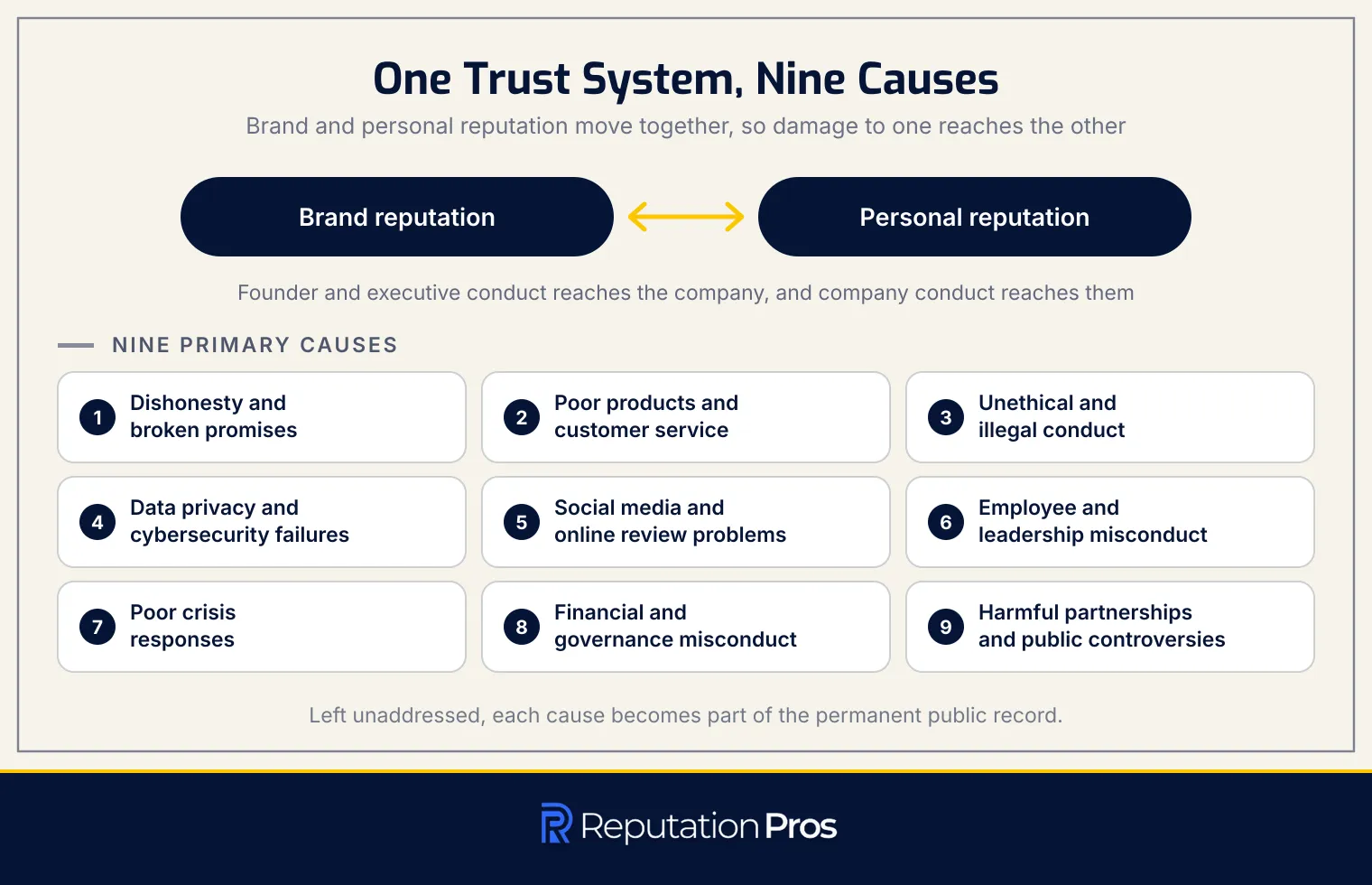
Reputational damage is the loss of trust that affects both brand and personal reputation, frequently resulting from several negative actions or perceptions. Brand reputation and personal reputation operate as an interlinked system where the conduct of founders and executives impacts the company, and vice versa. Interdependence means an issue touching one reaches the other quickly, leading to a broader loss of trust. Nine primary causes contribute to reputational damage, each with distinct mechanisms that convert incidents into lost trust:
- Dishonesty and Broken Promises: This involves making promises that are not fulfilled, leading to a gap between expectations and delivery.
- Poor Products and Customer Service: Defective products and inadequate service can lead to public dissatisfaction and negative reviews.
- Unethical and Illegal Conduct: Actions that are morally or legally questionable can severely damage credibility.
- Data Privacy and Cybersecurity Failures: Breaches and data leaks can erode customer trust and lead to regulatory scrutiny.
- Social Media and Online Review Problems: Negative posts and reviews can spread rapidly, affecting public perception.
- Employee and Leadership Misconduct: Misbehavior by employees or leaders can reflect badly on the entire organization.
- Poor Crisis Responses: Inadequate handling of crises can exacerbate the situation and prolong negative attention.
- Financial and Governance Misconduct: Irregularities in financial practices can lead to loss of investor confidence.
- Harmful Partnerships and Public Controversies: Associations with controversial entities can tarnish a brand’s image.
Each cause has a named mechanism that leads to trust erosion, such as product failures, misleading claims, or poor communication. If these issues are not addressed promptly, they can escalate quickly, becoming part of the permanent public record due to the internet’s archival nature. Early detection of potential trust problems can be achieved through monitoring signals like spikes in negative mentions, declining ratings, and search results highlighting criticism. Once damage has occurred, recovery involves a sequence of acknowledgment, apology, corrected behavior, feedback, and restored trust. Online reputation management is decisive in maintaining and repairing reputation by securing search visibility and accurate representation on owned profiles. The trust dependency between employer and personal brands highlights the need for effective crisis communication as immediate protection when incidents occur. Professional reputation management and continuous monitoring, as offered by companies like Reputation Pros, address these causes by providing tools and expertise to manage and recover from trust loss. That foundation connects directly to dishonesty and broken promises, the first cause examined in this context.
1. Dishonesty and Broken Promises
Dishonesty and broken promises can severely damage both brand and personal reputations. The pattern damage arises when there is a noticeable gap between what is promised and what is delivered, frequently seen in overpromising product features or service levels and failing to meet these commitments. Missed deadlines, presented as firm, further erode trust. When public values do not align with actual behavior, it signals hypocrisy, leading audiences to perceive these inconsistencies as character flaws rather than isolated errors. Repeated breaches, even small ones, compound over time, shifting perception from error to intentional deception. Misleading advertising claims not only damage trust but also expose brands to legal risks under truth-in-advertising standards enforced by bodies like the Federal Trade Commission. Advertising standards prohibit deceptive claims about product performance and endorsements. Overpromising without disclosing limitations can lead to breach-of-contract claims if the discrepancy between promise and delivery causes harm. The corrective practice to prevent damage from dishonesty and broken promises involves setting realistic expectations from the start. The pattern includes documenting what was committed to and delivering on or ahead of those commitments. Transparency in communication when changes are necessary also helps maintain trust. Honesty about constraints, timelines, and capabilities builds a reputation for reliability that can absorb occasional setbacks, whereas chronic overpromising creates a credibility deficit difficult to repair.
2. Poor Products and Customer Service
Poor products and customer service can severely damage brand reputation by converting product failures into trust failures. Product defects, recalls, or failures to meet customer expectations signal incompetence or indifference. Such issues frequently lead to public scrutiny through negative reviews and word-of-mouth, resulting in a tarnished brand image. When a defect affects safety, regulatory agencies may require public disclosure, amplifying the incident’s visibility. Customer service failures exacerbate the problem. Slow response times, dismissive tones, and unresolved complaints communicate that a customer’s concerns hold no value. Service failures escalate from private frustration to public grievance on platforms like Google Business Profile and Trustpilot. Refund and warranty commitments serve as binding promises; failing to honor them shifts the narrative from product issues to credibility issues. Legal and regulatory exposure may arise under consumer protection laws if commitments are not met. Corrective practices involve addressing product and service issues promptly. The pattern includes honoring refund and warranty commitments, responding within promised timeframes, and securing customer satisfaction before complaints become public. Proactive outreach and transparent communication about issues can convert dissatisfied customers into advocates, reducing the impact on reputation.
3. Unethical and Illegal Conduct
Unethical and illegal conduct severely damages both brand and personal reputation by revealing a misalignment between claimed standards and actual behavior. Misconduct in this category covers substance abuse, harassment, conflicts of interest, and discrimination. Substance abuse can impair judgment and workplace safety, while harassment creates hostile environments. Conflicts of interest arise when personal gain compromises professional duties, and discrimination based on race, gender, or other protected characteristics is above all damaging. The distinction between personal and corporate offenses is decisive. Personal misconduct, such as an executive’s DUI, directly impacts the individual but also reflects on the employer’s judgment. Conversely, systemic issues like workplace harassment indicate corporate liability. Legal exposure from unethical conduct is substantial. Harassment and discrimination can lead to investigations by agencies like the EEOC, civil litigation, and mandatory settlements. In severe cases, misconduct can result in criminal charges for fraud or regulatory violations. Conflicts of interest may breach fiduciary duties, void contracts, and trigger shareholder lawsuits. Substance abuse, frequently treated as a health issue, becomes reputationally damaging when linked to workplace incidents or arrests. Each incident creates a permanent searchable record through court filings and news coverage. Preventing unethical conduct requires clear policies and training on harassment, discrimination, and conflicts of interest. Organizations should have accessible reporting mechanisms, such as anonymous hotlines, and enforce consequences consistently. Background checks, conflict-of-interest disclosures, and workplace culture audits offer additional safeguards. When incidents occur, separating the individual from the institution is vital. Transparent discipline and policy revisions demonstrate that the behavior was an anomaly, not a reflection of organizational values.
4. Data Privacy and Cybersecurity Failures
Data breaches and privacy violations damage reputation by signaling a failure in safeguarding sensitive information. When personal identifiable information (PII), financial data, or health records are exposed, it indicates organizational negligence. Notification delay compounds the damage, as customers perceive it as a lack of transparency and control. Article 33 of the EU General Data Protection Regulation requires notification to the supervisory authority within 72 hours of becoming aware of a personal data breach, and the California Consumer Privacy Act requires disclosure in the most expedient time possible and without unreasonable delay. IBM’s Cost of a Data Breach Report 2025 put the global average cost of a breach at $4.44 million, down 9% on the previous year. Failure to comply can result in substantial fines and class-action lawsuits, reinforcing public distrust. Customer churn following a breach is substantial. Ponemon Institute research measuring abnormal churn after breach disclosure has put the average across incidents at roughly 3.6% to 3.9%, running higher in pharmaceuticals, communications, and healthcare. The loss reaches past direct victims, affecting prospective customers who view the breach as incompetence. Third-party and vendor breaches also impact reputation, as brands are held accountable for their partners’ security failures. The corrective practice involves fast containment, clear assessment, and timely notification to mitigate long-term trust damage.
5. Social Media and Online Review Problems
Social media and online review problems damage reputation by creating lasting public records of negative interactions. Employee posts and brand campaigns can become permanent liabilities due to screenshot permanence. Tone-deaf campaigns and inappropriate posts can quickly spread, remaining visible long after the original incident. The distinction between personal and corporate accounts frequently blurs, making personal posts reflect on the brand and vice versa. Online reviews on platforms like Google Business Profile, Trustpilot, and Glassdoor sharply influence consumer perception. Consumers prioritize review volume, recency, and overall ratings, treating these as trust proxies. A sudden drop in ratings or a pattern of unresolved complaints signals risk to potential customers. Fake reviews introduce legal and regulatory exposure, as they violate consumer protection standards and platform terms of service. The corrective practice for mitigating social media and review problems involves disciplined online reputation management. The pattern includes monitoring mentions, responding promptly and factually, correcting errors at the source, and maintaining accurate owned profiles. Implementing clear social media policies and a strong review-response protocol helps convert potential liabilities into manageable components of reputation.
6. Employee and Leadership Misconduct
Employee and leadership misconduct sharply damages reputation by signaling the organization’s values through the actions of its leaders. Micromanagement, credit-taking, and public criticism of staff erode both internal morale and external perceptions. Such behaviors are frequently interpreted as company policy rather than isolated incidents. When executives display poor conduct, it reflects on the company as a whole, affecting customer trust and complicating hiring efforts. The impact of leadership misconduct extends beyond the workplace, as former employees may share negative experiences on platforms like Glassdoor and LinkedIn. The pattern creates a permanent, searchable record that influences potential hires and customers. Misconduct can also lead to legal exposure under employment, civil rights, and harassment laws. Corrective practices include establishing clear conduct standards, conducting fair investigations, and implementing swift remediation measures. The pattern approach ensures accountability and helps maintain a positive organizational culture.
7. Poor Crisis Responses
Poor crisis responses can sharply damage a brand’s or individual’s reputation. Silence during a crisis frequently signals indifference or guilt, leading audiences to form negative perceptions. Denial, even when advised legally, can appear evasive and exacerbate the issue. Blame-shifting, where responsibility is deflected onto vendors, employees, or customers, quickly erodes credibility, frequently more than the incident itself. An over-lawyered non-apology, which uses phrases like “we regret any inconvenience,” fails to acknowledge harm or responsibility, leaving stakeholders feeling dismissed. Delayed statements, issued after speculation has solidified into assumed fact, allow negative narratives to dominate. A holding statement is decisive within the first response window, usually the first hour, to confirm awareness, acknowledge impact, and promise further updates. The pattern approach mitigates uncertainty and prevents speculation. According to crisis communication research, issuing a substantive response within the first 24 hours helps retain stakeholder trust. Legal exposure from poor crisis response includes potential defamation claims, regulatory penalties for missed disclosure windows, and contractual breaches if silence violates agreements. A pre-built crisis communication protocol is necessary, featuring a designated spokesperson, pre-approved holding statement templates, and rapid internal escalation paths. A response protocol balances legal caution against the human need for acknowledgment and activates swiftly to prevent irreversible trust loss.
8. Financial and Governance Misconduct
Financial and governance misconduct sharply impacts reputation by undermining trust in a company’s management and ethical practices. The pattern type of misconduct includes accounting irregularities, such as revenue misreporting or expense misclassification, which distort financial transparency. Disclosure failures, whether through omission or delay, violate securities regulations and damage investor confidence. Board oversight gaps, including ineffective audit committees or conflicts of interest, signal a breakdown in internal controls. Insolvency indicators, such as liquidity crises or covenant breaches, further erode stakeholder trust. The legal and regulatory exposure resulting from financial and governance misconduct is substantial. Accounting irregularities can lead to investigations by securities regulators like the U.S. Securities and Exchange Commission (SEC), which may impose civil penalties or require financial restatements. Companies may face shareholder lawsuits, delisting from stock exchanges, and credit rating downgrades. The permanent records of regulatory actions and financial restatements create an enduring searchable record of misconduct. Preventing financial and governance misconduct requires a culture of compliance and transparency. The pattern includes strong internal controls, regular audits, and timely disclosure of material information. Independent audit committees should actively challenge management assumptions. Adhering to frameworks such as the COSO Internal Control Framework ensures accountability and integrity.
9. Harmful Partnerships and Public Controversies
Harmful partnerships and public controversies can sharply damage a brand’s reputation. The pattern damage occurs when a brand becomes associated with scandals or unethical practices of its partners. The association frequently results in negative public perception and loss of trust.
Influencer and Sponsor Scandal Spillover Influencer and sponsor scandal spillover happens when a brand ambassador or celebrity endorser is involved in a controversy. Such incidents can tarnish the brand’s image by making it complicit in the partner’s misconduct. Association with a discredited partner brings public backlash and lower consumer trust.
Supplier Labour and Environmental Practices Supplier labor and environmental practices can indirectly harm a brand. If a supplier is found violating labor laws or environmental regulations, the brand sourcing from them may face consumer outrage and regulatory scrutiny. Supply-chain exposure damages the brand even where violations sit several tiers down.
Political or Cause Alignment Backlash Political or cause alignment backlash arises when a brand publicly supports a divisive political figure or social movement. Such alignments can alienate segments of the customer base, leading to boycotts and negative media coverage. Backlash frames the brand through its political stance rather than its products or services.
Brands can mitigate these risks through due diligence and morality clauses. Due diligence involves thorough background checks and alignment audits of potential partners. Morality clauses in contracts allow brands to terminate partnerships if a partner’s conduct breaches agreed standards. Vetting and monitoring protect the brand from reputational damage, which consists not only of the initial incident but also the perception that the brand condoned or failed to prevent it.
What Is Reputational Damage to a Brand or Person?
Reputational damage is the loss of trust and credibility for both brands and individuals. Reputational damage arises from incidents and behaviour that undermine public confidence. For brands, reputational damage affects organizational trustworthiness, customer loyalty, and market position. For individuals, it impacts character, professional competence, and social standing. Both operate as interconnected systems where executive actions reflect on the company, and corporate behavior impacts personal brands. Defamation, a legal aspect of reputational damage, includes libel and slander. Libel refers to written false statements, while slander involves spoken ones. Public figures face a higher legal threshold, needing to prove actual malice, meaning the false statement was made knowingly or with reckless disregard for the truth, the standard New York Times Co. v. Sullivan, 376 U.S. 254 (1964), established for public officials. Gertz v. Robert Welch, Inc., 418 U.S. 323 (1974), completed the division, holding that private individuals need show only fault and that states may not award presumed or punitive damages absent knowledge of falsity or reckless disregard. Reputational damage spans measurable losses, such as revenue decline or hiring difficulty, and perceived losses, where trust erodes without immediate financial impact. Consumers withdraw from brands after trust-breaking incidents, and published abandonment rates vary so widely by sector and incident type that no single figure describes the effect. Damage can result from deliberate actions, like false claims, or from blind spots, such as poor communication or oversight. Both paths lead to a permanent, searchable record that shapes perception and limits opportunities until addressed through reputation repair and monitoring.
How Do Poor Products and Customer Service Damage Reputation?
Poor products and customer service damage reputation by transforming individual negative experiences into public trust signals. When a product fails due to defects or recalls, or when customer service is slow or dismissive, these issues escalate into public complaints. Customers frequently attempt resolution through direct contact first; failure in this step leads them to share their experiences publicly, such as through online reviews. The escalation path matters because it turns private dissatisfaction into visible warnings that deter potential customers. The impact on reputation is compounded by the word-of-mouth effect. Negative experiences are shared more widely than positive ones, leading to a substantial loss in repeat purchases and referrals. Research indicates that dissatisfied customers share their negative experiences with an average of 9-15 people, while satisfied customers share positive experiences with only 4-6 people. Negativity bias means adverse word-of-mouth spreads faster and further, creating a disproportionate reputational impact. As unresolved complaints accumulate on public platforms, they form a searchable record that influences long-term brand perception, reducing the likelihood of repeat purchases and increasing barriers to new customer acquisition. The corrective practice involves maintaining rigorous quality control, honoring warranty commitments, and treating every complaint as an opportunity to demonstrate competence and care.
How Do Misleading Claims, Dishonesty, and Broken Promises Damage Reputation?
Misleading claims, dishonesty, and broken promises damage reputation by creating a credibility gap between what was promised and what was delivered. When a brand or individual fails to deliver on commitments, the audience perceives these failures as indicators of character rather than isolated mistakes. Repeated small breaches, such as missed deadlines or exaggerated claims, compound into a pattern that suggests unreliability. The pattern shift in perception is supported by research on trust dynamics, which shows that repeated small violations erode credibility more rapidly than a single large failure. Misleading advertising claims expose brands to regulatory scrutiny under truth-in-advertising standards, such as those enforced by the Federal Trade Commission (FTC). Advertising codes require that advertisements be honest, non-misleading, and substantiated on evidence. Failure to comply can lead to corrective advertising orders, fines, and mandatory public retractions. Even when legal thresholds are not crossed, the perception of dishonesty spreads quickly through reviews and social media, where each broken promise becomes a data point cited by former customers or partners. The corrective practice to prevent reputational damage involves making only substantiated claims and aligning statements with actual delivery. Truthful marketing requires alignment between marketing, operations, and leadership to make certain that external promises reflect true capacity. Acknowledging failures quickly, explaining causes without deflection, and committing to realistic remedies preserve trust more effectively than silence or vague apologies.
How Does Poor Communication Damage Reputation?
Poor communication directly undermines trust by creating perceptions of evasion or incompetence. When a brand or individual fails to respond, uses a dismissive tone, or provides inconsistent messaging across channels, stakeholders interpret these actions as a lack of transparency or care. Unanswered questions are frequently perceived as evasive, suggesting that the entity may be hiding something. Jargon in place of a straight answer deepens that perception, leading to mistrust. Unresponsiveness is above all damaging, as it signals to customers, employees, or the public that their concerns are not valued. A dismissive tone, whether in curt replies or template responses that ignore the substance of inquiries, adds to the perception of neglect. Inconsistent messaging across platforms, such as differing statements on a website versus social media, suggests disorganization or intentional deception. Inconsistent messaging erodes trust, because audiences expect coherent and unified communication. Ultimately, poor communication affects all stakeholder relationships. Each instance of silence, inconsistency, or obfuscation removes another layer of trust. Since communication is central to maintaining relationships with customers, employees, partners, and the broader public, its failure can lead to widespread reputational damage.
How Do Social Media and Online Reviews Damage Reputation?
Social media and online reviews damage reputation through rapid dissemination and enduring visibility. A single negative post can reach a vast audience quickly, amplified by shares and algorithm-driven visibility. A deleted post remains accessible through screenshots, which preserves content even after deletion. Consumers evaluate businesses against rating and recency thresholds, usually looking for a minimum of 3.5 to 4 stars and recent feedback. BrightLocal’s Local Consumer Review Survey 2026 found that 97% of consumers read online reviews when deciding about a local business, 85% become more likely to use one after positive reviews, 77% are put off by negative ones, and 47% will not consider a business carrying fewer than 20 reviews. A cluster of negative reviews can push a brand below this trust threshold, signaling unresolved issues to potential customers. The absence of a response to negative reviews can exacerbate reputational damage. Silence is frequently perceived as indifference, whereas a clear, factual response can mitigate fallout and demonstrate accountability. Fake reviews further distort trust signals, leading to potential platform enforcement and regulatory risks. To address these challenges, businesses need active review monitoring and should respond to legitimate complaints quickly, which puts accountability and resolution on the public record.
How Do Data Breaches and Privacy Violations Damage Reputation?
Data breaches and privacy violations damage reputation by signaling a failure in competence and trust. When sensitive data, such as financial or health records, is exposed, it indicates inadequate protection measures. Delay in notifying affected individuals suggests concealment rather than transparency. Under regulations such as GDPR and CCPA, companies must notify authorities within 72 hours of a breach, failing which they face penalties and public scrutiny. The consequences of a data breach extend beyond immediate regulatory compliance. Customers reassess their trust in the brand, and the resulting abnormal churn is what converts a security failure into a revenue one. The loss compounds when third-party vendor breaches are attributed to the brand, as customers hold the primary company accountable for data security. The breach becomes a permanent record, influencing future trust decisions and damaging the brand’s long-term reputation. The trust mechanism data breaches damage involves both the initial failure to protect sensitive information and the subsequent handling of the breach. A quick, transparent response can mitigate some damage, but the lasting impact on reputation remains substantial due to the persistent public record and customer perception of negligence.
How Do Employee, Leadership, Harassment, and Workplace Culture Issues Damage Reputation?
Employee and leadership misconduct sharply damages reputation through perceived organizational policy and public testimony. Leadership behavior, such as public criticism or micromanagement, is frequently interpreted as company policy, signaling what is tolerated internally. Former employees sharing experiences reinforce that perception on platforms like Glassdoor or Indeed, making internal culture publicly searchable and permanent. Attrition and hiring difficulties emerge as internal consequences, signaling cultural dysfunction externally. High turnover rates and difficulty filling positions indicate poor internal culture, affecting employer brand and customer trust. Governance failures read as ethical failures, exposing organizations to compliance risks like harassment or discrimination claims. The trust mechanism relies on inference, as external observers use employee accounts and leadership visibility as proxies for organizational integrity. When these signals suggest ethical lapses or misconduct, reputational damage extends beyond the employer brand, affecting product credibility and customer loyalty. Corrective practices include establishing accountability systems, transparent grievance processes, and leadership training focused on visible conduct, treating workplace culture as a reputational asset.
How Do Poor Crisis Responses Damage Reputation?
Poor crisis responses damage reputation by undermining trust and accountability. Silence and denial are frequently perceived as admissions of guilt, suggesting that the organization is avoiding responsibility rather than addressing the problem. Blame-shifting, where responsibility is deflected onto others, further erodes trust as it highlights a lack of accountability. Non-apologies, crafted to minimize legal risk without admitting fault, fail to reassure the public and can exacerbate negative perceptions. A weak first statement during a crisis frequently becomes the focal point of public scrutiny, overshadowing any subsequent efforts to manage the situation. The first statement sets the tone for the entire response and is frequently the most remembered aspect of the incident. The failure to respond effectively in a crisis can convert an operational issue into a long-term trust problem. Stakeholders may infer that the organization lacks competence and integrity, leading to lasting damage to its reputation. Addressing crises with transparency and accountability is necessary to maintain trust and mitigate reputational harm.
How Do Legal, Financial, and Ethical Failures Damage Reputation?
Legal, financial, and ethical failures damage reputation by creating a permanent, searchable record of misconduct. Litigation publicity, settlement coverage, and regulatory action all contribute to this process. Court filings and docket records remain accessible, signaling potential operational or ethical weaknesses. When litigation becomes public, it suggests wrongdoing, regardless of the case’s merit. Settlement agreements imply guilt, even without an admission, and regulatory penalties confirm that standards were violated. Court and regulatory records rank high in search results, overshadowing positive achievements. The mechanism operates on multiple levels of visibility and permanence. Once a lawsuit or penalty is visible, stakeholders frequently interpret it as proof of deeper issues within the organization. Legal documents are archived in public databases, and press coverage of settlements is indexed by search engines. The pattern creates a digital footprint that remains accessible to customers, investors, employees, and partners indefinitely. The perception of incompetence or deception erodes confidence among these stakeholders. The trust mechanism is further amplified by the inference stakeholders draw from these failures. Financial misconduct, such as accounting irregularities or disclosure failures, signals incompetence in areas where precision and honesty are expected. Ethical breaches, even without legal consequences, reveal a gap between stated values and actual conduct. A breach of honesty undermines the credibility trust depends on to exist, making it difficult for individuals and organizations to recover their reputations.
How Do Personal Conduct and Harmful Associations Damage Reputation?
Personal conduct and harmful associations damage reputation through mechanisms of perception and proximity. Off-duty behavior, such as substance abuse or inappropriate remarks, is frequently seen as a reflection of character, impacting professional reliability. Private conduct becomes public through social media or eyewitness accounts, blurring the line between personal and professional identity. Gossip and association by proximity further magnify reputational damage. Being linked to someone involved in a scandal can create guilt by association, affecting one’s perceived values and judgment. Old posts resurface out of context, frequently judged by current standards, leading to misinterpretation. Perception-driven damage is why maintaining a consistent public image and carefully considering associations and past actions matter. An unanswered incident can escalate quickly, spreading through social platforms and becoming part of a permanent public record. Without timely intervention, such incidents can rapidly evolve from minor lapses into substantial trust issues.
How Can Reputation-Damaging Incidents Escalate Without a Fast Response?
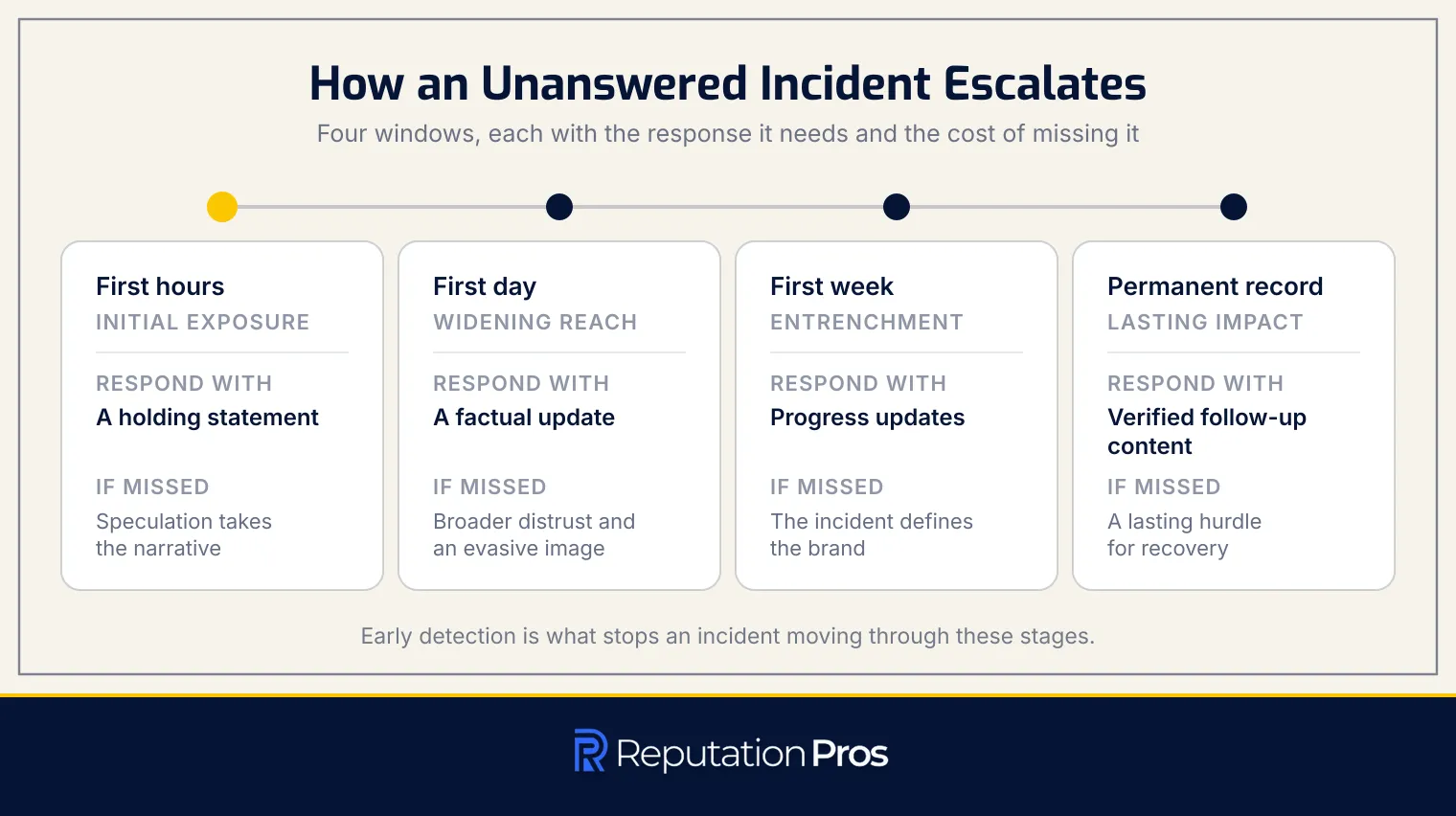
Reputation-damaging incidents escalate rapidly without a prompt response, following a predictable timeline. The stages of escalation from initial visibility to a permanent record are detailed below.
First Hours: Initial Exposure In the first hours, the incident becomes public, with early posts and screenshots shaping initial sentiment. A holding statement acknowledging the issue and outlining next steps is decisive. Missing this window allows speculation to dominate the narrative, making later corrections less credible.
First Day: Widening Reach Within the first day, the incident gains traction as it spreads through social media and search engines index the content. A factual update correcting misinformation and detailing immediate actions is necessary. Failing to respond promptly can lead to broader distrust and an image of evasiveness.
First Week: Entrenchment By the end of the first week, coverage solidifies, affecting future search results and brand associations. Providing progress updates and answering recurring questions helps manage the situation. Ignoring this stage allows the incident to define the brand’s identity, rather than being seen as an isolated event.
Permanent Search Record: Lasting Impact If unaddressed, the incident becomes part of the permanent digital record, accessible through news archives and indexed discussions. Ongoing management, including publishing verified follow-up content, is necessary to mitigate long-term damage. The stage represents a substantial hurdle for reputation recovery.
Early detection is necessary to prevent an incident from escalating through these stages, emphasizing the need for swift and effective crisis management.
How Can Brands and People Monitor Public Trust?
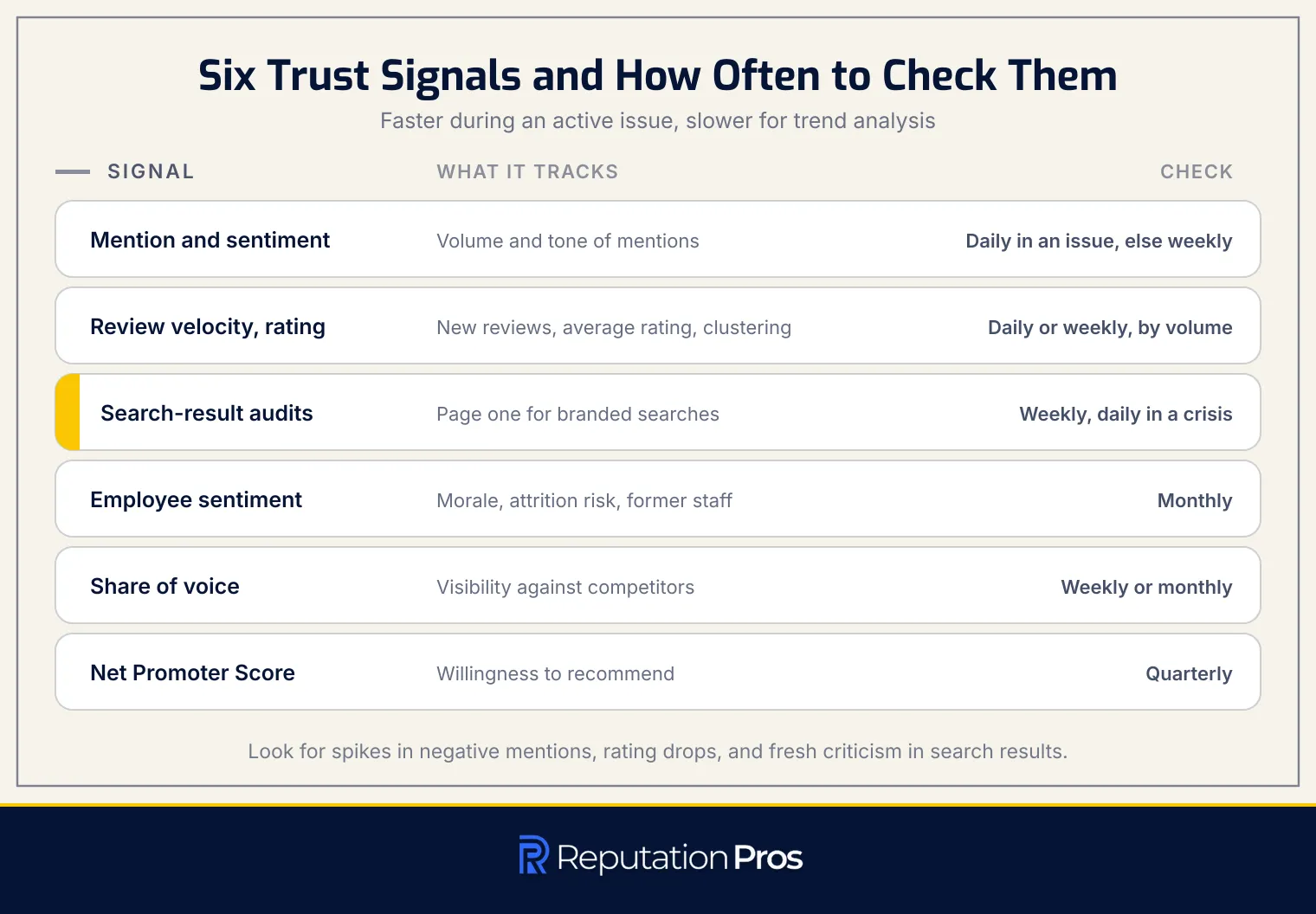
Monitoring public trust involves tracking several signals that reveal reputation health. Named tools capture those signals, reviewed at different cadences to secure timely detection and response.
- Mention and Sentiment Tracking: This tracks how frequently a brand or person is mentioned and the tone of these mentions, whether positive, neutral, or negative. Social listening and media-monitoring platforms capture this data. Review runs daily during an active issue and weekly for trend analysis.
- Review Velocity and Rating Trend: This tracks the number of new reviews, their average rating, and whether reviews are clustering around recent incidents. Review-management and location-listing tools capture this data. High-volume businesses should review this daily, while others can do so weekly.
- Search-Result Audits: This monitors what appears on the first page of search results for branded searches, including negative articles, complaints, and outdated profiles. Manual search checks and reputation dashboards are used for this purpose. Audits should be conducted weekly, and daily during a crisis.
- Employee-Sentiment Signals: This tracks internal morale, attrition risk, anonymous feedback, and former-employee commentary that can predict outward reputation issues. Employee-engagement surveys and workplace review platforms capture these signals. Monthly reviews are standard, with faster checks after leadership changes or incidents.
- Share of Voice: This measures the brand’s visibility compared to competitors across news, search, and social discussions. Media-intelligence and brand-analytics tools calculate this metric. Review runs weekly or monthly.
- Net Promoter Score (NPS): This tracks how willing customers are to recommend the brand, functioning as a compact trust indicator. Customer-experience surveys collect NPS data, which should be reviewed quarterly or after major product or service changes.
A strong monitoring program looks for spikes in negative mentions, sudden drops in ratings, fresh criticism in search results, and recurring complaints in employee or customer feedback. The signals show trust eroding before the damage becomes fully public.
How Does Public Perception Recover After Brand or Personal Reputation Damage?
Public perception recovery from brand or personal reputation damage involves a structured sequence of stages. Each stage requires named actions and has a realistic timeline, with clear signals indicating completion.
Acknowledgement The acknowledgment stage involves publicly recognising the incident. A clear statement should be made to confirm awareness and stop speculation. The stage runs within the first 24 hours and is complete when stakeholders stop questioning whether the issue is being ignored.
Honest Apology An honest apology involves accepting responsibility and explaining corrective actions without blame-shifting. Remediation follows within the first 72 hours. The stage is complete when the response is perceived as credible rather than evasive.
Sustained Corrected Behavior The remediation stage requires fixing the root cause and publishing evidence of remediation. Rebuilding involves consistent behaviour change over days to months. Completion is signaled when new incidents stop and the same complaints do not recur.
Solicited Feedback In this stage, feedback is actively sought from customers and stakeholders to assess improvements. The pattern occurs over weeks to months, and is complete when feedback becomes balanced and less dominated by the original complaint.
Restored Trust The final stage involves demonstrating consistent behavior long enough for skepticism to drop. Recovery takes months and completes when sentiment and engagement return to pre-incident norms.
Recovery relies on repeated proof of change, not just a single statement. Ongoing reputation management ensures the recovery process remains active, monitoring the return of trust and correcting the public record.
What Is Online Reputation Management?
Online reputation management (ORM) is the ongoing practice of monitoring, influencing, and controlling how a person, company, or brand is perceived across digital platforms. ORM encompasses three types of surfaces: owned, earned, and third-party. Owned surfaces include websites and social media profiles that the entity controls. Earned surfaces consist of media coverage and organic mentions, while third-party surfaces involve review platforms and forums. The distinction between suppression and removal is decisive in ORM. Suppression involves using search engine optimization (SEO) and content publishing to push negative content lower in search rankings. Removal, on the other hand, applies when content violates platform policies or legal standards. Accurate and consistent profile information across platforms such as Google Business Profile and LinkedIn is necessary to make certain that the public finds reliable data.
How Does Search Engine Reputation Management Reduce Negative Search Visibility?
Search engine reputation management (SERM) employs several mechanisms to reduce negative search visibility effectively. Suppression strategies displace harmful content in search rankings, thereby minimizing its impact.
- Ranking Owned Assets: SERM prioritizes optimizing company websites, executive profiles, and other branded properties. By enhancing these assets, they occupy top search positions, creating a barrier that shields against negative results.
- Publishing New Indexable Pages: Regular creation of fresh, high-quality content, such as blog posts, press releases, and thought leadership articles, increases the volume of positive material. Published owned content gets indexed and pushes older negative content lower in rankings.
- Correcting Misinformation at Its Source: When false or misleading information appears on third-party sites, SERM involves reaching out to webmasters or platform administrators to request corrections. Early outreach modifies or removes damaging content before it gains traction.
- Requesting Removal for Policy Breaches: Many platforms have policies against defamatory content, privacy violations, or outdated information. Submitting formal removal requests through proper channels can eliminate content that violates these terms.
Search behaviour data supports those mechanisms: published analyses of organic click-through find roughly 71% of clicks going to page one, with the first organic result alone taking close to a third of all clicks. Content pushed to page two or beyond reaches few readers, which cuts its reputational effect even where the content itself stays online.
How Can Positive Owned Content and Accurate Profiles Support Reputation Repair?
Positive owned content and accurate profiles form the foundation for effective reputation repair. Owned-content strategy rests on several components that help establish a truthful and authoritative narrative.
- Site Pages and Executive or Author Bios: These serve as primary owned assets that communicate credentials, achievements, and corrected narratives. A full About page or leadership bio section establishes credibility through verifiable career history and accomplishments. Regular updates make certain content remains current and demonstrate ongoing professional activity.
- Verified and Consistent Profiles Across Platforms: Uniformity across LinkedIn, industry directories, and Google Business Profile builds trust. Consistent information, such as name, title, credentials, and professional summary, reduces doubt and suggests authenticity. Verification badges on platforms like LinkedIn and Google signal credibility and reduce impersonation risks.
- Publishing Cadence: A consistent schedule of blog posts, articles, or social media updates demonstrates active professional engagement. Owned content addresses industry topics and offers a clear read, providing value rather than focusing defensively on past issues. A regular publishing rhythm helps displace older negative results with fresh content.
- Review-Response Protocol: Engaging with reviews on platforms like Google, Trustpilot, and Glassdoor shows accountability. Responding to negative reviews with a professional tone, acknowledging concerns, and providing corrective actions demonstrates customer focus. The pattern approach helps shift the overall sentiment visible on review platforms, supporting reputation repair efforts.
How Do Employer and Personal Brands Depend on Trust?
Employer and personal brands function as a unified trust system where the actions of individuals and organizations impact each other. Founder and executive behavior directly influences company trust, as leadership conduct frequently reflects organizational values. Conversely, company actions, such as poor management or ethical breaches, affect the personal brands of employees associated with the organization. Interdependence means reputational damage in one area can quickly transfer to the other, affecting perceptions on platforms like Glassdoor and impacting hiring costs. Research by LinkedIn indicates that strong employer brands lower recruitment expenses and enhance candidate trust, demonstrating the decisive nature of maintaining a positive reputation for both entities.
How Do Consistency, Authenticity, and Professional Conduct Build Trust?
Consistency, authenticity, and professional conduct build trust through the repetition of reliable behavior over time. Alignment between stated values and actual conduct makes certain that what is promised matches what is delivered. Professional conduct serves as the observable proof of both consistency and authenticity, transforming abstract values into concrete actions. Each repeated interaction reinforces credibility, allowing stakeholders to depend on an entity’s reliability.
Why Does Delivering on Promises Protect Brand and Personal Reputation?
Delivering on promises protects brand and personal reputation by establishing a reliable record of performance. Consistently meeting commitments builds a trust reserve that acts as a shield when unforeseen failures occur. A history of reliability means a single lapse is viewed as an exception rather than a pattern of unreliability. When promises are kept under normal conditions, it strengthens the foundation of trust, providing a buffer for when things go awry.
How Does Crisis Communication Protect Reputation?
Crisis communication protects reputation by making sure the organization maintains control over the narrative during a crisis. The speed of acknowledgment is decisive, with the first public statement needing to occur within hours of the incident. A single named spokesperson should deliver this message to establish a consistent voice and prevent contradictory statements. The initial statement must include a factual correction of the issue, detailing the scope of the incident and the stakeholders affected. Clarity and specificity in communication signal competence and transparency. The remediation commitment is another decisive element, specifying the actions the organization will take to address the root cause and prevent recurrence. The commitment stays time-bound and credible. Follow-up proof of these actions, such as process changes or policy updates, closes the loop between promise and delivery. Delivery turns the crisis from a reputational liability into a case study in accountability and integrity. When a crisis is too complex to handle internally, professional reputation support can help coordinate messaging and recovery efforts, so that the response remains credible and effective.
How Can Reputation Management Address Things That Can Damage Brand and Personal Reputation?
Reputation Pros specializes in addressing several causes of reputational damage. Our services include monitoring, search visibility enhancement, owned-content publishing, review response, and crisis communication. We invite individuals and brands facing active or emerging issues to consult with our team for effective solutions.
How Can Ongoing Monitoring Help Prevent Future Reputation Damage?
Ongoing monitoring serves as an early detection system for potential reputation damage. Monitoring surfaces new mentions and reviews before they escalate into substantial issues. A reliable review cadence involves real-time alerts for immediate risks, daily checks for new content, weekly audits of search results, and monthly trend analyses. A systematic cadence gets emerging issues addressed promptly, reducing the likelihood of costly damage. The cost difference between addressing an issue early and managing a widespread problem is substantial, as early intervention usually requires minimal resources compared to extensive damage control efforts. Continuous monitoring is decisive in preventing small problems from becoming major crises that can affect brand and personal reputation.