What Is Slander Per Se?
 16 min read
 On this page
Slander per se is a spoken defamatory statement so inherently damaging that harm to reputation is presumed without the plaintiff proving actual damages. In legal terms, slander per se involves false assertions treated as so harmful that the law assumes injury has occurred, which removes the need for the plaintiff to demonstrate specific financial losses. The presumption distinguishes slander per se from slander per quod, which requires proof of actual damages, and from libel per se, which involves written defamatory statements.
A statement qualifies as slander per se when it falls into one of four categories: accusing someone of a crime, imputing a loathsome disease, attacking professional competence, or alleging sexual misconduct. Damages are presumed in slander per se cases because the statements are so plainly damaging that proving financial loss is unnecessary. A plaintiff must still prove that the statement was false, published to a third party, referred to them, and made with the required level of fault.
Defenses against a slander per se claim include truth, protected opinion, and privilege. Truth serves as a complete defense when the statement is factually accurate. Protected opinion is a defense when the statement is an opinion rather than a factual assertion. Privilege applies to statements made in protected contexts, such as judicial proceedings. Slander per se directly impacts reputation and requires victims to act by documenting the statement, consulting legal counsel, and filing a lawsuit to repair their reputation.
What does slander per se mean legally?
Slander per se is a legal term for spoken defamatory statements so inherently harmful that they presume damage to a person’s reputation without requiring proof of actual harm. The concept is distinct from ordinary slander, where the plaintiff must provide evidence of specific damages to succeed in a claim. According to Cornell Law School’s Legal Information Institute, slander per se includes statements considered inherently damaging and actionable in court without additional proof of harm. The legal doctrine presumes malice and allows damages to be awarded without the plaintiff demonstrating special damages, which sets it apart from slander per quod cases, where proof of actual harm is necessary.
What Makes a Statement Slander Per Se?
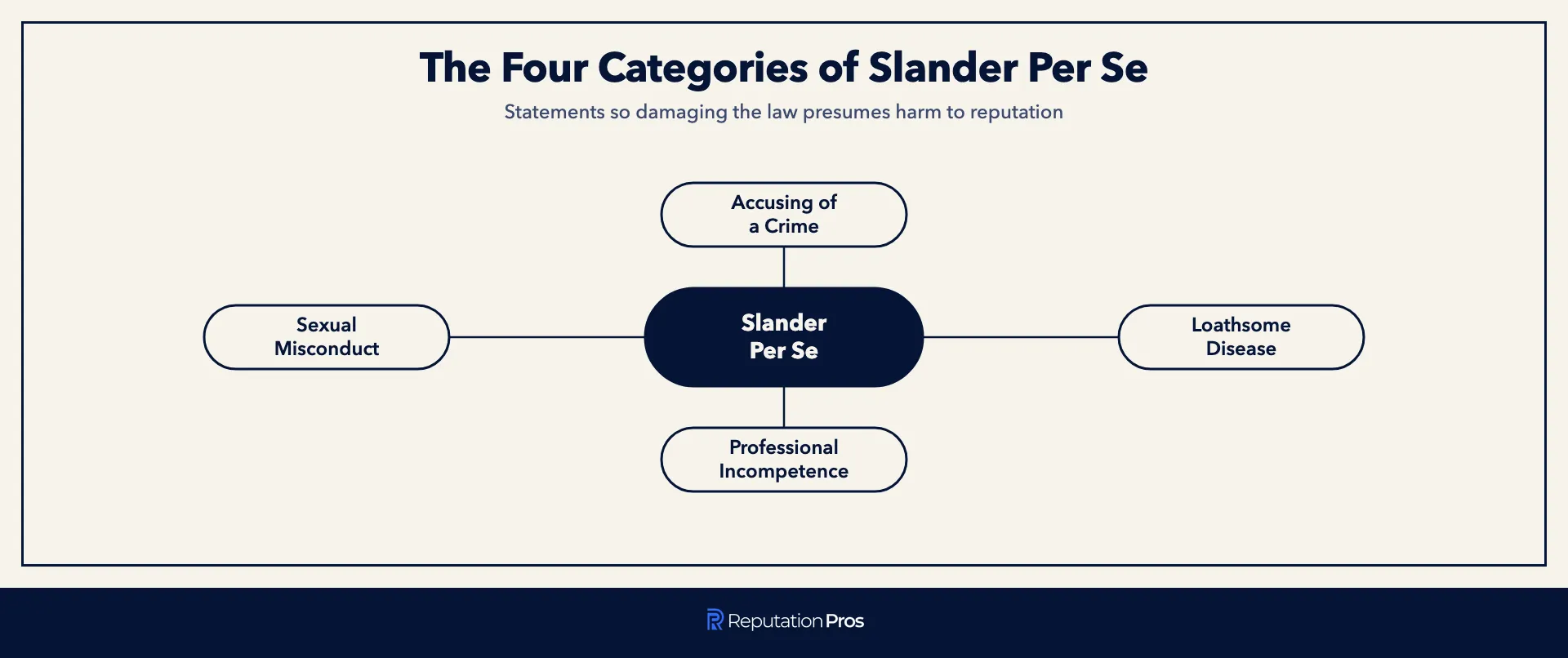
A statement qualifies as slander per se when it inherently harms a person’s reputation without the need for additional proof of damage. The form of slander falls into one of four specific categories recognized by law due to their inherently damaging nature. The four categories include accusations of a serious crime, imputing a loathsome disease, attacking professional or business competence, and alleging sexual misconduct. Each statement is treated as so damaging that the law presumes harm and removes the need for the plaintiff to prove actual damages. The presumption is based on the clear and direct harm the statements cause to an individual’s reputation.
How Does Slander Per Se Differ From Slander Per Quod?
Slander per se differs from slander per quod in the presumption of harm.
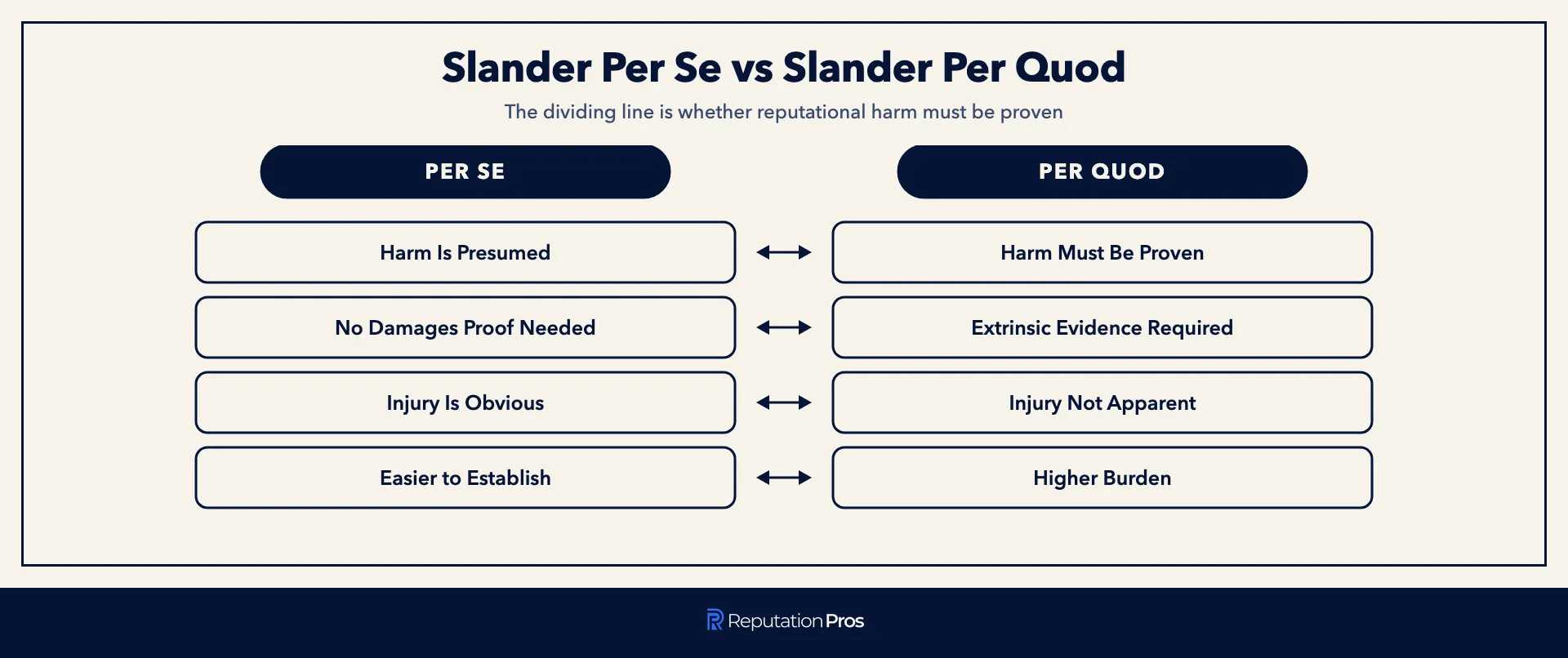 In slander per se, harm to the plaintiff’s reputation is presumed by law without the need for additional evidence of actual damages. Once the defamatory nature of the statement is established, the plaintiff does not need to prove specific economic losses. Slander per quod requires the plaintiff to provide extrinsic evidence and demonstrate actual damages, because the harm is not immediately apparent from the statement itself.
How Does Slander Per Se Differ From Libel Per Se?
Slander per se and libel per se differ in the form of communication used. Slander per se involves spoken defamatory statements, while libel per se involves written or published defamatory statements. Both forms are treated as inherently damaging, because both presume harm to reputation without requiring proof of actual damages — the difference between libel and slander rests on the medium alone.
What Are the Four Categories of Slander Per Se?
Slander per se falls into four distinct types of statements, each inherently harmful to a person’s reputation. The four categories are legally recognized as causing presumed damage without the need for the plaintiff to prove actual harm.
Accusing Someone of a Crime
Accusing someone of a crime is a major category of slander per se. The category involves making a false spoken statement that alleges an individual committed a criminal offense. Such accusations are inherently damaging because they attack a person’s moral character and social standing. The law presumes harm to the individual’s reputation without requiring proof of actual financial loss. For a statement to qualify as slander per se, it must assert a specific crime rather than a general moral failing. The accusation must also be false, unprivileged, and communicated to a third party.
The rationale behind treating criminal accusations as slander per se lies in the profound social stigma of being labeled a criminal. The stigma leads to immediate harm in personal and professional relationships. Even without proof of specific financial losses, the mere utterance of such an accusation can cause the victim to be shunned, distrusted, or avoided by others. The recognition of inherent harm is why plaintiffs alleging this type of slander are not required to demonstrate actual damages; the damage to reputation is legally presumed from the nature of the statement itself.
Is accusing someone of a crime slander per se?
Yes, accusing someone of a crime is slander per se because such statements are treated as inherently damaging to a person’s reputation, which removes the need for the plaintiff to prove actual damages.
Imputing a Loathsome or Contagious Disease
Imputing a loathsome or contagious disease is a category of slander per se where false claims about someone having a socially stigmatized or medically severe illness are made. Diseases like leprosy, tuberculosis, and sexually transmitted infections were once considered loathsome due to their severe social stigma and potential to cause ostracization. In modern contexts, the category still applies to diseases that provoke similar social aversion, such as HIV/AIDS.
For a statement to qualify under the category, the alleged disease must be one that would cause others to view the person with disgust or contempt. The accusation must be a false assertion of fact, not a subjective opinion. Because such claims lead to immediate social rejection or job loss, the law presumes harm to the plaintiff’s reputation and allows recovery of general damages for emotional distress without proof of specific financial losses.
Attacking Professional or Business Competence
Attacking professional or business competence is a recognized category of slander per se. The category applies when a false spoken statement directly harms an individual’s ability to perform their job, trade, or business. The law presumes harm to reputation without requiring proof of specific financial loss due to the inherent damage such statements cause.
For a statement to qualify as slander per se in the category, it must impute a general disqualification in the skills required for the occupation or allege conduct that lessens the person’s professional standing. Examples include false claims that a doctor negligently performed surgery or that an accountant engages in fraudulent practices. The statements directly impact the professional’s reputation and become actionable without proof of actual damages. Courts distinguish actionable factual accusations from protected opinions and keep only statements directly affecting professional capabilities within slander per se.
Alleging Sexual Misconduct
Alleging sexual misconduct is a category of slander per se because such accusations are inherently damaging to an individual’s reputation. The statements include false claims of sexual impropriety, harassment, or other forms of sexual misconduct. The law presumes harm from the accusations without requiring the plaintiff to demonstrate actual financial losses. Defamation law once recognized imputing “unchastity to a woman” as a per se category. Modern courts have expanded the category to cover allegations against individuals of any gender. The accusations severely impact personal relationships, professional opportunities, and social standing. The serious nature of the claims, above all in professional contexts where they can end careers and irreparably damage reputations, justifies the presumption of harm that characterizes slander per se claims.
Why Are Damages Presumed in Slander Per Se?
Damages are presumed in slander per se cases because specific defamatory statements are treated as inherently harmful. The statements are so damaging to a person’s reputation that the law assumes injury without requiring evidence of actual financial loss. The legal system recognizes that statements such as accusing someone of a crime, imputing a loathsome disease, attacking professional competence, or alleging sexual misconduct carry such severe social stigma that quantifying harm becomes unnecessary.
The presumption of damages in slander per se is based on the understanding that the statements automatically harm an individual’s reputation and standing in the community. According to legal precedent, such as the cases of Aronson v. Wiersma and Matherson v. Marchello, the law acknowledges the immediate and profound impact of the statements. While damages are presumed, plaintiffs must still prove other elements of their claim, such as the falsity of the statement and its publication to a third party with at least negligence.
What are the elements of a slander per se claim?
A slander per se claim involves several key elements that a plaintiff must establish to succeed. First, the plaintiff must demonstrate that the defendant made a false statement of fact. The statement must have been spoken to at least one third party, which keeps it communicated beyond the plaintiff. The statement must fall into one of the four recognized categories of slander per se: accusing someone of a crime, imputing a loathsome disease, attacking professional competence, or alleging sexual misconduct. The statement must be specifically about the plaintiff and carry a defamatory nature, meaning it harmed their reputation within the community.
While damages are presumed in slander per se cases, the plaintiff must still prove the foundational elements of defamation. Proving fault is also necessary, with the level of fault varying based on whether the plaintiff is a public or private figure, following the elements set out in the Restatement (Second) of Torts § 558. Once the elements are established, the law presumes reputational harm and removes the need for the plaintiff to demonstrate specific monetary losses.
What must a plaintiff prove for slander per se?
To establish a claim for slander per se, a plaintiff must demonstrate that the defendant made a false and unprivileged oral statement about the plaintiff. The statement must have been communicated to a third party, and the defendant must have acted with at least negligence. When the plaintiff is a public figure, they must also prove actual malice on the part of the defendant. Slander per se does not require the plaintiff to show actual financial loss or specific special damages, because harm is presumed by law when the statement falls within a recognized slander per se category.
What must a plaintiff prove for slander per se without showing damages?
In slander per se cases, a plaintiff must establish that the defendant made a false statement of fact about them, communicated to at least one third party. The statement must fall into one of the four recognized categories where harm is presumed, such as accusing someone of a crime, imputing a loathsome disease, attacking professional competence, or alleging sexual misconduct. The plaintiff must show the defendant acted with at least negligence regarding the truth of the statement.
What Defenses Apply to a Slander Per Se Claim?
Several defenses apply to a slander per se claim, even though damages are presumed. The defenses include truth, protected opinion, and privilege. Each defense negates the claim by addressing the core elements required for defamation, and are listed below:
- Truth: A complete defense. When the defendant demonstrates that the statement was substantially true, the claim fails regardless of any reputational harm.
- Protected Opinion: A defense that applies when the statement is a subjective viewpoint rather than a factual assertion. Such statements cannot be proven true or false and are non-actionable.
- Privilege: Certain contexts provide immunity from defamation claims. Statements made during judicial proceedings, legislative debates, or communications between parties with a legal duty to share information are protected.
The defenses keep not all harmful speech legally actionable and balance the protection of reputation with free speech rights.
Truth as a Complete Defense
Truth serves as a complete defense in slander per se claims. When the defendant demonstrates that the allegedly defamatory statement is true, the claim is nullified regardless of the statement’s impact on the plaintiff’s reputation. The principle is grounded in defamation law, which protects individuals from false statements rather than truthful ones. The burden of proof lies with the defendant, who must establish the truth of the statement by a preponderance of the evidence. The statement does not need to be true in every detail, because the substantial truth doctrine applies. The substantial truth doctrine holds that as long as the “gist” or “sting” of the statement is accurate, minor inaccuracies do not defeat the defense. When a person is accused of embezzling $10,000 but actually embezzled $9,500, the substantial truth defense still applies because the core assertion, that embezzlement occurred, is correct.
Protected Opinion and Privilege
Protected opinion and privilege are two defenses in slander per se claims that shield defendants from liability. Protected opinion refers to statements that express subjective viewpoints rather than objective facts. Courts recognize such opinions as constitutionally protected speech under the First Amendment. For a statement to qualify as a protected opinion, it must indicate a personal belief or judgment, not an assertion of fact. In some cases, negative consumer reviews were treated as protected opinions because they reflected personal experiences rather than verifiable claims.
Privilege offers immunity for statements made in specific contexts. Absolute privilege applies to statements made during judicial proceedings, legislative debates, and certain governmental functions and provides complete protection regardless of intent or truth. Qualified privilege protects statements made in good faith on matters of legitimate interest, such as employment references or communications where the speaker and recipient share an interest. The qualified protection is lost when the plaintiff proves the statement was made with actual malice. The defenses acknowledge the need for open communication in certain forums and relationships, even at the risk of reputational harm.
How does slander per se relate to reputation damage?
Slander per se is linked to reputation damage due to its nature of comprising statements so inherently harmful that the law presumes their damaging impact. The statements fall into four categories: accusations of a crime, imputations of a loathsome disease, attacks on professional competence, and allegations of sexual misconduct. Each category tarnishes an individual’s reputation because they directly affect how others perceive the individual’s character and integrity.
The presumption of damage in slander per se cases reflects a legal understanding that certain false statements are so serious that their harm is immediate and obvious. Unlike regular slander, where plaintiffs must demonstrate specific reputational harm, slander per se acknowledges that statements like falsely accusing someone of a crime naturally lead to social ostracism, lost professional opportunities, and emotional distress. The presumption of harm shows the law’s focus on protecting an individual’s standing in the community from inherently damaging statements, regardless of whether economic loss is demonstrated.
Reputation damage from slander per se appears in lost business opportunities, damaged professional relationships, and diminished community standing. The severity of the damage justifies the legal presumption of harm and allows plaintiffs to recover damages without proving specific financial losses. The legal framework shows the importance of reputation and the need for its protection against certain types of false statements.
Once the harm is done, recovery calls for a structured plan to rebuild the damaged reputation across search results, review platforms, and social channels.
How Do You Act on a Slander Per Se Statement?
To address a slander per se statement, follow the steps below to build a strong legal position and protect your reputation:
- Document the Statement: Record the details of the statement, including when, where, and to whom it was made. Identify any witnesses present.
- Preserve Evidence: Collect any recordings, messages, or witness statements that confirm the defamatory words were spoken.
- Send a Cease and Desist Letter: Formally request that the speaker stop making defamatory statements and issue a retraction.
- Consult a Defamation Attorney: Seek legal advice to evaluate the strength of your case and explore your legal options.
- Consider Legal Action: When necessary, file a lawsuit to seek damages for the harm caused by the slanderous statement.
- Act Promptly: Be aware of the statute of limitations, which ranges from one to three years, depending on the jurisdiction.
Why Choose Reputation Pros to Remove Defamatory Online content?
At Reputation Pros, we are the right choice for removing defamatory online content because of specialized services in content removal and reputation management. As an online reputation management company, we apply a full strategy that includes social media and local SEO to raise visibility and suppress negative content. Our team uses platform reporting, legal action, and search de-indexing to eliminate harmful statements, which protects and restores your online presence.
Can You Repair Your Reputation After Slander Per Se?
Yes, you can repair your reputation after slander per se. The damage from slander per se, while presumed, can be reduced through strategic actions. Legal remedies, such as seeking retractions or corrections, address defamatory statements. Proactive reputation management strategies, including positive content creation and community engagement, restore credibility and public trust.
What Are Examples of Slander Per Se?
Slander per se involves specific spoken statements that are inherently damaging to one’s reputation and require no proof of harm. Alongside broader online defamation examples, the examples below show the typical categories of slander per se:
- Accusing Someone of a Crime: Falsely stating that a neighbor embezzled funds from their employer. The accusation suggests criminal behavior, which is treated as inherently harmful.
- Imputing a Loathsome Disease: Falsely claiming a coworker has untreated tuberculosis imputes a loathsome disease. The claim can severely damage a person’s social standing.
- Attacking Professional Competence: A business rival falsely asserting that a doctor routinely misdiagnoses patients. The statement directly attacks the professional’s competence and integrity.
- Alleging Sexual Misconduct: Falsely accusing someone of sexual assault. Such allegations are damaging due to the severe social and legal implications involved.
The examples show why slander per se is treated as inherently damaging. Each statement falls into a recognized category where the law presumes harm and removes the need for the plaintiff to prove actual damages.