The 4 Main Elements of Defamation
 16 min read
 On this page
The four main elements of defamation are a false statement of fact, publication to a third party, fault, and damages or harm to reputation. Defamation in law is a claim that arises when the four elements are proven together, forming the basis for a legal cause of action. Each element carries part of the proof that a defamatory statement has occurred.
A false statement of fact is the first element, requiring that the statement is objectively untrue and presented as a fact rather than an opinion. Publication to a third party is the second element, meaning the statement must reach someone other than the person it concerns. The third element, fault, requires showing that the defendant acted with at least negligence; for public figures, fault rises to actual malice, meaning the statement was made with knowledge of its falsity or with reckless disregard for the truth. The fourth element, damages or harm to reputation, shows that the false statement injured the subject’s standing in the community or personal relationships.
Defamation, libel, and slander frame the four elements in different contexts: libel covers written defamatory statements, while slander covers spoken ones. The harm element is proven through evidence of tangible losses, such as lost business opportunities or emotional distress, and reputation can be restored through remedies like retractions or monetary damages. The hardest element to prove is damages or harm to reputation unless the statement qualifies as defamation per se. When a statement meets all four elements, the plaintiff establishes a prima facie case of defamation, and the claim stands on the four-element list that follows.
What Are the 4 Elements of Defamation?
A defamation case stands only when four elements are proven together. The 4 elements of defamation are listed below:
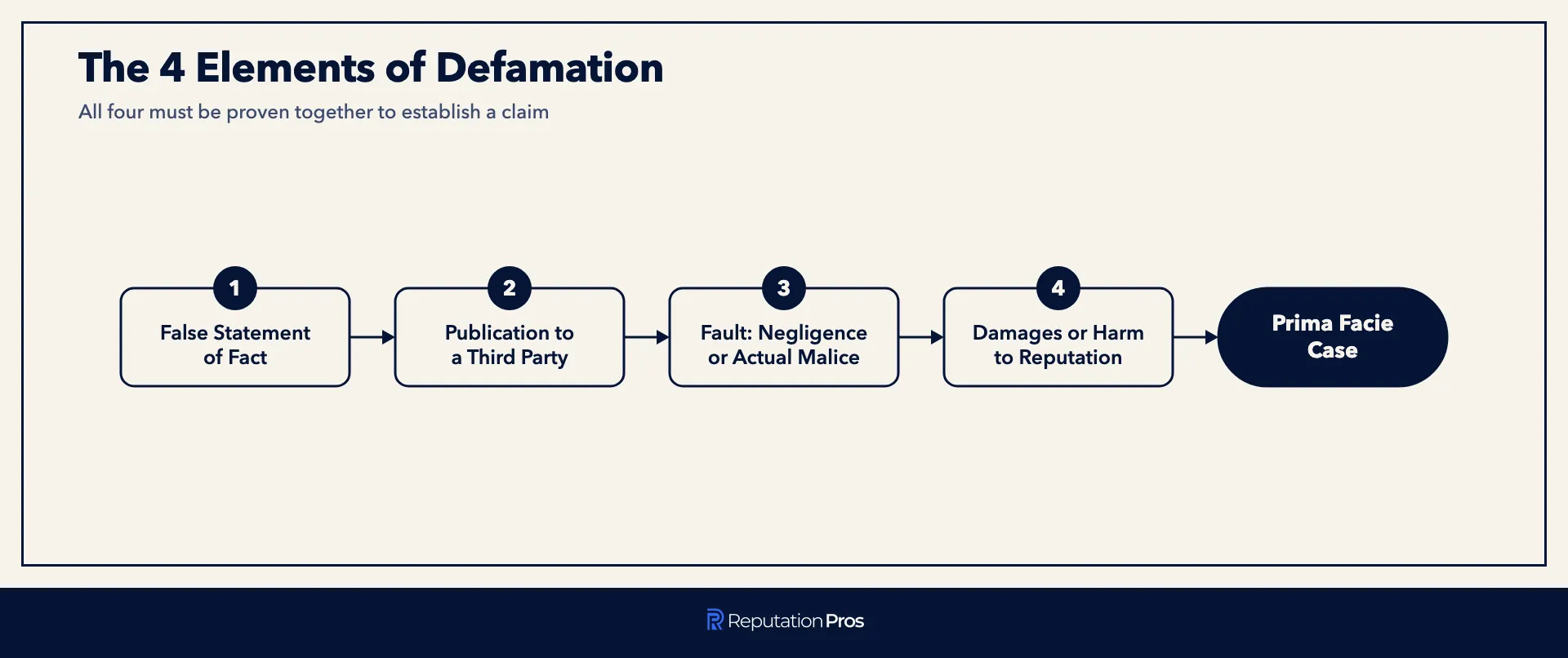
- A False Statement of Fact: The statement in question must be objectively false and presented as a fact rather than an opinion.
- Publication to a Third Party: The false statement must be communicated to at least one person other than the individual being defamed.
- Fault (Negligence or Actual Malice): The defendant must have acted with some degree of fault, ranging from negligence to actual malice depending on the plaintiff’s status as a private individual or public figure.
- Damages or Harm to Reputation: The statement must cause measurable harm to the plaintiff’s reputation, affecting personal relationships, professional standing, or causing emotional distress.
The first element, the false statement of fact, opens the breakdown.
Element 1: A False Statement of Fact
A false statement of fact is the first element of defamation, requiring the statement to be objectively verifiable as false. The statement must be presented as an assertion of fact rather than an opinion. For instance, claiming “John embezzled funds from the company” can be fact-checked, while saying “I think John is unreliable” is an opinion and constitutionally protected. The distinction decides the claim because opinions cannot form the basis of a defamation action.
The false statement must refer to the plaintiff, even if the plaintiff is not named. A reasonable person should be able to identify the individual being discussed. If the statement stays vague or targets a broad group, the statement fails to meet the defamation criteria. Courts assess whether the statement could reasonably be read as stating actual facts about the person or entity involved.
Truth serves as an absolute defense against defamation claims. If the defendant proves the statement is true, the defamation claim fails regardless of reputational harm. The burden falls on the plaintiff to demonstrate the statement’s falsehood, and courts examine the context to determine whether a reasonable person would perceive the statement as asserting factual claims.
Element 2: Publication to a Third Party
Publication to a third party is the second element of defamation. The publication element requires that the false statement reach at least one person other than the person making the statement and the person it concerns. The statement must be heard, read, or seen by that third party to count as published.
The statement does not need to appear in traditional media such as newspapers or online platforms. Any form of communication that conveys the defamatory content to a third party qualifies, including spoken words, written messages, or gestures. The publication element ties defamation to public perception, since private communications between only the speaker and the subject do not satisfy the requirement.
Defamation claims turn on identifying the original publication and any republications. The initial publisher can be held liable for the original statement, while people who repeat or share the content may face legal consequences of their own. Republication rules widen the reach of reputational harm, above all online, where information spreads fast and far.
Element 3: Fault (Negligence or Actual Malice)
The fault element in defamation law requires proving that the defendant acted with negligence or actual malice when making the statement. For private individuals, negligence suffices, meaning the defendant failed to exercise reasonable care in verifying the truth of the statement, such as skipping the research or fact-checking that would have kept the false information from spreading. Negligence is the lower fault standard and reflects the expectation that people take reasonable steps to confirm accuracy before publishing statements.
Public figures and officials must demonstrate actual malice to establish fault. Actual malice means the defendant made the statement with knowledge that it was false or with reckless disregard of whether it was false or not, according to the First Amendment Encyclopedia entry “Actual Malice” by Stephen Wermiel, published by the Free Speech Center at Middle Tennessee State University, July 2021. The actual malice standard sits higher and demands clear evidence of the defendant’s state of mind at the time of publication. The landmark case The New York Times Co. v. Sullivan established the standard to protect free speech while holding publishers accountable for knowingly spreading falsehoods. The split between negligence and actual malice balances reputational rights against open public debate.
Element 4: Damages or Harm to Reputation
The damages element in defamation cases requires the plaintiff to demonstrate how a false statement harmed the plaintiff’s reputation. The harm shows up as financial losses, such as lost business opportunities or revenue, or as non-financial injuries like emotional distress and damage to personal or professional relationships. In legal terms, damages serve both as evidence of harm and as the basis for compensation that restores the injured party’s previous standing.
Certain defamatory statements are categorized as “defamation per se,” where harm is presumed without specific proof of damages. The per se categories include false accusations of criminal behavior, allegations of sexual misconduct, and claims of professional incompetence. In per se cases, the law treats harm to reputation as inherent in the false statement itself, which relieves the plaintiff of the burden to prove specific damages.
For statements outside defamation per se, plaintiffs must present concrete evidence of actual damages. Evidence may include financial records showing lost income, testimony from colleagues or community members about altered perceptions, or documentation of social exclusion and psychological suffering. Proving damages anchors the claim because it establishes the direct impact of the false statement on the plaintiff’s reputation.
What is the definition of defamation in law?
Defamation in law is defined as a false statement of fact that is communicated to a third party, made with fault (either negligence or actual malice), and causes damages or harm to the subject’s reputation. The definition establishes the criteria for proving that a reputation has been unlawfully harmed through spoken or written words, and covers both the civil wrong committed and the remedy available to victims of false statements.
The legal definition of defamation varies by state across common law and statutory law, but the core elements stay consistent across jurisdictions. Courts assess whether statements can reasonably be seen as defamatory while preserving plaintiffs’ rights to seek redress for reputational harm. To establish a prima facie case of defamation, all four elements must be demonstrated: the statement must be false and presented as fact rather than opinion, the statement must have been published or communicated to at least one third party, the speaker must have acted with fault, and the victim must have suffered actual harm to reputation.
Defamation law recognizes that certain types of statements are presumed defamatory if false, such as accusations of committing a crime, professional incompetence, sexual misconduct, or having a loathsome disease. In defamation per se cases, harm is inferred from the statements themselves without additional proof of reputational damage. The legal definition distinguishes between fault standards depending on whether the plaintiff is a private individual or a public figure, with public officials required to prove “actual malice”, meaning the statement was made with knowledge of its falsehood or reckless disregard for the truth, as established in the landmark case The New York Times Co. v. Sullivan.
What is libel in defamation?
Libel in defamation is the written or published form of a false statement that harms an individual’s reputation. Unlike slander, which involves spoken words, libel covers any defamatory content in a permanent form, such as newspapers, books, or digital media. The permanence of written statements makes libel easier to prove than slander, because a lasting record exists that can serve as evidence in legal proceedings. Courts recognize the depth of harm libel inflicts on personal and professional reputations, and the harm results in compensable damages.
What is the difference between libel and slander?
The difference between libel and slander is the medium of communication. Libel refers to defamatory statements made in a fixed or permanent form, such as written articles, digital posts, or videos. The permanence lets libel reach a wider audience and cause more lasting reputational damage. Slander involves spoken or transient statements, such as oral remarks or live broadcasts that are not recorded. Slander’s temporary nature keeps the audience smaller, and courts treat slander as less damaging than libel. Both forms still require proof of a false statement of fact, publication to a third party, fault, and damages to establish a defamation claim.
What are the purposes of defamation law?
Defamation law balances individual rights with societal interests. The purposes of defamation law are listed below:
- Protection of Reputation: Defamation law safeguards individuals and entities from false statements that could damage their personal or professional reputation.
- Provision of Legal Redress: The law offers a mechanism for victims to seek compensation for damages caused by defamatory statements, including emotional distress and financial losses.
- Balancing Free Speech and Accountability: The law draws boundaries so that free expression does not come at the expense of unjust harm to reputation.
- Deterrence of False Statements: Legal consequences discourage the spread of false information that could cause serious harm.
What Are the Essential Elements of a Defamation Claim?
The essential elements of a defamation claim are listed below:
- False Statement of Fact: An assertion that is objectively untrue and presented as a fact rather than an opinion.
- Publication to a Third Party: The false statement must reach at least one person beyond the speaker and the victim.
- Fault: The defendant must have acted with some level of fault when making the statement; negligence suffices for private individuals, while public figures must demonstrate actual malice.
- Damages or Harm to Reputation: The statement must have caused actual harm to the subject’s reputation, such as damage to personal or professional relationships, loss of business opportunities, or emotional distress. Some statements qualify as defamatory per se, where harm is presumed from the statement’s nature.
What is the harm element in defamation?
The harm element in defamation is the damage a false statement inflicts on a person’s reputation. The harm element requires that the defamatory statement caused actual injury to the individual’s standing in the community or to personal and professional relationships. Without demonstrable harm, a defamation claim cannot succeed even if all other elements are present.
Harm in defamation shows up as damage to personal and professional relationships, loss of business opportunities, emotional distress, and reduced community standing. Certain statements, considered “defamatory per se,” automatically imply harm by their nature, such as accusations of serious crimes or professional incompetence. Statements that are “defamatory per quod” require the plaintiff to prove specific damages, such as lost income or emotional distress. Courts dismiss claims built on minor annoyances and focus on substantial reputational injury.
How is harm proven in defamation?
Harm in defamation is proven with concrete evidence of reputational damage tied to the false statement. The accepted forms of evidence are listed below:
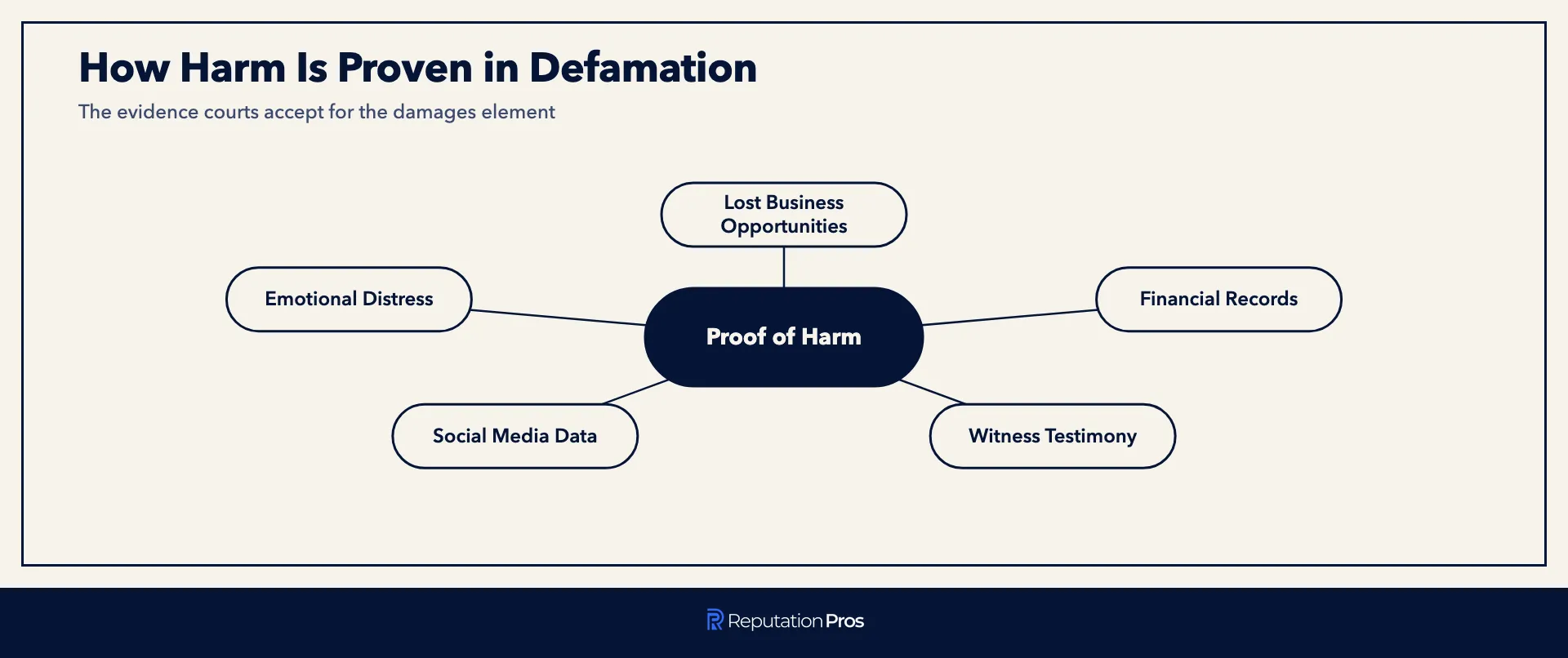
- Decline in Business Opportunities: Documentation of lost clients or contracts.
- Financial Losses: Records showing decreased revenue or income.
- Witness Testimony: Statements from colleagues or clients about changed perceptions.
- Social Media Analytics: Data reflecting negative shifts in online reputation.
- Emotional Distress: Evidence of mental health impacts requiring treatment.
Courts require concrete, direct evidence because speculation alone is insufficient in defamation cases.
How Is Reputation Harmed by Defamation?
Reputation is harmed by defamation when false statements turn public perception negative. The damage shows up as lost job opportunities, strained professional relationships, financial setbacks, and emotional distress. Courts measure the harm by the decline in public perception before and after the defamatory statements. False allegations erode trust and credibility across personal and professional interactions.
Once reputation is damaged, the task becomes restoring it. Addressing the harm involves issuing corrections, applying reputation management, and seeking monetary compensation for proven damages.
How to Restore Reputation After Defamation
To restore reputation after defamation, apply the steps listed below:
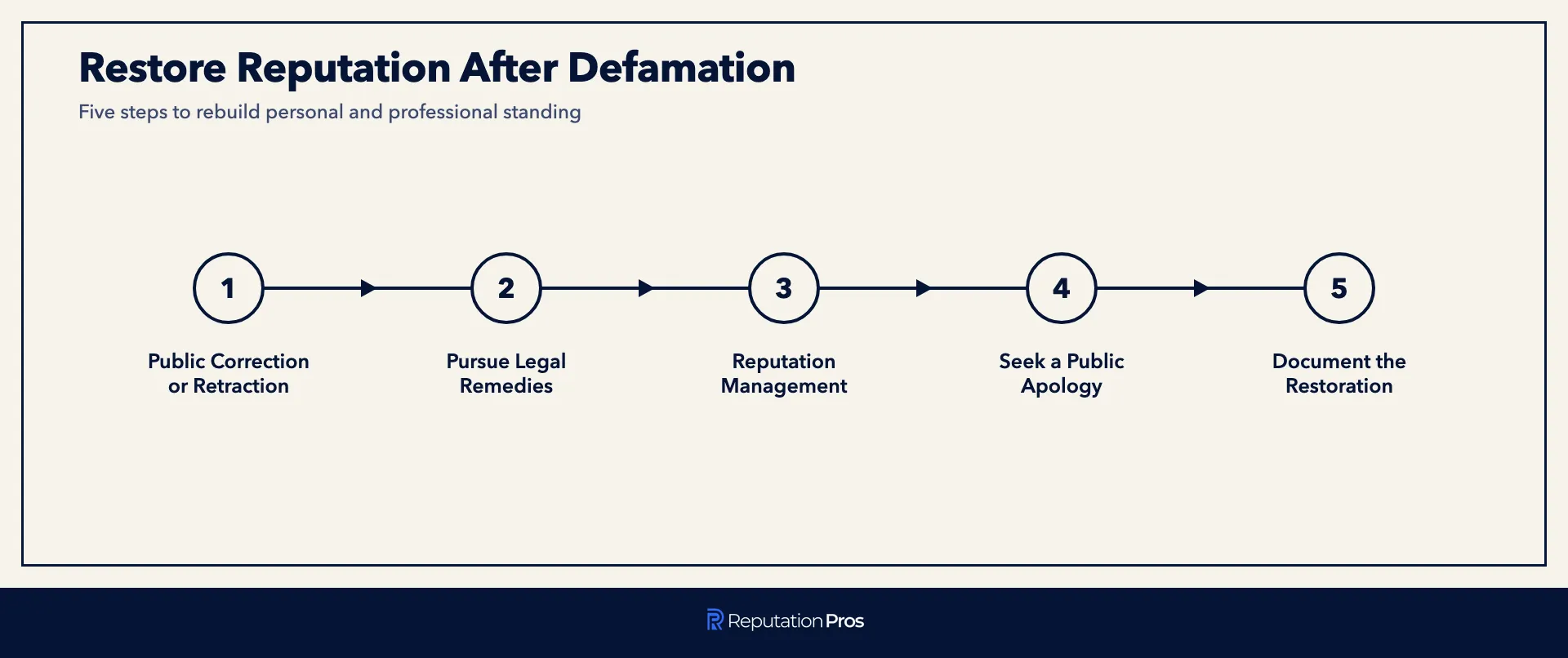
- Issue a Public Correction or Retraction: Request a retraction from the defamer to counter the false narrative.
- Pursue Legal Remedies: Consider filing a defamation lawsuit for accountability and possible damages.
- Engage in Reputation Management: Rebuild the public image through positive content and professional achievements.
- Seek a Public Apology: A formal apology from the defamer helps repair relationships and public perception.
- Document the Restoration Process: Keep records of all actions taken, including legal and personal efforts to restore credibility.
For a deeper playbook that expands each of these steps into a full crisis-to-recovery sequence, see our guide on reputation recovery strategies.
How Do the Elements Differ for Libel and Slander?
The elements of defamation, a false statement of fact, publication to a third party, fault, and damages, apply to both libel and slander, and the difference sits in the medium and the treatment of damages. Libel involves written or permanent forms of communication, such as newspapers or online posts, which reach a wider audience and cause lasting harm. Damages in libel cases are presumed in cases of libel per se. Slander involves spoken statements that are transitory, so the plaintiff must prove actual damages unless the case involves slander per se, such as allegations of serious crime or professional incompetence.
Which Defamation Element Is Hardest to Prove?
Damages or harm to reputation is widely considered the hardest element of defamation to prove. Defamation requires damages, or some harm caused to the reputation, as its fourth showing, according to the Wex legal encyclopedia entry “Defamation” published by Cornell Law School’s Legal Information Institute. The difficulty arises because plaintiffs must provide concrete evidence of that injury, such as financial loss or emotional distress, unless the statement qualifies as defamation per se. Proving harm requires detailed documentation, such as evidence of job loss, diminished business opportunities, or other tangible impacts on reputation.
The elements of falsity and publication are easier to demonstrate, since documents or witness testimony can prove them. Establishing the defendant’s fault, above all actual malice for public figures, presents its own challenges, but the subjective nature of reputational harm adds a layer of difficulty that the other elements lack. Once the plaintiff proves all four elements, a false statement of fact, publication to a third party, fault, and damages, the defamation claim stands, which raises the question of what happens when a statement meets every element.
What If a Defamation Statement Meets All the Elements of Defamation?
When a defamation statement satisfies all four elements, a false statement of fact, publication to a third party, fault, and damages, the plaintiff establishes a prima facie case. The prima facie case entitles the plaintiff to pursue compensatory damages for reputational harm, emotional distress, and any financial losses incurred. Courts may award punitive damages when the defendant’s conduct was egregious or demonstrated actual malice. Injunctive relief, such as a court order for retraction or removal of the defamatory content, may be granted to prevent further damage. Meeting all four elements returns the claim to where defamation law starts: the 4 main elements of defamation.