What Is Reputation Laundering?
 17 min read
 On this page
Reputation laundering is the process by which an individual or organisation cleans a tarnished public image by associating with respected institutions and positive causes, obscuring unethical, corrupt, or criminal conduct instead of resolving it. Money laundering conceals where funds came from; reputation laundering conceals what an actor did, and it trades on credibility rather than cash. Whitewashing, virtue cleansing, and image rehabilitation all describe the same practice, which runs from industrialist-era philanthropy to present-day sportswashing.
Reputation laundering works by transferring credibility from a trusted institution to a tainted actor through association, repetition across public channels, and the displacement of unfavourable information, carried out by public relations firms, law firms, lobbyists, banks, universities, and search suppression specialists. The practice takes philanthropy-based and political or state forms, is practised by kleptocrats, sanctioned oligarchs, authoritarian states, and disgraced corporations, and concentrates in open democracies and financial centres whose institutions carry the prestige worth borrowing.
The harm falls on the publics of the actor’s home country, on journalists facing retaliatory litigation, on recipient institutions, and on regulators. Anti-SLAPP laws and disclosure rules push back, and the line between reputation laundering and legitimate online reputation management rests on whether the conduct underneath has actually changed.
What Is Reputation Laundering?
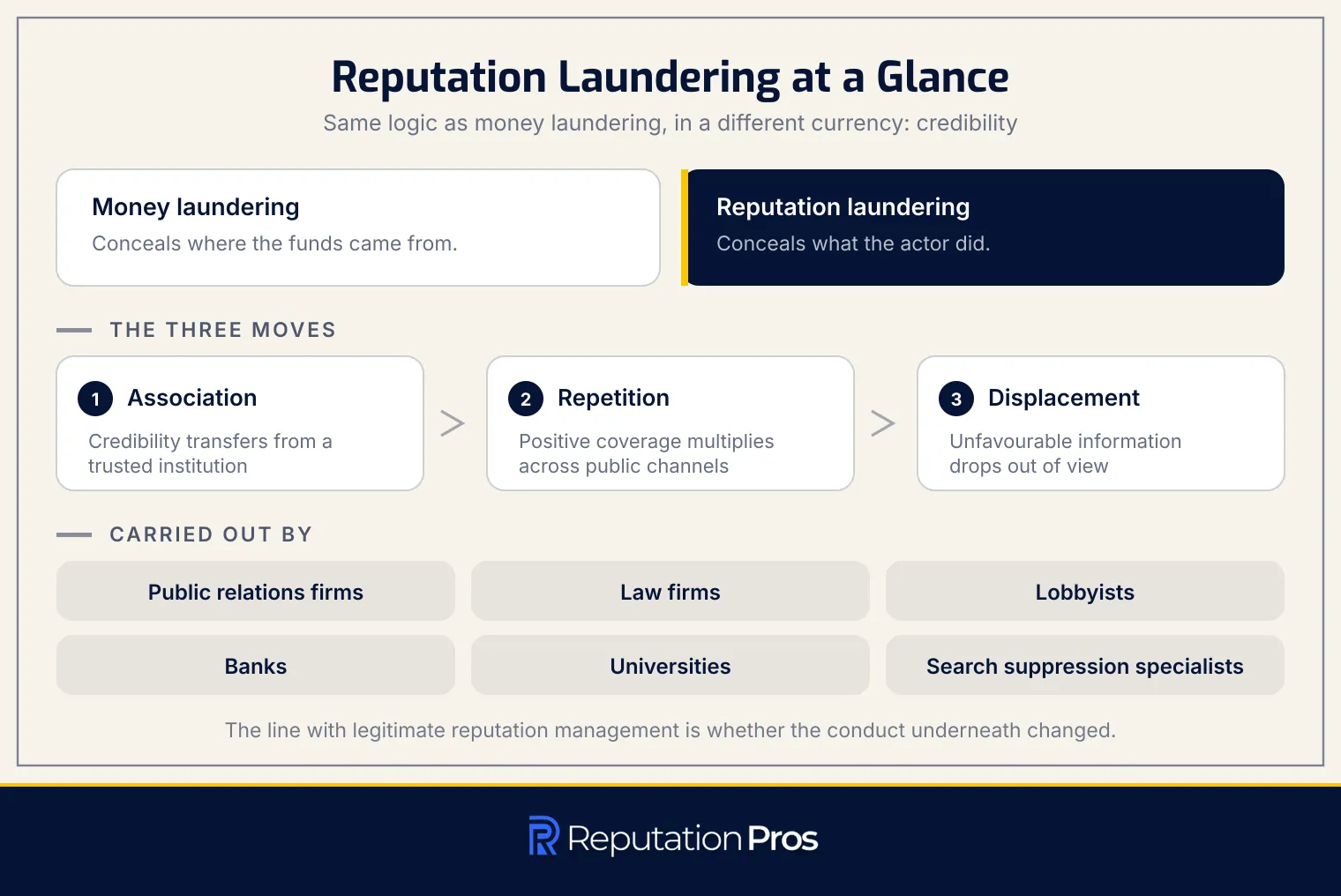
Reputation laundering is the process by which individuals or organisations use positive actions and prestigious associations to obscure unethical, corrupt, or criminal behaviour, improving public image without addressing the conduct behind it. Reputation laundering draws its name from money laundering, applying the same logic to perception instead of financial assets. Whitewashing, virtue cleansing, and image rehabilitation name the same intent: cleansing a damaged reputation through strategic intervention.
Reputation laundering becomes deceptive when it functions as a facade without reform, and the boundary between rehabilitation and deception lies in whether the actor changed or only arranged a polished image over continuing misconduct. The mechanism transfers credibility from trusted institutions through association, multiplies positive coverage, and displaces unfavourable information, with public relations firms, law firms, lobbyists, banks, universities, and search suppression specialists doing the work.
Reputation laundering has roots in industrialist-era philanthropy and continues through philanthropy-based and political or state laundering, the latter widely called sportswashing. Philanthropy-based laundering buys legitimacy through donations to prestigious nonprofits, while political laundering uses events and cultural funding to rebrand a state internationally, and both damage information integrity, accountability, and institutional trust.
Is Reputation Laundering Deceptive?
Reputation laundering is deceptive when it uses surface improvements to mask harm that remains unresolved. The intent is a facade of respectability that leaves the underlying conduct untouched, so a donation or a PR campaign that obscures continuing harm deceives even if the money does real good. The test is whether a positive image results from real change or serves only to hide the record. Charitable side effects do not cancel the deception when concealment is the primary aim. Chatham House’s December 2021 research paper “The UK’s kleptocracy problem: How servicing post-Soviet elites weakens the rule of law,” by Alexander Cooley, John Heathershaw, Thomas Mayne, Casey Michel, Tena Prelec, Jason Sharman and Ricardo Soares de Oliveira, treats reputation laundering as a harm in its own right, carried out by British professional service providers who help elites launder their reputations alongside their money.
How Does Reputation Laundering Work?
Reputation laundering works through a structured sequence that starts with trusted intermediaries. Public relations firms, law firms, and nonprofit partners arrange donations, sponsorships, and advisory roles that create a formal link between the controversial actor and a respected institution.
Repetition across channels follows the association. Press releases announce philanthropic gifts, sponsored content runs in mainstream media, and op-eds appear in prestigious publications, flooding search results with favourable material that displaces negative coverage. Reputation laundering has grown into a professional service industry, with specialist firms charging substantial fees for campaigns that combine search engine optimisation with narrative construction.
Displacement completes the sequence, pushing adverse reporting down the rankings until few people see it. What results is the credibility transfer: legitimacy borrowed from respected institutions reframes public perception without any genuine reform.
What Is the Reputational Transfer Process?
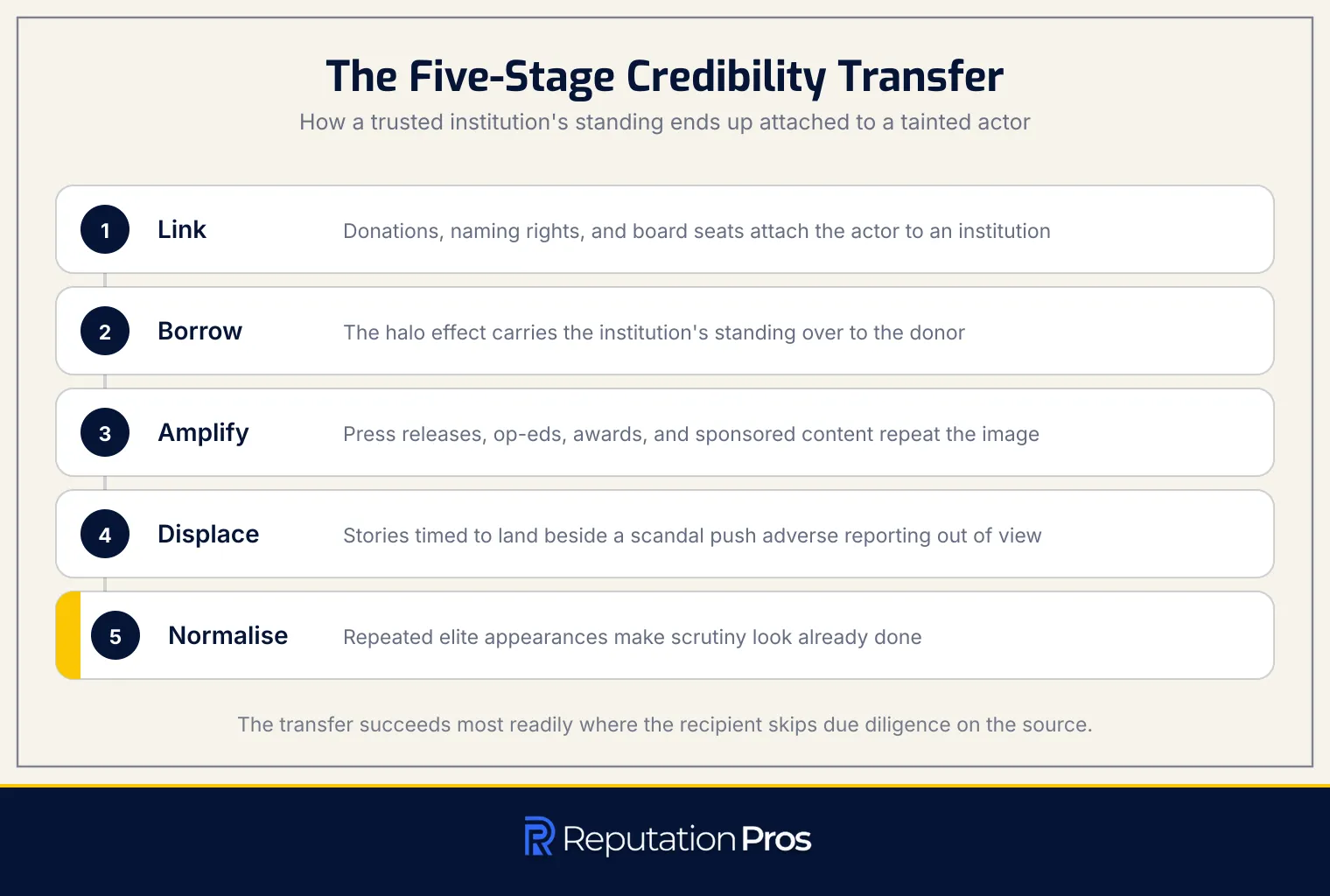
The reputational transfer process moves credibility from a trusted institution to a controversial actor through association. Credibility behaves as a transferable asset here, borrowed by linking the actor with universities, think tanks, or cultural bodies. Association is the vehicle because third-party endorsement persuades where self-promotion does not, and a trusted institution’s apparent endorsement reads as independent validation of the actor’s legitimacy.
Linking a Controversial Actor to a Trusted Institution
Linking a controversial actor to a trusted institution relies on attachment mechanisms. Large donations secure naming rights that embed the donor’s identity in buildings and programmes. Board seats and honorary affiliations give the actor official standing inside the institution. Universities, museums, think tanks, hospitals, and sports clubs are the usual targets, because their credibility and visibility make them effective vehicles for transfer.
Borrowing Credibility From a Positive Association
Borrowing credibility from a positive association uses the prestige of a respected entity to lift a controversial actor’s image. The halo effect does the work, carrying the institution’s standing over to the donor or partner. The recipient’s prestige is the asset being purchased, through donations, sponsorships, or board roles, and the transfer succeeds most readily where the recipient skips due diligence on the source, which lets the actor rent legitimacy without scrutiny.
Amplifying Positive Associations Across Public Channels
Amplifying positive associations across public channels runs as a coordinated media campaign. Press releases announce partnerships and gifts for wide pickup in reputable outlets, and paid placements and sponsored content reinforce the image in editorial-style articles. Op-eds position the actor as a thought leader, conference platforms supply speaking slots that lend legitimacy, and award schemes, sometimes arranged or influenced by the actor, manufacture the appearance of peer recognition. Coordinated social posts, influencer collaborations, and algorithmic optimisation saturate feeds with favourable narratives, and the cumulative effect pushes negative reporting out of view.
Displacing Attention From Harmful Conduct
Displacing attention from harmful conduct floods the information space with positive narratives until negative information is hard to find. Campaigns are timed to land alongside scandals and investigations, so favourable stories dilute the damaging coverage at the moment it matters most. Saturating public channels with press releases and sponsored articles crowds out adverse reporting, which reduces the visibility of past misconduct and makes damaging information harder for journalists and the public to reach.
Reducing Scrutiny Through Reputational Normalization
Reducing scrutiny through reputational normalisation makes a controversial actor appear mainstream through repeated association with respected institutions and platforms. Consistent appearances in elite venues, cultural organisations, and media outlets shift how the actor is read. Once the actor is seen repeatedly in respectable settings, journalists and regulators tend to assume someone else has already vetted them and move their attention elsewhere, and paid professionals build and protect those associations deliberately.
How Do Trusted Intermediaries Enable Reputation Laundering?
Trusted intermediaries enable reputation laundering by converting a client’s money and connections into credibility. The intermediaries involved are listed below:
- Public relations firms: construct narratives and place media, earning substantial fees for polishing images and diverting attention from negative material.
- Law firms: mount legal defences and file strategic lawsuits that suppress unfavourable coverage, sustained by client confidentiality and repeat business.
- Lobbyists: connect clients to policymakers and institutions, translating private influence into public legitimacy on lucrative retainers.
- Banks and wealth managers: steer clients toward prestige donations and affiliations, motivated by asset management fees and retention.
- Universities: dependent on funding, accept donations tied to naming rights and academic affiliations without thorough due diligence.
- The art market: galleries and museums accept contributions from controversial donors that confer social legitimacy, under financial pressure.
- Event organisers: supply speaking engagements and awards that confer standing, in exchange for sponsorship revenue.
How Do Public Relations Campaigns Enable Reputation Laundering?
Public relations campaigns enable reputation laundering by reshaping perception while obscuring the conduct underneath. The tactics are listed below:
- Narrative construction: storylines reframe a tainted actor’s image, emphasising positives and omitting harm.
- Media relationship building and co-branded content: established ties with journalists secure favourable coverage, and sponsored content appears as legitimate journalism.
- Interview and profile placement: features in prestigious publications create an aura of mainstream acceptance.
- Astroturfed grassroots support: fake accounts and coordinated online campaigns simulate organic public backing.
- Greenwashing messaging: environmental and social responsibility campaigns present an ethical veneer over continuing harmful practice.
How Does Search Engine Suppression Enable Reputation Laundering?
Search engine suppression enables reputation laundering by controlling what the public finds when it searches. The methods are listed below:
- Positive content saturation: favourable articles, press releases, and sponsored content push negative coverage past the first pages, where few users look.
- Legal takedown and de-indexing requests: copyright claims, privacy law, and terms-of-service complaints remove unfavourable content from search indexes.
- Right-to-be-forgotten removals: data protection rules in the European Union allow individuals to request the delisting of search results carrying personal information under defined conditions.
- Editing pressure on Wikipedia and knowledge sources: persistent revisions and administrative complaints remove references to controversies or challenge the sources that document them.
Right-to-be-forgotten delisting stems from the Court of Justice of the European Union’s May 2014 ruling that individuals may ask search engines to delist certain results about them, and Google has published a running count of those requests in its Transparency Report ever since. Delisting has a hard limit, which Google sets out in “Remove my private info from Google Search”: removal takes material out of Google’s results without deleting it from the site hosting it. The weighing of privacy against the public’s interest in information about public figures is the tension reputation launderers exploit.
What Are the Types of Reputation Laundering?
The types of reputation laundering are listed below.
Philanthropy-based laundering. Large donations to universities, museums, and cultural organisations earn naming rights and public acknowledgement, transferring the institution’s credibility to the donor and obscuring where the wealth came from.
Sportswashing. Owning teams, sponsoring major events, and hosting international competitions attach an actor or a state to the goodwill sport generates, distracting from negative coverage.
Greenwashing. Selective sustainability claims create a false impression of environmental responsibility while harmful practices continue.
Astroturfing. Fake accounts, paid endorsements, and coordinated testimonials simulate grassroots support that does not exist.
Political and state laundering. National image campaigns, think tank funding, and cultural sponsorship soften scrutiny of corruption and human rights abuses.
Media collaboration. Paid placements, sponsored stories, and exclusive interviews shape favourable narratives that overshadow adverse reporting.
Legal strong-arming. Strategic lawsuits against public participation, defamation threats, and jurisdiction shopping silence critics and deter investigation.
Rebranding and renaming. New names, logos, and corporate structures distance an actor from past misconduct while the behaviour continues, fragmenting both public memory and search results.
What Is Philanthropy-Based Reputation Laundering?
Philanthropy-based reputation laundering is the use of donations to prestigious institutions to repair the public image of a tainted individual or organisation. Contributions flow to elite universities, museums, and think tanks, usually attached to naming rights or a foundation bearing the donor’s name. Critics describe such wealth as twice-stolen, taken first through unethical means and then converted into respectability, which leaves recipient institutions deciding whether to return it, a decision that rests on their own nonprofit reputation.
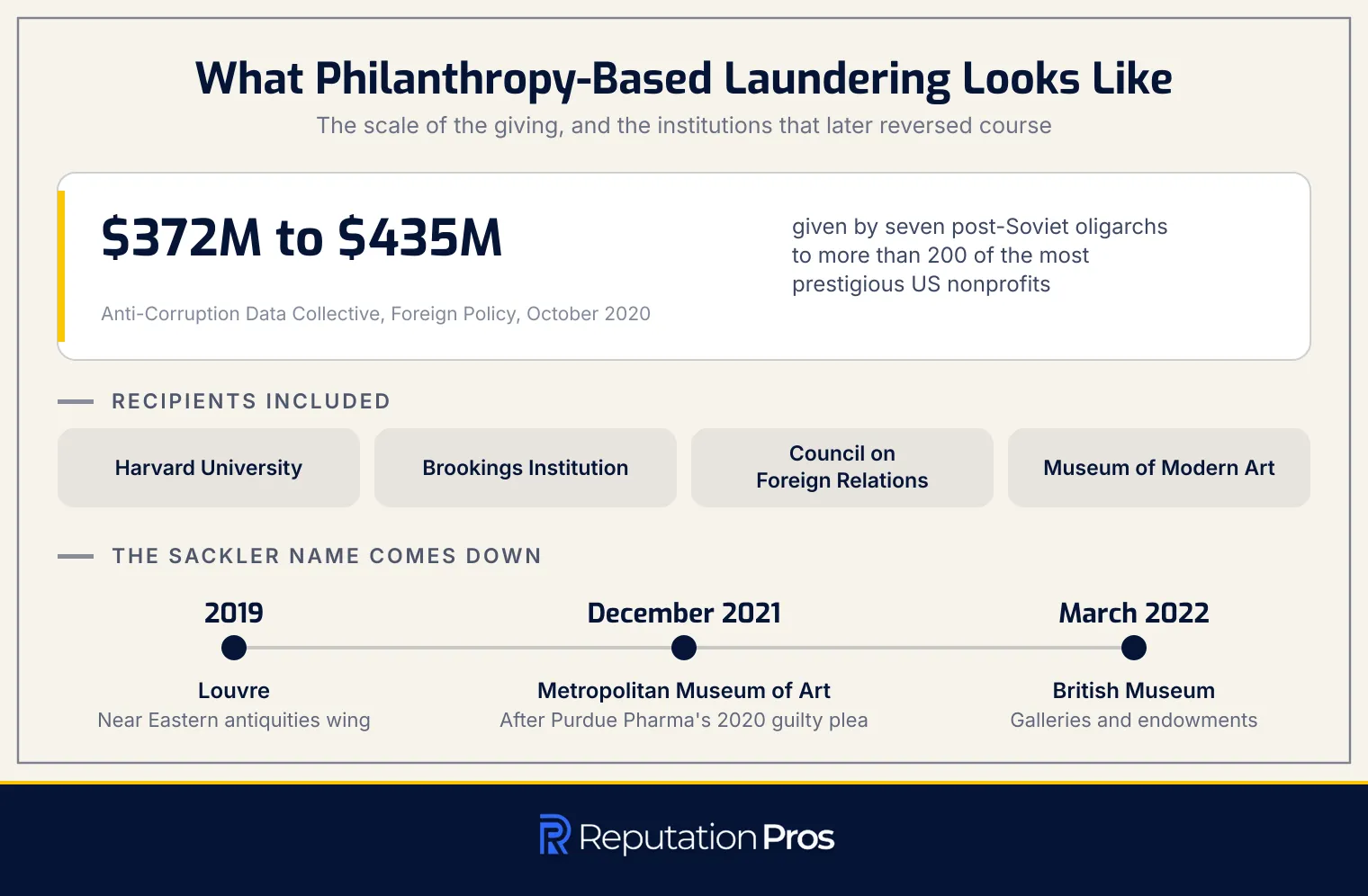
The scale is substantial. The Anti-Corruption Data Collective, publishing in Foreign Policy in October 2020, found that seven post-Soviet oligarchs had given between $372 million and $435 million to more than 200 of the most prestigious nonprofits in the United States, including Harvard University, the Brookings Institution, the Council on Foreign Relations, and the Museum of Modern Art. Recipient institutions have started reversing course under public pressure: the Louvre removed the Sackler name from its wing of Near Eastern antiquities in 2019, the Metropolitan Museum of Art followed in December 2021 after Purdue Pharma’s 2020 guilty plea over its marketing of OxyContin, and the British Museum announced the removal of the name from its galleries and endowments in March 2022.
What Is Political and State Reputation Laundering?
Political and state reputation laundering is a national effort to improve a country’s global image while masking human rights abuses or corruption. States host mega-events, acquire sports franchises, and fund cultural institutions abroad, and the term sportswashing covers the sporting end of that activity. Qatar’s hosting of the 2022 FIFA World Cup and the Saudi Public Investment Fund’s acquisition of Newcastle United are the most widely cited examples. States lobby and fund think tanks as well to influence opinion inside democracies, with public relations firms and cultural platforms supplying the legitimacy; Chatham House’s 2021 kleptocracy report devotes a full chapter to reputation laundering and political influencing through the UK’s professional services sector.
Why Does Reputation Laundering Matter?
Reputation laundering matters because it corrupts the public’s access to accurate information. Converting illicit assets and influence into apparent legitimacy obscures who the parties really are, and lets individuals and organisations evade sanctions and accountability by embedding themselves in institutions that fail to scrutinise them. The effect reaches policy debate and erodes trust in universities, charities, and the media, strengthening transnational kleptocracy in the process.
The consequences run past individual cases into governance itself. When universities and museums accept donations without rigorous vetting, they surrender independence and credibility together. The Anti-Corruption Data Collective’s donation database, begun in 2020, documents gifts from post-Soviet oligarchs to US universities, think tanks, and cultural institutions that arrived with little transparency about their origins, a pattern the group links to buying access to decision-makers and pushing back against scrutiny. Chatham House reached the same conclusion about the UK, finding that servicing post-Soviet elites has undermined the integrity of domestic institutions and weakened the rule of law. Countering reputation laundering depends on transparency and accountability enforced collectively across democracies.
Who Practices Reputation Laundering?
The main practitioners of reputation laundering are listed below:
- Kleptocrats and politically exposed persons: use donations and affiliations with reputable institutions to distance themselves from corruption at home and present as respectable global actors.
- Sanctioned oligarchs: launder reputations to blunt the effect of international sanctions, frequently through large institutional gifts.
- Authoritarian states: improve international standing through public relations firms, mega-events, and cultural funding abroad.
- Disgraced corporations: shift attention toward positive narratives and away from ethical failures or criminal conduct.
- Individuals after a criminal or ethical scandal: seek rehabilitation through charitable giving and institutional association without reform.
- Service-side practitioners: public relations firms, legal advisers, lobbyists, and other intermediaries who build the narratives, manage media relationships, and broker political access.
Most of that activity lands in democracies and high-prestige venues, where institutional standing and media reach convert visibility into credibility.
Where Does Reputation Laundering Commonly Occur?
The venues where reputation laundering commonly occurs are listed below:
- Open democratic societies: rule-of-law protections and prestigious institutions carry the legitimacy launderers want to borrow.
- Financial and legal centres: London and New York host the law firms and public relations agencies that supply both the specialist skills and the regulatory opacity the work depends on.
- University and museum sectors: large donations from controversial figures buy naming rights and board seats that transfer institutional credibility.
- Sports leagues and mega-events: high-profile competitions and clubs let owners and host states normalise their image through positive exposure.
- Offshore jurisdictions and citizenship-by-investment programmes: legal structures obscure the origin of wealth, and passports add mobility and respectability.
How Can Reputation Laundering Be Identified?
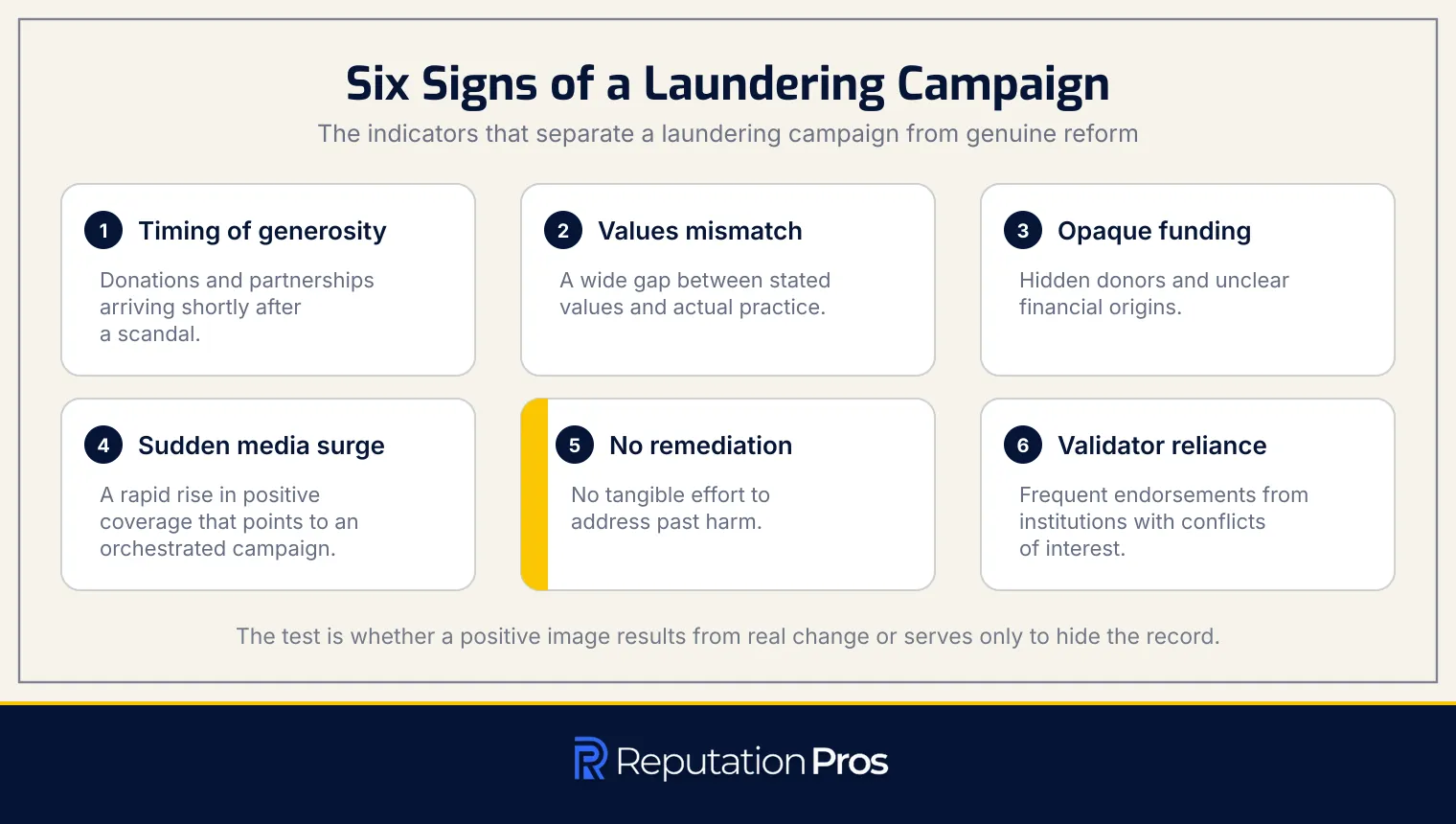
The indicators that identify reputation laundering are listed below:
- Timing of generosity relative to a scandal: donations and partnerships arriving shortly after a scandal suggest diversion.
- Mismatch between publicised values and operating record: a wide gap between stated values and actual practice.
- Opacity of the funding source: hidden donors and unclear financial origins.
- A sudden surge in media profile: a rapid rise in positive coverage that points to an orchestrated campaign.
- Absence of remediation to victims: no tangible effort to address past harm.
- Heavy reliance on third-party validators: frequent endorsements from institutions with potential conflicts of interest.
Who Is Affected by Reputation Laundering?
The groups affected by reputation laundering are listed below:
- Publics in the actor’s home country: citizens bear the most direct harm when officials and kleptocrats legitimise wealth taken from them, which lets extraction continue with impunity.
- Journalists and researchers: those investigating face strategic lawsuits, legal threats, and intimidation designed to stop scrutiny, which narrows press freedom and public knowledge.
- Recipient institutions: universities, museums, think tanks, and cultural bodies lose trust when questionable gifts come to light, and staff, students, and donors feel the gap between stated values and accepted funding.
- Competitors held to honest standards: legitimate businesses, researchers, and philanthropists compete against actors who gained access and standing by bypassing normal vetting.
- Regulators and law enforcement: a laundered reputation creates a veneer of legitimacy that delays enforcement and makes wrongdoing harder to prioritise and prove.
The legal risk journalists carry is what drove the development of anti-SLAPP protection.
How Do Anti-SLAPP Laws and Regulators Push Back Against Reputation Laundering?
Anti-SLAPP laws push back against reputation laundering by ending strategic lawsuits early, before litigation cost silences the journalist or critic being sued. The European Union adopted Directive (EU) 2024/1069 in April 2024 to protect journalists and civil society from abusive proceedings, with a transposition deadline of 7 May 2026 that no member state fully met. In the United Kingdom, sections 194 and 195 of the Economic Crime and Corporate Transparency Act 2023 came into force on 18 June 2025, allowing courts to strike out a SLAPP at an early stage where it is less likely than not to succeed at trial. The protections dismiss abusive claims at an early stage, shift costs onto the claimant, and impose dissuasive penalties, which blunts libel tourism as well, where a claimant sues in whichever jurisdiction has the most favourable defamation law.
Regulators add sanctions and disclosure requirements that expose hidden ties and financial flows, making the origin of wealth harder to obscure. Protection still varies by jurisdiction, and cross-border legal threats continue to reach investigators where local statutes do not.
How Does the Online Reputation Management Industry Intersect With Reputation Laundering?
The online reputation management industry intersects with reputation laundering through shared techniques: content creation, search engine optimisation, and suppression of negative material. The same methods can present a client accurately or conceal unethical conduct. Client vetting and purpose separate the two: legitimate reputation management helps clients present accurate, current information, while reputation laundering hides continuing misconduct without addressing it. Suppression crosses into concealment once hiding negative material becomes the aim rather than giving a balanced picture.
What Is the Difference Between Online Reputation Management and Reputation Laundering?
The difference between online reputation management and reputation laundering lies in purpose and ethical standing, despite overlapping tools. The comparison is set out below.
| Aspect | Online Reputation Management | Reputation Laundering |
|---|---|---|
| Goal | Improve public perception by promoting accurate and positive information. | Cleanse or obscure a damaged reputation to hide misconduct. |
| Truthfulness of Content | Content is truthful, policy-compliant, or defensible. | Content may be misleading, selectively framed, or disconnected from reality. |
| Treatment of Conduct | Addresses issues openly with fixes and verified corrections. | Avoids or conceals harm without resolving underlying issues. |
| Typical Client | Legitimate businesses, public figures, and organizations. | Actors with reputational damage from corruption or scandal. |
| Methods Used | SEO, content strategy, accurate press outreach, and monitoring. | PR campaigns, prestige association, media saturation, and suppression of negative coverage. |
| Transparency | Transparent, with honest disclosure and source attribution. | Opaque, with paid influence or hidden sponsorships. |
| Legal and Ethical Standing | Generally legitimate, avoiding deception and manipulation. | Ethically suspect, potentially unlawful, designed to mislead or evade accountability. |
What Is Search Engine Reputation Management?
Search engine reputation management is the practice of influencing what search engines return about a person or organisation. Legitimate search engine reputation management puts forward truthful content that reflects real achievements and operational reality, so accurate information is visible and outdated or misleading content ranks lower. Its honest boundary holds while the work improves an accurate picture, and breaks the moment it suppresses valid criticism or conceals material facts about past conduct.
How Can Organizations Build Genuine Reputation Instead of Turning to Reputation Laundering?
Organisations build genuine reputation instead of turning to reputation laundering by fixing what went wrong and proving it openly. The steps are listed below:
- Remediate the original harm: compensate affected parties, correct misinformation, and stop the harmful practice.
- Provide transparent disclosure: publish funding sources, affiliations, donors, conflicts of interest, and any controversial ties.
- Implement verifiable operational change: adopt concrete policy and governance changes, train staff, update controls, and publish evidence that reform took place.