Most Effective Strategies for Building Nonprofit Reputation
 17 min read
 On this page
The most effective strategies for building nonprofit reputation are mission-aligned goals, transparent governance, evidenced impact, and accountable risk response. Nonprofit reputation is the credibility an organisation earns and its stakeholders perceive over time, held by donors, beneficiaries, staff, volunteers, boards, grantors, the media, and the search and review surfaces those groups check first.
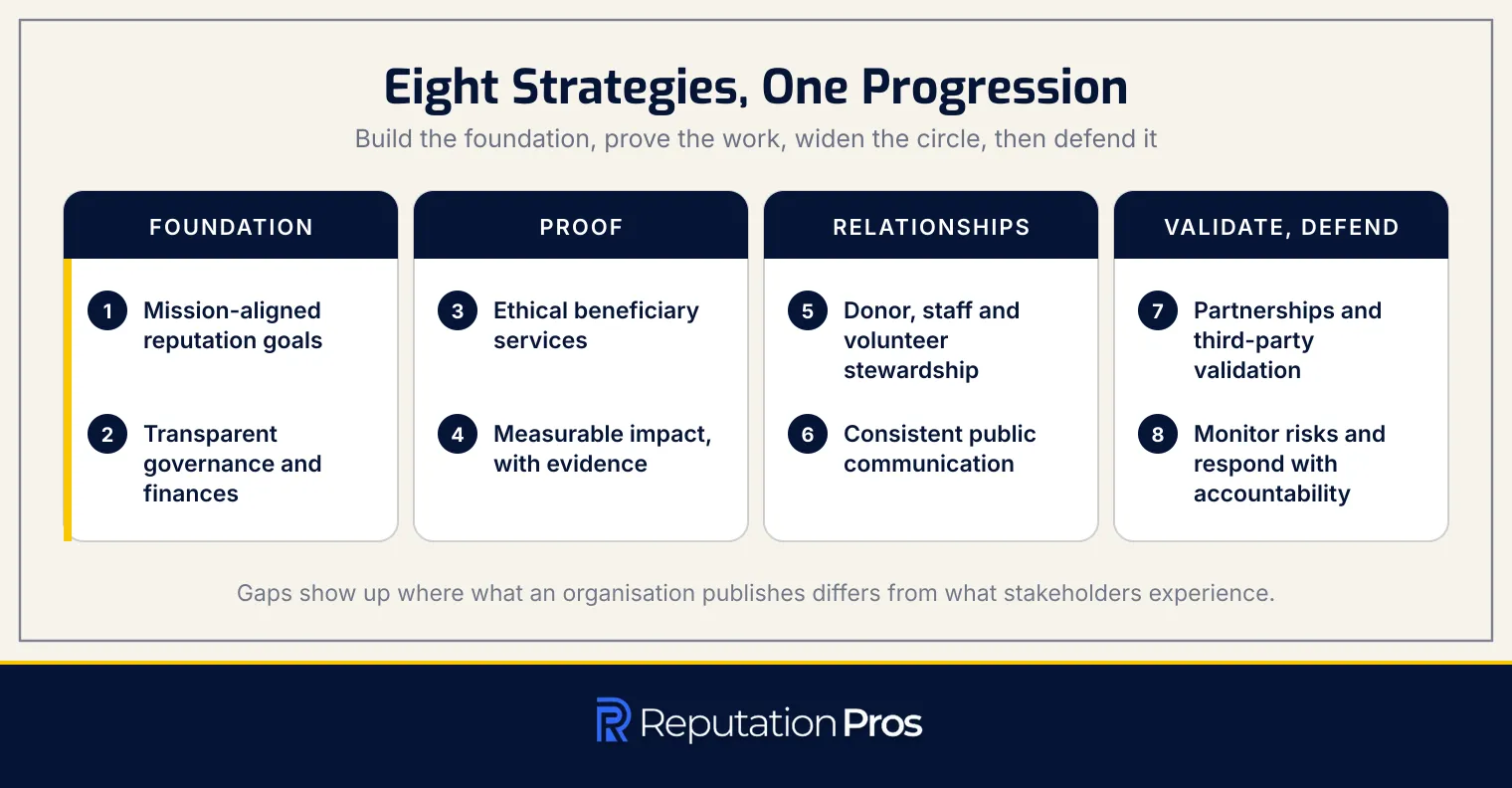
The eight strategies form one progression: set mission-aligned goals, open governance and finances, deliver ethical services, report measurable impact, steward donors and staff, communicate consistently, build third-party validation, and monitor and answer risk. An organisation finds its reputation gaps by comparing what it publishes against what stakeholders experience, then sequences the strategies for the most impact within its resources.
Search, social media, and reviews carry nonprofit reputation in public, and measurement systems track stakeholder trust rather than reach. That trust underwrites fundraising, governance, and sustainability, and it starts with reputation goals traced back to the mission.
1. Define mission-aligned reputation goals
To define mission-aligned reputation goals, identify whose trust the organisation needs and for what purpose. Donors need assurance of financial stewardship; beneficiaries need confidence in service quality. The mission statement and organisational values translate into concrete reputation objectives, such as recognition for transparency in youth education or for cost-effective mental health interventions.
Each objective links to a measurable outcome, such as donor retention rate or beneficiary satisfaction score, so progress stays trackable. Consistency over time outweighs visibility, because repeated alignment between mission, values, and experience is what builds durable credibility, and stakeholder personas keep investment focused on depth of trust rather than breadth of awareness.
Defined goals create the frame for the accountability structures that make them credible, with systems that monitor and report progress against the stated objectives.
2. Build transparent governance and financial accountability
To build transparent governance and financial accountability, make governance and financial records open so stakeholders can verify integrity for themselves. The components are published financial statements, a clear program-versus-administrative expense ratio, disclosed executive compensation, conflict-of-interest and whistleblower policies, board oversight, and independent audits.
Published financials and expense ratios. Financial statements set out revenue sources, program expenses, and administrative costs. The program-versus-administrative expense ratio is a metric donors and rating platforms use to judge how much funding reaches mission work rather than overhead, and explaining it plainly builds trust.
Executive compensation and policies. Disclosing executive compensation removes speculation. Formal conflict-of-interest and whistleblower policies show that safeguards against internal misconduct exist, and give people a protected channel to report it.
Board oversight and independent audits. An independent board sets governance policy, reviews financial performance, and holds leadership to account. Annual independent audits by certified public accountants verify that the financial statements represent the organisation’s actual position. IRS Form 990 brings governance structure, program activity, and financials together in one public filing, which makes it a primary credibility signal for donors and grantmakers. The IRS requires exempt organisations to make their annual information return available for public inspection for three years from its due date, and returns received since 2017 can be viewed by anyone through the IRS Tax Exempt Organization Search.
3. Deliver ethical high-quality beneficiary services
Ethical, high-quality beneficiary services are the primary input to nonprofit reputation, shaping stakeholder perception more than any communication that follows. Ethical delivery starts with safeguarding and staff conduct standards that protect beneficiaries’ physical and emotional safety, documented, trained, and enforced without exception.
Published program descriptions have to match what beneficiaries receive, because a gap between promise and delivery erodes credibility fast. Regular internal audits compare external claims with delivered services, letting program staff catch inconsistencies before stakeholders do. Beneficiary dignity and consent govern storytelling: informed consent, protected privacy, and respect for beneficiaries’ agency. Service quality then supplies the evidence base for reporting measurable impact.
4. Report measurable impact with evidence
To report measurable impact with evidence, separate outcome metrics from activity metrics so stakeholders can verify what programs achieve. Outcome metrics measure change in beneficiaries’ lives; activity metrics count outputs such as workshops held or meals served. Stakeholders expect beneficiary numbers paired with cost per outcome, which gives donors and grantors a transparent efficiency comparison.
Outcome metrics versus activity metrics. Outcome metrics capture tangible change, such as improved health or education levels, and demonstrate real impact. Activity metrics quantify volume without proving effectiveness.
Beneficiary numbers and cost per outcome. Clear figures on people served and cost per outcome show donors how contributions become results.
Third-party evaluation. Independent evaluation validates self-reported outcomes and confirms the methodology is sound.
Success stories and data integration. Stories anchored in the underlying data illustrate impact on individual lives without falling back on anecdote.
Annual impact report cadence. A predictable annual report lets stakeholders compare stated goals against results year on year.
5. Earn trust through donor, staff, and volunteer stewardship
To earn trust through stewardship, acknowledge gifts promptly, report how funds were used, and make the volunteer experience a good one. Donor retention works as a trust metric, signalling a relationship that is credible and respectful. Staff and volunteers carry reputation through everyday interactions, which makes a supportive internal culture part of reputation work, and staff embody the organisation’s values in their daily roles.
Regular feedback from every stakeholder group surfaces problems before they go public. Testimonials and user-generated content from people who experience the work directly carry weight that the organisation’s own claims cannot, and acting on feedback shows stakeholders their voices count.
6. Communicate consistently across public channels
To communicate consistently across public channels, hold messaging, voice, and tone identical everywhere the organisation appears. Unified key messages run across the website, email, social media, and press, so a donor meeting the organisation on any one channel hears the same account of what it does and why.
Program pages stay accurate and current, because an outdated page contradicts the organisation’s own claims at the moment a prospective donor is checking them. A written style guide fixes voice and terminology across staff and channels, and a regular newsletter sets a predictable publishing cadence that keeps supporters informed between appeals. Third-party profiles, on rating platforms and directories, get the same information as owned channels, and owned properties are maintained so they appear in search when someone looks the organisation up.
7. Build credible community partnerships, third-party validation, and advocacy
To build credible partnerships, third-party validation, and advocacy, source credibility from voices outside the organisation. Partner and corporate sponsor endorsements signal shared values and extend reach. Coalition membership shows peer organisations are willing to associate their reputations with the nonprofit’s. Ratings and accreditation seals from established evaluators independently verify financial health, transparency, and impact, giving donors and grantors a shortcut to trust.
Earned media carries validation paid advertising cannot buy, positioning the organisation as credible and newsworthy. Ambassadors and influencers extend the organisation’s voice to audiences who already trust them. Taking a public stance on a mission-related issue builds advocacy leadership, and it requires a deliberate judgment: the position must be mission-aligned, the risk of alienating funders or partners must be weighed, and the organisation must be ready to defend it over time. Collaboration with other nonprofits on joint events and shared content extends reach further, and together these relationships turn isolated organisational claims into a network of corroborating voices.
8. Monitor reputation risks and respond with accountability
To monitor reputation risks and respond with accountability, identify the risks in advance and watch for them continuously. Fraud, staff misconduct, on-site accidents, funder controversies, and leadership departures are the common ones, and each damages trust if left unanswered. Google Alerts and social listening platforms surface emerging issues while they are still small.
Set response-time expectations for negative reviews and comments so replies arrive promptly and with empathy. A named spokesperson and a defined escalation path anchor the crisis communication plan, which states how the organisation acknowledges mistakes and announces corrective action.
Google Reviews, Charity Navigator, and GuideStar function as public reputation surfaces where unresolved criticism shapes donor perception. Continuous monitoring with timely response turns a potential crisis into evidence of integrity and operational maturity.
What is nonprofit reputation?
Nonprofit reputation is the credibility an organisation earns over time as its stakeholders perceive it. Nonprofit reputation builds through consistent alignment between what the organisation communicates and what stakeholders experience. Brand equity attaches to identity and symbols; reputation rests on trust accumulated through behaviour, transparent governance, measurable impact, and ethical service. The gap between claims and experience decides whether reputation strengthens or erodes, and public perception forms from the whole of donor interactions, beneficiary outcomes, staff conduct, financial transparency, and accountability when problems arise.
Why does nonprofit reputation matter to donors?
Nonprofit reputation matters to donors because giving is a trust-based decision. Prospective donors research before giving, checking rating platforms such as Charity Navigator and Candid alongside annual reports and Form 990 filings to confirm their money will be used effectively. Grantmakers go further, requiring documented outcomes, financial transparency, and compliance with governance standards before they fund.
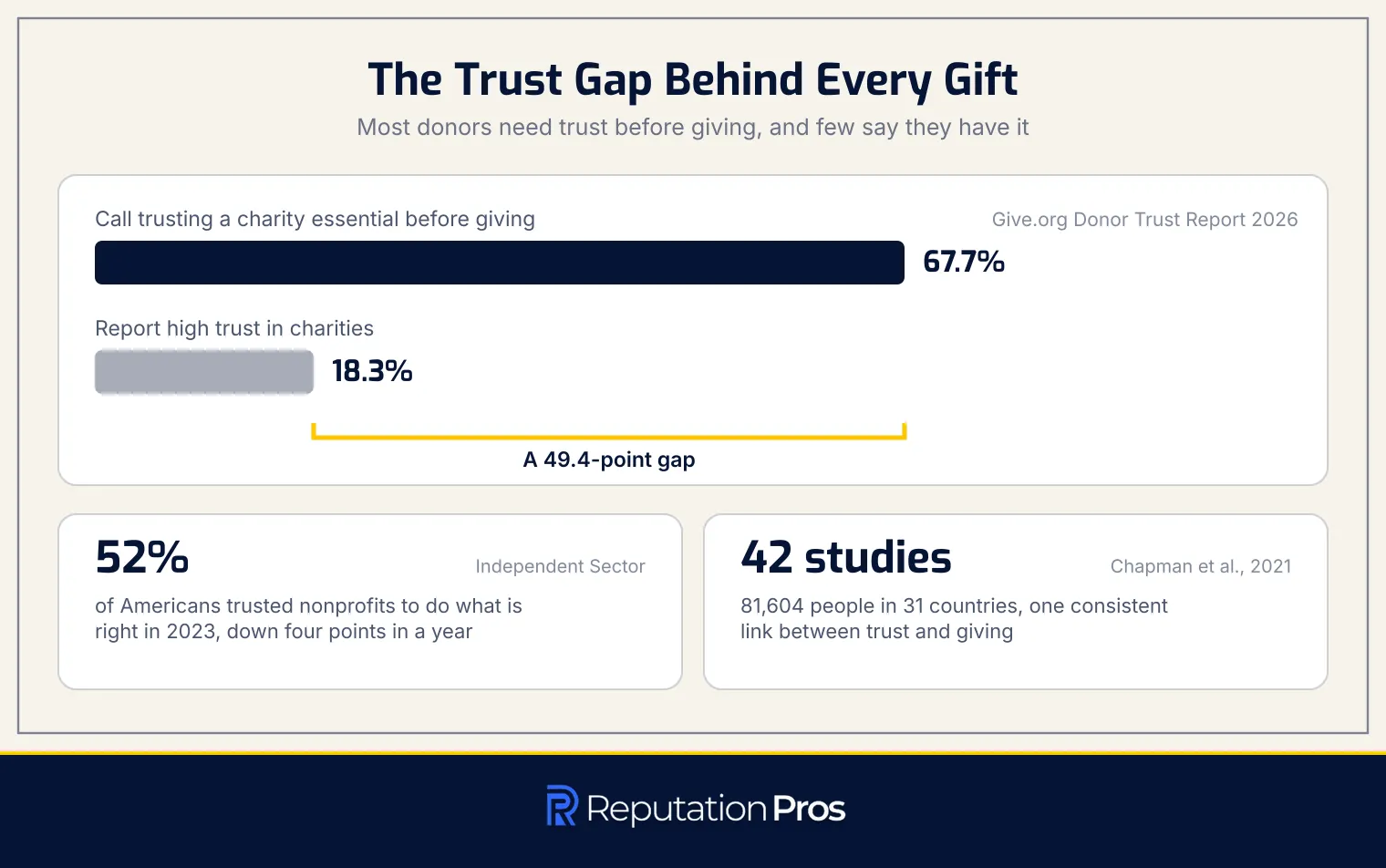
Trust shapes the gift itself. A 2021 meta-analysis in Nonprofit and Voluntary Sector Quarterly by Cassandra Chapman, Matthew Hornsey and Nicole Gillespie, “To What Extent Is Trust a Prerequisite for Charitable Giving?”, pooled 69 effect sizes from 42 studies covering 81,604 people in 31 countries and found a consistent positive link between trust and giving, strongest for trust in the specific organisation. Independent Sector’s Trust in Civil Society report for 2023 found that only 52% of Americans trusted nonprofits to do what is right, down four points in a year, and BBB Wise Giving Alliance’s Give.org Donor Trust Report 2026 found that 67.7% of US adults call trusting a charity essential before giving while only 18.3% report high trust in charities. That gap raises the stakes of donor scrutiny, and a single negative incident can persist in search results and reviews long enough to overshadow years of good work.
Who shapes nonprofit reputation?
The stakeholders and platforms that shape nonprofit reputation are listed below:
- Donors: giving decisions, repeat contributions, and recommendations, shaped by financial transparency and proven impact.
- Beneficiaries: direct experience of service quality, safety, and whether promises were kept, which feeds community perception.
- Staff: daily interactions, workplace culture, and professionalism, with consistency toward the public and service users.
- Volunteers: the quality of their service, the stories they tell, and their willingness to return or recruit others.
- Boards: governance standards, policy approvals, and visible accountability.
- Grantors: due diligence, funding decisions, and reporting standards.
- Media: coverage that magnifies success or exposes conflict to audiences with no direct contact with the organisation.
- Regulators: compliance expectations, public filings, and enforcement that affect credibility.
- Search and social algorithms: the systems deciding what stakeholders see first, which makes results, reviews, and posts the default public impression.
Frontline interactions and the tone of an email shape reputation as much as formal communications, because stakeholders judge behaviour alongside statements.
How should nonprofits assess reputation gaps?
Nonprofits should assess reputation gaps by auditing publicly visible signals against the mission and against stakeholder experience. The audit areas are listed below:
- Search results: how the organisation appears in search, including misleading or outdated information.
- Review profiles: consistency and accuracy on charity rating sites and review platforms.
- Program pages: whether program descriptions match across the website, social media, and printed materials.
- Social media replies: comments and engagement that reveal stakeholder sentiment.
- Stakeholder experience: what the organisation claims compared with what stakeholders report actually receiving.
- Baseline sentiment: surveys and feedback tools that set a starting measure for later comparison.
The audit exposes concrete gaps, such as inconsistent messaging or outdated claims, which set the priority order for the strategies, following the same method as any reputation audit.
How should nonprofits prioritize reputation strategies?
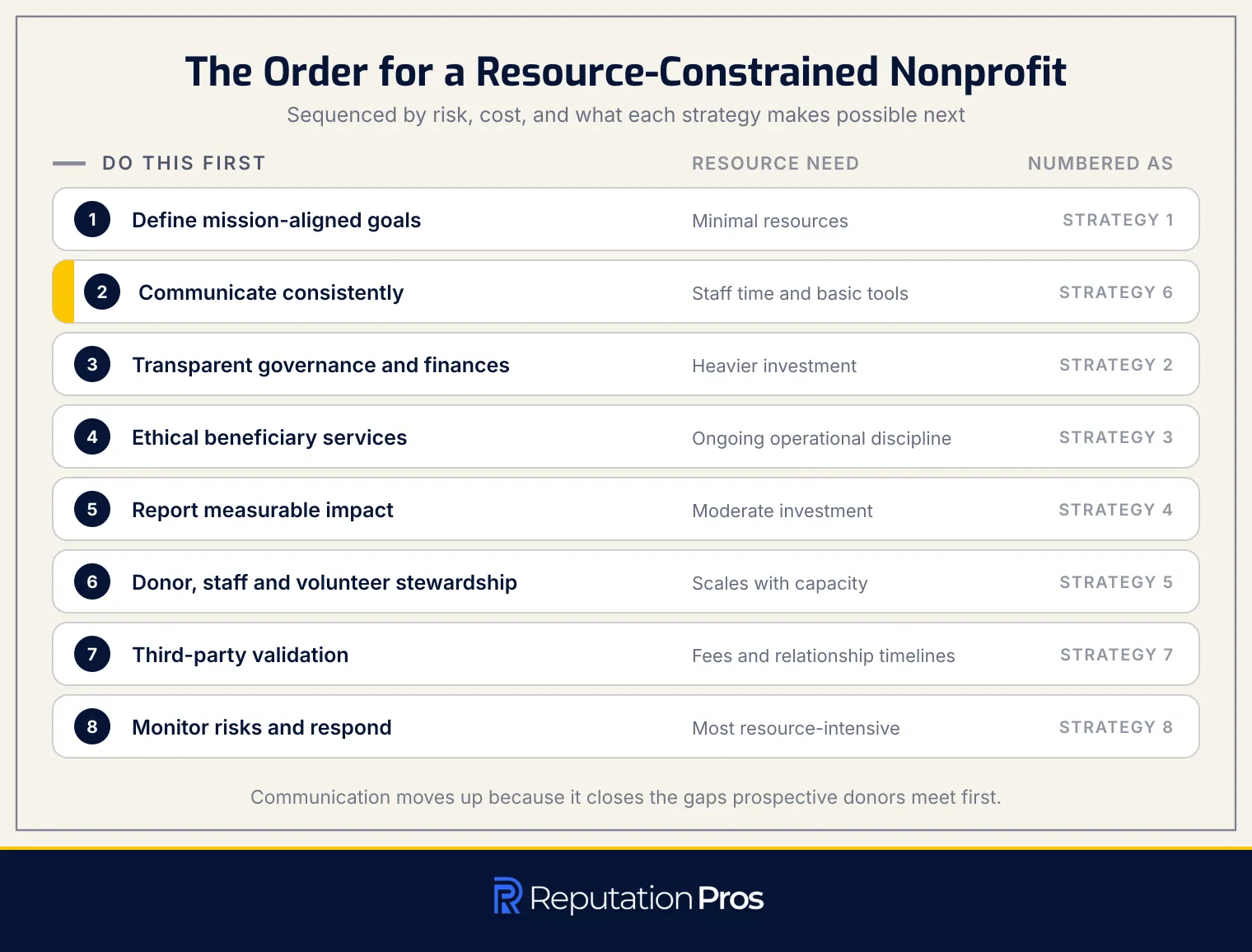
Nonprofits should prioritise reputation strategies by risk exposure, resource requirement, and the order in which each strategy makes the next possible. The recommended sequence for a resource-constrained organisation is listed below:
- Define mission-aligned reputation goals: minimal resources, and the foundation that clarifies whose trust matters and why.
- Communicate consistently across public channels: staff time and basic tools, closing the visibility gaps prospective donors meet first, and able to run alongside larger governance work.
- Build transparent governance and financial accountability: heavier investment in audits, board documentation, and disclosure policy, central to donor trust.
- Deliver ethical high-quality beneficiary services: an ongoing operational discipline feeding every other signal, requiring training, conduct standards, and monitoring.
- Report measurable impact with evidence: moderate investment in data infrastructure and evaluation, decisive with institutional funders.
- Earn trust through donor, staff, and volunteer stewardship: relationship work that scales with capacity through acknowledgment systems and feedback loops.
- Build third-party validation and partnerships: draws on credibility the earlier strategies built, with fees and relationship timelines attached.
- Monitor reputation risks and respond with accountability: the most resource-intensive, requiring tools, crisis protocols, spokesperson training, and rapid response, built up as budget allows.
How do search, social media, and online reviews affect nonprofit reputation?
Search, social media, and online reviews affect nonprofit reputation by forming the first impression a prospective donor meets. Search results aggregate ratings, news coverage, and social commentary into an immediate read of credibility or concern. Charity Navigator, Candid, and Google reviews magnify stakeholder experience, with review volume, recency, and response rate all signalling attentiveness.
A single negative comment travels fast across social channels and can undercut years of trust-building. Nonprofits choose between free profile management with narrow control and paid tiers that add response tools and analytics. Donors carry out substantial due diligence online before giving, and because criticism weighs more heavily than praise, proactive monitoring pays for itself.
What is a nonprofit social media strategy?
A nonprofit social media strategy is a structured plan connecting organisational goals, audience personas, channels, and content to measurable engagement outcomes. A posting routine publishes; a strategy defines what the organisation wants from social platforms, who it is trying to reach, which channels reach them, and what content will land.
How can nonprofits create an effective social media strategy?
The steps to create an effective nonprofit social media strategy are listed below:
- Set clear goals: raising awareness, recruiting volunteers, or driving donations, each tied to the mission with a measurable outcome.
- Define the audience: personas for donors, beneficiaries, and volunteers covering interests, preferred platforms, and engagement behaviour.
- Research peer nonprofits: the formats and platforms producing engagement for comparable organisations.
- Choose strategic channels: one or two core platforms where the audience is active, prioritising engagement over presence everywhere.
- Build a content plan: a calendar mixing mission storytelling, updates, calls to action, behind-the-scenes content, and supporter appreciation.
- Select tools for execution: scheduling and analytics tools that support consistent posting and measurement.
- Engage the community actively: prompt replies to comments and messages, encouragement of user-generated content, and two-way conversation.
- Track metrics tied to goals: engagement rate, reach, and donation conversion, used to refine the plan.
What are the most common nonprofit social media strategy FAQs?
The most common nonprofit social media strategy questions are answered below:
- Best platforms: Facebook for broad reach and donor engagement, Instagram for visual storytelling and younger audiences, LinkedIn for corporate partnerships, and X for real-time advocacy and media outreach, weighted toward wherever the target audience is active.
- Which metrics to track: engagement rate, reach, click-through to donation or program pages, social-to-donation and volunteer conversion, and sentiment in comments and mentions.
- Follower growth: follower quality and engagement outweigh raw count, since a smaller engaged base of supporters delivers more than a large passive one, though steady growth signals widening awareness.
- Team size needed: one dedicated staff member or trained volunteer can run an effective presence for a small nonprofit with scheduling tools, while larger organisations run one or two full-time specialists coordinated with program and communications staff.
- Whether social media drives donations: social media builds awareness, trust, and community more than it drives gifts directly, acting as a stewardship channel in a giving path where most gifts follow several touchpoints across email, website, and social.
How does reputation support nonprofit sustainability?
Reputation supports nonprofit sustainability by turning one-time gifts into recurring giving and grants into renewals. Retention is where the sector is losing ground: the Fundraising Effectiveness Project, run with the Association of Fundraising Professionals, found that average donor retention fell to 42.9% in 2024, the fifth consecutive annual decline, while dollars raised rose 3.5% as the number of donors fell 4.5%, which leaves organisations more dependent on the donors who stay. Donors who trust an organisation commit to ongoing support, and a strong reputation eases staff and volunteer recruitment and retention because people prefer to align with credible, effective organisations. Partners collaborate more readily when reputation signals reliability and shared values, and accumulated stakeholder trust gives resilience when something goes wrong.
How does public trust support nonprofit fundraising and service delivery?
Public trust supports nonprofit fundraising and service delivery by standing in for a product that donors, grantors, volunteers, and partners cannot inspect directly. Stakeholders who trust a nonprofit give money, volunteer time, and accept its services, which converts trust directly into funded programs and delivered services. Research consistently finds that nonprofit reputation generates trusting beliefs and supportive behaviour, including donating and volunteering.
How can nonprofit management sustain stakeholder trust?
Nonprofit management sustains stakeholder trust by treating reputation as an operating discipline rather than a campaign. Named ownership inside management keeps trust-building consistent. Regular routines, including financial and program reporting, internal controls, and stakeholder feedback collection, surface issues early and keep credibility aligned with mission delivery. Embedding that maintenance in daily operations lets the organisation correct course early and keeps trust intact between major campaigns.
What nonprofit governance standards support public trust?
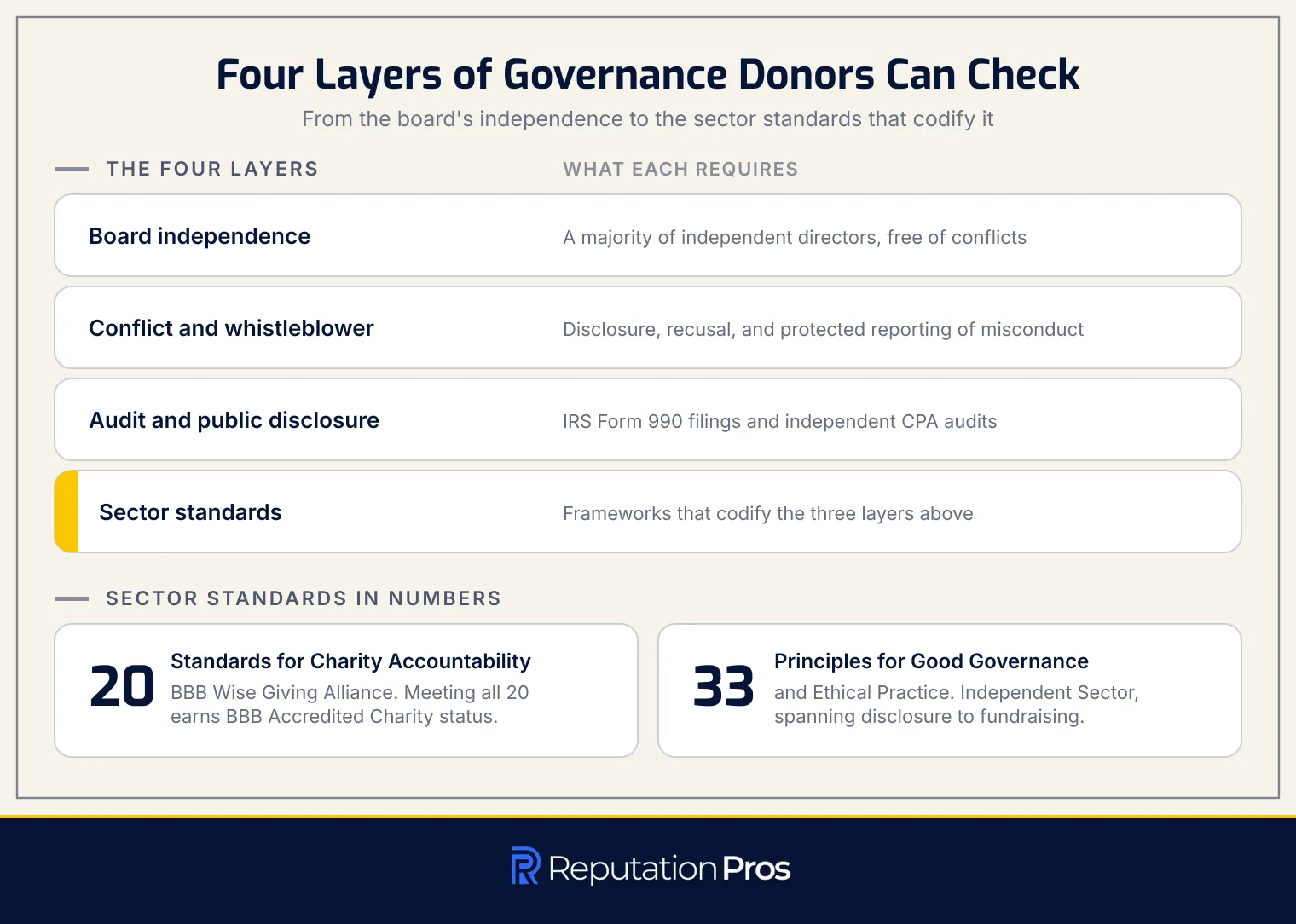
The nonprofit governance standards that support public trust are board independence, conflict-of-interest and whistleblower policies, audit and public disclosure requirements, and sector accountability and accreditation standards. Board independence keeps decisions free of conflicts of interest, with a majority of independent directors. Conflict-of-interest policies require disclosure and recusal, and whistleblower policies protect people reporting misconduct. Public disclosure through IRS Form 990 makes financial and governance practice transparent, and independent CPA audits verify the financial statements and internal controls. Sector standards codify the rest: the BBB Wise Giving Alliance’s 20 Standards for Charity Accountability cover governance, results reporting, finances, and truthful and transparent communications, with charities meeting all 20 earning BBB Accredited Charity status, and Independent Sector’s Principles for Good Governance and Ethical Practice set out 33 principles spanning legal compliance and public disclosure, governance, financial oversight, and responsible fundraising.
How can boards use sector standards for accountability?
Boards use sector standards for accountability by converting them into oversight routines. A formal self-assessment against an established framework comes first, followed by documented adoption of the required policies, such as conflict-of-interest and whistleblower protections. Boards then publish the results through annual reports and Form 990 filings, which turns compliance into something stakeholders can check.
What nonprofit measurement systems track stakeholder trust?
Nonprofit measurement systems track stakeholder trust by measuring credibility and confidence rather than audience size. The common systems are set out below.
| Measurement System | Stakeholder Group Measured | Trust Metric Produced | Cadence |
|---|---|---|---|
| Donor Trust Survey | Donors and prospective donors | Overall donor trust score; trust-to-give intent | Annual or quarterly |
| Beneficiary Feedback System | Beneficiaries and service users | Confidence in service quality; dignity/respect score | After service or periodic |
| Employee Trust Survey | Staff | Internal trust score; confidence in leadership; perceived integrity | Quarterly or semiannual |
| Volunteer Feedback Survey | Volunteers | Volunteer trust score; likelihood to continue; recommend score | After events or quarterly |
| Online Review Monitoring | Reviewers, donors, service users | Average rating; response rate; negative sentiment trend | Weekly or monthly |
| Third-party Trust Benchmark | Public and sector stakeholders | Benchmark trust percentile; trust gap versus peers | Annual |
Those systems measure the quality of relationships and perceived integrity, which is what reach metrics miss and what a reputation score sets out to capture.
How can trust data guide reputation improvements?
Trust data guides reputation improvements by showing which stakeholder signals fall below an acceptable threshold. Falling donor trust scores point to Strategy 5, stewardship, through better gift acknowledgment and clearer reporting on fund use. Beneficiary concerns about service quality point to Strategy 3, ethical service delivery, through staff training or program redesign. Each change carries a follow-up measurement date that checks whether the revision moved the metric, which keeps the strategies responsive to stakeholders and emerging risk.
How can nonprofit leaders use continuous improvement to strengthen nonprofit reputation?
Nonprofit leaders use continuous improvement to strengthen nonprofit reputation by reviewing strategy against trust data on a fixed cycle. A quarterly review assesses current strategies against stakeholder trust metrics and reputation goals, feeding in feedback from donors, beneficiaries, staff, volunteers, and partners. When the data shows a gap, such as falling donor retention or negative review sentiment, leaders identify which of the eight strategies needs adjusting and assign responsibility for the revision.
Executive leadership oversees the loop together with the board, which keeps reputation management part of governance and operations rather than a periodic campaign. Institutionalising the review-and-revise cycle keeps the full set of strategies, from mission-aligned goals and transparent governance to impact reporting and risk response, current, credible, and matched to the organisation’s capacity to deliver on its mission.