What Is the Difference Between Public and Private Figures Defamation?
 15 min read
 On this page
The difference between public and private figures defamation is the fault standard applied in legal claims. Public figures must prove actual malice, meaning the false statement was made knowingly or with reckless disregard for the truth. Private figures only need to demonstrate negligence, a lower burden of proof. Defamation is defined as a false statement of fact that harms a person’s reputation, and defamation law applies that definition differently depending on who the statement targets.
Defamation of a public figure and defamation of a private figure are distinguished by how defamation law defines the claim and its elements. Public figures, such as politicians and celebrities, must meet the actual malice standard, while private individuals need only show negligence. The higher burden for public figures reflects their greater access to communication channels to counter false statements.
Defamation damages personal and professional standing for public and private figures alike. Reputation management responds to the damage with content removal and public relations work that limits the harm. The reputation stakes weigh hardest on public figures, who must satisfy the strict actual malice requirement before a defamation claim succeeds. The comparison starts with the definition of defamation of a public figure.
What is a defamation of a public figure?
Defamation of a public figure is a false statement of fact that harms the reputation of someone who has gained broad public attention or notoriety. Public figures include politicians, celebrities, and other people who have achieved pervasive fame or entered public controversies. To succeed in a defamation claim, a public figure must demonstrate “actual malice,” which means proving that the false statement was made with knowledge of its falsity or reckless disregard for the truth.
The requirement for public figures to prove actual malice stems from the 1964 Supreme Court decision in New York Times Co. v. Sullivan, which established the higher burden of proof to protect free speech and public discourse. The actual malice rule later expanded to cover not only public officials but anyone who has achieved fame or notoriety. The rationale behind the strict requirement is that public figures hold greater access to communication channels to counter false statements and face closer public scrutiny.
The effect of defamation on a public figure’s reputation includes loss of public trust and economic harm. Reputation management for public figures relies on media platforms to correct misinformation and restore the public image.
What is a defamation of a private figure?
Defamation of a private figure is a false statement of fact about an individual who has not sought public attention, causing harm to that individual’s reputation. Private figures are ordinary individuals who have not entered public controversies or pursued media exposure. In defamation cases involving private figures, the burden of proof sits lower than for public figures. A private figure only needs to demonstrate that the statement was made negligently, meaning the person who made the statement failed to exercise reasonable care in verifying its truthfulness.
Private figures do not need to prove “actual malice,” the standard reserved for public figures. A statement that qualifies as defamatory per se, inherently harmful to reputation, lets a private figure proceed without demonstrating actual monetary damages. Defamation law grants private individuals greater protection because private individuals hold less access to communication channels for rebuttal and remain more exposed to reputational harm. The two definitions set the frame for the difference between public and private figures in defamation.
What is the difference between public and private figures in defamation?
The difference between public and private figures in defamation is the fault standard required to prove a claim. Public figures must demonstrate actual malice, meaning the false statement was made knowingly or with reckless disregard for the truth. Private figures only need to prove negligence, a failure to exercise reasonable care in verifying the statement’s accuracy.
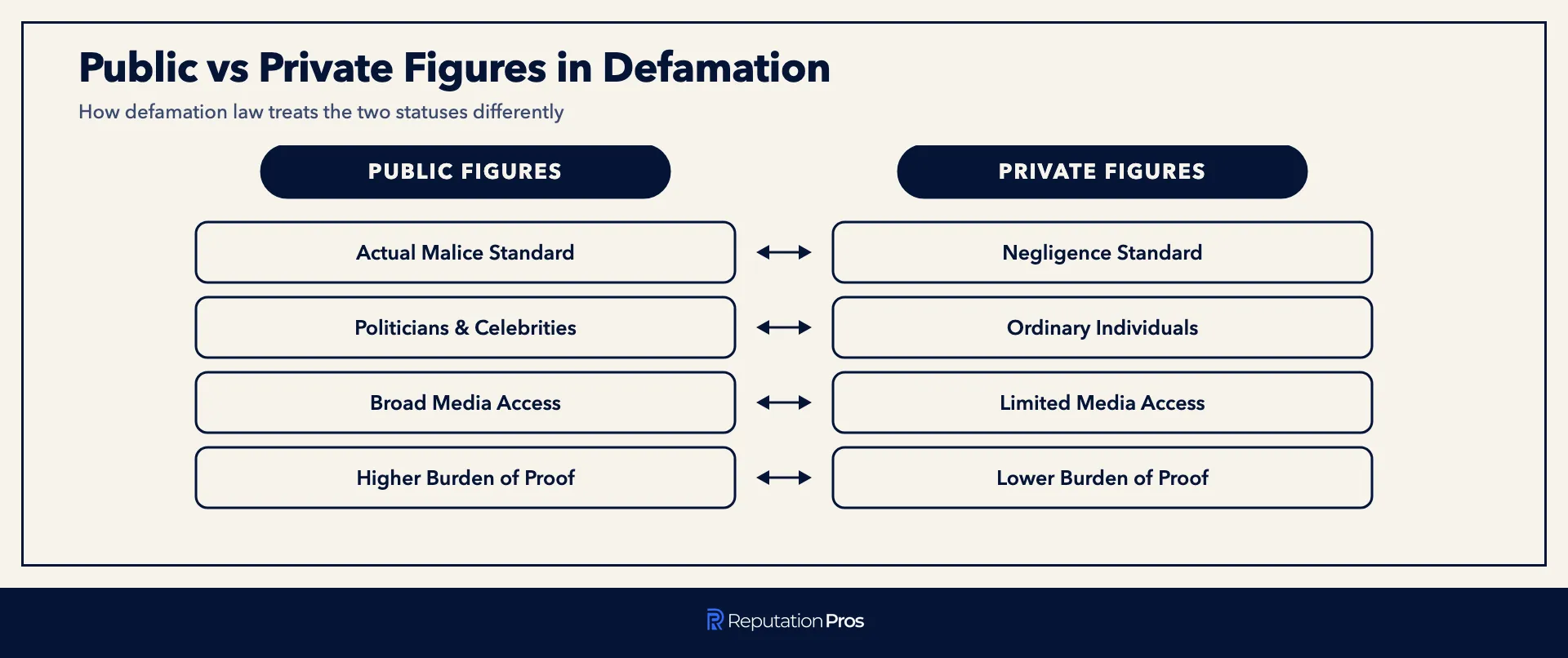
Defamation involves a false statement of fact that harms a person’s reputation, and the fault rules apply differently to each status. For public figures such as politicians and celebrities, the law requires proof of actual malice because public figures hold media access for self-defense. Private figures must show only negligence, since private figures have not sought public attention and remain more exposed to reputational harm.
The distinction in defamation law is rooted in the landmark case New York Times Co. v. Sullivan, which established the two standards. The impact of defamation on reputation varies between the two statuses and shapes how reputation management strategies are applied. Public figures carry the heavier burden because of their public exposure, while private figures receive more protection under the law.
What is defamation in law?
Defamation in law is a false statement presented as fact that injures a person’s reputation. Defamation takes two main forms: libel, which covers written or broadcast statements, and slander, which covers spoken words. For a defamation claim to be valid, the statement must be proven false, communicated to at least one other person, and shown to cause reputational harm to the subject. Defamation law balances the protection of individual reputations with free speech rights under the First Amendment, so people gain recourse against false statements while freedom of expression stays protected.
What are the elements of a defamation claim?
A defamation claim stands on four elements that decide whether a statement qualifies as defamatory. The elements of a defamation claim are listed below:
- False Statement of Fact: The statement must be objectively false and presented as a fact, not an opinion.
- Publication to a Third Party: The statement must be communicated to at least one person other than the plaintiff.
- Fault: The level of fault depends on the plaintiff’s status, requiring negligence for private figures and actual malice for public figures.
- Damages or Reputational Harm: The statement must cause harm to the plaintiff’s reputation, leading to actual damages or presumed harm in cases of defamation per se.
What Is the Main Difference in Their Defamation Claims?
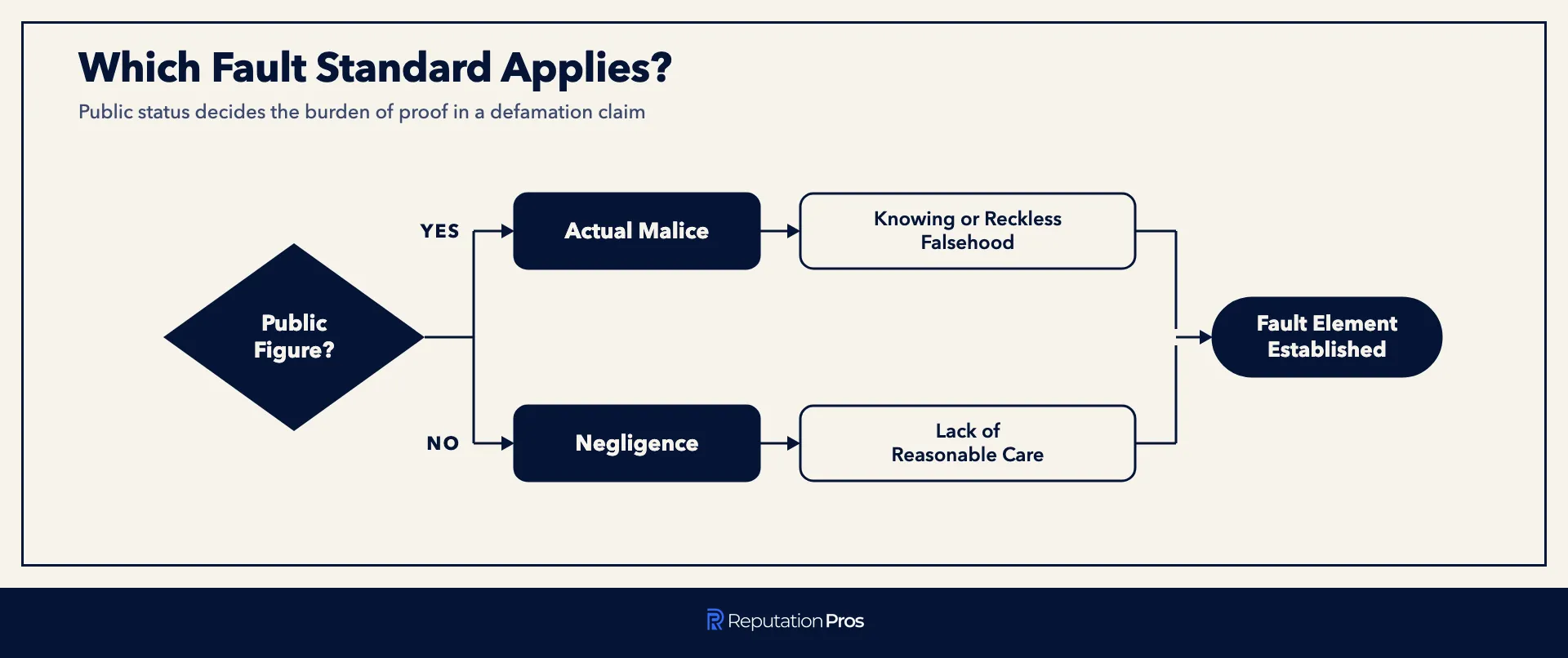
The main difference in defamation claims between public and private figures is the fault standard required to prove the claim. Public figures must demonstrate “actual malice,” meaning the false statement was made knowingly or with reckless disregard for the truth. Private figures only need to prove negligence, which involves showing that the defendant failed to exercise reasonable care in determining the truth of the statement.
The split between the two standards is rooted in balancing First Amendment rights with the protection of individual reputations. Public figures, given their access to media channels and exposure to public scrutiny, face the higher burden of proof to keep public discourse open. Private figures remain more vulnerable to reputational harm and therefore carry the lower burden. The fault standard breaks down into two proof requirements: actual malice for public figures and negligence for private figures.
Public Figures Must Prove Actual Malice
Public figures must demonstrate actual malice to succeed in a defamation claim. The actual malice standard requires proving that the false statement was made with knowledge of its falsity or with reckless disregard for the truth, according to the Wex legal encyclopedia entry “New York Times v. Sullivan (1964)” published by Cornell Law School’s Legal Information Institute. The U.S. Supreme Court established the requirement in the landmark case New York Times Co. v. Sullivan, protecting free speech about public officials and figures of influence. Public figures, given their prominence and access to communication channels, are expected to counter false statements on their own. The actual malice standard reflects the First Amendment’s commitment to open public debate, since public figures invite greater scrutiny and criticism by entering the public sphere.
Private Figures Only Prove Negligence
Private figures only need to prove negligence, a lower burden of proof than the actual malice standard applied to public figures. Negligence in defamation means the defendant failed to exercise reasonable care in verifying the truth of the statement before publishing it. The negligence standard acknowledges that private individuals lack the media access needed to counter false statements and remain more vulnerable to reputational harm.
Section 580B of the “Restatement (Second) of Torts”, published by the American Law Institute in 1977, holds a defendant liable for publishing a false and defamatory communication about a private person if the defendant acted negligently in failing to ascertain the truth of the statement. The lower threshold lets private individuals seek compensation for reputational damage without proving that the defendant knew the statement was false or acted with reckless disregard for its truth.
What Is the Effect of Defamation on Reputation?
The effect of defamation on reputation is damage to personal and professional standing caused by the spread of false statements. The damage shows up as lost employment opportunities, broken business relationships, and social exclusion. The impact grows in the digital age, where false information spreads across online platforms and creates a permanent digital footprint. Digital publication already drives a majority of defamation disputes: 51.3 percent of Australian defamation cases between 2013 and 2017 involved digital publications, according to the 2018 report “Trends in Digital Defamation: Defendants, Plaintiffs and Platforms” by the Centre for Media Transition at the University of Technology Sydney. Defamatory content online persists indefinitely, which makes recovery difficult for victims even after legal remedies are pursued. The lasting harm raises the value of reputation management strategies that limit the long-term effects of defamation.
What Is the Effect of Defamation on a Public Figure’s Reputation?
The effect of defamation on a public figure’s reputation is severe and lasting damage. Public figures, such as celebrities and politicians, face heightened scrutiny, and defamatory statements spread fast enough to multiply the reputational harm. The damage leads to financial losses, lost professional opportunities, and emotional distress. Public figures hold greater media access to counter false claims, yet still require swift reputation management to limit the fallout before pursuing legal action.
At Reputation Pros, we handle this fallout through our celebrity reputation service, which combines rapid takedowns, search suppression, and positive-content building to shield high-profile clients from lasting defamation damage.
What Is the Effect of Defamation on a Private Figure’s Reputation?
The effect of defamation on a private figure’s reputation is severe emotional distress and tangible losses such as job termination or social isolation. Private individuals lack the public platform needed to counter false statements, which leaves private reputations more exposed to harm. Managing the damage without litigation relies on direct communication, correction requests, and content removal.
How to Manage Reputation Instead of Suing for Defamation
To manage reputation instead of suing for defamation, apply the non-legal strategies listed below:
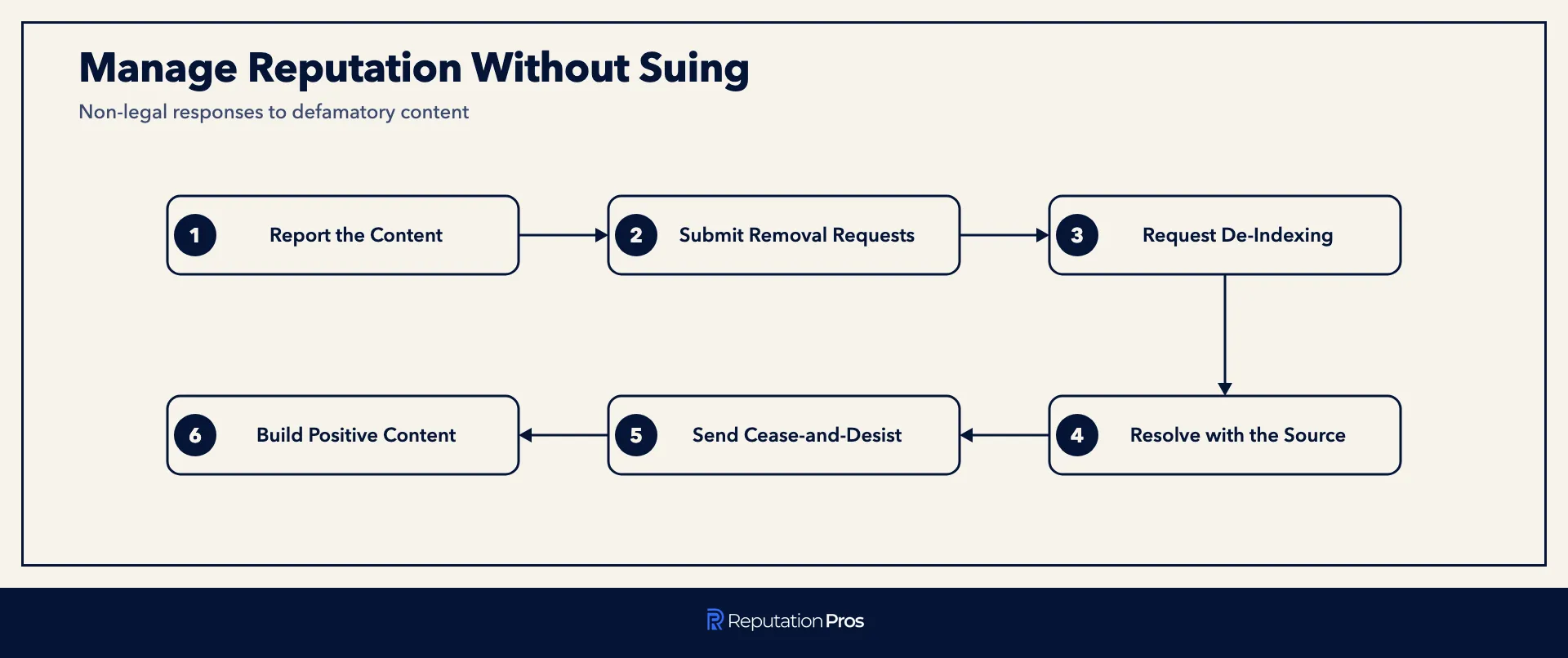
- Report the Content: Use platform-specific reporting tools to flag defamatory content as a violation of terms.
- Submit Removal Requests: Send a formal notice to the website or host to remove defamatory material based on policy violations.
- Request De-indexing: Ask search engines to remove the harmful URL from search results, limiting its visibility.
- Engage in Voluntary Resolution: Address complaints directly with the source to encourage content alteration or removal.
- Send a Cease-and-Desist Letter: Use legal counsel to formally demand the removal of false statements.
- Apply Domain Measures: Invoke policies like the UDRP to address domain misuse tied to defamatory content.
- Build Positive Content: Generate and optimize positive material to outrank negative content in search results.
How Reputation Pros Removes Defamatory Content
At Reputation Pros, we remove defamatory content for both public and private figures across online platforms and search engines. Our removal service addresses false statements without the need for legal action, restoring reputations regardless of which fault standard applies. We bridge the gap between the strict proof requirements public figures face and the more accessible negligence standard for private figures, closing the difference between public and private figures defamation with one practical removal path.
Our team removes defamatory content from search engines through direct takedown requests, publisher negotiations, and Google removal filings, so the harmful pages leave Google’s index and stop reaching new readers.