What Is a Reputation Management Company?
 15 min read
 On this page
A reputation management company is a specialized firm that monitors, influences, and improves the online perception of individuals or businesses. A reputation management company manages search engine results, oversees customer reviews, and suppresses negative content to protect and strengthen brand perception across online platforms. The article defines reputation management companies, describes the services they provide, identifies who hires them, explains how reputation campaigns operate, and outlines how to evaluate providers. The article covers engagement costs and compares online reputation management (ORM) with related disciplines such as public relations and SEO.
Reputation management companies matter because online reputation shapes hiring decisions, consumer trust, and revenue. Negative search engine results or reviews can deter potential customers and create substantial financial consequences. Reputation management firms bring know-how in handling complex search engine algorithms and platform policies, a capability that individuals or general marketers lack. Maintaining a positive online presence today requires domain knowledge and strategic intervention.
What is Online Reputation Management?
Online reputation management (ORM) is the practice of influencing, controlling, and monitoring online content related to individuals, businesses, or brands. ORM manages search engine results, reviews, and social media mentions to project a positive image online. ORM employs strategies such as search engine optimization (SEO), content creation, and review management to strengthen or protect a brand’s online presence. ORM matters because online perceptions shape consumer trust, hiring decisions, and revenue. ORM addresses negative content and magnifies positive assets, which supports favorable public perception and search visibility.
How a Reputation Management Company Differs From a Marketing Agency
A reputation management company and a marketing agency serve distinct roles in the online market. A reputation management company manages and improves a brand’s online presence by controlling search engine results and reviews. The primary goal of a reputation management company is to suppress negative content and strengthen positive visibility. Reputation management companies deploy defensive strategies such as SEO suppression, review management, and content removal to protect brand perception.
Marketing agencies concentrate on growth and audience acquisition. Marketing agencies direct their efforts toward attracting new customers through advertising, content marketing, and lead generation. Marketing agencies build brand awareness and drive sales through proactive campaigns. Marketing agency deliverables include campaign metrics, conversion rates, and audience growth statistics.
What is the main role of an Online Reputation Management Agency?
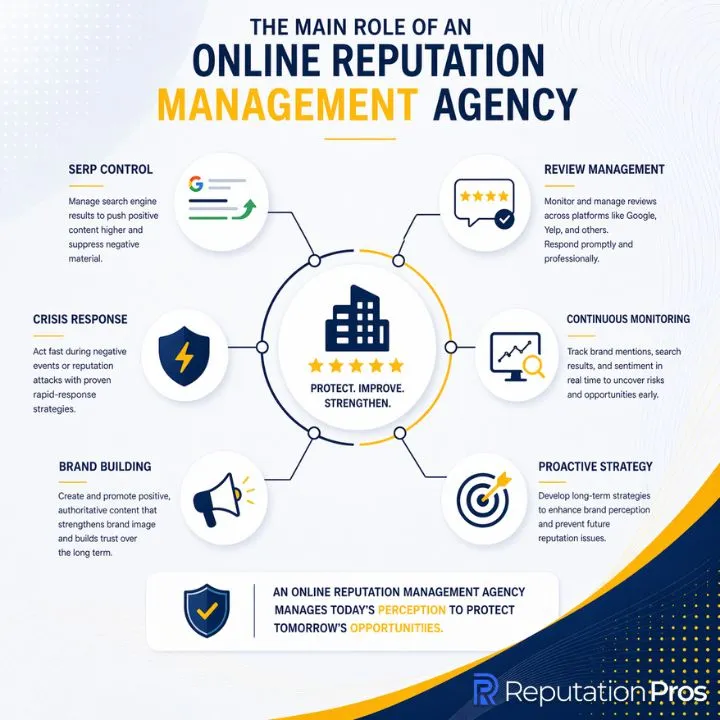
An online reputation management agency controls a brand’s online image by managing search engine results and review platforms. An online reputation management agency focuses on Search Engine Results Page (SERP) control, which raises positive content higher while negative material is suppressed. An online reputation management agency handles review management across platforms such as Google and Yelp, addressing customer feedback without delay. During a crisis, an online reputation management agency deploys rapid-response strategies to mitigate reputation damage. An online reputation management agency builds long-term brand perception through ongoing monitoring and proactive measures.
What are the main Services a Reputation Management Company Provides?
Reputation management companies offer services that help individuals and businesses maintain a positive online presence. The main reputation management services are reputation repair, online content removal, review management, brand monitoring, reputation SEO, and crisis management support. The main services a reputation management company provides are listed below.
- Reputation Repair: Corrects negative search results and public perception through strategic content creation and suppression tactics.
- Online Content Removal: Removes or de-indexes harmful content using legal tools such as DMCA notices, terms-of-service violations, and privacy claims.
- Review Management and Response: Monitors reviews on platforms such as Google and Yelp, solicits positive feedback, and writes professional responses to negative reviews.
- Brand Monitoring and Listening: Tracks brand mentions on an ongoing basis across search engines, social media, news outlets, and forums to detect reputation threats early.
- Search Engine Optimization for Reputation: Uses content creation, link building, and technical optimization to raise the ranking of positive assets and suppress negative content.
- Crisis Management Support: Provides rapid-response services for viral negative content and PR incidents, including holding statements, search result suppression, and legal coordination.
Reputation Repair
Reputation repair corrects damaged search results and public perception by addressing negative online content and surfacing positive assets. Reputation repair targets issues such as negative articles, mugshot sites, outdated news, defamation, and forum attacks. Reputation repair tactics include strategic suppression and removal to push harmful content down in search results. Reputation repair firms create and optimize positive assets such as professional profiles, press releases, and owned websites to raise trustworthy information. Reputation repair firms pursue legal takedown requests for defamatory content and de-indexing requests to search engines. The goal of reputation repair is to make sure a search for the client’s name or brand returns an accurate, professional image on the first page rather than outdated or misleading negativity.
Online Content Removal and Suppression
Online content removal and suppression eliminates targeted negative content from search results and source platforms, or reduces its visibility when direct removal is not possible. Online content removal requires working through complex legal and platform-level policies. The main online content removal methods are listed below.
- De-indexing Requests: Reputation management firms submit requests to search engines such as Google to remove targeted URLs from search results. De-indexing requests apply to outdated or irrelevant content.
- Right-to-be-Forgotten Claims: EU regulations allow individuals to request the removal of personal data that is no longer relevant or necessary, which protects privacy.
- Terms-of-Service Violations: Content that breaches a platform’s terms of service can be flagged for removal. Terms-of-service violations cover defamatory or harmful material that breaks user agreements.
- DMCA Notices: The Digital Millennium Copyright Act provides a mechanism for removing content that infringes on copyright laws, which enables legal takedowns of unauthorized material.
- Legal Takedowns: Defamation or privacy violations can be addressed through court orders or settlements that compel content removal.
Certain types of content resist removal. Removal-resistant content includes truthful factual reports such as court records and verified news articles, along with opinion-based reviews protected under free-speech laws. When removal is not feasible, reputation management firms apply suppression strategies to push negative content down in search rankings, which reduces its visibility and impact.
Review Management and Response
Review management monitors, solicits, and responds to customer reviews on platforms such as Google, Yelp, TrustPilot, and app stores. Review management matters because 77% of consumers check at least two review sites before purchasing. Effective review management keeps businesses at high average ratings, which matters since 71% of consumers avoid businesses with ratings below three stars.
Review management follows two main strategies. Proactive solicitation of positive reviews from satisfied customers builds review volume and improves ratings through automated campaigns that encourage feedback. Professional responses to negative reviews demonstrate accountability and customer care. Negative-review responses address concerns without escalating issues, sometimes requiring direct engagement or escalation to platform support for removal when terms of service are violated. Automated notifications alert businesses to new reviews in real time, which supports timely responses and sustained customer trust.
Brand Monitoring and Listening
Brand monitoring and listening track brand mentions on an ongoing basis across online platforms. Brand monitoring platforms include search engines, social media, news sites, forums, and review sites. The primary goal of brand monitoring is to identify reputation threats early and surface sentiment trends before a crisis develops. Reputation management companies use advanced tools and software to capture positive and negative brand references in real time. Real-time monitoring allows reputation management companies to detect and respond to emerging issues such as unfair reviews or viral complaints without delay.
Brand monitoring includes sentiment analysis to track shifts in public perception over time. Sentiment analysis helps brands adjust strategies for long-term protection and trust-building. An increase in negative Google reviews or a viral social media post can be addressed at speed to prevent further damage. Brand monitoring integrated into ongoing campaigns saves businesses time compared with manual checks and frees them to focus on core operations. Brand monitoring transforms reputation management from reactive damage control into strategic brand stewardship.
Search Engine Optimization for Reputation
Search Engine Optimization (SEO) for reputation uses content creation, link building, and technical optimization to raise positive assets in search results while pushing negative content down. Reputation SEO controls the search results for a brand or individual name so favorable, accurate information appears at the top. Growth SEO increases traffic through competitive keyword ranking, while reputation SEO adopts a defensive positioning strategy. The goal of reputation SEO is to occupy the top search results for branded queries with authorized, positive content.
Reputation SEO creates and optimizes owned assets such as LinkedIn profiles, company websites, press releases, and bio pages. Owned assets are engineered to rank higher than negative articles, mugshot sites, or defamatory content. Reputation management firms apply link-building tactics to raise the domain authority of positive pages. Higher domain authority allows positive pages to outrank negative mentions, outdated news articles, or content that harms brand perception. Reputation SEO results show early movement within 4–8 weeks, with notable page-one shifts achievable in 3–6 months, depending on the competitiveness of the brand search results and the strength of the negative pages.
Crisis Management Support
Crisis management support is a rapid-response service that reputation management companies provide when a brand encounters viral negative content, a PR incident, a scandal, or a coordinated attack. Crisis management support activates at once to contain damage and prevent long-term harm to brand perception. Crisis management deliverables include holding statements for public communication, search result suppression tactics that reduce the visibility of damaging content, and coordination with legal teams when threats involve defamation or unlawful attacks. Reputation management companies set up a monitoring war room where the team tracks the crisis in real time across every online channel. Crisis management examples include the 2015 Volkswagen scandal, which required broad PR strategies and ORM efforts and cost the company €30 billion, and a 2024 incident in which a London restaurant faced cybercriminals demanding £10,000. Crisis response commands premium pricing because of urgency, 24/7 availability requirements, and the specialized know-how needed in high-stakes situations where every hour of inaction can multiply reputational damage.
Who Hires a Reputation Management Company?
Reputation management companies serve a wide range of clients with distinct needs and objectives. The main reputation management clients are small and local businesses, mid-market and enterprise brands, executives and corporate leaders, public figures and celebrities, and private individuals. The main client profiles a reputation management company serves are listed below.
- Small and Local Businesses: Small and local business clients need help managing customer reviews, optimizing Google Business Profiles, and responding to negative feedback.
- Mid-Market and Enterprise Brands: Mid-market and enterprise clients focus on multi-location review monitoring, executive protection, and crisis playbooks that control corporate search engine results pages (SERPs).
- Executives and Corporate Leaders: Executive clients protect personal search results, strengthen LinkedIn and Wikipedia presence, and prepare for board-of-directors due diligence and succession planning.
- Public Figures and Celebrities: Public figure clients hire reputation management firms for tabloid suppression, fan-forum interactions, image control during public incidents, and press coordination.
- Private Individuals: Private individual clients need mugshot removal, outdated news management, resolution of defamation from ex-partners or rivals, and employment-screening support.
Reputation management firms serve business entities and private individuals with engagement scopes matched to each client’s particular needs.
Small and Local Businesses
Small and local businesses hire reputation management firms to handle online reviews, optimize their Google Business Profile, and reply to negative feedback with a professional tone. Review management and Google Business Profile optimization shape local search visibility and customer foot traffic. Reputation management firms manage reviews on platforms such as Google and Yelp, solicit positive feedback, and address complaints without delay, which prevents major revenue loss. Small businesses lack the time or know-how to handle these tasks in-house, so reputation management firms step in to maintain a strong local presence and build customer trust.
Mid-Market and Enterprise Brands
Mid-market and enterprise brands hire reputation management firms for several strategic reasons. Mid-market and enterprise brands require multi-location review monitoring to maintain consistent customer sentiment across many locations. Executive protection services safeguard the personal search results of C-suite leaders and keep their online presence positive. Crisis playbooks provide structured response protocols for potential PR incidents and enable rapid action. Corporate SERP control keeps branded search results accurate and favorable about the company. Mid-market and enterprise engagements address stakeholder concerns across customers, employees, investors, and board members, which makes the engagement scope complex and strategic.
Executives and Corporate Leaders
Executives and corporate leaders hire reputation management firms to maintain and strengthen their personal online presence, which drives professional credibility. Reputation management firms optimize personal search engine results pages (SERP) so positive achievements and profiles rank above negative or outdated information. Reputation management firms build up LinkedIn and Wikipedia profiles with authoritative content and high-quality backlinks aligned with the executive’s career narrative. Reputation management companies support board-of-directors due diligence by auditing and suppressing unflattering search results that could surface during vetting. Reputation management firms assist succession preparation by building a legacy of positive online visibility that supports leadership transitions. Reputation management for executives protects high-stakes personal brands that shape corporate decisions and opportunities.
Public Figures and Celebrities
Public figures and celebrities hire reputation management firms for several core reasons. Public figures face intense media scrutiny, which makes tabloid suppression a priority. Reputation management firms push sensationalized or false stories down in search results. Fan-forum management is a core service that monitors and addresses rumors or negative discussions. Image control during public incidents such as controversies or scandals protects a positive public image. Reputation management firms coordinate with press outlets so authorized narratives rank at the top while unauthorized or damaging coverage is suppressed. Celebrity reputation shapes earning potential through endorsements, casting opportunities, and public appearances. Professional reputation management becomes a high-value business investment that safeguards the personal brand and career longevity of public figures.
Individuals Managing Personal Reputation
Private individuals hire reputation management firms to address online vulnerabilities that affect personal and professional life. Private-individual vulnerabilities include mugshot removal from arrest-record sites, suppression of outdated news articles that no longer reflect current circumstances, and elimination of defamatory content posted by ex-partners or business rivals. Private individuals seek to optimize search results for employment-screening concerns, where negative content can hinder job opportunities. Reputation management firms apply defensive strategies such as content suppression and positive asset creation, including polished LinkedIn profiles or bio pages matched to personal search engine results pages (SERPs). Individuals lack the know-how to work through search engine algorithms or platform policies, so reputation management firms restore a professional online image on their behalf.
What types of search results push individuals to hire an ORM firm?
Individuals hire an Online Reputation Management (ORM) firm when negative search results dominate their personal search engine result pages (SERPs), including mugshots, outdated or inaccurate news articles, defamatory content, or negative reviews.
How Does a Reputation Management Campaign Work?
A reputation management campaign has four main phases: audit, strategy, execution, and monitoring. Each phase strengthens and protects an individual’s or brand’s online presence in a structured way. A reputation management campaign begins with an audit of the current reputation state, which assesses search engine results pages (SERPs), review profiles, sentiment analysis, and brand mentions across online platforms. The audit establishes a baseline for public perception and identifies areas that need improvement.
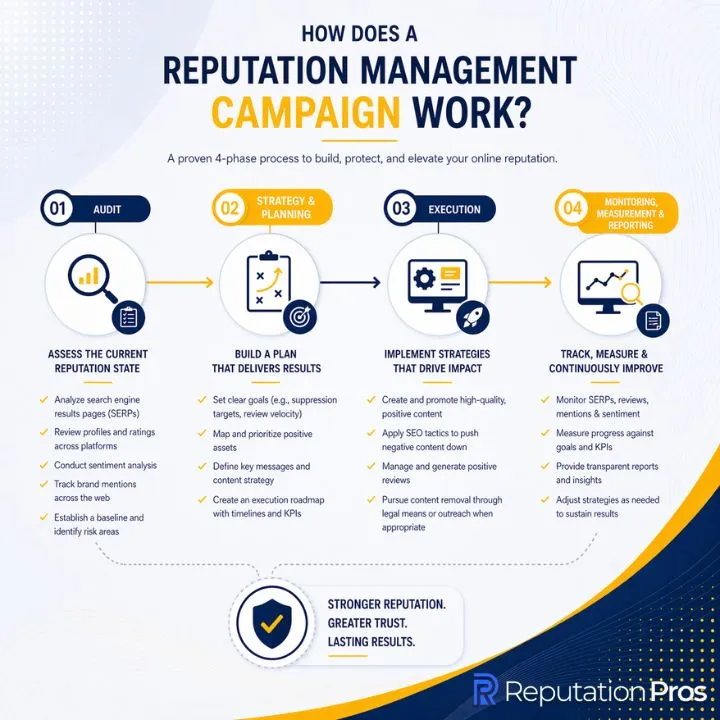
The strategy and campaign planning phase sets defined goals, such as suppression targets for negative content and review-velocity benchmarks. Strategy and planning includes mapping positive assets and defining execution timelines. The execution phase creates positive content, deploys SEO tactics to push negative content down, and uses legal means or outreach for content removal. The monitoring, measurement, and reporting phase tracks SERPs and sentiment on an ongoing basis and delivers regular client updates. The monitoring phase adjusts strategies as needed and sustains a positive online reputation over time.
Audit of the Current Reputation Landscape
The audit phase establishes the baseline assessment of a brand’s or individual’s online presence. Reputation management firms conduct a full analysis of search engine results pages (SERP) during the audit phase to evaluate what appears when the client’s name or brand is searched on Google, Bing, and Yahoo. The audit covers review profile evaluation across platforms such as Google, Yelp, and TrustPilot, documenting star ratings, review volume, and response rates. Sentiment analysis categorizes mentions as positive, negative, or neutral across social media, news outlets, forums, and blogs. Reputation management firms measure mention volume to capture the scale of online conversation and identify every platform where the brand or individual has an online footprint. The audit’s mapping provides the foundation for subsequent strategy and execution work and establishes clear metrics for measuring campaign success.
Strategy and Campaign Planning
The strategy and planning phase sets clear objectives and creates a structured roadmap for a reputation management campaign. The strategy phase begins with defined goals, such as negative content that needs suppression and targets for positive review velocity. Reputation management firms develop an asset map that outlines the positive content assets to push up, including bio pages, press releases, and high-authority profiles. A detailed timeline is then established to align with search engine dynamics and client priorities. The strategy phase timeline accounts for the natural pace of search engine indexing and review accumulation, which sets realistic expectations for visibility shifts. The strategic framework serves as a blueprint for subsequent execution and offers benchmarks for measuring campaign success.
Suppression, Removal, and Response Execution
The execution phase of a reputation management campaign deploys active intervention tactics to address negative content and protect online reputation. The execution phase includes outreach campaigns that request content removal from website owners and platform administrators. Reputation management firms pursue legal escalation when defamatory or unlawful content requires it. The execution phase implements SEO suppression strategies that push negative search results down by raising positive assets. Systematic review-response workflows activate during execution to address customer feedback with a professional tone and without delay. The execution phase requires coordination across legal, content, SEO, and community management teams to maintain consistency and compliance with platform policies.
Monitoring, Measurement, and Reporting
Monitoring, measurement, and reporting are core components of a reputation management campaign. The monitoring phase tracks search engine results pages (SERP) on an ongoing basis to observe the ranking of both positive and negative content. The monitoring phase includes real-time sentiment tracking across online channels to identify threats or positive trends early. Reputation management firms maintain Key Performance Indicator (KPI) dashboards that track review ratings, search result rankings, mention volume, and sentiment scores. Reputation management firms deliver monthly or quarterly client reports that include visual rank-tracking charts, sentiment analysis summaries, review-response metrics, and strategic recommendations for future actions. The monitoring feedback loop produces measurable progress, responsiveness to new threats, and a documented return on investment for reputation management efforts.
How long does a reputation management campaign take to show results?
Reputation management campaigns take between 3 and 6 months to yield meaningful results. Initial improvements, such as improved review responses and the establishment of monitoring systems, appear within the first 30 days. Several factors influence campaign duration. The scope of damage, the number and authority of negative items, shapes the timeline. Campaign complexity, such as legal removals versus straightforward SEO suppression, affects campaign length. Search engine dynamics require time for algorithms to reindex and prioritize new positive assets. Severe cases such as crises or deeply entrenched negative content extend campaign timelines to 6–12 months. Reputation management agencies focus on sustainable, white-hat tactics to avoid penalties and support long-term success.
How to Choose a Reputation Management Company
Choosing a reputation management company follows a structured approach that supports effective results. Start by researching the firm’s credentials and track record. Look for verifiable case studies and client testimonials that demonstrate success in managing online reputations. Reputable reputation management companies such as Reputation Pros showcase know-how through documented results in suppressing negative content and strengthening positive visibility.
Ask targeted questions about firm methodologies. Inquire about the tactics a firm uses for search engine results page (SERP) suppression, content creation, and crisis response. A firm’s answers reveal its transparency and commitment to ethical practice. Avoid firms that promise instant top rankings or rely on vague tactics, since guaranteed rankings and vague tactics signal potential unreliability.
Evaluate the company’s industry affiliations and team skill. Confirm memberships in professional organizations and the presence of experienced specialists who know search engine dynamics and legal removals. Contract-term negotiation matters; focus on timelines, exit clauses, and performance metrics. Hiring Reputation Pros delivers industry-leading effectiveness in negative content removal and client satisfaction through custom strategies that produce discreet and rapid results.
What are the main signs of a Legitimate Reputation Management Firm?
A legitimate reputation management firm can be identified by several key trust signals. The main signs of a legitimate reputation management firm are verifiable case studies, transparent methods, industry memberships, and named team members. The main signs of a legitimate reputation management firm are listed below.
- Verifiable Case Studies: Legitimate firms provide detailed client success stories with measurable outcomes that show the firm’s ability to improve search engine results pages (SERP) and manage public perception.
- Transparent Methods: Reputable firms explain tactics such as SEO strategies and content creation without vague promises or unethical practices. Open tactic disclosure builds client trust.
- Industry Memberships: Affiliation with established industry bodies or councils signals commitment to ethical standards and accountability. Industry memberships reassure clients of the firm’s alignment with best practices.
- Named Team Members: Legitimate firms list team members with credentials and areas of skill. Named team listings build accountability and trust in the firm’s capabilities.
What are the questions to Ask Before Signing a Reputation Management Contract?
Before finalizing a reputation management contract, clients should ask several core questions that clarify scope and alignment. The main questions to ask cover scope of work, guaranteed deliverables, reporting, and contingencies for failed removals. The main questions to ask before signing a reputation management contract are listed below.
- What is the scope of work? Clarify the platforms, search terms, and tactics included, and identify any services that fall outside the engagement.
- What deliverables are guaranteed? Distinguish between promised outcomes such as removal of targeted content and aspirational goals such as ranking improvements.
- How is reporting handled? Confirm the frequency and format of progress reports, which KPIs will be tracked, and how clients access updates.
- What happens if a content removal request fails? Determine whether alternative suppression tactics will be used, whether legal escalation is an option, and whether extra costs apply for failed removal attempts.
What to Avoid When Hiring a Reputation Management Company
Clients hiring a reputation management company should watch for red flags that indicate unprofessional or unethical practices. The main red flags are guaranteed top-ranking promises, lack of transparency about tactics, pay-for-delete extortion schemes, and unwillingness to define KPIs. The main red flags to avoid when hiring a reputation management company are listed below.
- Guaranteed top-ranking promises: No reputable firm can guarantee exact search engine rankings because ranking algorithms are unpredictable.
- Lack of transparency about tactics: Reliable firms explain methods in plain terms without vague claims or hidden unethical techniques.
- Pay-for-delete extortion schemes: Be wary of firms that charge for content removal, above all when the firm controls the negative sites, since pay-for-delete arrangements can lead to legal complications.
- Unwillingness to define KPIs: Ethical firms establish clear, measurable key performance indicators that track progress and accountability.
How Much Does a Reputation Management Company Cost?
The cost of hiring a reputation management company varies by several factors. Monthly retainers range from $2,000 to $25,000, depending on the scope and engagement level of the reputation management work. Key cost drivers include the extent of reputational damage, the number of search terms to manage, and the urgency of the campaign. Industry factors such as heavily regulated sectors affect pricing. Project-based work, such as removing a single negative article, costs $3,000 to $15,000. Emergency response services that require rapid deployment command rates of $15,000 to $50,000.
For a custom quote that matches individual needs and budget, contact Reputation Pros. The Reputation Pros team offers a complimentary reputation audit and transparent pricing with no hidden fees.
Retainer Pricing for Ongoing Reputation Campaigns
Retainer pricing for ongoing reputation management campaigns ranges from $2,500 to $25,000 per month. The retainer fee covers ongoing monitoring of search results and reviews, proactive content creation that raises positive assets, and suppression of negative content. Retainer packages cover review response management and regular reporting with key performance indicators (KPIs) that track progress.
Project-Based Pricing for One-Time Engagements
Project-based pricing for one-time engagements ranges from $1,000 to $25,000. Project-based pricing fits defined tasks such as single-piece content removal or a one-off SERP cleanup. Clients receive transparent costs that cover strategy, execution, and short-term monitoring.
Emergency and Crisis Response Rates
Emergency and crisis response rates carry premium pricing because of the urgent nature of the services. Crisis response rates cover rapid-deployment work required for managing reputation damage during viral negative content incidents, PR crises, or coordinated attacks. Crisis response engagements include 24/7 war-room support, expedited search result suppression, and legal coordination that mitigate reputational threats.
How a Reputation Management Company Compares to Related Services
A reputation management company differs from related services such as PR firms, SEO agencies, and digital marketing agencies. Each service category has distinct goals, methods, and focus areas that shape operations and outcomes.
Reputation Management vs. PR Firms
Reputation management companies control and improve what appears about a client online, in search engine results and reviews. PR firms build and maintain positive media relationships to secure favorable coverage and shape public narratives. Both reputation management and PR manage public perception, but reputation management intervenes in online content while PR develops media relationships.
Reputation Management vs. SEO Agencies
SEO agencies increase a website’s visibility and drive traffic through high-ranking keywords. Reputation management companies use SEO techniques for defensive purposes, to suppress negative content and raise positive assets. The primary difference is intent: SEO agencies focus on growth and audience acquisition, while reputation management prioritizes protection and perception control.
Reputation Management vs. Digital Marketing Agencies
Digital marketing agencies concentrate on audience acquisition and conversion through ads, content marketing, and social media campaigns. Reputation management companies manage and improve existing perceptions by monitoring sentiment, responding to reviews, and controlling the narrative. The overlap between reputation management and digital marketing appears in tools such as SEO, but the intent diverges: digital marketing pursues expansion while reputation management pursues protection.
ORM vs Public Relations Firm
Online Reputation Management (ORM) firms and Public Relations (PR) firms play distinct but connected roles in managing public perception. ORM firms control search engine results pages (SERPs) and manage online reviews to suppress negative content and strengthen positive visibility. ORM relies on technical strategies such as SEO suppression and content de-indexing. PR firms build earned-media relationships through press releases, media pitches, and journalist outreach to shape narratives across traditional and online media platforms. ORM addresses immediate online threats by altering online visibility, while PR firms engage in proactive storytelling and crisis communication that shape public opinion through third-party endorsements. ORM and PR provide a connected approach to reputation management: ORM handles direct online challenges, and PR focuses on broader media engagement.
ORM vs SEO Agency
An Online Reputation Management (ORM) firm differs from an SEO agency in strategic focus and execution. ORM firms prioritize defensive suppression of negative search results and push unfavorable content down in search rankings through targeted content creation and link-building. SEO agencies prioritize growth-driven keyword ranking that lifts website visibility and attracts new visitors. ORM reshapes search engine results pages (SERPs) to raise positive assets and mitigate damage, while SEO agencies concentrate on discoverability and competitive market positioning for business growth.
ORM vs Digital Marketing Agency
Online Reputation Management (ORM) firms differ from digital marketing agencies in core objectives and methodologies. ORM prioritizes perception management by controlling search engine results pages (SERPs), suppressing negative content, and shaping brand sentiment. ORM manages existing reputational threats such as negative reviews or viral incidents to stabilize trust. Digital marketing agencies drive traffic, leads, and sales through audience acquisition strategies such as advertising, content marketing, and SEO optimized for conversions. ORM firms ask, “What do people see and believe about us when they look?”, while digital marketing agencies ask, “How do we attract more customers?” ORM and digital marketing can complement each other but remain different at the core: protection versus growth.
What are the benefits of Hiring Reputation Pros Reputation management company?
Hiring Reputation Pros provides several major advantages for managing online reputation. The main Reputation Pros benefits are advanced content suppression, positive content surfacing, information protection, rapid crisis resolution, industry-leading track record, and specialized leadership. The main benefits of hiring Reputation Pros reputation management company are listed below.
- Advanced suppression of negative content: Reputation Pros uses technical know-how in Google’s ranking systems to suppress misleading or defamatory content from top search results on a consistent basis.
- Raising positive, high-authority content: Reputation Pros builds custom strategies that raise authentic, high-authority content and strengthen trust and long-term search engine visibility.
- Protection of personal and corporate information: Reputation Pros implements advanced privacy protection tools that safeguard sensitive information from data-harvesting sites.
- Fast and discreet crisis resolution: Reputation Pros addresses CEO search result cleanup, outdated legal content removal, and viral misinformation protection at high speed.
- Industry-leading track record: Reputation Pros was ranked #1 by TidewaterNews.com in 2025 for service effectiveness, customer satisfaction, and proprietary SEO strategies.
- Specialized skill under proven leadership: Reputation Pros operates under a consultant with proprietary frameworks for search result rehabilitation and serves CEOs, athletes, and public figures.
Can an In-House Team Replace a Reputation Management Company?
No, an in-house team cannot replace a reputation management company. Reputation management companies provide scalable access to advanced tools, real-time monitoring software, crisis skill, and established workflows. In-house teams lack that capacity because of constrained resources, shifting online threats, and high overhead costs such as salaries and benefits.
Does a Reputation Management Company Guarantee Results?
No, a reputation management company does not guarantee results. Reputation management outcomes depend on search engine algorithms, cooperation from content sources, and the severity of negative content. Reputation management strategies focus on suppression and monitoring rather than assured removal or rankings.
When does outsourcing reputation management become cost-effective?
Outsourcing reputation management becomes cost-effective when the cost of reputational damage, such as lost revenue or diminished customer trust, exceeds the monthly fee of a specialized firm.