How to Protect Your Reputation on OnlyFans
 22 min read
 On this page
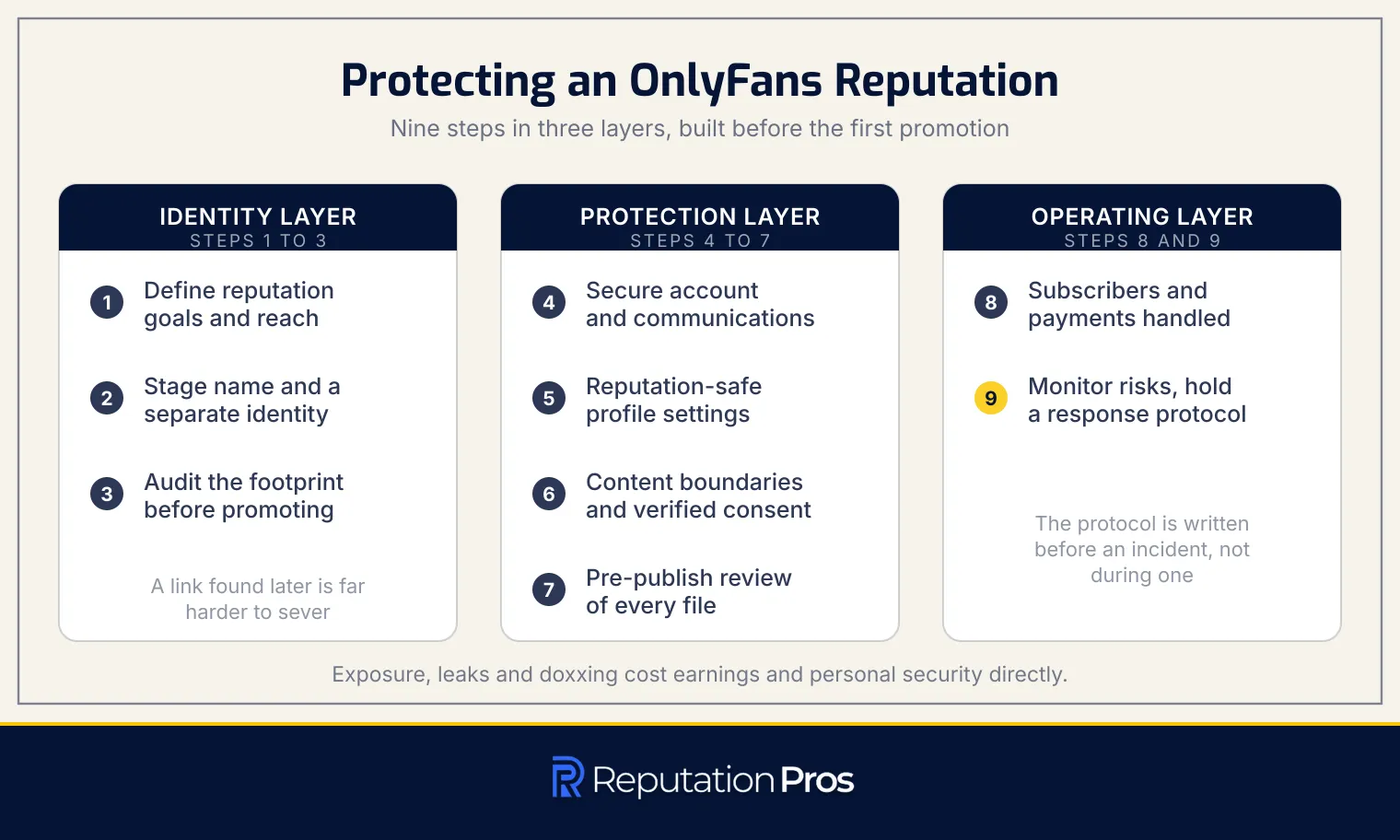
To protect your reputation on OnlyFans, separate the creator identity from the legal identity and control what each one surfaces. OnlyFans reputation protection is the ongoing practice of keeping the creator persona, the published content, and the legal identity’s search footprint under the creator’s own control. Exposure, leaks, and doxxing cost earnings and personal security directly, so the protective sequence gets built before the first promotion, not after an incident.
The identity layer comes first: defining the reputation goals that set how strict every later measure must be, creating a stage name with a fully separate creator identity, and auditing what the real name already surfaces. The protection layer follows, covering account and communication security, a reputation-safe profile, content boundaries and consent agreed before filming, and a review of every file before publication. The operating layer closes the sequence with professional handling of subscribers and payments, and continuous risk monitoring backed by a defined incident response protocol.
OnlyFans reputation management covers what the practice is, how identity, privacy, and content stay protected against leaks and piracy, and how creators respond to leaks, impersonation, and doxxing. The remaining contexts extend to monitoring and correcting false claims, the point at which legal or professional help becomes necessary, workplace and family privacy, leaving the platform cleanly, and maintaining reputation over the long term. Every measure in that sequence traces back to the reputation goals a creator sets at the start.
1. Define your OnlyFans reputation goals
To define your OnlyFans reputation goals, decide what the real name and the stage name should each surface. The real name should surface as little as possible, confined to legal, tax, and banking contexts. The stage name carries everything public that belongs to the creator persona.
The anonymity-versus-reach tradeoff governs the rest. Greater connection to personal life raises discoverability and promotional reach while lowering privacy, and a creator sets that dial before building anything. Deciding the intended audience follows: subscribers alone, or a wider audience reached through social promotion.
A creator’s disclosure stance completes the goal set, determining whether the work stays private, gets shared selectively, or operates openly. Those decisions set the strictness of every later measure. A creator working under their real name enforces hard content boundaries and monitors for leaks; a creator pursuing strict anonymity builds every protection layer that follows.
2. Create a stage name and separate creator identity
To create a stage name and a separate creator identity, build a persona that no search can trace back to the legal identity. Stage-name selection follows non-traceability rules: the name derives from nothing in the real name, appears nowhere else online, and carries no personal identifier such as a birthdate or hometown. A search check across Google and the major social platforms confirms the name is unused before adoption.
Separate contact infrastructure holds the identity apart. A dedicated email address handles OnlyFans communication alone. A separate phone number, obtained through an eSIM or virtual number provider, handles two-factor authentication and platform verification and never reaches subscribers. Social handles matching the stage name get secured across every platform to block impersonation.
Device and browser separation prevents cross-contamination. A creator uses a dedicated device, or a browser profile with its own cookies and login sessions that signs in only with the creator email and blocks location services. Personal photos never get reused in creator content, because a reverse-image search links them straight back to the real identity. With the creator persona built, the audit of what the real name still surfaces comes next.
3. Audit your online footprint before promoting OnlyFans
To audit your online footprint before promoting OnlyFans, search what the real name already returns and close every link between it and the creator persona. The audit runs before the first promotional post, because a connection found later is far harder to sever.
The checks that make up the audit are listed below:
- Reverse image search: run every photo intended for creator use through Google Images, TinEye, and Yandex, and confirm none appears elsewhere under the real name or a personal account.
- Legacy social accounts: review past social profiles, dating accounts, and forums for reused usernames and handles, then anonymise old posts and deactivate accounts no longer in use.
- Data-broker listings: work through the opt-out procedures at the major people-search brokers, including Whitepages and Spokeo, to pull name, address, and phone number records.
- Search engine audit: search the real name across several engines, combined with city, workplace, and school, and address any result that narrows down the creator’s identity.
A completed audit establishes the secure baseline the stage name depends on, which is what account security then protects.
4. Secure your OnlyFans account and creator communications
To secure your OnlyFans account and creator communications, layer authentication, network, and device defences so no single failure exposes the identity behind the account.
Two-factor authentication and password management. Two-factor authentication runs through an authenticator app such as Google Authenticator, Authy, or Microsoft Authenticator, not SMS, which SIM-swapping defeats. The account password stays unrepeated, at least 16 characters across letters, numbers, and symbols, held in a password manager such as Bitwarden or 1Password, and rotated every 90 days or immediately after any compromise.
Phishing and link security. Phishing reaches OnlyFans creators through direct messages claiming to come from platform support, offering a verification badge, or threatening suspension, each carrying a link built to harvest login credentials. A creator ignores links in unsolicited DMs and reaches OnlyFans by typing the URL. Legitimate support never asks for a password and never opens contact through a social media DM.
VPN and network security. A reputable VPN such as Mullvad or ProtonVPN encrypts traffic and masks the IP address on any login, and matters most on public Wi-Fi. The VPN connects before the browser or app opens, and the creator confirms the connection is live before entering credentials.
Device-level security. The device used for creator work runs full-disk encryption, a strong passcode or biometric lock, and a short automatic screen-lock, with the operating system and applications patched. Reputable antivirus software runs on a schedule. One device or browser profile stays dedicated to creator work, no one else gets access to it, and unverified software never gets installed on it.
Account takeover indicators. Unexpected password-reset emails, login notifications from unfamiliar locations, posts or messages the creator did not send, and changes to payout information each signal compromise. The response runs in order: change the password from a secure device, revoke every active session in account settings, contact OnlyFans support through official channels, and document the activity for escalation.
5. Build a reputation-safe OnlyFans profile
To build a reputation-safe OnlyFans profile, configure visibility and privacy settings so the profile reaches subscribers without reaching the creator’s own community.
The settings that make a profile reputation-safe are listed below:
- Geo-blocking by country and region: restricting access from the home country or state lowers the chance of discovery by people in the creator’s immediate community.
- Profile visibility and privacy settings: setting the profile to subscribers-only and disabling public directory listing and recommendation feeds keeps the profile out of general circulation, unless public exposure forms part of the promotion strategy.
- Bio and bio-link exposure: the bio carries no city, workplace, or school, and link-in-bio services such as Linktree get configured carefully, because a misconfigured one exposes the real name.
- Local identifiers: neighbourhood references and local landmarks stay out of the bio, since each one narrows a searcher’s radius.
A profile configured this way protects privacy while still presenting a professional creator presence, and content boundaries govern what then goes into it.
6. Set content boundaries and verify consent
To set content boundaries and verify consent, write the boundary list before filming and obtain releases from anyone who appears. The boundary list names what never gets published: identifiable tattoos, recognisable landmarks, documents, and other people’s faces without consent.
The boundary list governs how other people appear in content. Explicit consent and a content release come before filming from anyone who will be seen or heard, and the release states what gets recorded, how identifying features get handled, and where the content gets published. Custom content requests get screened against the boundary list first, and any request that pushes a boundary or demands identifying details gets refused.
Consistent enforcement across direct messages is what makes the boundary list work. A subscriber who repeatedly requests prohibited content or personal information gets blocked. With boundaries set and consent documented, the pre-publish review enforces them file by file.
7. Review and protect content before publishing
To review and protect content before publishing, strip metadata, audit visual detail, apply watermarks, and run a fixed checklist over every file. The pre-publish review is the last control point before content reaches subscribers and, through leaks or redistribution, the open internet.
The pre-publish steps are listed below:
- Strip metadata and EXIF data: every image and video carries hidden metadata that can expose the creator’s real name, device model, GPS coordinates, and capture timestamp, so every file gets stripped before upload and re-checked afterward to confirm removal.
- Audit visual details: every frame and background gets examined for location tells: street signs, landmarks, mail or packages showing an address, branded bags from local stores, reflections in mirrors or screens, and documents showing names or account numbers. Small details combine to confirm a creator’s location.
- Apply watermarks: a visible watermark carrying the stage name deters casual redistribution, and a subscriber-unique watermark, such as a faint user ID or randomised code embedded in each copy, traces a leak back to the account that released it.
- File-naming hygiene: filenames carry no real name, personal identifier, birthday or anniversary date, or reused name from a personal photo library, and a neutral randomised convention leaves no linkage if files get intercepted.
- Run a fixed pre-publish checklist: the checklist covers metadata removal, background audit, watermark presence, boundary compliance, and file-name sanitation, which turns the agreed boundaries into a repeatable process that catches errors before they become permanent.
8. Manage subscribers and payments professionally
To manage subscribers and payments professionally on OnlyFans, separate creator finances from personal finances and hold every subscriber exchange to a fixed standard.
The practices that keep subscribers and payments professional are listed below:
- Separate bank account: a dedicated account for OnlyFans income keeps records clean and holds creator earnings apart from personal finances.
- Discreet billing descriptors: a neutral descriptor prevents a subscriber’s statement from disclosing the purchase to anyone who reads it.
- Chargeback management: a chargeback arises when a subscriber disputes a charge, whether through an unauthorised-use claim or a discovery within their household, and the creator answers it by preserving transaction records and working through the platform’s dispute channel.
- Tax and reporting obligations: creator income is self-employment income. The IRS states in “Estimated taxes” that people in business for themselves generally make estimated tax payments, and that an individual expecting to owe $1,000 or more when the return is filed must pay across the year’s four payment periods, so a portion of earnings gets set aside as it arrives.
- Professional communication: a polite, consistent tone across direct messages lowers escalation risk and makes moderation decisions defensible.
- Blocking and reporting workflow: users who make threats or push for off-platform payment get blocked and reported on a standing workflow rather than case by case.
- Refuse off-platform payments: payments taken outside OnlyFans carry fraud risk and expose personal payment details, so they get declined without exception.
9. Monitor risks and respond to reputation incidents
To monitor risks and respond to reputation incidents, run standing detection on the stage name and hold a written response protocol ready before an incident happens. Alerts on the stage name across search engines, social platforms, and forums catch unauthorised distribution early, and scheduled reverse-image searches and content scans track leaks and impersonation.
Escalation ladder. A written ladder separates minor incidents from severe ones. A single unauthorised repost gets handled through platform reporting and a DMCA takedown. Widespread leaks, account compromise, and doxxing escalate immediately.
Named emergency protocols. Each incident type carries its own protocol. A content leak calls for documenting URLs, capturing screenshots, and filing DMCA notices. An account hack calls for a password change, two-factor authentication, and notification of subscribers if unauthorised content was posted. Doxxing calls for preserving evidence, contacting platform administrators for emergency removal, and involving law enforcement where personal safety is at risk. A blackmail attempt calls for no engagement with the threat actor, preservation of all communications, and reports to OnlyFans and law enforcement.
What is OnlyFans Reputation management?
OnlyFans reputation management is the practice of controlling two distinct reputational surfaces: the creator persona’s public image and the legal identity’s search footprint. Platform safety covers account security and compliance; OnlyFans reputation management covers how each identity is perceived and what each one surfaces. The creator persona’s public image concerns visibility and trust inside the platform community and across promotional channels. The legal identity’s search footprint concerns keeping personal details and the real name unconnected to adult content and shielded from leaks, doxxing, and cross-contamination. Working both surfaces at once is what balances professional reach against personal security.
What does protecting your reputation on OnlyFans involve?
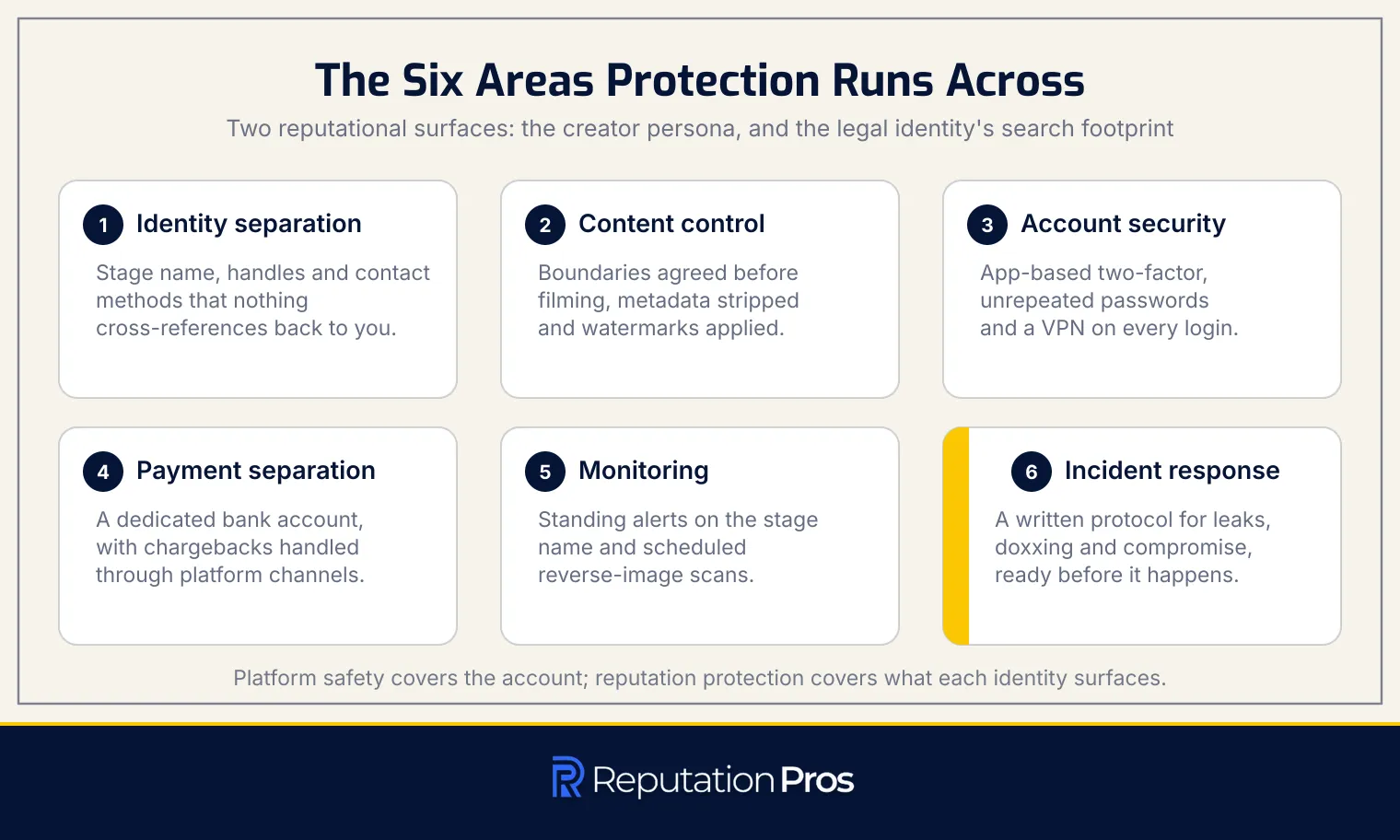
Protecting your reputation on OnlyFans involves six working areas, listed below:
- Identity separation: a clear division between creator persona and legal identity, carried through separate stage names, social handles, and contact methods.
- Content control: strict content boundaries and a review process that strips metadata and applies watermarks before anything gets published.
- Account security: two-factor authentication, unrepeated passwords, and a VPN, which together block unauthorised access.
- Payment separation: a dedicated bank account for OnlyFans transactions, with chargebacks and disputes handled through platform channels.
- Monitoring: continuous checks for leaks and impersonation, backed by alerts that surface unauthorised distribution.
- Incident response: a written protocol for leaks, doxxing, and account compromise, covering evidence capture and reporting routes.
How can creators protect their identity and privacy on OnlyFans?
Creators protect their identity and privacy on OnlyFans through a layered set of measures, each closing one exposure route. The measures are listed below:
- Stage name and separate identity: a stage name unconnected to the real identity, supported by a dedicated email, phone number, and social accounts that nothing cross-references.
- Dedicated devices and browser profiles: a separate device or browser profile for creator work, which prevents session-data leakage and the accidental login that merges two identities.
- VPN: a VPN masking IP address and location on every session, which keeps the creator’s geography private.
- No reused personal photos: content shot for OnlyFans alone, so no reverse-image search connects a photo to a personal profile.
- Geo-blocking: regional blocks that keep family, colleagues, and neighbours from finding the profile.
- Footprint audit and cleanup: reverse-image searches on photos, secured legacy social accounts, and removal of personal records from data brokers.
- Metadata and EXIF stripping: metadata removed from every upload, which withholds location, device, and timestamp.
- Communication boundaries: a professional tone across subscriber messages, with no personal detail shared.
- Separate financial accounts: a distinct bank account for creator income, which separates financial records and simplifies tax handling.
- Two-factor authentication: app-based two-factor authentication protecting the account against unauthorised access.
How can creators prevent personal-detail exposure in OnlyFans content?
Creators prevent personal-detail exposure in OnlyFans content by auditing every file for identifying information before publication. The checks are listed below:
- Metadata and EXIF removal: stripping metadata from photos and videos withholds location and device information.
- Background and reflection checks: street signs, reflective surfaces, and distinctive landmarks each narrow a searcher’s radius, so every frame gets reviewed for them.
- Identifying marks: tattoos, birthmarks, and other distinguishing body features trace back to the creator and stay out of frame or get concealed.
- Visible documents: identification, mail, and paperwork never appear in content.
- No reused personal photos: photos taken from personal social media or private collections let a reverse image search connect the creator persona to the real identity.
How can creators protect OnlyFans content from leaks and piracy?
Creators protect OnlyFans content from leaks and piracy by learning how leaks happen and building detection before redistribution spreads. Leaks run through subscriber screen recording, redistribution by paying users, and reposting on forums, tube sites, and aggregators. Redistribution removes the exclusivity that paid content depends on, cutting earnings while raising personal safety risk through doxxing and harassment. A 2024 study presented at the USENIX Security Symposium by Ananta Soneji, Vaughn Hamilton, Adam Doupé, Allison McDonald and Elissa M. Redmiles, “I feel physically safe but not politically safe”: Understanding the Digital Threats and Safety Practices of OnlyFans Creators, interviewed 43 creators and found that hunting down and removing leaked content draws sustained time away from the work that actually earns. OnlyFans provides baseline Digital Millennium Copyright Act protections and account security features, and monitoring for piracy beyond the platform falls to the creator.
Protective measures work best in combination: watermarking, geo-blocking, and regular leak monitoring detect unauthorised distribution early and contain how far it travels.
How can creators use watermarking, geo-blocking, and leak monitoring to protect OnlyFans content?
Creators use watermarking, geo-blocking, and leak monitoring as four distinct protective functions, listed below:
- Visible watermarking: the stage name or branding placed across content makes redistribution harder to pass off as someone else’s.
- Per-subscriber watermarking: an identifier such as a subscriber username embedded in each copy traces a leak back to the account responsible.
- Region-level geo-blocking: restricting access by geography keeps viewers in the creator’s home country or region from reaching the profile at all.
- Ongoing reverse-image scanning: scheduled reverse-image searches surface unauthorised redistribution across platforms while it is still contained.
- Content scanning services: automated services monitor known piracy sites and forums for a creator’s watermarked images and videos and raise an alert on each match.
How can creators respond to leaked content, impersonation, or doxxing on OnlyFans?
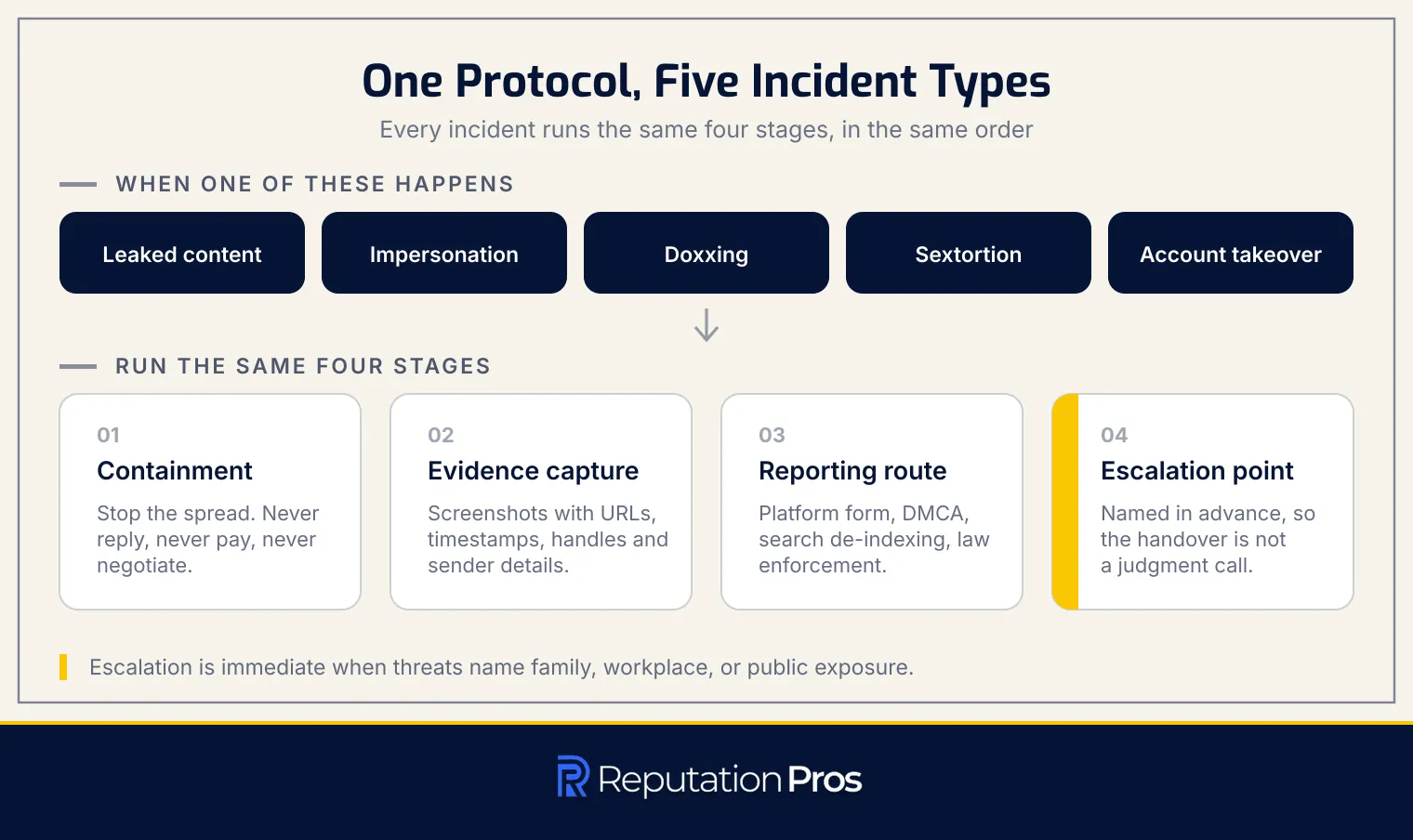
Creators respond to leaked content, impersonation, or doxxing on OnlyFans by working a protocol matched to the incident type. Each protocol runs the same four stages: containment, evidence capture, reporting route, and escalation point.
Leaked content. Containment pauses new uploads and reviews active subscriptions for suspicious accounts. Evidence capture records screenshots showing visible URLs, timestamps, and watermarks, alongside a download of the leaked file and its metadata. The reporting route files a DMCA takedown with the host and requests URL deindexing from search engines. Escalation follows when leaks appear across multiple sites, carry personal information, or survive takedowns, at which point an OnlyFans leak removal service or legal counsel takes over.
Impersonation. Containment documents every fake account without replying, since a reply confirms the target is watching. Evidence capture screenshots the fake profile, bio, profile picture, messages, handle, URL, and follower count. The reporting route uses the OnlyFans impersonation form and the identity-theft tools on other platforms. Escalation follows when an impersonator collects payments or pairs real photos with the creator’s name.
Doxxing. Containment enables two-factor authentication across personal accounts and alerts trusted contacts. Evidence capture screenshots each posting of personal information with URLs and usernames, and saves page-source HTML from forums that delete quickly. The reporting route reports the posts as harassment and files with local law enforcement where warranted. Escalation follows when doxxing carries threats or reaches family or an employer.
Sextortion or blackmail. Containment means refusing to pay or negotiate. Evidence capture preserves every threatening message with sender information. The reporting route runs through OnlyFans, the contact platform, law enforcement, and the FBI’s Internet Crime Complaint Center. Escalation is immediate when threats name family, workplace, or public exposure.
Account takeover. Containment changes passwords, revokes sessions, and enables two-factor authentication. Evidence capture documents login anomalies and unauthorised changes. The reporting route notifies the platform and the relevant cybercrime channel.
How can creators document evidence, file DMCA takedowns, and report abusive accounts?
Creators document evidence, file DMCA takedowns, and report abusive accounts through a fixed sequence, listed below:
- Capture evidence: record the URL and take full-page screenshots showing the content, URL bar, and timestamp, and save original messages or DMs relating to threats without editing them.
- File a DMCA takedown notice: send a written notice to the host’s designated agent, carrying all six elements that 17 U.S.C. § 512(c)(3) requires, namely a signature, identification of the copyrighted work, identification of the infringing material and where it sits, contact details, a good-faith statement that the use is unauthorised, and a statement of accuracy under penalty of perjury, according to the U.S. Copyright Office’s Section 512 resources. A notice missing an element can be disregarded without costing the host its safe harbour.
- Request search-engine removal: where infringing content appears in search results, submit a separate removal request to the search engine, because delisting and host removal are separate processes.
- Use in-platform reporting tools: report abusive accounts through the OnlyFans tools, supplying the username, a description of the violation, and supporting screenshots.
- Escalate repeat infringers: track every takedown request and document repeat infringement, then notify the platform so its repeat-infringer policy triggers account suspension.
How can creators monitor their online reputation and address false claims about OnlyFans work?
Creators monitor their online reputation and address false claims about OnlyFans work by running alerts and scheduled scans, then correcting or suppressing rather than arguing. Alerts on the stage name and a fixed scan cadence across search results surface a false claim while it is still small.
When a false claim appears, the response is correction or suppression, not public dispute. Documentation comes first, with screenshots and URLs preserved, followed by removal through official channels where the content breaches terms of service. Where removal is unavailable and the claim causes damage, publishing accurate, authoritative content pushes the false claim down the results. Public argument amplifies a claim and extends its life, which is why suppression outperforms response.
When does an OnlyFans reputation problem require legal or professional help?
An OnlyFans reputation problem requires legal or professional help once it crosses a threshold that affects income, safety, or legal standing. The thresholds are listed below:
- Mass redistribution: content reposted across forums, tube sites, and aggregator networks creates continuing infringement that needs legal support for DMCA takedowns and evidence preservation. Federal law now backs the removal route: the TAKE IT DOWN Act, signed on 19 May 2025, criminalises non-consensual publication of intimate images, covers AI-generated “digital forgeries” alongside authentic material, and obliges covered platforms to run a notice-and-removal process that acts within 48 hours of a verified request.
- Sextortion and blackmail: threats to release private content or expose the real identity call for law enforcement and reputation management, and never for negotiation or payment. The FBI advises victims to stop all interaction with the extortionist and report to its Internet Crime Complaint Center, because paying funds further criminal activity.
- Doxxing with physical-safety risk: exposure of a home address or phone number carries harassment and physical-harm risk, which makes immediate legal action and law enforcement involvement necessary.
- Defamation: false statements that damage the creator’s reputation, such as fabricated allegations, call for a defamation attorney and cease-and-desist letters.
- Employer contact: a third party who sends OnlyFans content to the creator’s employer may create a harassment or interference claim.
- Civil or tax compliance exposure: unreported income and disputes affecting tax filings call for a tax professional or attorney before penalties accrue.
Once a threshold is crossed, the work belongs to a qualified attorney or a reputation management professional, depending on whether the main risk is legal liability, search suppression, or content removal.
How does a Reputation management company protect your OnlyFans reputation?
A reputation management company protects an OnlyFans creator’s reputation by running content takedowns at volume, suppressing unwanted search results, and monitoring continuously for new threats. High-volume DMCA takedowns clear unauthorised content across many platforms at once, which no individual creator can sustain alongside producing work. Search suppression and deindexing reduce the visibility of leaked or unwanted material in results. Continuous monitoring surfaces new leaks, impersonation accounts, and emerging threats early. At Reputation Pros, we provide these services for OnlyFans creators as an online reputation management company, covering both the creator persona and the legal identity’s search footprint.
How can creators protect workplace reputation while operating OnlyFans?
Creators protect workplace reputation while operating OnlyFans by managing employment-contract risk and holding the professional and creator identities strictly apart. Employment agreements in education, healthcare, and government frequently carry morality clauses and social-media policies that adult content creation can trigger even when the work happens entirely off-duty. No single law protects employees for what they do away from work, and only a handful of states, among them California, Colorado, New York and North Dakota, restrict employers from acting on lawful off-duty activity, as Workplace Fairness sets out in its “Off-Duty Conduct” guide. A creator therefore reviews their agreement and consults an employment attorney where the language is unclear.
Practical separation lowers the exposure. Geo-blocking the home region reduces the chance of discovery by colleagues and clients, work devices and networks never touch creator activity, and professional and creator social accounts stay entirely separate.
The disclosure-versus-containment tradeoff stays personal. Proactive disclosure to a trusted supervisor demonstrates transparency and gives up deniability. Non-disclosure preserves privacy and leaves the creator exposed if a colleague discovers the account. Workplace culture and contract language decide which path a creator takes.
How can creators protect family and relationship privacy around OnlyFans?
Creators protect family and relationship privacy around OnlyFans by controlling disclosure and keeping relatives and partners out of content entirely. The creator decides who knows about the work and holds that boundary consistently. Family members and partners stay out of every frame, including backgrounds and reflections, where accidental exposure most commonly happens. Where a partner or relative does get exposed, the creator documents the incident, requests removal, and revises the boundary that allowed it.
How can creators leave OnlyFans without reputation damage?
To leave OnlyFans without reputation damage, remove content deliberately, close the account on the right terms, and keep monitoring after departure.
Deletion versus deactivation. Deactivation suspends the profile while account data remains available for reactivation. Deletion makes the profile inaccessible, and platforms retain some records for legal and financial compliance regardless. The choice depends on whether a creator may return.
Content removal. Posts, messages, and media get deleted manually before account closure. Deletion removes public content, and subscriber purchases and platform records persist, so a creator assumes anything published may already have been saved externally.
Search deindexing and suppression. After deletion, deindexing requests for cached pages and profiles go through Google Search Console and Bing Webmaster Tools, and DMCA notices handle content reposted on third-party sites. Where immediate removal is unavailable, publishing accurate content under the real name suppresses what remains.
Monitoring and post-exit risk. Redistribution risk rises after departure, when content stops being available legitimately, so alerts and reverse-image searches on the stage name continue. Post-exit blackmail attempts get documented and reported to law enforcement, without engagement and without payment.
How can creators maintain their reputation on OnlyFans?
Creators maintain their reputation on OnlyFans by running a recurring maintenance routine rather than reacting to incidents. The routine sets a fixed cadence for scanning the stage name and published images, keeps credential and device hygiene current, reviews content boundaries against what the creator now publishes, and re-audits the online footprint as the real name accumulates new results. A standing cadence catches leaks, unauthorised access, and identity overlaps while each one is still small, which is what keeps the protection built in the earlier steps intact over time.