10 Things to Consider When Choosing a Reputation Management Company
 16 min read
 On this page
Choosing a reputation management company involves evaluating 10 main factors that confirm the reputation management company meets buyer needs. An online reputation management company is a specialized service provider that monitors, influences, and improves how individuals or organizations are perceived online. The 10 evaluation criteria for choosing a reputation management company are listed below.
- Identifying buyer goals
- Checking service range
- Verifying track record
- Confirming industry experience
- Examining methodology
- Assessing reporting standards
- Reviewing pricing
- Reading contract terms with attention
- Asking targeted questions
- Watching for red flags
1. Identify Your Reputation Management Goals First
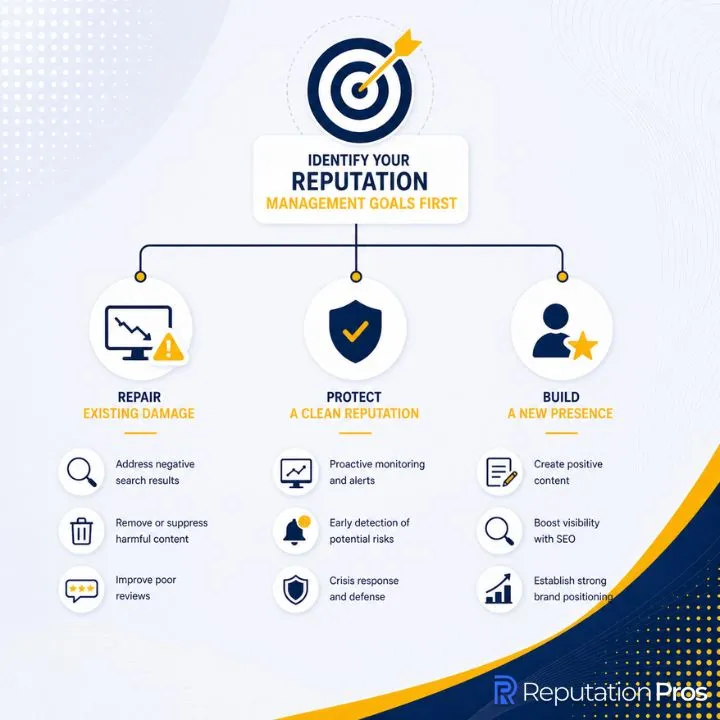
Identifying reputation management goals is the first step before evaluating any reputation management company. Goal identification confirms that the selected services align with buyer needs. Without clear goals, buyers risk selecting services that do not address the actual situation, leading to wasted time and resources. Reputation management goals fall into three main categories: repairing existing damage, protecting a clean reputation, or building a new presence from scratch.
Repairing existing damage involves addressing negative search results, harmful content, or poor reviews. Protecting a clean reputation focuses on proactive monitoring and defense for buyers with no current issues. Building a new presence establishes visibility for new brands, executives, or professionals. Matching goals to the appropriate services confirms that the selected provider meets the buyer’s needs. For damage repair, buyers should look for firms with proven content removal and suppression capabilities. For protection, buyers should prioritize providers offering real-time monitoring and crisis response. For building a new presence, buyers should choose companies strong in content creation, SEO, and positive brand positioning.
2. Check the Range of Services Offered
When choosing a reputation management company, evaluating the range of services offered confirms the provider can cover varied reputation needs. A full service portfolio prevents the client from switching providers when challenges shift. Service flexibility supports handling evolving challenges and maintaining a consistent reputation strategy.
Key service categories to consider include:
-
Reputation Repair: Reputation repair corrects negative search results and public perception through content creation and suppression tactics.
-
Content Removal: Content removal eliminates or de-indexes harmful content using legal tools such as DMCA notices and privacy claims.
-
Review Management: Review management monitors reviews on platforms like Google and Yelp, solicits positive feedback, and writes professional responses to negative reviews.
-
Crisis Response: Crisis response provides rapid action plans for managing PR emergencies and reputational threats.
-
Brand Protection: Brand protection covers ongoing monitoring and defense against reputation attacks.
A wide range of ORM services allows the reputation management company to adjust its approach as new challenges arise. Service breadth reduces disruption and preserves continuity because the same team understands the client’s complete reputation profile.
3. Verify the Company’s Track Record and Case Studies
Verifying a reputation management company’s track record and case studies is important before signing a contract. Track record verification provides concrete evidence of the firm’s ability to deliver results, rather than relying on marketing promises. Documented proof should include removal counts, detailing the number of negative pieces eliminated, and suppression timelines, which range from three to six months for noticeable search engine results page (SERP) shifts. Before-and-after SERP screenshots demonstrate actual ranking changes, while named-client references offer verifiable outcomes such as improved sentiment or review ratings.
To distinguish between vanity claims and verifiable metrics, scrutinize the company’s marketing language for vague boasts, such as “top rankings guaranteed,” which lack supporting data. Instead, demand quantifiable key performance indicators (KPIs) like domain authority changes or first-page control percentages. Cross-check vendor claims through third-party audits or client testimonials. If a company refuses to provide historical case data or deflects questions about methodology, treat the refusal as a red flag indicating potential inexperience or reliance on questionable tactics.
4. Confirm the Company’s Industry Experience
Industry experience on reputation management is a key factor when selecting a reputation management company. Different sectors face distinct challenges that require specialized knowledge. Healthcare organizations must address HIPAA compliance and manage reviews on platforms like Healthgrades. Legal firms deal with attorney review sites and bar regulations, while financial services operate under strict regulatory scrutiny. Hospitality businesses focus on managing reviews on platforms such as TripAdvisor. Without industry-relevant knowledge, a generalist provider might apply ineffective, one-size-fits-all tactics that overlook industry conventions and compliance requirements.
To verify a company’s experience in a given industry, request case studies and references for that sector. Industry verification includes evidence of handling sector challenges, such as suppressing negative content on industry platforms or managing crisis communications within regulatory boundaries. Companies like Reputation House highlight multilingual capabilities and regulatory knowledge for brands under scrutiny. A provider with proven success in a given industry anticipates challenges and builds strategies with precision, reducing onboarding time and delivering a more targeted approach.
5. Examine the Methodology Used to Manage Reputation
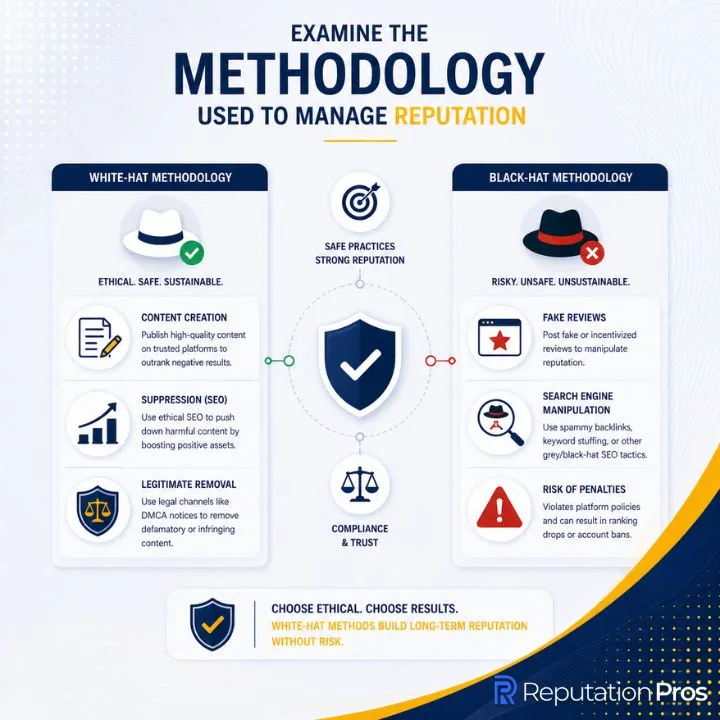
Examining the methodology used by a reputation management company is important to distinguish ethical providers from those employing risky tactics. Legitimate providers use white-hat tactics, which include ethical content creation, suppression, and legitimate removal. White-hat methods maintain compliance with platform policies and avoid penalties from search engines.
White-hat tactics involve creating high-quality content, such as detailed articles or profiles on trusted platforms, to outrank negative content. Suppression uses SEO to push down harmful results by raising positive assets. Legitimate removal uses legal channels like DMCA notices to remove defamatory content. In contrast, black-hat tactics, such as fake reviews or search engine manipulation, can lead to penalties. Knowing white-hat versus black-hat methodologies helps buyers make informed choices when selecting a reputation management company.
6. Assess Reporting and Transparency Standards
Assessing reporting and transparency standards is a decisive factor when selecting a reputation management company. Detailed and full-scope reports enable clients to verify the progress of reputation management efforts and hold the provider accountable for results. Without transparent reports, distinguishing between genuine improvements and vague claims becomes challenging. A reputable company should provide documented evidence of changes in search results, addressed content, and brand sentiment shifts over time. Reporting transparency allows clients to make informed decisions about continuing or adjusting the strategy.
Effective reputation management reports should include defined metrics such as SERP positions for brand-name queries, documented counts of content removed or suppressed, sentiment trends, and review volume and rating shifts across platforms like Google Business Profile, Yelp, and Trustpilot. Reporting follows a tiered cadence: daily alerts for urgent issues, weekly reviews of new mentions and review activity, monthly full KPI reviews with trend analysis, and quarterly thorough audits of search results and competitive benchmarking. Red flags include vague reports that describe activities without measurable outcomes or lack defined URLs or rankings. A legitimate provider documents baseline metrics upfront to track progress with accuracy over the engagement period.
7. Review the Pricing Structure
Reviewing the pricing structure is a key step when choosing a reputation management company. Knowing the pricing models helps align the service with buyer budget and expectations. The three main pricing models are retainer, project-based, and hourly. Each model indicates a different engagement type. Retainer pricing involves ongoing monthly fees for continuous services, signaling a long-term commitment. Project-based pricing covers defined tasks like content removal and suits one-off repairs. Hourly billing applies to consulting or smaller tasks but can lead to unpredictable costs.
Price ranges vary based on factors like campaign scope, damage severity, industry, and cost intensity. Basic retainers start at $1,000–$3,000 per month, covering monitoring and review management. Full-scale campaigns addressing severe damage can cost $5,000–$20,000+ monthly. Industry cost intensity, such as regulated sectors like finance, drives costs higher. Knowing the cost factors helps buyers negotiate with transparency and avoid low-ball quotes that may hide fees or deliver subpar results.
8. Read the Contract Terms Carefully
Reading the contract terms with attention is key when choosing a reputation management company to protect against unexpected costs and restrictive conditions. Key clauses to examine include the scope of work, which details the services provided, and performance guarantees that outline expected outcomes without promising particular search rankings due to algorithm variability. Termination terms should allow easy exit without penalties, and intellectual property (IP) ownership clauses must confirm that any content created is owned by the client. Confidentiality provisions safeguard sensitive information.
Red flags in contracts can indicate potential issues. Vague deliverables that lack measurable outcomes can hide ineffective services. Written guarantees of top search rankings are unreliable due to the unpredictable nature of search engine algorithms. Contracts that prevent the client from working with other providers limit flexibility and may suggest overconfidence or unethical practices. Always confirm the contract is clear and includes a detailed roadmap with steps and timelines before signing.
9. Ask the Right Questions Before You Hire
Asking the right questions before hiring a reputation management company is a key step for filtering out ineffective providers. Targeted questions help determine if a company has documented processes, verifiable success rates, and transparent communication practices. Key questions include:
-
How do you handle negative content through removal, suppression, or both?
-
What is your documented removal success rate, and can you share concrete examples?
-
Who owns the content created during the campaign, and can the client use it after the engagement ends?
-
What is your reporting cadence, and what metrics will you track monthly?
Good answers are direct and reference concrete timelines, documented case studies, and verified metrics. Red flags include evasive responses, guarantees of top rankings, refusal to disclose methods, vague pricing, or pressure-sales tactics that rush the buyer into a contract.
10. Watch for Red Flags When Choosing a Reputation Company
When selecting a reputation management company, awareness of common red flags helps identify potential issues. Red flag awareness helps buyers avoid ineffective or unethical providers.
-
Guaranteed Top Rankings: Promises of guaranteed top rankings are unrealistic, as search engines do not allow manipulation and can penalize such tactics.
-
Vague Pricing Structures: Lack of clear pricing breakdowns can hide further costs and make assessing the true value of services difficult.
-
No Verifiable Case Studies: Absence of documented proof, such as removal counts and before/after SERP screenshots, indicates a lack of transparency and effectiveness.
-
Refusal to Disclose Methods: Companies that do not explain their methodologies may be using black-hat practices, like fake reviews, which can harm reputation in the long run.
-
High-Pressure Sales Tactics: Pressure to sign contracts fast can prevent buyers from conducting due diligence and making informed decisions.
To verify a company’s legitimacy, check third-party reviews on platforms like Google, Yelp, or Trustpilot for consistent client feedback. Review Better Business Bureau (BBB) records for complaints and ratings, and request former-client references to confirm the provider employs ethical, white-hat strategies.
What Is a Reputation Management Company?
A reputation management company is a specialized firm that focuses on shaping the online perception of individuals or businesses. A reputation management company monitors, influences, and improves digital presence across multiple platforms, including search engines, review sites, and social media. The main characteristics of a reputation management company include the use of ethical SEO tactics, content creation, and media outreach to manage and improve public perception. Reputation management companies aim to suppress negative search results, remove harmful content, and advance positive assets, securing a favorable digital narrative.
What are the different types of Online Reputation Management companies to choose from?
The different types of ORM companies are listed below.
-
ORM for Individuals: ORM for Individuals specializes in managing personal reputations for executives, public figures, professionals, and private individuals. ORM for Individuals focuses on suppressing negative personal search results and building positive online assets such as optimized profiles and thought leadership content.
-
ORM for Businesses and Brands: ORM for Businesses and Brands focuses on corporate reputation needs, including review management, brand monitoring, search result optimization, and managing public perception across multiple platforms. ORM for Businesses and Brands works to strengthen positive business signals and mitigate negative feedback or complaints.
-
ORM for Crisis Response: ORM for Crisis Response provides rapid-response services for urgent reputation emergencies. ORM for Crisis Response offers real-time monitoring, PR crisis containment, negative content suppression, and media handling to prevent escalation during high-stakes situations.
How to Choose a Reputation Management Company for Individuals
Choosing a reputation management company for individuals involves several key steps to address personal reputation needs with precision. The selection steps for individuals are listed below.
- Conduct a Personal Reputation Audit: Start by searching your name in incognito mode across Google, review sites like Yelp, and social platforms such as LinkedIn and Twitter. Identify negative content, review average ratings, and note which first-page search results you control. The personal reputation audit clarifies the current state of your online presence.
- Verify Experience with High-Profile Individuals: Ask potential companies for case studies and references from executives, public figures, or professionals in your field. Focus on challenges such as personal defamation, privacy claims, or suppression of negative search results. Documented references confirm the company has relevant experience.
- Prioritize White-Hat Methods: Confirm the company uses legitimate tactics like content creation, SEO optimization for positive assets, and legal removals. Avoid black-hat methods that could harm reputation further. White-hat approaches are ethical and sustainable.
- Confirm Transparency and Reporting Standards: Select providers offering detailed reports on search engine results page (SERP) changes, sentiment trends, and content removed. Confirm the provider delivers scheduled updates on a monthly cadence to track progress on personal brand visibility.
How to Choose a Reputation Management Company for a Business and Brand
Selecting the right reputation management company for a business and brand involves several key steps. Each step confirms that the chosen company aligns with the defined needs of the business, focusing on review management, brand mentions, and corporate communication.
- Conduct a Baseline Reputation Audit: Start by evaluating the current online reputation of the brand. Search for branded terms, reviews, complaints, and executive names in incognito mode. The baseline audit identifies negative search engine results pages (SERPs), review sites like Google Business and Yelp, and unmonitored mentions on social platforms such as Twitter and LinkedIn.
- Prioritize Providers with Strong Review Management: Look for companies that excel in review management and monitoring capabilities. Strong review management providers handle review responses, solicit positive feedback, track sentiment trends, and maintain consistent Name, Address, Phone Number (NAP) data across directories. Consistent review management strengthens authority and helps dilute negative perceptions.
- Evaluate Expertise in Brand Mentions and Corporate Communication: Choose companies that offer suppression of negative content through positive content creation, such as thought leadership articles and press releases. The selected providers should deliver digital PR services for high-authority assets and maintain crisis-ready strategies to control narratives and mitigate harmful results.
- Verify Reporting on Business Impact Metrics: Confirm the company provides transparent tracking of business impact metrics. Business impact tracking includes monitoring SERP shifts, review volumes and ratings, conversion rates, and brand sentiment. Reporting conducted on a weekly or monthly basis helps measure the return on investment (ROI) for brand protection efforts.
How to Choose a Reputation Management Company for Crisis Responses
Choosing a reputation management company for crisis responses requires careful evaluation of defined capabilities. The key crisis-response selection steps are listed below.
-
Verify 24/7 Availability: Confirm the company offers round-the-clock monitoring and immediate response services. Crises can occur at any time, requiring constant vigilance to manage narratives with speed and precision.
-
Assess Rapid SERP Suppression Capabilities: Choose a provider with proven experience in pushing negative content down in search results at speed. Request timelines from past cases to confirm efficiency in content suppression.
-
Evaluate Media Handling Capability: Select a company with strong PR skills and established media relationships. Media-skilled providers manage journalist inquiries with confidence and place positive stories in top publications during crises.
-
Confirm Damage Containment Protocols: Review the company’s crisis management workflow, including real-time monitoring tools and escalation procedures. The firm should demonstrate how it mitigates damage and restores credibility through documented processes.
What is the importance of choosing the right Reputation management company?
Choosing the right reputation management company is a decisive step in safeguarding brand credibility and customer trust. A competent provider employs ethical strategies, transparent reporting, and customized approaches to protect against reputational damage. The right reputation management partner aligns the online presence with brand values while taking proactive steps to reduce potential threats.
What are the consequences of choosing the wrong Reputation management company?
Choosing the wrong reputation management company can result in financial loss due to ineffective services. Wrong providers may employ unethical tactics like black-hat SEO, leading to potential legal issues and further damage to the online reputation. Poor providers may fail to suppress negative content with any effectiveness, resulting in prolonged exposure to harmful material that can erode trust and damage business opportunities.
What to know before hiring an Online reputation management company?
Before hiring an online reputation management company, define reputation goals and know the cost structure involved. Research the provider’s track record through verifiable case studies and confirm the methods are ethical and transparent. Knowing the pricing model (whether retainer, project-based, or hourly) helps align the budget with the potential financial impact of reputational damage.
How Much Does Hiring a Reputation Management Company Cost?
Hiring a reputation management company costs between $3,000 and $15,000 monthly for standard campaigns, while enterprise-level engagements can exceed $20,000. Project-based pricing may start at a few hundred dollars for basic services, scaling up to thousands for full-scale packages.
Several factors influence reputation management costs, including the severity of reputation damage, where high-authority negative content requires more resources for suppression or removal. Industry specifics play a role because regulated sectors like healthcare and finance demand specialized legal and compliance efforts. The campaign scope (basic monitoring or full-scale reputation repair) further affects pricing. The chosen pricing model (retainer, project-based, or hourly) determines the financial commitment. Balancing reputation management costs against potential financial losses from reputational damage is a key factor in sound management decisions.
How long does it take for an Online Reputation Management company to deliver visible results?
Online reputation management companies deliver visible results within 3 to 9 months. The timeframe for achieving meaningful changes in search engine results pages (SERP) depends on several factors. The result timeframe factors include the severity and authority of negative content, the scale of the campaign, and the competitiveness of search results. Initial improvements, such as setting up monitoring systems or responding to reviews, can occur within the first 30 days. More challenging cases, especially those involving high-authority negative sources, may extend the timeline to 6 to 12 months.
Should You Hire an Online Reputation Management Agency or Choose an Alternative?
Deciding between hiring an online reputation management (ORM) agency and opting for alternatives like in-house management or reputation management software depends on defined needs and circumstances. An ORM agency suits complex situations requiring specialized knowledge in legal content removal, SEO suppression, and high-authority content creation. ORM agencies excel in managing severe reputation damage and crisis situations, offering coordinated efforts across legal, SEO, and monitoring teams.
In contrast, in-house management suits organizations with clean reputations and sufficient internal resources. In-house management allows for ongoing monitoring and brand protection on a lower budget but lacks advanced suppression capabilities. Reputation management software fits low-complexity scenarios where budget constraints exist. Reputation management software provides tools for ongoing tracking and sentiment analysis, prioritizing cost savings over full-scale intervention.
What are the benefits of choosing an online reputation management Company?
Choosing an online reputation management company offers several distinct advantages that strengthen brand perception and mitigate negative content impact. The benefits of choosing an online reputation management company are listed below.
-
Specialized Knowledge: Reputation management firms possess broad knowledge of search engine algorithms and per-platform removal processes, enabling effective suppression and removal of harmful content.
-
Faster Results: Professional ORM companies utilize coordinated strategies across legal, content, SEO, and community management teams, achieving meaningful search engine result page (SERP) changes within 45 days to 3 months.
-
Access to Removal Channels: ORM companies maintain direct relationships with platforms and legal contacts, providing distinct pathways for content removal and de-indexing that are unavailable to individuals.
-
Ongoing Monitoring: Reputation management firms apply systematic review-response workflows, real-time alert monitoring, and sentiment tracking to address negative mentions without delay before escalation.
-
High-Authority Content Creation: ORM companies develop and rank authentic, high-authority positive assets like press releases and thought leadership pieces, which improve long-term search engine visibility.
Why Choose Reputation Pros as your Online Reputation Management Company?
Reputation Pros delivers industry-leading effectiveness in negative content removal and client satisfaction through custom strategies that produce discreet and rapid results. Reputation Pros provides initial improvements within the first 30 days, including full audits of the client online presence, personalized ORM strategies to mitigate negative press, positive content creation across multiple channels, and SEO optimization that pushes negative results off the first page of Google.
What to Expect After You Hire a Reputation Management Company
After hiring a reputation management company, clients can expect a structured process beginning with the onboarding phase. The onboarding phase involves capturing a baseline of search engine results pages (SERPs), review profiles, and sentiment analysis to identify negative content and improvement opportunities. The audit phase follows, where the company conducts a full review to establish measurable goals, such as suppression targets.
Upon completing the audit, the company develops and launches a customized campaign. The customized campaign may include content creation, suppression tactics, removal requests, and review management strategies. Clients should anticipate a consistent reporting rhythm, with weekly or monthly updates on SERP movements, content removed or suppressed, sentiment shifts, and review volume changes. The structured engagement process verifies that progress is tracked with precision and adjustments are made as needed to achieve the desired outcomes.
What Happens in the First 30 Days of Working with Reputation Pros?
In the first 30 days with Reputation Pros, the process begins with a full audit of the client online presence. The full audit captures a baseline of current search result positions and identifies any negative content. Following the audit, Reputation Pros develops a custom content strategy aligned with the client reputation goals. Initial actions include the first removal or suppression requests targeting harmful content.