10 Best Ways to Build a Good Reputation as an Actor
 18 min read
 On this page
To build a good reputation as an actor, work with consistent preparation, stay reliable, and treat every person on a production with respect. A good reputation as an actor is the accumulated third-party judgment held by casting directors, agents, directors, and crew, an invisible file that follows an actor from audition to set and decides whether they are brought back or referred. Reputation carries a stark asymmetry: years of consistent behaviour build it, and one incident damages it.
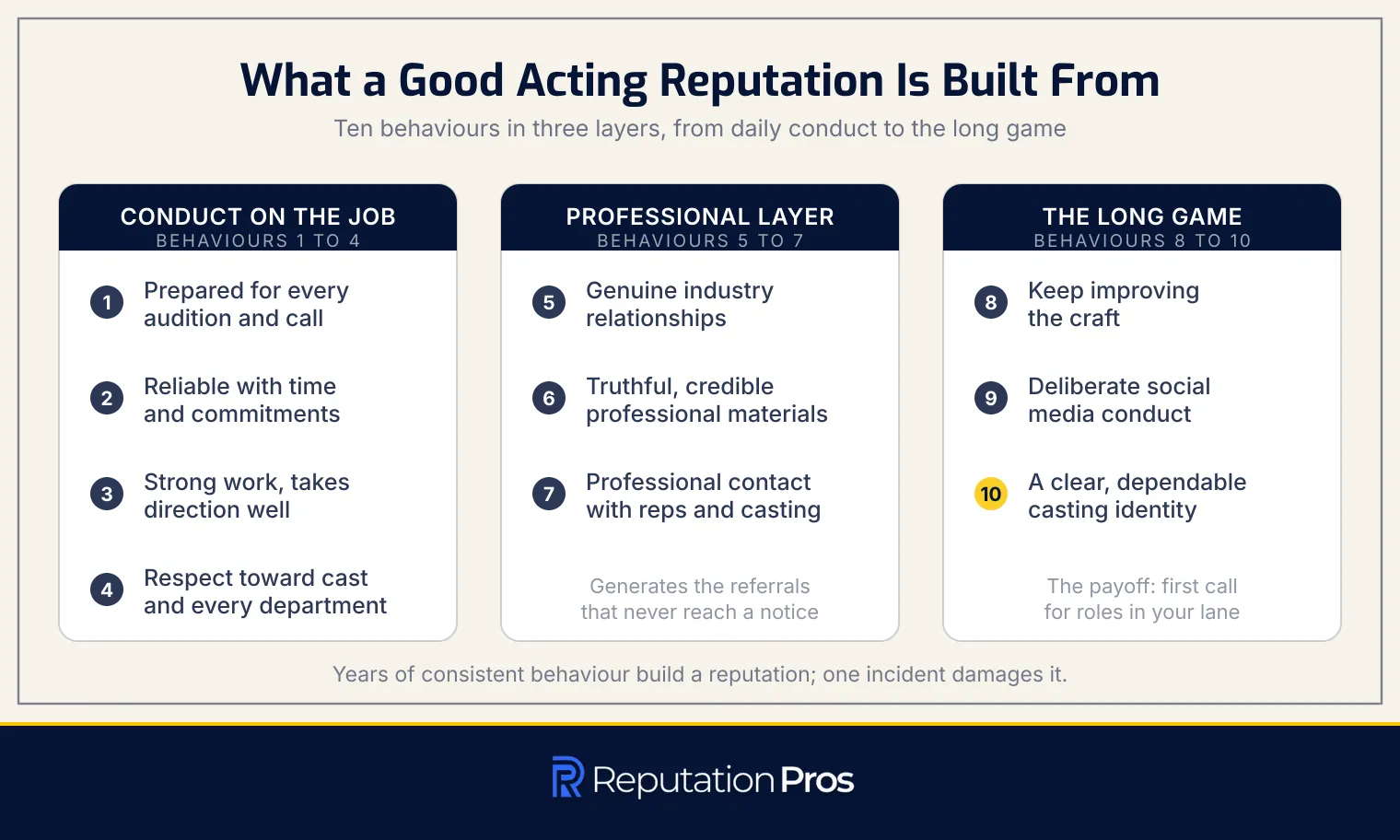
The ten behaviours that build an actor’s reputation follow one progression. Conduct on the job comes first, covering preparation for every call, reliability with time and commitments, strong work delivered while taking direction, and respect toward cast and crew in every department. The professional layer follows, covering industry relationships that generate referrals, truthful materials across every platform, and professional communication with representatives and casting offices. The long-game layer closes the sequence with craft development, deliberate social media conduct, and a clear casting identity.
A good reputation in acting consists of consistent behaviour across preparation, conduct, and communication, and it carries direct weight in repeat bookings and referrals. Actors build trust in the room through preparation, punctuality, and direction-taking, and they hold credibility across public materials through accurate, current, and consistent information. Criticism, rejection, and mistakes stop short of lasting damage when an actor responds rather than reacts, acknowledges error openly, and shows recovery behaviour that becomes its own reputation signal. Unreliability, credit inflation, on-set disrespect, public venting, and ghosting representatives each carry booking consequences, and a damaged reputation still recovers through a defined sequence: audit what is publicly visible, correct inaccurate credits and outdated material, address negative search results through removal or suppression, rebuild with current work, and monitor on an ongoing basis. Actors perform that repair alongside agents, publicists, legal counsel where the matter requires it, and online reputation management specialists such as Reputation Pros, who handle search results, professional profiles, and press coverage in step with an actor’s existing team. Reputation management begins where the ten behaviours begin, with the daily work of arriving ready, on time, and professional.
1. Be consistently prepared for auditions, rehearsals, and shoots
Consistent preparation is the clearest proof of professionalism an actor can offer. Preparation covers script and line readiness, self-tape quality control, and arriving informed about the project and the role. A self-tape carries controlled audio and lighting, framed sides, and a full review before submission.
Preparation reaches past memorised lines into the character’s motivations and the scene’s context, which lets an actor absorb a change in direction without losing the performance. In the audition room, that readiness signals discipline and respect for the casting process, and casting directors separate prepared actors from unprepared ones within the first minute. Readiness sets the first impression and raises the odds of a callback and a booking.
2. Be reliable with time, communication, and commitments
Reliability in acting means honouring commitments across time, communication, and obligations. A reliable actor answers messages promptly, discloses availability honestly, and holds to commitments unless an emergency intervenes. Answering calls and emails within 24 hours on business days respects the timelines casting directors and agents work to.
Honesty about availability carries equal weight. An actor who discloses a scheduling conflict the moment it appears lets a production adjust, rather than absorb a late disruption. Cancellation etiquette follows the same logic: cancel as early as possible, state the reason without drama, and offer to reschedule where the schedule allows.
Reliability builds trust with casting professionals because it signals dependability in fast production environments. An actor who meets commitments and states things plainly assures decision-makers of steady behaviour under pressure, which drives repeat bookings and referrals.
3. Deliver strong work while taking direction well
Strong work and direction-taking operate together in an actor’s reputation. Quality performance shows technical skill and emotional depth, and the speed at which an actor absorbs an adjustment separates the professional from the talented-but-unbookable. Direction-taking rests on active listening, which lets an actor understand a note and apply it without defensiveness.
Consistency across takes matters to directors and editors, who build a scene from footage an actor must be able to repeat. An actor who reproduces a strong take with a shift in tone, pacing, or intensity demonstrates craft and reliability at once. Receiving notes without defensiveness signals that the actor values the project above personal ego and reads direction as collaboration.
Active listening drives effective direction-taking, because a note carries an intention beyond its words. Actors who listen at that level integrate feedback quickly, need fewer takes, and keep the set collaborative. Strong work combined with flexible adjustment-taking builds the reputation that leads to repeat bookings, because it marks an actor as talented and easy to work with.
4. Treat cast and crew with respect
Respect toward cast and crew is the foundation of an actor’s on-set conduct. How an actor behaves toward every department, from the assistant director to wardrobe, lighting, sound, and the production assistants, reveals professionalism and character. Respect shows in courteous communication, attentive listening, and collaboration across roles, and each department carries part of the production.
Small proactive actions strengthen an actor’s standing on set. Helping crew members before being asked, holding focus through long shooting days, and thanking individuals by name all register. The assistant director manages the flow of the set and holds real influence over how an actor is discussed afterward, so respectful conduct toward the whole crew travels as word of mouth and returns as casting opportunities.
5. Build genuine industry relationships
Genuine industry relationships sustain an acting career in a way transactional networking cannot. Relationship-building rests on reciprocity and long-horizon contact maintenance, where an actor stays connected with peers, offers support, and remains a steady presence between collaborations.
The qualities that separate genuine relationships from transactional networking are listed below:
- Reciprocity: genuine relationships run on mutual support, and an actor who helps others without expecting immediate return builds goodwill that surfaces as opportunity later.
- Long-horizon contact maintenance: periodic, low-pressure check-ins, such as congratulating a peer on a recent success or passing along relevant industry news, keep an actor present in the minds of casting directors and producers.
- Distance from transactional networking: transactional networking chases the immediate benefit, while genuine relationship-building earns trust, and trust is what converts into referrals.
Referrals and industry relationships carry a large share of acting work that never reaches a public casting notice. A 2012 study in Organization Studies by Irena Grugulis and Dimitrinka Stoyanova, “Social Capital and Networks in Film and TV: Jobs for the Boys?”, found that hiring across film and television runs through informal networks and personal recommendation rather than open recruitment, which makes the network an actor maintains a working channel rather than a social one.
6. Maintain truthful, credible professional materials
Truthful professional materials protect an actor’s credibility. Every public profile, across IMDb, Spotlight, Casting Networks, Actors Access, and the agency profile, must carry accurate and consistent information, with verifiable credits and honest skill claims. IMDb accepts only submissions that are accurate and backed by supporting evidence or supplied by verifiable sources, and its editors compare listings against on-screen credits once a title is released and delete entries that do not match, according to IMDb’s “Cast/Acting Credits Guidelines.”
Headshots form the other half of an actor’s materials. A headshot must be current, within roughly two years, so it represents the actor who walks into the room; an outdated headshot creates a misleading first impression that works against the casting decision. Consistency across platforms carries the same weight, because a discrepancy between two profiles invites doubt about everything else an actor claims.
Accurate, synchronised, public-facing information reinforces an actor’s reliability before any meeting takes place. Casting directors read materials as the first evidence of professionalism, which makes the profile audit part of the reputation itself.
7. Communicate professionally with representatives and casting offices
Professional communication with representatives and casting offices keeps the working relationship functional. Communication runs on clear, plain language, written and spoken, without inflated self-promotion. A message stays concise, respects the recipient’s time, and covers what the recipient needs: availability, a question about sides or project details, or confirmation of a submission or appointment.
Follow-up cadence carries equal weight. An actor answers agents, managers, and casting offices within 24 hours where possible, and follows up on an audition or submission only when invited or after a reasonable interval of one to two weeks, unless the casting notice states otherwise. Repeated unsolicited follow-ups signal unfamiliarity with industry norms and work against the actor.
A professional tone holds even through difficult messages, such as a scheduling conflict or a declined opportunity. The aim is a standing reputation as someone who communicates in plain terms, respects boundaries, and understands the workflow of the professionals who control access to auditions and bookings. That conduct shapes how often an actor is considered, called in, and cast.
8. Keep improving your acting craft
Ongoing craft development signals commitment to casting directors, agents, and directors. An actor who keeps training demonstrates a proactive relationship with the work, through continued coaching and a widening technical range.
Actors who train on a regular cycle show a proactive approach to the craft. Training covers scene study, script analysis, and audition technique, and sharpening those skills raises an actor’s adaptability across stage, screen, and self-tape.
Breadth of technique comes from studying different acting methods and disciplines. An actor may work through Meisner or Stanislavski and add voice, movement, or improvisation, which widens their range and their reach across casting opportunities.
Investment in craft development raises performance quality and strengthens professional standing at the same time, because industry professionals read sustained training as dedication and reliability.
9. Use social media carefully as a working actor
Deliberate social media conduct protects a working actor, because public posts are permanent and open to industry scrutiny. Casting directors, agents, and producers screen an actor’s online presence before auditions and bookings, as Backstage documents in “How Casting Directors Use Social Media to Find Actors.” An actor’s online persona therefore needs to align with their professional identity, since inconsistency raises questions about authenticity and reliability.
Thoughtful responses to criticism protect that standing. An impulsive or emotional reply in a public forum damages an actor’s image regardless of talent or experience. Social media serves an actor best when it shows professionalism, industry engagement, and training, and a regular audit removes content that no longer serves the career.
What is publicly visible across Instagram, X, Facebook, TikTok, LinkedIn, and a personal website all belongs in that audit. Privacy settings, tagged content, and third-party mentions need to match the professional image an actor intends to project, which turns social media into support for a reputation rather than a risk to it.
10. Build a clear, dependable casting identity
A clear casting identity establishes a recognisable niche that matches how casting directors think. Casting identity requires consistent type signalling across auditions, materials, and past roles, so decision-makers can place an actor into named parts without effort. An actor known for late-twenties corporate professionals, or for edgy character work with physical comedy, carries a strong casting identity.
Consistent type signalling drives memorability. When headshots, reel clips, résumé credits, and audition choices point to the same casting lane, an actor becomes the first call for those roles. Scattered signals, such as alternating between ingénue and hardened detective without the range to support both, dilute recall and weaken the advocacy a casting office is willing to offer.
The casting identity built across these ten behaviours, from preparation and reliability through truthful materials and deliberate social media conduct, is what a good reputation consists of in practice: the accumulated judgment that an actor is skilled, professional, and dependably castable within a credible identity.
What defines a good reputation in acting?
A good reputation in acting is the collective judgment of industry professionals, including casting directors, agents, directors, and crew. That judgment reflects an actor’s professionalism, reliability, and conduct on set and in professional exchanges. A good reputation forms through consistent preparation, punctuality, and respect for colleagues, alongside performances delivered without friction. Unlike personal branding, which an actor controls, a good reputation forms independently in the minds of decision-makers and functions as an invisible credential in casting.
What is the meaning of good reputation?
A good reputation is the positive judgment others hold of a person’s professionalism, reliability, and character. In acting, a good reputation means casting directors, agents, directors, and crew trust an actor to perform and to conduct themselves well.
What is the importance of reputation for an actor’s career?
Reputation is the primary gatekeeper to repeat bookings and referrals in an acting career. Casting directors, agents, and producers return to actors with a proven record of professionalism and reliability, and a strong reputation opens roles that never reach a public casting notice. The asymmetry between building and losing a reputation governs how an actor treats every interaction: credibility accumulates across years of consistent behaviour, while a single instance of unreliability or public misconduct undercuts it. Negativity bias explains the imbalance: bad impressions form faster and resist disconfirmation more stubbornly than good ones, as Roy Baumeister, Ellen Bratslavsky, Catrin Finkenauer and Kathleen Vohs established in “Bad Is Stronger Than Good,” published in Review of General Psychology in 2001. Reputation management therefore sits on equal footing with reputation building across a career.
How can actors build trust during auditions, rehearsals, and shoots?
Actors build trust during auditions, rehearsals, and shoots through preparation, punctuality, and direction-taking. Preparation means knowing the script and the character details and arriving with lines ready, which shows commitment to the role and the production team. Punctuality means arriving on time and ready to work, which signals respect for everyone else’s schedule. Direction-taking means listening to a note, adjusting quickly, and applying the change without defensiveness, which demonstrates coachability. Together those behaviours communicate professionalism and dependability to casting directors and production teams.
How can actors build lasting industry relationships?
Actors build lasting industry relationships through reciprocity and sustained contact beyond a single job. Sustained contact means offering value, keeping communication regular, and taking genuine interest in the careers of directors, producers, and fellow actors over years rather than production cycles.
How can actors maintain credible professional reputation?
Actors maintain a credible professional reputation through accuracy and consistency across every public profile. Credibility requires current headshots, verifiable credits, and honest skill claims on IMDb, Spotlight, Casting Networks, and Actors Access. Consistency across those platforms prevents the contradictions that erode a casting director’s trust. Regular audits of professional materials, with updates after each booking or training course, show the same attention to detail casting teams expect in preparation and conduct.
How can actors handle criticism, rejection, and mistakes professionally?
Actors handle criticism, rejection, and mistakes professionally by acknowledging error openly and treating it as material for growth. Acting holds no perfection standard, so errors are expected and recovery behaviour carries the weight. An actor demonstrates professionalism through quick acceptance of responsibility and a visible adjustment in approach, which signals the emotional maturity and resilience casting directors and crew value. Recovery behaviour becomes its own reputation signal, showing that the actor works under pressure and learns from feedback, and a well-handled mistake can strengthen a reputation rather than dent it.
What habits damage an actor’s professional reputation?
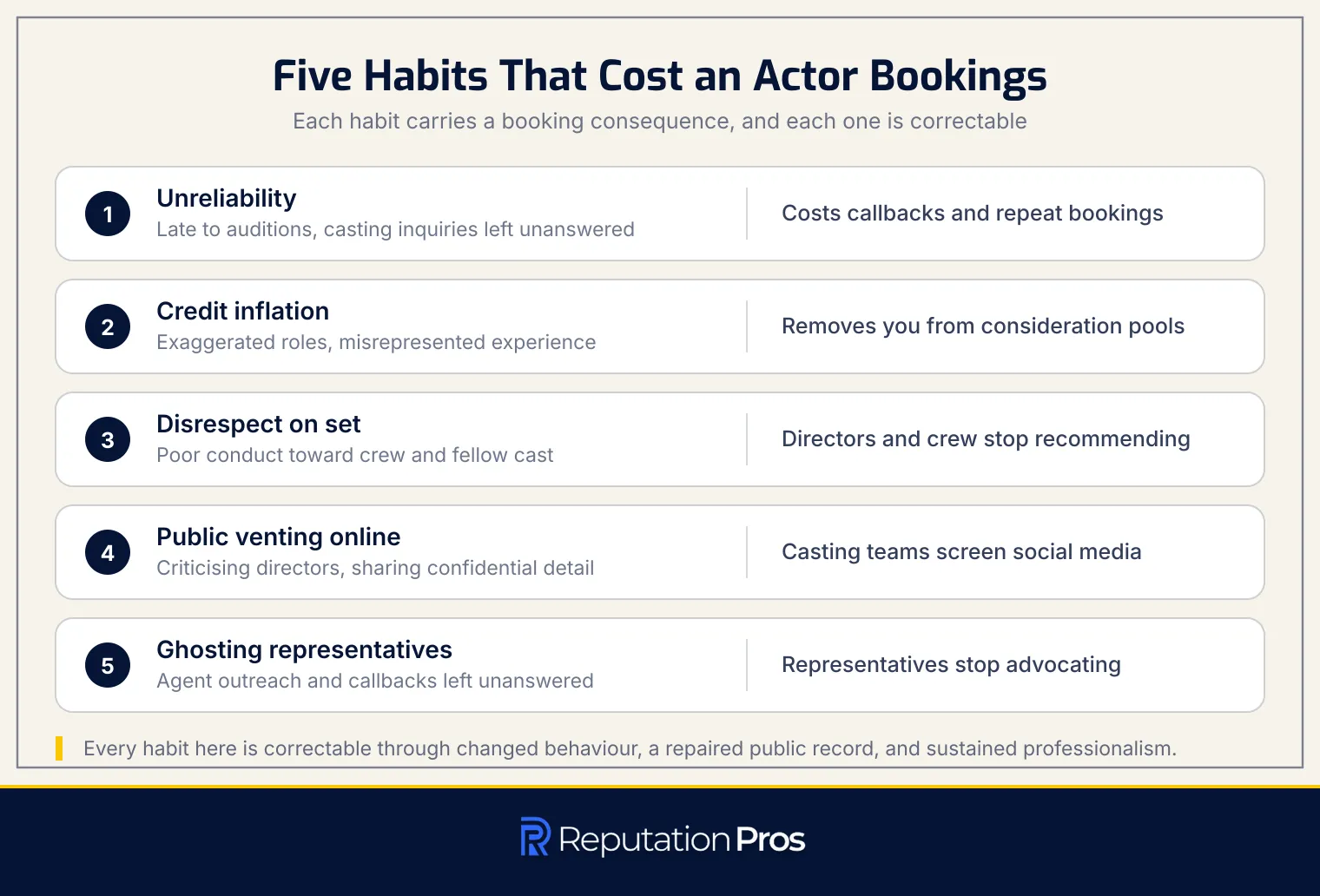
The habits that damage an actor’s professional reputation are listed below:
- Unreliability: arriving late to auditions or leaving casting inquiries unanswered reads as disrespect for other people’s time, and decision-makers treat it as a risk to schedule and budget, which costs callbacks and repeat bookings.
- Credit inflation: exaggerating a role or misrepresenting experience on a résumé surfaces quickly once a casting director verifies credits, and it removes an actor from consideration pools while damaging the representative who vouched for them.
- Disrespect on set: poor conduct toward crew and fellow cast signals weak collaboration, creates tension, and makes directors and crew unwilling to recommend the actor; word travels fast inside production communities.
- Public venting online: criticising directors or sharing confidential production information in public shows poor judgment, and because casting teams screen social media, public volatility can make an actor unbookable regardless of talent.
- Ghosting representatives: leaving agent outreach or callback requests unanswered weakens working relationships and reduces advocacy, and representatives drop actors who create communication blackouts.
Each habit carries a booking consequence, and each remains correctable through changed behaviour, a repaired public record, and sustained professionalism over time.
How can actors repair a damaged reputation?
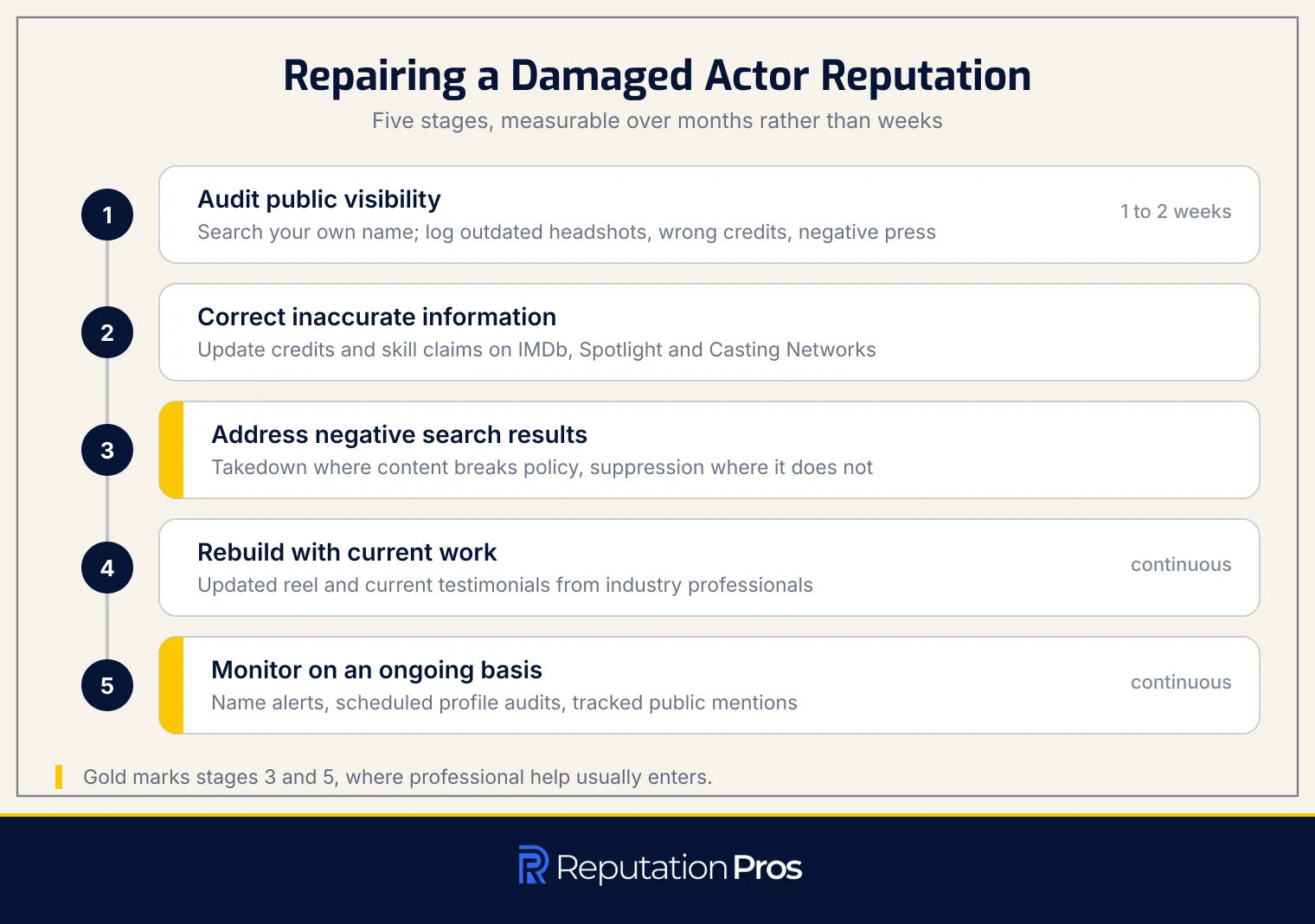
To repair a damaged reputation, an actor works through a structured sequence of five stages.
Stage 1: Audit public visibility. The repair begins with a full audit of what is publicly visible. An actor searches their own name on Google, IMDb, and social platforms and documents outdated headshots, inaccurate credits, and negative press mentions. The audit runs one to two weeks and sets the foundation for every later stage.
Stage 2: Correct inaccurate information. An actor then corrects the inaccuracies in their professional materials, updating credits, skill claims, and biographical details on IMDb, Spotlight, and Casting Networks. IMDb reviews submitted corrections against supporting evidence before publishing them, and its editors compare a listing against the finished on-screen credits once a title is released.
Stage 3: Address negative search results. An actor next addresses negative or outdated search results, either through formal takedown requests where content violates platform policy, or through suppression, publishing accurate material that outranks the negative result. Google Search Help sets the limit of that first route in “Remove my private info from Google Search”: a granted request takes material out of Google’s results without deleting it from the site that hosts it, so contacting the host and suppressing what remains both stay in the sequence. De-indexing moves faster than suppression, which works over months rather than weeks.
Stage 4: Rebuild with current work. Rebuilding generates new professional material, including an updated reel and current testimonials from industry professionals. Stage 4 runs continuously alongside an actor’s active career.
Stage 5: Monitor on an ongoing basis. Ongoing monitoring closes the sequence. An actor sets alerts on their name, audits profiles on a schedule, and tracks public mentions, which stops new inaccuracies from settling into the record.
Progress becomes measurable over months rather than weeks, and stages 3 and 5 are where professional help usually enters. The sequence mirrors the wider playbook for rebuilding a damaged online reputation, applied to an acting career.
Who can help fixing online reputation for actors?
The professionals who help fix an actor’s online reputation are listed below, with what each one handles and where their remit ends.
| Professional Category | What They Handle | What They Cannot Do | When to Involve Them |
|---|---|---|---|
| Publicists | Shape media coverage, coordinate announcements, and frame a public narrative | Remove defamatory material, change platform records | When managing publicity, press response, or crisis messaging |
| Agents and Managers | Support career positioning, maintain industry relationships, communicate with casting and production contacts | Provide legal remedies, erase harmful search results | When reputation issues affect bookings, submissions, or industry communication |
| Legal Counsel | Handle defamation, privacy, harassment, and data-protection issues | Replace ongoing PR, profile maintenance, or craft rebuilding | When dealing with false, unlawful, or damaging content requiring legal action |
| Online Reputation Management Specialists | Audit search results, suppress negative content, improve visibility of accurate material | Make every negative item vanish, substitute for legal action | When managing search visibility, public profiles, and long-term online reputation |
| The Actor Working Alone | Correct profiles, keep materials current, respond professionally | Control third-party coverage, legal disputes, or search engine rankings | For day-to-day upkeep, before issues extend beyond personal maintenance |
At Reputation Pros, we work within the online reputation management specialist category, handling the technical and strategic work that falls outside what agents, publicists, and legal teams cover: suppressing negative search results, correcting inaccurate platform content, and raising the visibility of credible professional materials.
Why choose Reputation Pros for actor reputation management?
At Reputation Pros, we manage actor reputations across search results, professional profiles, and press coverage. We shape search results so an actor’s first impression matches their professional identity. Our team maintains professional profiles and public materials, holding credits, headshots, and bios consistent across IMDb, Spotlight, Casting Networks, and Actors Access. We handle press coverage to build credibility rather than leave it to chance, and we deliver confidential, white-glove celebrity reputation management for high-visibility clients who require discretion. We work alongside agents and managers, keeping reputation repair and visibility management aligned with an actor’s broader team strategy.