Understanding Content Removal Policies of Google
 14 min read
 On this page
Google’s content removal policies define the specific categories that Google removes from Search, including personal identifiers, non-consensual imagery, court-ordered unlawful content, and DMCA copyright claims. The policies remove a URL from Google Search under a qualifying ground, which is not the same as deindexing (where the site owner blocks a page with a noindex tag or robots.txt rule) and not the same as deleting the page from the source site.
Removal requests run through three main channels. The Results About You tool handles personal information such as phone numbers, home addresses, and email addresses. A Legal Removal Request covers content that violates the law, including defamation, copyright infringement under the DMCA, and court-ordered material. The Refresh Outdated Content tool updates search results when the source page has been deleted or substantially changed but Google’s cached version still shows old data. Each request needs the exact URLs, a clear explanation of the policy or legal ground, and supporting documentation where relevant.
Google’s policies are narrow on purpose. Truthful news articles, accurate public records, and lawful criticism stay accessible in search results, even when they affect reputation. Approved removals usually process within a few days, though legal cases can take weeks, and removed content can reappear when the source page is updated or duplicated elsewhere. When Google declines a request, the alternatives are contacting the website owner directly, suppressing the content with positive assets that outrank it, or pursuing legal action for a court order that compels removal at the source.
What are content removal policies of Google?
Google’s content removal policies define the specific categories of content that Google removes from its Search results. The categories include personal identifiers, non-consensual imagery, court-ordered unlawful content, and material that infringes DMCA copyright claims. The policies aim to protect individual rights while keeping Google compliant with legal requirements. Google content removal is the process of taking a URL out of Google Search under a qualifying policy or legal ground, which differs from deleting the page from the site itself.
How does deindexing differ from content removal in Google?
Deindexing and content removal are distinct processes in Google Search. Deindexing makes a webpage invisible in search results without deleting the content from the original site, usually through a noindex tag or a robots.txt rule set by the website owner. Content removal takes a URL out of Google Search under a qualifying policy or legal ground, such as non-consensual imagery or a DMCA copyright claim. Deindexing hides content from search results, while content removal blocks the URL from appearing in Google Search altogether.
What content does Google remove for policy violations?
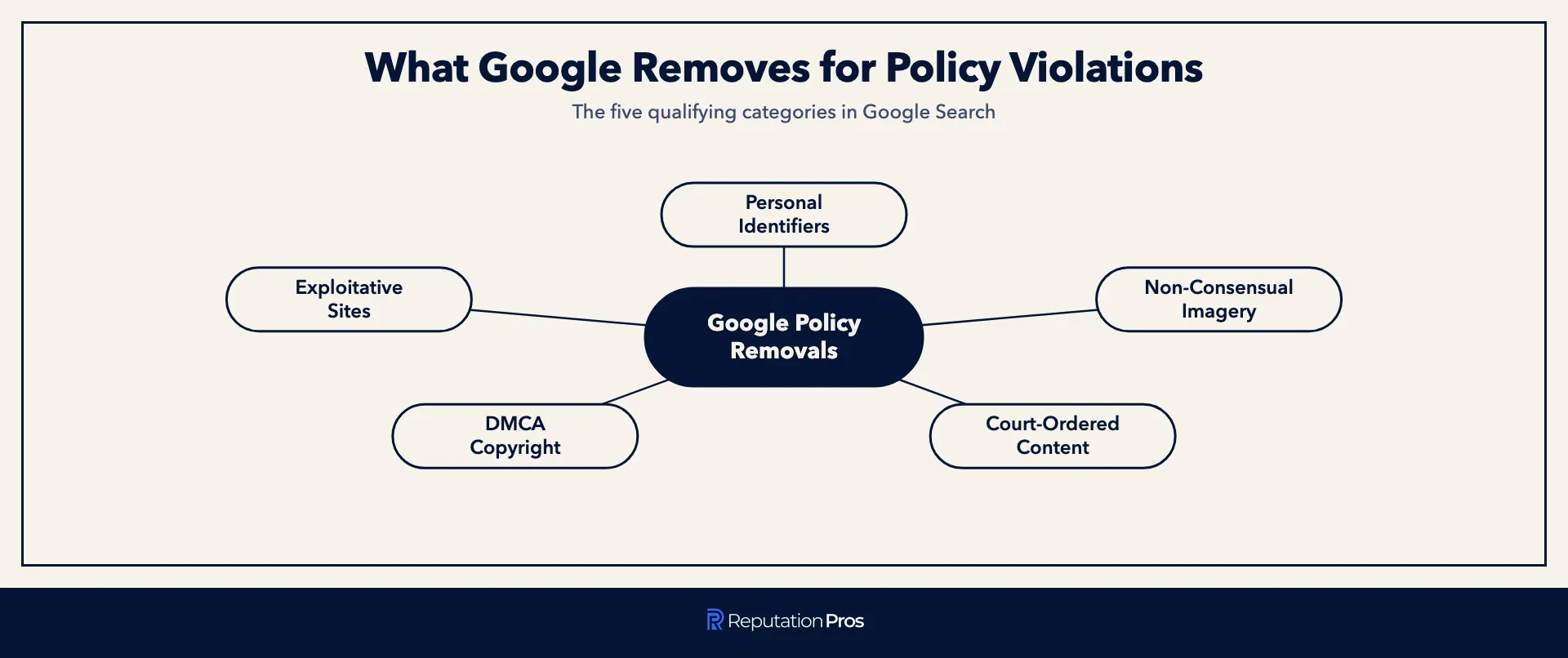
Google removes content from its Search results that violates specific policy categories. The categories are personal contact information and identifiers, non-consensual and explicit imagery, court-ordered unlawful content, copyrighted material under the DMCA, and content on sites with exploitative removal practices, such as sites that demand payment to take content down. Each category is detailed below.
Personal Contact Information and Identifiers
Google removes personal contact information and identifiers when their presence poses a real risk of identity theft, financial fraud, or other harm. The category covers sensitive details such as phone numbers, email addresses, home addresses, government-issued identification numbers, bank account details, and login credentials. A removal request must include the specific URLs and screenshots of the content. Google weighs each request individually, balancing the privacy risk against the public interest in the information. The removal affects search results only and does not delete the content from the original website, so a person may need to contact the website owner directly for complete removal.
Non-Consensual and Explicit Imagery
Non-consensual and explicit imagery is content involving intimate images or videos shared without the subject’s consent. The category includes non-consensual intimate images, often called revenge porn, where private images are distributed without permission. Google also removes AI-generated or fake explicit images, known as deepfakes, that depict individuals in situations they never took part in. Content that falsely ties someone to sex work or the adult entertainment industry is also removable when it is harmful and inaccurate. A person requests removal through Google’s dedicated forms, specifying the type of content and the URLs where it appears. Google balances removal of harmful content against public-interest access, unless the content causes personal distress. Once removed from Google Search, the content is deindexed, though it may still exist on the original website unless the site owner removes it.
Court-Ordered Unlawful Content
Court-ordered unlawful content is material that Google removes from search results following a valid court order. Google removes content a court has deemed unlawful, such as defamatory material, copyright infringements, or privacy violations. Google checks whether the court order is valid and applicable to its services, and a confirmed order leads Google to suppress the content from search results, though the content remains on the original website unless the order also requires removal there. Google logs the action in its Transparency Report, which discloses removal requests by country and type.
Copyrighted Material Under the DMCA
Google removes copyrighted material from its search results when a valid request is filed under the Digital Millennium Copyright Act. The Digital Millennium Copyright Act, codified at 17 U.S.C. section 512, is a U.S. copyright law that lets copyright holders request removal of unauthorized copies of their work from search results. When Google receives a complete, valid DMCA takedown notice, it removes the specific URLs named in the complaint from its search index, making them unavailable in search results, though the removal does not delete the material from the original website. A copyright holder or authorized representative files a DMCA request through Google’s designated process, including identification of the copyrighted work, the URLs where unauthorized copies appear, and a good-faith statement that the use is not authorized. Google’s Copyright Help Center provides guidance on the removal process and the requirements for a valid takedown notice.
What content does Google remove for spam?
Google removes content that violates its spam policies, which target manipulative practices designed to deceive users or game search rankings. The primary spam types Google removes are listed below:
- Automatically generated content: content created by automated processes without meaningful human input.
- Scraped content: material copied from other sites without adding value or original commentary.
- Keyword stuffing: excessive repetition of keywords to manipulate rankings.
- Cloaking: showing different content to users and to search engines to deceive ranking systems.
- Sneaky redirects: sending users to a different page than the search result indicated.
- Hidden text or links: concealing text or links that affect search visibility but not the user experience.
- Doorway pages: pages built only to rank for specific queries and funnel users elsewhere.
- Link schemes: manipulating PageRank through unnatural links.
The practices lower the quality of search results, and Google’s algorithms and manual reviewers detect and remove such spam.
What content does Google remove for legal reasons?
Google removes content for legal reasons when a valid legal process or court order requires it. The legal category covers content a court has deemed unlawful, such as defamatory material, privacy violations, or content that infringes copyright law, including the Digital Millennium Copyright Act. A legal removal request goes through Google’s Legal Help Center, where the requester specifies the Google product involved, explains why the content violates the law or their rights, and provides the specific URLs. Google can restrict access to content on its products when legally required, and complete removal from the web may still require contacting the website owner directly.
What content does Google not remove for policy violations?
Google does not remove content just because it is unwanted or embarrassing. Truthful news articles, accurate public records, and lawful criticism stay accessible in search results. Google will not remove the content listed below:
- Factual news articles from legitimate sources, even when they affect reputation.
- Public records, such as arrest records or court opinions, that are legally accessible.
- Negative but honest reviews and lawful commentary without defamatory statements.
- Social media posts, unless they violate specific policies such as doxxing or non-consensual imagery.
The approach reflects Google’s balance between individual privacy and the principles of information access and free expression.
How Do You Report Content for Removal to Google
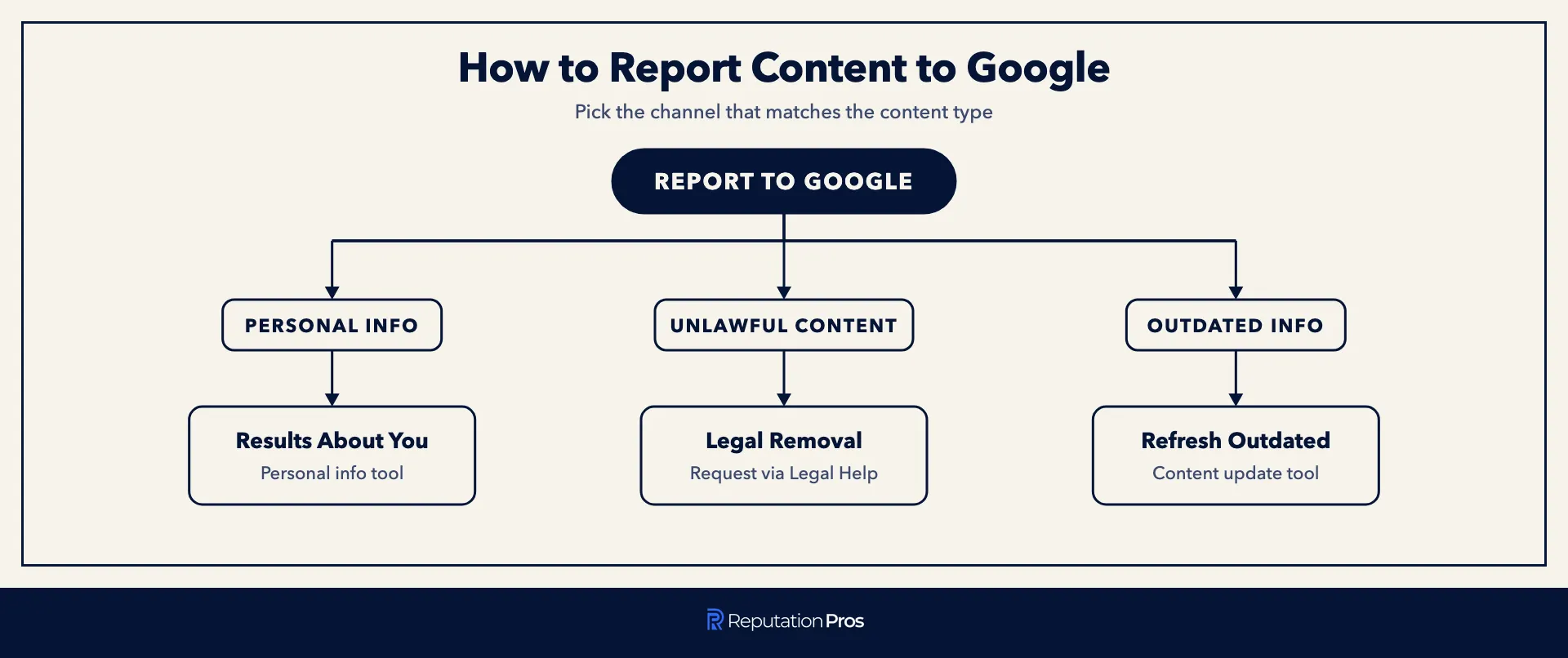
To report content for removal to Google, select the reporting channel that fits the type of content and the specific policy violation. The channels are the Results About You tool for personal information, a Legal Removal Request for content that violates laws, and the Refresh Outdated Content tool for information that is no longer accurate. Each tool requires the specific URLs and a description of why the content should be removed under Google’s policies. The correct reporting method decides whether the request succeeds, and each tool is broken down below.
Using the Results About You Tool
The Results About You tool streamlines requesting removal of personal information from Google Search. The tool helps users find and manage search results that include their personally identifiable information, such as phone numbers, home addresses, and email addresses.
A user opens the tool through Google Search and starts a removal request by providing the URLs where the information appears and explaining why the content should be removed under Google’s personal information policies. After submission, Google weighs the content against its removal criteria, balancing privacy against public interest.
The tool helps most with doxxing or exploitative removal practices and aims to prevent identity theft by removing sensitive information from search results. The tool affects Google Search results only and does not delete the content from the original website or other search engines.
Filing a Legal Removal Request
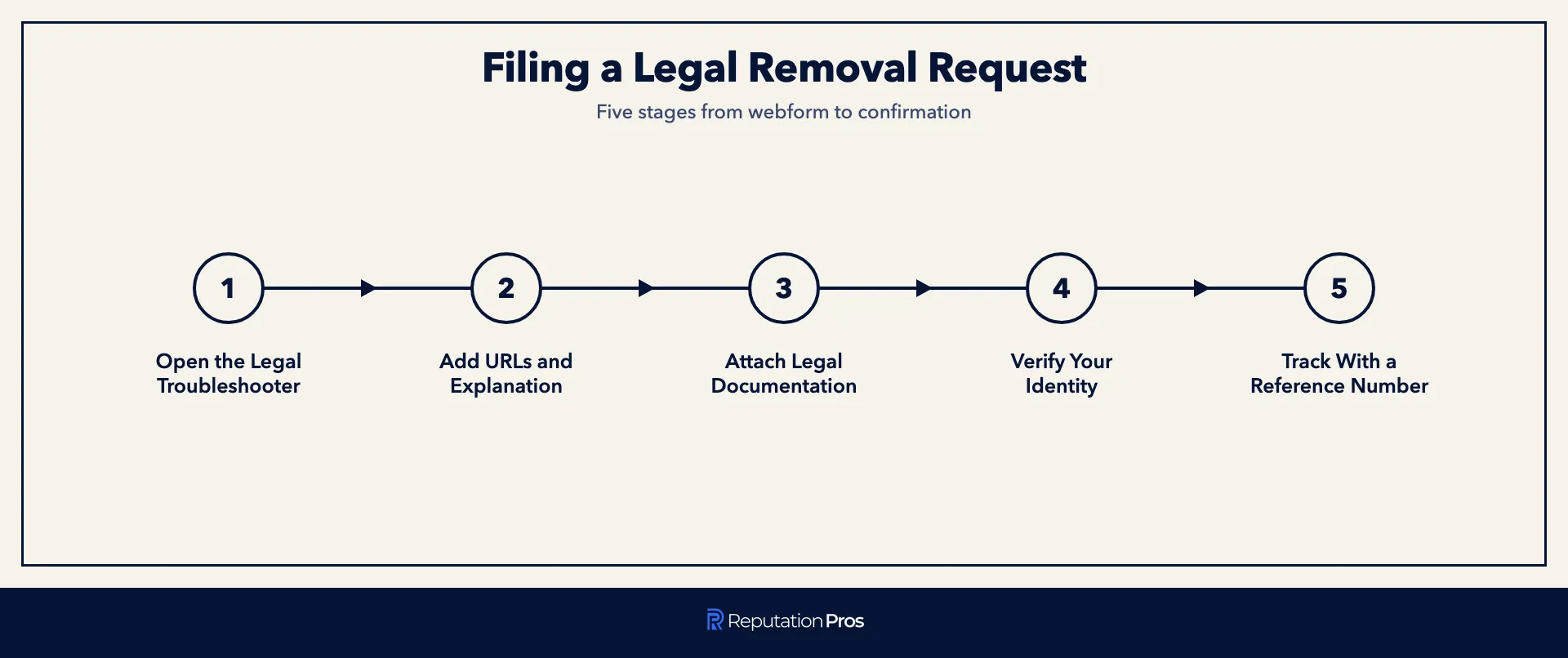
Filing a legal removal request with Google follows a structured process for content that violates legal standards. A user opens the Google Legal Removal Troubleshooter, which routes to the correct webform based on the specific legal issue, such as defamation, copyright infringement, or a court order.
The request must include the specific URLs and a detailed explanation of why the content is unlawful, and supporting documentation, such as a court order or copyright details, is often required. Identity verification is mandatory, usually through a government-issued ID.
After submission, Google reviews the information and sends an email confirmation with a reference number, which lets the user track the request and answer follow-up questions.
Submitting a Refresh Outdated Content Request
Submitting a Refresh Outdated Content Request lets users update search results when Google shows outdated information. The request applies when the original webpage has been deleted or substantially altered but Google’s cached version still shows old data, so the user must confirm the content is gone or changed on the source site first.
A user logs into a Google account, opens the Refresh Outdated Content tool through Google Search Console, provides the exact URL of the outdated page or image, and submits it. An approved request updates or removes the outdated search result, while content that remains unchanged on the source website leads to a denied request.
What are the things to know about Content Removal Policies of Google
Google’s content removal policies have a specific scope and clear limits. The policies are narrow, targeting personal identifiers, non-consensual imagery, court-ordered unlawful content, and DMCA copyright claims, and they remove URLs from Google Search results rather than deleting content from the original site. Removal timelines and effectiveness vary: simple requests can process within a few days, while complex legal cases can take weeks. Even after removal, content can reappear when the source page is updated or re-indexed. When Google denies a request, alternatives include contacting the website owner, using suppression tactics, or pursuing legal action.
How Long Does Google Take to Remove Content?
Google usually reviews and removes content from search results within a few days of approving a valid removal request. The timeframe varies with the complexity of the request and the type of content, and cases that involve legal issues or difficult policy violations can take several weeks. Simple requests, such as outdated content, tend to process faster than legal or court-order cases.
Is Content removal request from Google effective?
Content removal requests to Google are effective when they meet Google’s specific policy criteria or legal requirements. Requests within qualifying categories, such as non-consensual imagery, personal identifiers, court orders, or DMCA copyright claims, are reviewed and processed, while requests that fall outside those categories are declined. An approved removal affects Google Search results only, not the original webpage, where the content stays hosted.
Can removed content reappear in search results?
Yes, removed content can reappear in Google search results. Reappearance happens when the original website updates the page to include the content again or when duplicate copies exist on other sites Google has not deindexed. A successful counter-notice after a DMCA or legal removal can also lead Google to restore the content to its index. To prevent reappearance, confirm the content is permanently removed from the source site, check for duplicates across other platforms, and submit a Refresh Outdated Content request when the URL still shows stale snippets.
What are the alternatives of Requesting removal content from Google?
When Google declines a content removal request, several alternatives address the issue. The most direct route is contacting the website owner or publisher to request deletion or modification at the source, and many sites negotiate when a valid privacy or outdated-information concern is presented. A second route is reputation management that pushes negative content down in search results by creating and promoting positive content that ranks higher, which lowers the visibility of the unwanted material. For the full playbook, see our guide on how to suppress content from Google. Legal action fits when the content is defamatory or violates privacy rights, and it can produce a court order for removal. The alternatives give individuals and organizations workable paths when direct removal from Google is not an option.
Why Choose Reputation Pros for Google Content Removal?
At Reputation Pros, we are a strong choice for Google content removal because we understand Google’s complex removal policies in depth. As an online reputation management company, we use a multi-part approach that combines direct engagement with Google and publisher negotiations to improve outcomes. Our approach gives clients guidance fitted to their situation and raises the odds of a successful content removal.