Understanding Content Removal Policies of Facebook
 14 min read
 On this page
Facebook’s content removal policies define what the platform removes under its Community Standards, including bullying and harassment, privacy-violating posts, court-ordered defamatory content, and intellectual property infringements. Distasteful posts that do not cross those lines generally stay up, and defamatory content usually needs a valid court order before Facebook acts, because the platform does not independently assess defamation claims under local laws.
Removal requests run through three main channels. In-app reporting handles general Community Standards violations such as harassment, hate speech, or privacy issues, filed directly on the post or profile. An intellectual property complaint covers copyright or trademark infringement through Facebook’s dedicated IP forms. A legal removal request covers defamatory content and other legal issues, submitted with supporting documentation such as a court order.
Standard violations usually process within a couple of days, while intellectual property and legal cases can take several days to weeks. Removed content can reappear when Facebook overturns its decision on appeal or restores content flagged in error. When Facebook declines a request, the alternatives are appealing through the Support Inbox, pursuing legal remedies such as a cease-and-desist letter or a court order, and content suppression that pushes negative posts lower in search results with positive assets that outrank them.
What Content Will Facebook Remove?
Facebook removes content that violates its Community Standards to keep the platform safe and respectful. The main categories are listed below:
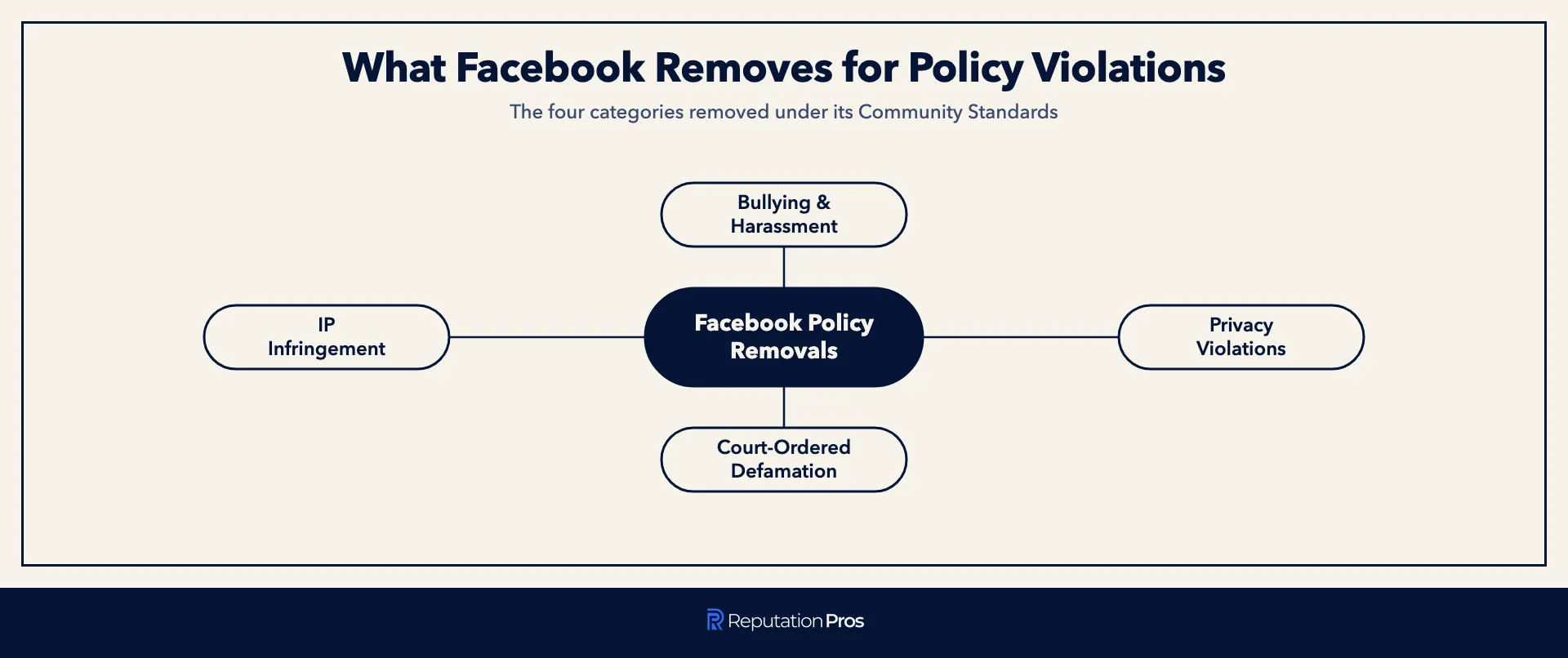
- Bullying and harassment: content targeting individuals with abusive, threatening, or humiliating behavior.
- Privacy-violating posts: posts sharing personal information without consent, such as addresses or phone numbers.
- Court-ordered defamatory content: content a court has deemed unlawful, removed on a valid legal request.
- Intellectual property infringements: content using copyrighted material or trademarks without authorization.
The categories anchor Facebook’s content removal policies, as set in its official Community Standards.
Bullying and Harassment Content
Bullying and harassment content on Facebook is abusive behavior targeting individuals, including threats, degrading statements, or coordinated campaigns meant to humiliate or intimidate. Facebook’s Community Standards prohibit the content, especially when it targets private individuals, and cover credible threats of violence, sexual harassment, and sharing private residential information with malicious intent. Facebook gives everyday users more protection than public figures, and content that crosses into severe bullying, such as calls for self-harm or non-consensual sharing of sexualized images, comes down regardless of the target’s public status. A user who experiences bullying can report the content through Facebook’s tools, which can lead to account restrictions or bans for offenders.
Privacy-Violating Posts
Privacy-violating posts share personal or confidential information without consent. Under Facebook’s Community Standards, the category covers posts that disclose private contact information such as phone numbers, addresses, or email addresses, and it also covers unauthorized sharing of personal identification documents, medical records, or private messages and images shared in confidence. The content creates risks of identity theft, stalking, or harassment. Facebook’s privacy protections, aligned with Meta’s Data Policy, collect and share personal information only with consent and within applicable laws. A user can report privacy violations through Facebook’s tools, prompting Facebook to review and potentially remove the content.
Court-Ordered Defamatory Content
Court-ordered defamatory content is material a court has legally determined to be defamatory. Facebook removes the content only on a valid court order from a competent legal authority, which confirms the statements are false, harmful to reputation, and made without adequate legal privilege or defense. When Facebook receives a court order, it reviews the order for validity and jurisdictional authority, then removes or restricts access to the specified posts, comments, or materials. The legal removal process differs from Facebook’s internal policy enforcement because it relies on external legal adjudication rather than the Community Standards.
Intellectual Property Infringements
Intellectual property infringements on Facebook occur when content uses someone’s copyrighted material, trademarks, or other proprietary rights without authorization. Facebook removes the content when the rights holder submits a valid complaint with evidence of ownership and identification of the infringing content through Facebook’s dedicated reporting tools. Common examples include unauthorized use of copyrighted photographs, videos, music, and branded logos. Copyright claims fall under the Digital Millennium Copyright Act, codified at 17 U.S.C. section 512. After a complaint is filed, Facebook reviews the submission to decide whether the content violates intellectual property rights and removes confirmed infringing material. A user whose content is removed is notified and can submit a counter-notification when they believe the removal was an error.
What Content Will Facebook Not Remove?
Facebook will not remove content that follows its Community Standards, even when some users find it offensive or controversial.
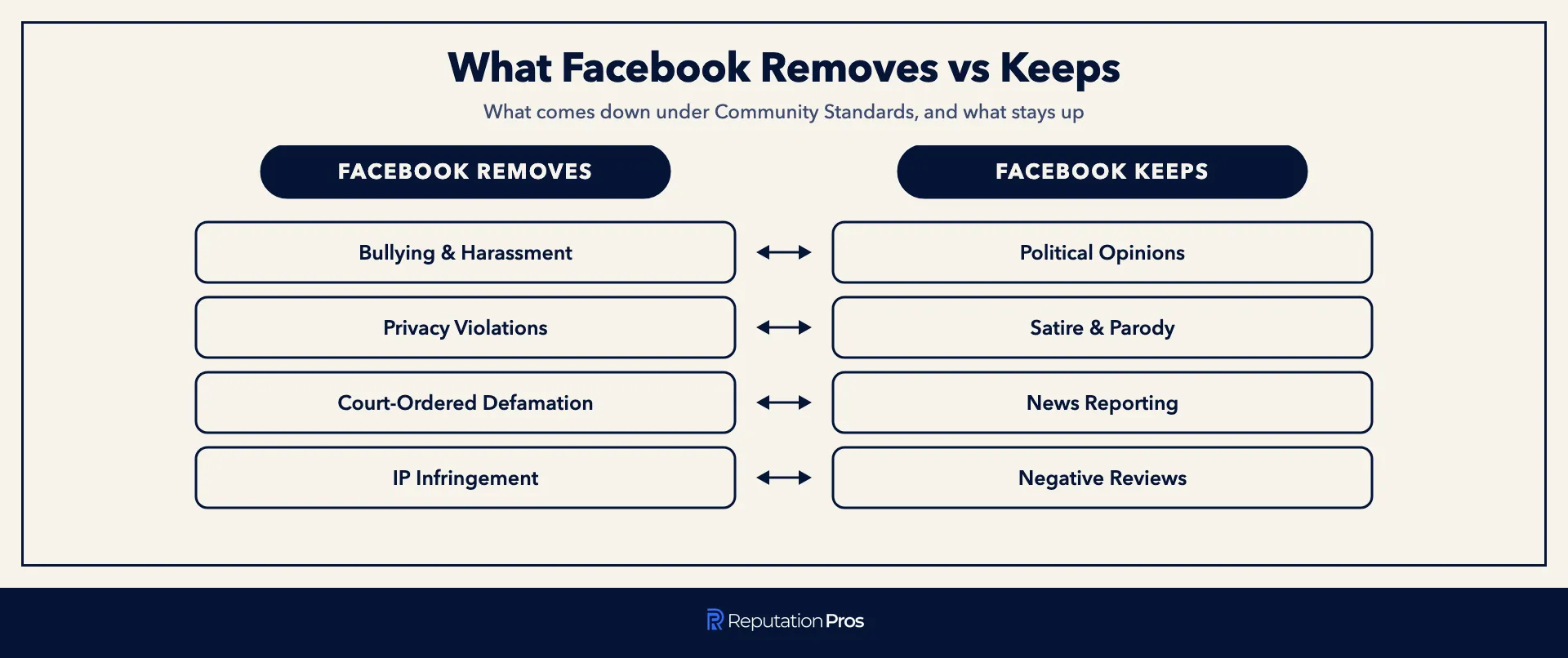 Protected content includes political opinions, satire, and parody, as well as news reporting on sensitive topics. Distasteful content that does not cross into prohibited categories, such as hate speech or threats, generally stays up. Facebook also declines to remove defamatory content without a valid court order, because the platform does not independently assess defamation claims under local laws. Facebook will not remove content just because someone is tagged in a photo they dislike or mentioned in a post they find unfavorable, unless it violates privacy policies by sharing personal information such as contact details or financial data. Negative reviews and unfavorable comments generally stay unless they break a specific Community Standard.
How Do You Report Content for Removal on Facebook?
Reporting content for removal on Facebook starts with choosing the channel that fits the violation. The three primary methods are listed below:
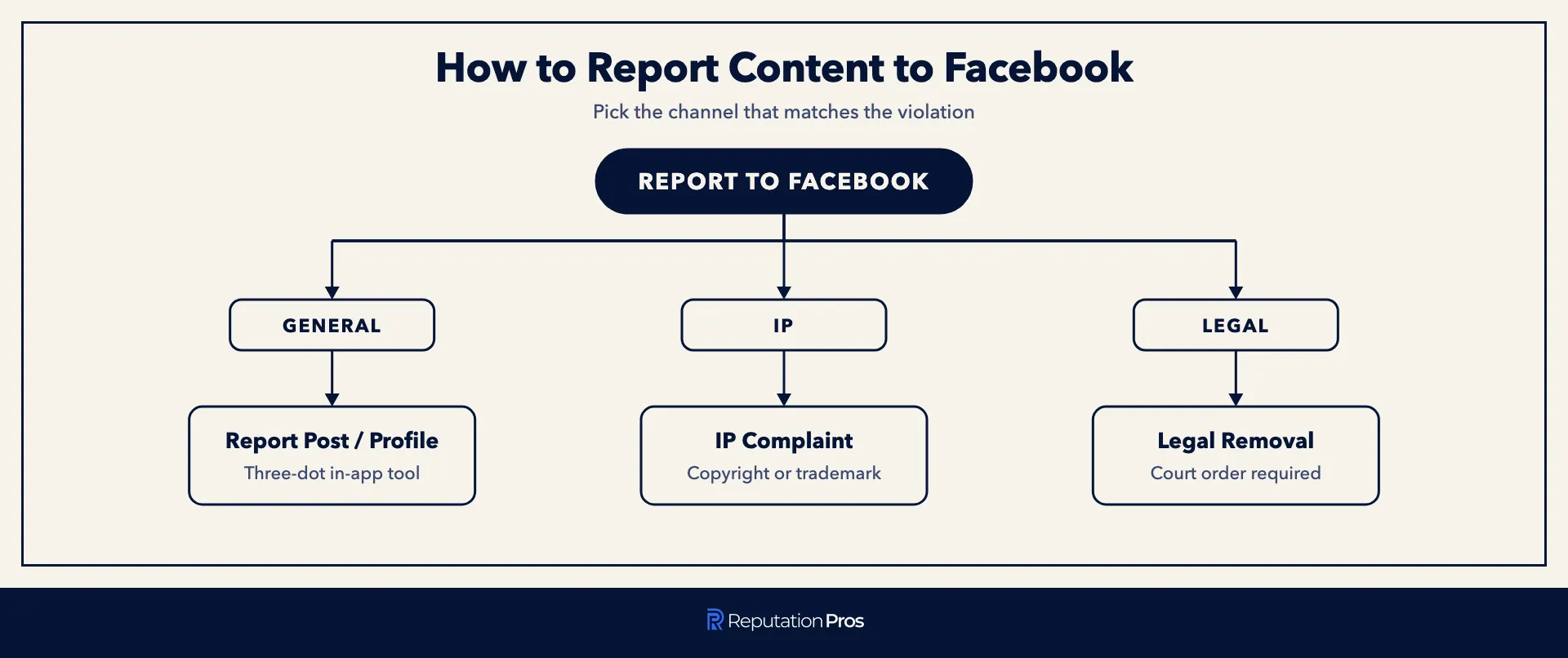
- In-app reporting: for general violations such as bullying, harassment, or privacy issues, reported directly through the post or profile with Facebook’s built-in tools.
- Intellectual property complaint: for copyright or trademark infringement, filed through Facebook’s dedicated IP reporting forms.
- Legal removal request: for defamatory content or other legal issues, submitted as a legal removal request, often requiring a court order for defamation.
Each method requires specific information, and each channel is detailed below.
Reporting a Post or Profile
Reporting a post or profile uses Facebook’s built-in tools to flag content that violates Community Standards. To report a post, a user clicks the three-dot menu in the upper-right corner of the post and selects Find support or report post, then chooses the type of violation, such as harassment, hate speech, or false information, and adds context before submitting the report to Facebook’s review team. Reporting a profile follows a similar path: the user opens the offending profile, clicks the three-dot menu under the cover photo, selects Find support or report profile, and specifies the reason, such as impersonation or inappropriate content. Facebook’s automated systems and human reviewers then decide whether to restrict, disable, or remove the profile, and the user usually receives a notification about the outcome, though specific actions may not always be disclosed for privacy reasons.
Filing an Intellectual Property Complaint
Filing an intellectual property complaint on Facebook follows a structured process for copyright or trademark violations, with specific reporting forms for each type. The forms are listed below:
- Copyright infringement: Facebook’s Copyright Reporting Form takes details about the copyrighted work, the location of the infringing content, and your contact information, plus a good-faith statement and an electronic or physical signature.
- Trademark violations: Facebook’s Trademark Reporting Form takes information about the registered trademark, proof of registration, and examples of misuse.
- Counterfeit goods: report counterfeit goods with examples of the counterfeit items and evidence of the legitimate product.
After submission, Facebook reviews the complaint to decide whether the content violates intellectual property law, and a valid complaint can lead to removal and notice to the user who posted it.
Submitting a Defamation or Legal Removal Request
Submitting a defamation or legal removal request on Facebook is a formal procedure separate from standard content reporting, for content that may be legally actionable, such as defamatory statements or other legal violations outside the Community Standards. A user seeking removal provides legal documentation, such as a court order or official legal judgment, proving the content violates applicable laws. The request goes through Facebook’s Legal Removal Request forms, separate from the intellectual property forms, and includes specific content URLs, the legal basis for removal, supporting documentation, and contact information. Facebook evaluates the request against local legal standards and usually requires evidence from a court to treat content as defamatory, so legal removal requests receive legal review before Facebook acts. For a full walkthrough of the enforceable legal rights in online defamation cases, see our dedicated guide.
What are the things to know about Content Removal Policies of Facebook?
Facebook’s content removal policies have several key traits. Facebook reviews content against its Community Standards, which guide the removal of posts, profiles, or pages, using automated systems and human reviewers. When content comes down, Facebook usually informs the user and gives the reason, naming the policy that was violated. Removal handling differs by content type: Community Standards violations are managed internally, intellectual property complaints require specific documentation, and legal removal requests such as defamation often need a court order. Facebook publishes transparency reports with removal statistics and offers appeals for users who believe their content was removed in error.
How Long Does Facebook Take to Remove Content?
Facebook usually reviews reported content within a couple of days for standard Community Standards violations such as bullying, harassment, and privacy violations, using both automated systems and human reviewers. More complex cases, such as intellectual property infringements or legal removal requests, can take several days to weeks, because they often need specialized review teams or legal assessments. Content involving imminent harm or child safety receives expedited review. Once Facebook decides, it notifies the user through the Support Inbox, stating whether the content was removed or the report was declined.
Will Facebook Remove a Defamatory Post Without a Court Order?
No, Facebook generally does not remove a defamatory post without a court order. Facebook’s Community Standards do not usually address defamatory content, and Section 230 of the Communications Decency Act (47 U.S.C. section 230) shields the platform from liability for user posts, so Facebook requires a legal judgment declaring the content defamatory before removal. The approach keeps Facebook compliant with legal standards and balances free expression against protection from harm.
Can Removed Content Reappear on Facebook?
Yes, removed content can reappear on Facebook under specific conditions. When Facebook overturns its initial removal on appeal, it can reinstate the content after finding it does not violate the policies. Content removed through an error in automated processes can also be restored after a manual review.
What Can You Do When Facebook Will Not Remove Content?
When Facebook declines to remove reported content, several actions can address the issue. First, a user can appeal Facebook’s decision through the Support Inbox or Activity Log, requesting a review. Documenting the content with timestamped screenshots supports potential legal action or escalation. An attorney can offer legal remedies, such as a cease-and-desist letter, a civil lawsuit for defamation, or a court order for removal when the content violates the law in your jurisdiction. Reputation management can also limit the impact of harmful content: creating and promoting positive content pushes negative posts lower in search results, a technique known as content suppression. Adjusting privacy settings, blocking the user posting harmful content, and using Facebook’s tools to hide or limit who sees certain interactions are practical measures. For serious threats, harassment, or illegal activity, reporting the matter to local law enforcement or a regulatory authority may fit, because Facebook often responds faster to official requests from legal authorities than to individual user reports.
When Should You Escalate Facebook Content Removal to a Professional?
Escalate Facebook content removal to a professional when self-resolution has failed or when the content causes serious harm. A professional helps most with complex legal issues, such as defamation that requires a court order, and when harmful content persists across multiple platforms and damages your personal or business reputation. A professional can work through Facebook’s policies, assemble the necessary evidence, and pursue legal action when needed. Professional help is most valuable when removal requests are repeatedly declined yet the content plainly violates Facebook’s Community Standards or applicable laws.
Why Choose Reputation Pros for Facebook Content Removal and Suppression
At Reputation Pros, we are a strong choice for Facebook content removal and suppression because of a full-scope approach. As an online reputation management company, we run digital footprint analysis, custom strategic repair plans, and legal-eligibility reviews to find the best path for removing or suppressing harmful content. We also focus on positive content creation and review management, backed by round-the-clock monitoring through AI-powered alerts, to protect clients’ online reputations.